aja cion shipping now

It has three modes to extend dynamic range:

1. high frame rates blended into lower frame rates (like shooting 24 fps actually at 72 fps)
2. different exposures for even and odd pixels
3. piecewise linear response

It is the third one, the piecewise linear response, that sounds most promising to me (albeit not an expert)...
Why do you think the blending won't work?

If a sensor can do 48 fps - and a lot of sensors won't do that at full resolution - then it looks like a gimme. Even with an alternating res blending - let's say, 4K for even frames and 2.5K for odd frames - it should be visually indistinguishable.
 
I didn't mean that I thought the first two modes won't work. They will certainly extend the dynamic range. The question is, which mode brings the fewest artifacts?

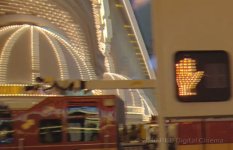
There are motion artifacts if you extend dynamic range by blending two or more frames taken at different shutter speeds. Adam Wilt pointed it out in RED's EasyHDR:

17hx.jpg

Observe the LEDs in the "don't walk" sign and the bulbs on the canopies: there's a dim, motion-blurred streak for 1/48 sec, with a sharp, 1/384 image at the trailing edge of the blur: visually similar to the effect of a long exposure on a still camera with a "first curtain" flash, a flash fired at the beginning of the exposure. It may seem backwards at first, but remember that the bulbs are moving to the right in the image, thus their blurs precede their sharp images: the reverse of the standard cartoon convention, in which the blurs of a fast-moving subject trail their sharp leading edges.

"I asked Jim if it would be possible to reverse the order of exposure, to simulate the look of a "second curtain" flash, in which the blur follows the sharp image instead of preceding it, giving us nice still frames that match our comic-book-driven expectations. He gave me a pained look, and agreed that it would be nice, but it wouldn't be in the first release, and it would be a "science project" to see if it could be made to happen at all."

--- http://www.provideocoalition.com/red_visit_21_september_hdrx
 
Jon Thorn, I think it's pretty cool that you participate here. And I agree with everything those reviews say as far as the ergonomics and aesthetics. The Cion really does look great, and it's not just the look that I like, it's the functionality of the design, tried and true media, abundance of connectivity, right down to the incredibly sensible layout. ND would have really topped it off. I wish Sony laid out the fs700 or fs7 this well. I know some people don't like the boxy F series look, but I love it, it's simple and well laid out, easily accessible, intuitive, and the Cion's layout gives me that sort of feeling at a much cheaper price.

But when it comes down to performance, the sensor is just too underwhelming. Just going from what I've seen so far, I think the color is nice. But the chart that Cinema5D shot reveals the limits of that sensor. I don't care how much DR the sensor sees- I care about how much I can see. And even if they underrated the "usable" DR, how far could that margin be? No one is looking into the last few barely-there stops and saying it's usable. If there's room for subjectivity, it's going to be one stop, maybe a little more. And stretching someone's definition of "usable" DR is pushing the image to where quality falls apart. I think most people probably want to be safely within that range, not bumping up against the outer limits or crossing them.

The camera looks really nice, and I think every review I've read glows about how nice it feels to hold. If only you guys could upgrade the sensor, and maybe even add some assignable buttons for easy access to functions, and maybe ND. Instead of changing the entire camera, maybe just make it upgradeable like Arri. The setup you guys have right now... despite how nicely it's put together... it doesn't make the IMAGE better than the Ursa, aside from maybe the color. And that's the problem for me. With 8+ stops of DR, I look at the Cion as a BMD Production 4k + better connectivity/media/color/hfr. And I'm not willing to spend $9k for that.

I saw a Cion product presentation on youtube, and I recall the rep saying the goal was to have this camera under $10k. And I think that goal sabotaged the cion, basically, the things you cut out to keep the price down, that's the stuff I want and would pay for. The cion at $9K might make the image a little better than the Ursa, but if I invest modestly more money I'm right at the Scarlet Dragon, or F5, with an image quality that actually performs for the money. If AJA can upgrade the sensor to something equivalent to the FS7(global or rolling, preferably global), put some assignable buttons, put ND, internal compressed hfr, that would put it between the F5 and F55, and price it around $13k, that would be a serious all-around camera, well worth the money, rubbing elbows with the F5 and scarlet dragon. The way the cion is right now, it's situated in an awkward position, better hardware than the Ursa or Production 4K, but same underperforming sensor, consequently lesser image quality than the upper model cameras. It's neither here nor there. I don't think the better hardware is worth $9K with an underperforming sensor.

If AJA says they're going to explore an upgrade path or come out with a Cion II(ie, same camera body, but better sensor + more features), like Arri or Red does, then I would definitely hold off my purchase a bit longer to see the outcome, not indefinitely, but within this year.
 
Sttratos,
I will try to make my reply to you as complete as possible since that was what you requested of me in your earlier posting and you seem to have implied that I haven’t answered you specifically in the past; keep in mind that I do my best to answers people’s questions, but sometimes things get missed in threads, so I apologize if you feel you haven’t been answered satisfactorily in the past.

Everyone, including you, is entitled to their opinion; that is all I was trying to say with my earlier post pointing out that there are other articles that have been written about CION.

I’m not sure why you said that the links to those articles I provided say nothing; I acknowledge that one is a preview of an upcoming review (which is supposed to post shortly), but the other one is a full review that pre-dates the Cinema 5D review. Each of the reviewers - just like those on this thread - is going to have a unique opinion.

Yes, the primary method of controlling CION is from the operator side of the camera. We wanted to produce a camera that a single user could operate from one side, without an assistant. Yes, some cameras, like the Alexa, have “assistant side” with controls, but many other cameras are like CION and do not offer camera controls on the non-operator side of the camera. CION offers the UI screen on the side of the camera so that you can look at the settings on that screen and see their impact without menu parameters being overlaid on the picture; with a lot of cameras, yes, you can see the menu superimposed over the picture, but you may not be able to judge the picture until you exit the menu structure since it will often obscure and cover your picture. If you are suggesting that we consider adding superimposed menu items to the video output on CION, I think that is a fine enhancement request to make. We will consider adding that in the future.

It is also worth mentioning that in addition to the operator side of the camera, you can also configure and control CION from the web UI via the LAN connection. This means that in situations where you simply cannot reach the camera, such as when it is elevated on a jib arm, you can run an inexpensive LAN cable of whatever length is appropriate to reach the camera. In fact, we have even remotely controlled a CION between offices over the internet; few cameras offer this type of feature.

Everyone makes assumptions about which sensor AJA has used in CION. Part of the reason everyone speculates is because we don’t publish that information. To be clear, we also don’t publish the specifications for the FPGA, memory and other key components that are also used internally for the product. Many manufacturers, not just AJA, simply don’t share every aspect of a product’s design. Maybe you feel that there is some dishonesty in this, but it is simply a choice. Like anything else, you are allowed to have an opinion about this, which I think you have expressed.

Yes, there are certainly some cameras that cost less. And there are certainly some that cost far more. Yes, it is our first camera. And yes, we have not followed the typical marketing strategy for introducing a camera. I appreciate you sharing your opinion about our marketing effort. I can certainly share that with others at AJA who handle the marketing. I’m not dismissing the Cinema 5D review, I’m simply saying that it is one opinion. Again, the links I shared are other opinions from people who have also used the camera and either are reviewing it or have reviewed it. I’m not asking anyone to ignore a review. I was trying to clarify something from a review that even the author of the review attempted to clarify.

Thank you for sharing your opinion with us.

Sincerely,
Jon Thorn
Senior Product Manager
AJA Video Systems, Inc.
 
Poormanwally,
Thanks for your kind words about my participation here. More importantly, thank you for taking the time to write a detailed note outlining what you like about CION’s design, what you do not care for in terms of CION’s design and the type of product you’d like to see in the future.

Sincerely,
Jon Thorn
Senior Product Manager
AJA Video Systems, Inc.
 
I didn't mean that I thought the first two modes won't work. They will certainly extend the dynamic range. The question is, which mode brings the fewest artifacts? ...
The new Qualcomm chip and software claim to solve the inter-frame artifacts. I would assume is that the easiest step to the HDR shots is to drop the resolution and to increase the frame rate, thus lowering the time intervals in between the frames.

Then again, a dual-ISO readout a la Alexa should also be possible. ARRI can't be holding a patent on it, can it?
 
A lot of users visiting this forum are solely interested in a lower priced camera. So 9000 usd becomes difficult to digest for a lot of people. So it is good to see Jon Thorn politely answering questions without getting ruffled. I feel it would have been good if AJA would have given the camera to a few guys to shoot some short films and show us the capability in real world situations. The launch of C300 comes to mind where four gentlemen of repute had shot with it and shown us the short films. Even now it can be done so that we don't debate over the interpretations of dynamic range.

This being the first camera offering from AJA. Like everything in life, we do some things good in our first attempt and some other things are not so good. I am wondering if this camera can be upgraded later by AJA with a better sensor when it is available. If so, then the buyers will not hesitate.

On another note, does anyone know who makes the sensors for RED?
 
Then again, a dual-ISO readout a la Alexa should also be possible. ARRI can't be holding a patent on it, can it?
The BAE/Fairchild CIS2521 uses dual-gain readout. Also, CMOSIS has previewed a dual-gain readout architecture, though it hasn't been implemented in a commercial product yet, as far as I'm aware.
 
A lot of users visiting this forum are solely interested in a lower priced camera. So 9000 usd becomes difficult to digest for a lot of people. So it is good to see Jon Thorn politely answering questions without getting ruffled. I feel it would have been good if AJA would have given the camera to a few guys to shoot some short films and show us the capability in real world situations. The launch of C300 comes to mind where four gentlemen of repute had shot with it and shown us the short films. Even now it can be done so that we don't debate over the interpretations of dynamic range.

This being the first camera offering from AJA. Like everything in life, we do some things good in our first attempt and some other things are not so good. I am wondering if this camera can be upgraded later by AJA with a better sensor when it is available. If so, then the buyers will not hesitate.

On another note, does anyone know who makes the sensors for RED?

RED sensors are made by TowerJazz, I think.
 
The sensor in both the Blackmagic Ursa/Production cameras and the Cion is the CMOSIS CMV12000.

CMOSIS, on their data sheet (http://www.jm-vistec.com/datasheet & manual/Cmosis/Flyer CMV12000.pdf) clearly list the sensor at 60dB, or 9.9 stops (which is 60/6.06).

(Also, while that sensor is listed as going up to 90dB or 14.5+ stops, it can only do so in an extended DR mode that combines frames at different exposure times, which leads to odd motion smearing. Neither the Ursa/Production nor the Cion use this mode.)

And that 60dB is definitely measurable. It comes from dividing the full well capacity by dark noise.

Full well capacity is where the photosite is saturated by electrons (which is what the photons you are capturing are converted to) and the image is fully blown out. Dark noise is where electrons leak out of the small amount of electricity that is always present, and those electrons are naturally mistaken for photons.

After you divide the two, you would take the 20log[SUB]10[/SUB] of the result to arrive at the decibel number, which just describes the ratio between the two numbers in a logarithmic scale.

In this case, full well capacity is 13,500e and dark noise is 13e, so 13500/13=1038.46. Significant digits mean we have to take the result as 1000. 20log(1000) = 60db.

The dark noise floor spec is not an absolute hard cutoff for DR at the bottom like full well clipping is at the top. Depending on how in camera NR is handled it is possible to pick up at least a stop over this figure. 1.5 stops is not uncommon.

But the sensor specs for the CMOSIS illustrate pretty well the potential trade offs between image aesthetic choices and pure performance numbers in any particular camera design.

I think the CION reflects a lot of smart design choices with respect to size, weight, form factor, and operating features. I like the aesthetic choices they have made with IQ given the limitations of the sensor. To me it is a significantly better all around camera than the BM cameras using the same sensor. It produces lovely high quality images within its limits.
 
Finally got info on physical dimensions:

Length: 12.685"
Height: w/o handle 5.547" with handle 8.752"
Width: 4.606"
 
Back
Top