aja cion shipping now

Seems like a great 4K video recorder hooked up to a weak sensor. I don't hear much about the URSA and limited DR but would assume it has same DR as Cion/BMC4K or did they manage some electronic wizardry to pull closer to 12 out of it? I haven't heard many complaints about URSA aside from weight.
 
Well, so much for the cion... I think sony rated the fs700 at 12 stops, and usable is something like 10+... that's really the boiler plate for that money. I can't find a good and sensible reason to spend $9k on 8.2 stops... that, combined with the already expected poor low light performance, kills it. I don't know what I was hoping for, having heard the old rumors that it was the same sensor as the blackmagic, I should have expected less. How can you justify 3x the price of the blackmagic 4k for only better color(which will be subjective anyway)? OK, better connectivity, raw signal out, power, etc... but 3x? I wonder how much more performance they could eek out of the sensor if it was rolling shutter. The 1000asa is pretty much useless, why even have it on there? If the DR was 10+ usable stops, I would still consider it, but I don't think that's achievable with firmware, that's the limits of the sensor... so I guess I'm back at sony now, or if something nicer comes out at NAB.
 
Well, so much for the cion... I think sony rated the fs700 at 12 stops, and usable is something like 10+... that's really the boiler plate for that money. I can't find a good and sensible reason to spend $9k on 8.2 stops... that, combined with the already expected poor low light performance, kills it. I don't know what I was hoping for, having heard the old rumors that it was the same sensor as the blackmagic, I should have expected less. How can you justify 3x the price of the blackmagic 4k for only better color(which will be subjective anyway)? OK, better connectivity, raw signal out, power, etc... but 3x? I wonder how much more performance they could eek out of the sensor if it was rolling shutter. The 1000asa is pretty much useless, why even have it on there? If the DR was 10+ usable stops, I would still consider it, but I don't think that's achievable with firmware, that's the limits of the sensor... so I guess I'm back at sony now, or if something nicer comes out at NAB.


What do you mean? Why don't you think a big, heavy camera, with 8.5 stops of DR and bad low light performance for $10K doesn't sound good to you? At least there is that prores thing.
 
I would take global shutter with 8.5 stops over rolling shutter with 10 or more, so great is my hatred of motion distortion.

I've been doing some tests of real-world dynamic range. It looks like you have a very hard time exceeding 11 stops. That's in broad daylight, with someone in the sun with a white shirt, and someone in the shade with a black shirt.

The difference between something white and something black, under the same light, is 5 or 6 stops. The difference between sun and shade on a clear day is 3 to 5 stops. So if you take worst case of both, that's 6 + 5. This is from some rough tests with less than the best gear, but Roger N. Clark also came up with 11 stops in an extreme lighting situation.

The reason that certain cameras with more than 11 stops look good (like the Alexa) and certain cameras with just barely 11 look bad I am thinking has more to do with baked-in looks. For example, the Canon 5D Mark III looks fantastic, with just 11.7 stops (or something like 8 stops of "useful" dynamic range?), if you output raw and grade later.


(This video came out May 31, 2013, so it's not using Magic Lantern's dual-ISO feature to raise dynamic range, which came out January 22, 2014.)
 
Last edited:
Combatentropy, I'm not saying the cion is junk. It's a piece of equipment that does a lot of nice things, but my point is that it's way over priced for what it does. Comparing the Cion to the Ursa, there's no contest aesthetically, the Cion is a handsome camera, lighter, lots more connectivity, changeable mounts, even the 4k hdmi, all very nice. But if you reduce their specs to paper, their performance is about the same. So that leaves the hfr(if you go Corvid +$$$), the better color science(subjective, of course), and some better connectivity on the Cion, but does that put a whole lot of distance from the Ursa, like $3k worth of distance?

I was thinking AJA remapped the sensor, or whatever magic it is they do that BMD might have been incapable of achieving, and suddenly they had made that sensor perform at least as well as the fs700 in DR... and I see now that I was just being overly optimistic. For the Cion, basically a usable 10+ DR, with the connectivity, with the aesthetics(and other nicknacks), altogether made a 3 legged stool for me, where at $9k it made great sense. But with 8+ DR, it's just too expensive for what it is. If that review really reflects the Cion's true performance, I think the Cion and the Ursa are more or less different packages of the same thing.

Comparing to the fs700's rolling shutter, sure, I agree that global is awesome. But I'm not paying $3k more for just a global shutter, and also taking the big hit in BOTH DR and low light. I wonder what the Cion's hfr will look like, considering it's so light hungry. I don't like the fs700 color, the rolling shutter, and sony's usual death-by-a-1000-nickels-and-dimes... but that's why I'm not buying that camera. And it's the same reason I'm almost certainly not going to buy the Cion, it's just not worth it to me. I think I remember them saying the Cion was a 5 year project... and maybe that "age" shows. Right now, I think the market and tech is changing faster than AJA could have anticipated.. so the Cion, like the Varicam, is late to the game, and somewhat underwhelming. Although the Panasonic's dual ISO is very cool, I'm not breaking the bank for that either. Even Sony's been having trouble keeping up, look at their product lifecycle... they're making new cameras to keep up, just like Arri had to change to serve the market with the Amira, and now the mini, and RED with the scarlet, then the dragon, now the ThermonuclearGrenadeGunKnifeNunchuckWeaponX. They all got shook up, and I hope this NAB is going to produce a nice all-around camera that's benefited from this recent/ongoing market flux. Since Arri already announced the mini, and RED announced their thing... and I don't expect much from BMD these days... and I doubt Pansonic or AJA is going to release a new camera... I think that leaves Sony and Canon, hope they're going to have something nice to round it out.

And the Alexa look is more than just a nice paintbox, that DR is a huge reason the Alexa is king. 14+ usable stops reaches far into the blacks and keeps the highlights, so your blacks don't look punchy and cartoonie, and your highlights don't clip all videoy with the highlights having that nice shoulder with smooth roll off, in addition to the color science, the undersaturated highlights, and the renown creamy skintones. I remember seeing the Fox series "Sleepy Hollow" and instantly recognizing the Epic and its underwhelming color, choppy blacks and noise in low light, blown out whites on exterior shots; and also instantly recognizing the Alexa used on ABC's "Castle." It's THAT obvious. And add Arri's standardized gear, the lens data, the remote, the easy user interface, their ruggedness... there's a reason Arri is on top, of course it's branding as well. As much as I dislike RED as a company and Jim J as a person, I have to admit the Dragon's DR brings it closer, not quite there, but closer in just that one, single regard. Still won't buy a RED though... if I had the money to buy a RED Thermonuclear...etc..., I'd just put that money towards financing a used Alexa XT plus. Whatever happens, I hope everyone has the patience to wait till NAB to pull the trigger on the Cion or anything else.
 
Everyone has a unique opinion about what makes a camera desirable for their use. Here are two additional opinions of CION for your consideration:
http://www.redsharknews.com/production/item/2455-first-hands-on-preview-aja-cion


And:
http://www.creativeplanetnetwork.com/news/shoot/color-science-and-color-science-camera-capabilities-aja-cion/608908


Regarding the Cinema 5D review being referred to in this thread, I think that's simply another opinion.


Despite the Cinema 5D review making generally positive comments about the ‘organic image quality' that CION produces, it seems like many people have chosen to focus solely on the dynamic range that Cinema 5D described as the "usable dynamic range".


What follows are Sebastian Wöber's own words about the Cinema 5D dynamic range measurement presented in their CION review.


"It is likely that AJA’s approach to rate dynamic range is different to our’s. Commonly people refer to “usable dynamic range” when talking about a camera’s latitude. This is what we try to find in our tests and it has taken a year to get a ratings system that we can apply to many cameras."


Cinema 5D has used their own criteria and method to determine what they describe as "usable dynamic range". To be clear, what one person might consider to be "usable dynamic range" could differ considerably from what another person might consider "usable dynamic range."


Another comment from Sebastian:


"Hi, Sebastian from cinema5D here. The reason why manufacturers rate their camera's dynamic range higher is that there is no standard that dictates how to rate it. A camera has a total dynamic range that can differ highly from the actual usable dynamic range. Noise also creates shades of grey that can be measured and taken into account for example. In the case of the Cion this is probably how they came up with 12 stops, but if you look closely at the charts you will see that in a real world scenario 8-9 stops is all there is."


Here Sebastian is more clear about the opinion being expressed: the value they offered in their review is what theyconsider usable dynamic range, not necessarily the total dynamic range.


Manufacturers typically offer a total dynamic range value in their specifications since opinions about what might be considered "usable dynamic range" can differ.


Again, everyone will have a unique opinion. The most productive thing you can do as a manufacturer is listen to people's opinions and continue to improve your product.


I can assure you that we are continuing to improve CION. The camera began shipping at the end of December, we offered a firmware update with improvements in early February and we are working on another update with improvements even as I type this.


Sincerely,
Jon Thorn
Senior Product Manager
AJA Video Systems, Inc.
 
Last edited:
David Mullen, ASC, said that film's "usable" dynamic range is about 10 stops. Anyway I would rather hear absolute dynamic range rather than the nebulous "usable" one. The high side should be when the sensor clips totally white, when the pixel is totally full. The low side should be when the the noise completely engulfs the step.

I would not focus too hard on the numbers on paper, especially numbers on Internet paper. While there are still almost no videos from Cion owners, there are lots and lots of videos from Blackmagic 4K and URSA, which Cinema5D says have the same "usable" dynamic range as the Cion. Just watch them and judge for yourself whether the scene is rendered with enough dynamic range and low-light sensitivity for your needs.

 
Last edited:
The sensor in both the Blackmagic Ursa/Production cameras and the Cion is the CMOSIS CMV12000.

CMOSIS, on their data sheet (http://www.jm-vistec.com/datasheet & manual/Cmosis/Flyer CMV12000.pdf) clearly list the sensor at 60dB, or 9.9 stops (which is 60/6.06).

(Also, while that sensor is listed as going up to 90dB or 14.5+ stops, it can only do so in an extended DR mode that combines frames at different exposure times, which leads to odd motion smearing. Neither the Ursa/Production nor the Cion use this mode.)

And that 60dB is definitely measurable. It comes from dividing the full well capacity by dark noise.

Full well capacity is where the photosite is saturated by electrons (which is what the photons you are capturing are converted to) and the image is fully blown out. Dark noise is where electrons leak out of the small amount of electricity that is always present, and those electrons are naturally mistaken for photons.

After you divide the two, you would take the 20log[SUB]10[/SUB] of the result to arrive at the decibel number, which just describes the ratio between the two numbers in a logarithmic scale.

In this case, full well capacity is 13,500e and dark noise is 13e, so 13500/13=1038.46. Significant digits mean we have to take the result as 1000. 20log(1000) = 60db.
 
Last edited:
One huge benefit of the Ursa, that I don't see mentioned here, is that the sensor can be changed. While it's just a potential at this point, it could prove to be a very attractive potential.

For instance, check out the specs on this sensor, which was just announced by Fairchild Imaging, the company that supplied the sensors for the Blackmagic Pocket and Cinema cameras: http://www.bmcuser.com/showthread.php?13066
 
while that sensor is listed as going up to 90dB or 14.5+ stops, it can only do so in an extended DR mode that combines frames at different exposure times, which leads to odd motion smearing

It has three modes to extend dynamic range:

1. high frame rates blended into lower frame rates (like shooting 24 fps actually at 72 fps)
2. different exposures for even and odd pixels
3. piecewise linear response

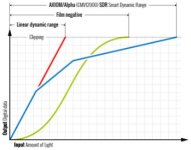
It is the third one, the piecewise linear response, that sounds most promising to me (albeit not an expert). The drawback they say is that your camera has to know exactly which points the response bends, because it bends at points, not in a smooth curve (that's why it's called piecewise, because it's in pieces). But if it knows then the camera can reconstitute the image into a smooth curve.

dr-illustration-v03.jpg

You can read about and watch videos of Apertus playing with this Piecewise Linear Response (PLR).

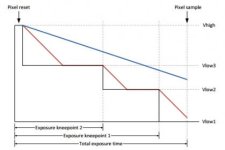
It took some reading, like of this PDF from CMOSIS (see pages 25 and 26), but I think I finally understand how they do the piecewise linear response. In a way they pause the pixel if it is filled to a certain point. Then it is unpaused. CMOSIS actually lets you put in two pause points.

Not technical enough? Okay, more technical. As a pixel absorbs photons, it converts them into electrons, then voltages. CMOSIS lets you set a certain voltage point. If the pixel reaches this voltage, it will stop there, even as more photons pour in. It will ignore them. But only for a moment. Then it will unpause and let its voltage start rising again in response to new photons.

plr.jpg

This is all within the time of one frame exposure. Anyway, the blue line represents the filling of a pixel that's getting hit by a little light over the course of the exposure. It's unaffected, because it doesn't meet the criteria for throttling the exposure. The red line shows the filling of a pixel that's getting hit by a lot of light. There's a formula that you can program in. Say the exposure is 1/48 of a second. That's about 20 milliseconds. So the formula might be something like: If a pixel reaches 30% saturation just 5 milliseconds into the exposure, then pause for 10 milliseconds, then resume. I just made up those numbers, but it's something like that.
 
Last edited:
The 30 second boot time and 8.5-9 stops of DR is a huge issue. How can anyone take this camera seriously?

And that's insane if D. Mullen said that film is 10 stops. Film STILL exceeds every digital camera so using that logic, I would have to assume that the Alexa has like 9 stops and these other cameras maybe 7. ?
 
The piecewise linear exposure creates motion artifacts, it's basically adding a 1/48s exposure with a 1/192 one and a 1/768 one (all of them ending in the same point in time, but, still, highlights will have less motion blur than the rest of the image). I tested the CMV12000 directly from CMOSIS, before the BM4K was available, and found it to have between 8 and 9 stops of usable DR, and a hell of a lot of fixed pattern noise.

That new BAE APS-C sensor, on the other hand, looks absolutely killer. I may have to revive my "making my own camera" project... XDDD
 
The 30 second boot time and 8.5-9 stops of DR is a huge issue. How can anyone take this camera seriously?

And that's insane if D. Mullen said that film is 10 stops. Film STILL exceeds every digital camera so using that logic, I would have to assume that the Alexa has like 9 stops and these other cameras maybe 7. ?

Film, as I've always understood it, is closer to 15-16 stops. Plus, I've yet to see a video image really emulate the look and wonderful, mild grainy texture of film (although 24p helps). I also fear that DR will be the downfall of the JVC LS300. I would snap up one of those in a heartbeat if the image from the sensor and its processing produced wonderful fall-off and decent DR (in the 11-13 range). For now, my wallet stays in my pocket.

It's hard to fathom that my "lowly" AF100a has superior DR to the Cion. Incredible engineering faux pas by Aja, IMHO.
 
Everyone has a unique opinion about what makes a camera desirable for their use. Here are two additional opinions of CION for your consideration:
http://www.redsharknews.com/production/item/2455-first-hands-on-preview-aja-cion


And:
http://www.creativeplanetnetwork.com/news/shoot/color-science-and-color-science-camera-capabilities-aja-cion/608908

The links you gave say nothing. They are not full reviews. They are just hearsay and first impressions. The C5D was the first real review and is not good. It’s not only the dynamic range and it’s not only opinion. In who’s opinion is it a good idea to be able to control menus only on the side of the camera and not EVF and only camera operator’s side? There are other things too but anybody who read the review already know.


Regarding the Cinema 5D review being referred to in this thread, I think that's simply another opinion.


Despite the Cinema 5D review making generally positive comments about the ‘organic image quality' that CION produces, it seems like many people have chosen to focus solely on the dynamic range that Cinema 5D described as the "usable dynamic range".


What follows are Sebastian Wöber's own words about the Cinema 5D dynamic range measurement presented in their CION review.


"It is likely that AJA’s approach to rate dynamic range is different to our’s. Commonly people refer to “usable dynamic range” when talking about a camera’s latitude. This is what we try to find in our tests and it has taken a year to get a ratings system that we can apply to many cameras."


Cinema 5D has used their own criteria and method to determine what they describe as "usable dynamic range". To be clear, what one person might consider to be "usable dynamic range" could differ considerably from what another person might consider "usable dynamic range."


Another comment from Sebastian:


"Hi, Sebastian from cinema5D here. The reason why manufacturers rate their camera's dynamic range higher is that there is no standard that dictates how to rate it. A camera has a total dynamic range that can differ highly from the actual usable dynamic range. Noise also creates shades of grey that can be measured and taken into account for example. In the case of the Cion this is probably how they came up with 12 stops, but if you look closely at the charts you will see that in a real world scenario 8-9 stops is all there is."


Here Sebastian is more clear about the opinion being expressed: the value they offered in their review is what theyconsider usable dynamic range, not necessarily the total dynamic range.


Manufacturers typically offer a total dynamic range value in their specifications since opinions about what might be considered "usable dynamic range" can differ.


Again, everyone will have a unique opinion.


Jon, I can see where you are coming from. But does it really make a difference if 8 stops is only C5D’s opinion? It’s more and more obvious you are using the CMOSIS CMV12000 sensor, which maxes out at 10 stops. So why are you advertising 12 stops? I actually brought this up several times, but you chose to ignore it. No matter what the dynamic range can’t be what you are advertising. Even if C5D got it wrong.
I think if you would be a little more transparent it would do you good. If not, there is not much point in having somebody from AJA participating here. It’s pretty obvious that you are using the same sensor as Blackmagic at this point. The cat is pretty much out of the bag. Might as well address it or at least not try to pretend it’s not the case. You are bringing a camera to market that is about 2 years late. If the Cion was released 2 years ago it would have been a hit. But now there are cameras that cost less, do more and have a more guaranteed future because they come from bigger manufacturers experienced in making cameras. You are starting at a disadvantage. You need to understand that and rethink your strategy.
Again the Cion is 2 years late, offers less for the same price and AJA didn’t even bother to hire a proper DP to shoot a proper demo and put online. Now the first real review comes out and is not good and you want to just dismiss it as opinion. Don’t you think you have to back this up with more than just words? Where is the footage proving that the 10 stop sensor you are using can indeed do 12 stops? The only footage officially released is crushed to bits, which is what you do to make low dynamic range footage look good.
I think you are asking a little too much from your potential buyers. You are asking for people to dump money on your first try at a camera without seeing anything and asking them to ignore reviews coming out and blindly believe your opinion. All the while asking for more money than cameras with superior specifications. Don’t you think you are asking too much? If the review on C5D is not representative of your product, show us what your product can do. But don’t just talk about it.


The most productive thing you can do as a manufacturer is listen to people's opinions and continue to improve your product.


I can assure you that we are continuing to improve CION. The camera began shipping at the end of December, we offered a firmware update with improvements in early February and we are working on another update with improvements even as I type this.

So here is an opinion. Drop the price of the Cion to between the FS7 and the Ursa, hire a real DP to shoot an impressive demo and put it online. Then readjust your spec sheet to show realistic specifications.

Or hold the shipping of the Cion, keep the same price, put a better sensor in there and release it end of the year.

I want to ask if you will reply to my post reply to everything and don’t just pick out the parts which are convenient. Thanks.
 
Back
Top