AG-DVX200 4K Large-Sensor Handheld Camcorder

Have to address a few points. One above for starters - what was this taken from?

QUOTE]

I extracted it from the Kyoto 4k video. If examined at 100% there's lack of real detail in this video all over. Sharp defined lines looks fine when scaled down to 1080 but all complex natural elements have no detail.
A chart tells you one thing and shooting the real world shows you another thing.
 
1,024 levels of brightness which have only 256 *different* levels of brightness. You cannot 'create' brightness differences that weren't recorded by the camera. One would get the very same effect putting 1080p 8 bit footage on 10 bit timeline – which brings no practical benefit.

Only in perfectly lit and totally monochrome areas this is true. In real world images, with its constant gradations in luminance and color, an 8 bit image produces fine gradations beyond the 8 bit limitation by dithering. When you downrez a 4K image to HD this dithering is translated into 10 bit color information. It is possible that "true" 10 bit acquisition has even more information - to a certain extend there might be some highlight recovery or information in the shadows that is simply cut off in the 8 bit acquisition. But reducing an 8 bit 4K image to 10 bit HD makes still a lot of sense, as there is definitely much more information retained than if going from 8 bit 4K to 8 bit HD.
 
Wrong! If you downrez UHD to 1080, 4 pixels of the UHD picture (2x2 block) will combine to make 1 pixel of the 1080 picture. So at the dark end, if the 4 UHD pixels are 0,0,0,0, then the 1080 pixel value is 0. If the 4 UHD pixels are 0,0,0,1, then the 1080 pixel value is 1. And so on until you get to the brightest pixel at 255,255,255,255 which combine to 1020. So basically, 8-bit UHD data can be downrezzed to 10-bit 1080 data, with 1021 unique levels of brightness.

Can we confirm which NLEs/post tools actually do this. Just saying "proper" tools is not quite there.
A realistic 4K workflow is editorial, stabilization/reframing to something in between HD/UHD, color correction, downscale to HD for delivery. This is a bit more involved than a 2x2 block theoretical upsampling, both for luma/chroma. I don't have much...trust in the process. The luma/chroma upsampling, such as it is, is last in the chain. Before that goes upscaling to 4K (consequence of stabilization/reframing) and color work (which will be done at 4K on 8 bit equivalent data, even if in 32bit RGB representation).
Maybe, just maybe, cutting/finishing/downscaling from ONE tool like the latest Resolve might work, but it should be looked into.
The alternative would be to downscale to HD and going into editorial 444 10b; after stabilization/reframing this would yield less than HD.
EDIT: I thought more about it and the solution to all of the above is (likely) editing/finishing the 4K sources directly in a HD timeline.

Also I'm interested in hardware downscaling (Teranex, Snell Alchemist) but this is somewhat outside the scope of this discussion.
 
Last edited:
Sorry, but all I can see is extremely high and ugly YouTube compression. The clip probably wasn't properly compressed before upload, which makes look YouTube even worse.
 
I've got an idea! Let's post a bunch of videos from YouTube of footage that claims to be DVX200, from shooters that we don't know their skill level, who rushed their shoot and edit to be the "first" DVX200 footage, with shots shooting out windows and poorly post-processed, and examine the footage pixel by pixel despite terrible compression to determine the quality of this camera. Sounds like a great idea!

if you agree with the above statement, you are hopeless because you don't even understand how high-quality footage is made. A bit of advice: Wait til you see footage from a credible source before making a judgement about this camera.
 
It doesn't take to many videos to see the basics of what a camera is all about when it comes to IQ. Even poorly done videos confirms the fundamentals within a camera. I remember the first C300 video, it caught my attention, before that the 5DmkII. I learned that first impression often lasts.
 
As far as I can tell, if you're pixel-peeping, you're missing the whole point of a fixed lens camcorder anyway. This camera will be used on tons of web stuff, lots of corporate videos, that sort of work. In those situations, it will be judged on features like usability, durability, cost of ownership, and ease of inserting into whatever existing workflow they already have. If you want to make a feature film or national TV spot, you probably want a different tool.

You don't buy a car over a bus because you compared their spec sheets or heard stories about how some guy could only get it up to 80 MPH. Buy the one that's designed to be used for your purposes, fits your budget, and then consider image quality.

Very reasonable attitude, one that I endorse. However, an entire generation of "filmmakers" has grown up seeking the cheapest way to produce an image of a given quality. They look to that first and then add whatever is needed to make it work. They are not trying to maximize their output but fool viewers into thinking that they used better equipment. People with this attitude naturally gravitate to forums such as DVXuser to find ways to beat the price versus quality trade off. Blackmagic caters to these people.

I see the DVX200 as Panasonic's attempt to move the GH1/2/3/4 crowd into more complete solutions where ease of use is a factor. That transitional niche will be growing as more and more people tire of the effort required to do lots of video work, or quick paced video work, with DSLR cams. The accessory and rig makers will fight this, but Panasonic does not sell rigs, and the YAGH was a ergonomic disaster that I am sure they would like to forget (I have seen it being sold new for 20% of the original price.) The only reason that we lost track of how good all in one solutions can be is that manufacturers in "pro" divisions kept the prices high artificially.

Now Panasonic is investigating if there is a new new sales model that will work with all in one "pro" cameras. If they succeed they will be as disruptive to the video camera industry as the GH1 and 5D2 were. And start a new movement just as the DVX100 did. And that is exactly what Panasonic has been telling us, but somehow their clear marketing message has been lost as people evaluate the DVX200 as if it were a DSLR or cine camera.
 
Last edited:
Now Panasonic is investigating if there is a new new sales model that will work with all in one "pro" cameras. If they succeed they will be as disruptive to the video camera industry as the GH1 and 5D2 were.

Exactly. And the closest camera out there to the DVX200 is actually the GH4, especially with V-log. You'll find several videos on the web with prerelease V-log. There you can judge detail and dynamic range much better. You can be quite sure that those shooters know very well their tool, the GH4, and only had to adapt to V-log. The DVX200 certainly won't look worse.

https://www.youtube.com/watch?v=bupwaQ0DUfE

https://www.youtube.com/watch?v=7VRtoRt6b8c

https://www.youtube.com/watch?v=pc70XGKDxww
 
As far as I can tell, if you're pixel-peeping, you're missing the whole point of a fixed lens camcorder anyway.
"The whole point of a fixed lens camcorder is to provide very good images with nice Bokeh and wide enough dynamic range!!!" :2vrolijk_08:
maybe this footage is "broken", but the guy who did it - Sebastian Wiegärtner, usually shoot on RED and Alexa, so I don't think that "he don't know what he doing"...unless he did it specially... :laugh:


anyway - I will wait some original footage from this camera, and then will decide "To buy, or not to buy" ..:cheesy:
 
... the guy who did it - Sebastian Wiegärtner, usually shoot on RED and Alexa, so I don't think that "he don't know what he doing"...unless he did it specially...

Somebody who shoots on Red and Alexa might be too generous when it comes to expose the image properly. With the codec of the DVX200 you simply don't have the leeway in post you have with those big guns. So it could be a disadvantage not to shoot every day with a somewhat limiting 8bit codec. You have to nail exposure exactly to get those 12 stops of DR, you just can't recover highlights in post as easily.
 
Possibly different people evaluate differently 'picture quality'.
BTW, how do you know it has excellent picture quality?
Because I've got one and I'm using it right now. Unlike many of the people on this thread, I'm not making observations on recompressed youtube footage. I'm able to see firsthand what it can do -- and that's with an engineering sample, not a finished product; it will only get better.
 
It doesn't take to many videos to see the basics of what a camera is all about when it comes to IQ. Even poorly done videos confirms the fundamentals within a camera. I remember the first C300 video, it caught my attention, before that the 5DmkII. I learned that first impression often lasts.

Yeah. That video was definitely similar to the youtube links you've been finding. I mean, that rooftop shot definitely had a large production team and a pretty decent budget, as well as a top-notch dp. Totally comparable.

A credible source (Barry Green) posts an obvious comparison of the RED One on a chart compared to the DVX200, and all you can say is that it's not "the same as real-world footage"? Give me a break. An open mind would say, "that seems to have pretty good sharpness, maybe the camera does resolve a lot of detail." A closed mind would respond exactly the way you responded. If you are so sure that this camera is so poor, just walk away.

For everyone else, the credible footage I've seen is showing me that this camera is EXACTLY what the market needs. Lens changing, audio off camera, expensive external monitors, and manual ND filters need not apply. The ONLY thing you might want is an external recorder, but 4K 4:2:0 will do just fine :D (especially when you actually understand the engineering of it).
 
We have owned five BM cams. They are good cine cams but poor ENG event cams.

Yes I agree. They are a small company branching out into the camera arena, but they listen and have nothing to lose by developing a camera in the sub 10k market that everybody wants per the statement 3-4 years.
 
1,024 levels of brightness which have only 256 *different* levels of brightness. You cannot 'create' brightness differences that weren't recorded by the camera. One would get the very same effect putting 1080p 8 bit footage on 10 bit timeline – which brings no practical benefit.
Perhaps you missed the part where I said we were summing the pixels? The conversion to 10-bit is reliant on the overall resolution being brought down to 1080.

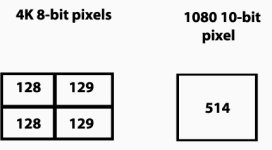
On an 8-bit camera, medium gray is 128. On a 10-bit camera, medium gray would be 512. Exact same shade, but represented with a different number. On an 8-bit camera, the next-brighter shade would be 129. On a 10-bit camera, that same shade would be represented by 516. The 10-bit camera is capable of distinguishing between 512, 513, 514, 515 and 516. The 8-bit camera cannot, it sees either 128 (aka 512) or 129 (aka 516). It doesn't see the in-between shades.

However, when downconverting, it definitely could. If there were a borderline shade that fell between two numbers, the pixels representing it would likely straddle that number. Like this:
8-bit-to-10-bit pixels.jpg

When the four pixels are converged to one, the values get summed together. They do not get averaged. If they got averaged, you'd have the situation you describe -- but you don't average them, you sum them and keep them together. And the result is you end up with shades that are between, like what a 10-bit 1080p camera would have seen.
 
Yeah. That video was definitely similar to the youtube links you've been finding. I mean, that rooftop shot definitely had a large production team and a pretty decent budget, as well as a top-notch dp. Totally comparable.

A credible source (Barry Green) posts an obvious comparison of the RED One on a chart compared to the DVX200, and all you can say is that it's not "the same as real-world footage"? Give me a break. An open mind would say, "that seems to have pretty good sharpness, maybe the camera does resolve a lot of detail." A closed mind would respond exactly the way you responded. If you are so sure that this camera is so poor, just walk away.

For everyone else, the credible footage I've seen is showing me that this camera is EXACTLY what the market needs. Lens changing, audio off camera, expensive external monitors, and manual ND filters need not apply. The ONLY thing you might want is an external recorder, but 4K 4:2:0 will do just fine :D (especially when you actually understand the engineering of it).

I beg to differ. To me this camera ticks no boxes.

Barry also found the AF100 to be great. I owned that camera and struggled to get it to where I wanted my images to look. In the end it looked okay but the time I spent to squeeze the little juice out of that camera I wouldn't like to ever do that again. With this in mind I don't see Barrys opinion when it comes to these cameras to credible. To me that is.
 
Yes I agree. They are a small company branching out into the camera arena, but they listen and have nothing to lose by developing a camera in the sub 10k market that everybody wants per the statement 3-4 years.
Well I've owned 4 different Blackmagics and not a single one of them have come without a quirk, a fault, or a complete failure. So 3-4 years out maybe they will get one right but until then the track record stands as is. So while they listen to the buyer they still prove that a camera capable of what we want that has zero quirks, faults, or failures cost a helluva lot more than what they have offered. But, even still, I applaud what they are doing. But they aren't the the staple or example of how to do it when you compare to companies like Sony, Canon, or Panny.
 
I beg to differ. To me this camera ticks no boxes.

Barry also found the AF100 to be great. I owned that camera and struggled to get it to where I wanted my images to look. In the end it looked okay but the time I spent to squeeze the little juice out of that camera I wouldn't like to ever do that again. With this in mind I don't see Barrys opinion when it comes to these cameras to credible. To me that is.
Wow, calling out our leader Barry.
Let me ask you? What other options for a large chip sub $5000 camera was there when the AF100 launched outside of the DSLR? And perhaps you were too self indulged to read Barry's very detailed book that came with the camera to be able to "squeeze the little juice out of that camera".
When I mounted up the AF100 coming from DSLRs at the time (we had what? the 5dmk2 and the gh1) and took the AF100's images into the NLE, I was enormously pleased with the camera. It had so much in it for the time. Damn, I probably made $80,000+ with that camera while I had it. I was pretty happy with that purchase and very thankful to Barry for his contribution on how to set it up and so on.
 
Back
Top