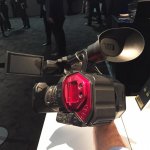
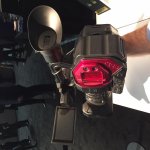
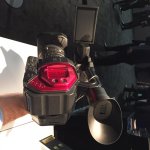
AG-DVX200 4K Large-Sensor Handheld Camcorder

Is it similar or similar enough to the C100 sensor size? I hear some of you talk about doing sports with it which would make it seem that that sensor size would have very deep DOF. never really worked with an Af100 so that comparison wont help me. Thanks.
Yes it is similar to, but a little smaller than, the C100 sensor size. The C100 is (IIRC) 22.3 mm wide; the AF100 was 17.8mm wide. Both are vastly bigger than a 2/3" video camera sensor; the m43 sensor is 4x bigger than a 2/3" sensor.
 
Can someone at NAB get an answer to this question: How many megapixels is the sensor? It would help a lot to get a sense for low light capability.

That number is not known. What we do know is this camera is NOT using the GH4 sensor. It was termed something like "the next generation" of GH sensors. We don't know exactly what that means - will this sensor be the same as the GH5? Or is this a video-only version of what the GH5 might have? We don't know. All we can reasonably guess is that the video from this camera should exceed what the GH4 can do. Maybe by a little, maybe by a lot.
 
So am I correct in that the DVX200 is roughly 4 2/3" size sensors packed in one? That should produce some killer 1080p even with that f/4.5 lens
You could think of it like that, yes. The m4/3 chip is as big as four 2/3" sensors.

And the lens isn't f/4.5, it is f/2.8-4.5. For some portion of the zoom range it will be f/2.8, and then gradually ramp down to f/4.5. Which may sound like a lot, but it is really only 1 1/3 stops.
 
Aye... but isn't this camera using all of the sensor so that 28mm is actually 28mm right? No crop factor? Wouldn't that actually be quite a bit wider than the 25mm on the GH4 with it's 2.3 crop?

It is quoted as a "28mm equivalent". So, yes, that would be much wider than a GH4 with a 25mm lens. It should be approximately the same as a GH4 with a 14mm lens.
 
The more I think about it - the more I'd like to get my hands on one of these new DVXs.
I long for the old days of turning the camera on and shooting.
Of course that's not every gig....but it is some.
 
Will it have the classic DVX "clunk"?...

Yes - and you will be able to upload your phone ring sounds, too!

But again, a 4:2:2 codec in HD is a MUST. Even if it's only 8 bit. This was one of the main selling points of the C300 and even though that camera has interchangeable lenses, now, that it became much "cheaper", there is a big market overlap for the C300 and the DVX200. 4:2:2 is considered "pro" regardless the quality of any 4:2:0 codec and for some of my future projects therefore it's absolutely necessary. And I love being able to throw footage on my timeline without the need of conversion. That's how one man bands play.
 
I see a market for this camera. Its going to sell well, but I think its just not for the DVXUSER anymore. The spiritual successor to the dvx was the HVX, but for this day and age, was the AF100.

Back when I got my DVX100, which was my second camera after a sony TRV900, the closest I could get to a cinema look, was through deinterlacing footage to make it look like "sort of" 24/25P. Interchangeable lenses was left for 35 or 16mm film, or very, very expensive CCD Betacam 2/3rd cameras. When the DVX100 came out, it gave us Cinemagamma - the panasonic "mojo"- one of the best encoded DV footage out there, and a very, very good PanaLeica Dicomar lens. It was truly revolutionary. You could get, with certain effort, a bit of shallow DOF, and many surprising films, some of them award winning, came of it.

The HD revolution came, and Panasonic responded with another great camera- The HVX200 (I still own it today). What Panasonic did with it was again give more to its core audience, the independent filmmakers, then the competition. They didn't fight for the Megapixels - the HVX used Pixel shifting for its 1080p signal- but introduced solids State P2 to the masses, as well as a fantastic professional codec: DVCPRO HD. The HVX200, till this day, is a camera that can make Broadcast ready material in most markets (was even used in some feature films).

By that time, 3 key moments would come that would change the indie production scene forever:

1st, the 35mm Adapters- these clumsy, handcrafted tools started to appear at the end of the SD DV era, but it was on the HVX and HDV heydays that it became more available to the masses. It opened doors for 35mm lenses to be used in these "sort of" inexpensive prosumer cameras, and clever, creative and talented filmmakers were introducing stunning looking films with these clumsy setups.

2- A certain company by the name of Red Digital Cinema was formed, and promised a camera with an S35 sensor and interchangeable lenses that could shoot 4K raw, for 17.5K. This was a prohibitive price for most indie filmmakers and DVX crowd, but was an incredible bargain vs the 200 000 USD 2/3rd cameras or the Price of shooting film offered from the competition.

3- the third and probably the one that created the biggest impact was the H264 1080p 30 capable recording 5D MarkII. Yes, Nikon came first with a Rolling Shutter monster at 720p, but it was the 5D Mark II (and the 7D that came months later) that created the so called "democratisation of filmmaking". 5D's started to be used in major features, may they be award winning indie films or Hollywood blockbusters, and the indie filmmaker had a hassle free (yes, moire, no 24p at the beginning, aliasing) affordable way to be in full control of its cinematography and cinematic language. It was the beginning of the DSLR, small form factor era.

Panasonic was caught out a bit in the middle of this. They had their high end Broadcast division with the Varicam and HDX 2/3rd cameras. They were fairly popular. The DSLR movement, the appearance of new players in the game- RED, Blackmagic, etc. Made Panasonic, who was actually leading in its innovations on the indie market, lose its grip on the market, clumsy and slow to react. Having not invested themselves in S35 or full frame sensor technology like Sony or Canon, and having invested in CCD development in the beginning, it made them play catch up. A corporate decision was made to fully support the 4/3rds, and later the Micro 4/3rds format jointly with Olympus, looking more into the Consumer market. panasonic and Olympus bet on smaller form factor and Mirrorless as their future.

So their answer, and I think a lot of it came from Jan and DVX forum main man Barry Green, at the peak of the DSLR revolution, of the appearance of the affordable interchangeable lens cameras, was the AF100. It captured the hearts of many, but was far from the success of the DVX? Why? Because the competition, albeit for a little bit more money, were offering things like 10bit codecs, 4:2:2 options, even RAW, and larger sensors. Panasonic was too afraid to eat on its own topper end Broadcast market, which they were losing anyway, and "lost" the chance to lead again, on the segment.

So where does this make Panasonic right now? A company looking to refocus.

They are looking back at what made them successful. The first thing they did was to look back at the DVX, and try to recapture that formula. It certainly gains points in nostalgia sake and brand recognition. It could very well be a camera that excels in certain forms of productions. However, for most of the independent filmmakers, its a tool that, even at 4000 USD, doesn't provide the value or the "groundbreaking" factor the mighty DVX100 did- or the HVX200 for the matter.

In times of Ursa Mini's, of sub 5k C300's, of Sony Fs7's its probably time for Panasonic to understand that certain key technological things they hold dear need to go to this segment: their top codecs, their top sensors, best display technology. There's space for the fight at Arri Alexa's, Red Weapons and others for their Varicam Line. But they really need to refocus and give the DVX USER base the tools that they can use to excel and surprise, just like the DVX did. The DVX200 is interesting. I like it. But it could be much, much more. Disruptive like they intended? Not quite. But there's always hope!
 
concerning interchangeable systems I'm rather fascinated how small systems like the GH4 are evolving. You almost get a little Red for few money.

Now, the DVX200 is certainly a totally different breed. And we should not judge it for something that it isn't nor is intended to be. It's a very valid move from Panasonic to offer something different.
 
I personally like the idea of this camera. It's a large sensor camera made for run and gun. Perfect! What I don't like however is:
- the form factor. I've always found this form factor to be semi useful at best. I would like to see such a camera made for shoulder mounting or made to be rigged. In fact, if this was to come in a shoulder ENG stile body, with a lens grip and a proper EVF, I would probably order one tomorrow. Otherwise give me a small box with a lens attached to it (with XLR and built in NDS, etc.) so I can build a rig around it to my pleasing.
- the codec obviously...
- 12 stops of DR is a bit worrying. I mean, if this equates to 12 usable stops then that's OK, but I doubt that they are stating 12 stops DR as 12 usable stops. 12 stops DR probably means 12 absolute stops, which means cca. 10.5 stops usable - which is not enough really, not for run and gun, not for 2015.
- What worries me is the focus ring. I didn't like the focus ring on my HPX171 at all. It was a servo driven focus ring with no hard stops. That kinda worked on that small chip (1/3) camera but on a large sensor camera you need a good focus ring! So I really really hope they get the focus ring right! Something like the EX1/3 had would be okey.

If they get the DR to 12 usable stops and if the focus ring is going to be good then this will be a potential buy for us. Especially as we have a GH4 already. Oh yes, and the lens MUST be parfocal! I see this as a good camera for verite documentary shooting and for events, or anything that needs a continuous shooting mode, not limited by that annoying 30 min rec limit that we EU people got on DSLRs...

This IS the camera I would have bought when I was making a decision about my next purchase when I was selling my HPX171. Wonder why it took so long to make it. I mean the technology was here for quite some time.
 
...- 12 stops of DR is a bit worrying. I mean, if this equates to 12 usable stops then that's OK, but I doubt that they are stating 12 stops DR as 12 usable stops. 12 stops DR probably means 12 absolute stops, which means cca. 10.5 stops usable - which is not enough really, not for run and gun, not for 2015...

...If they get the DR to 12 usable stops and if the focus ring is going to be good then this will be a potential buy for us...

What I have heard in various videos and gotten from the literature is it's 12 stops with Vlog... which tells me 12 usable stops. There usually almost always seems to be an emphasis that it's 12 stops with Vlog. How many stops without Vlog is anybody's guess right now.
 
What I have heard in various videos and gotten from the literature is it's 12 stops with Vlog... which tells me 12 usable stops. There usually almost always seems to be an emphasis that it's 12 stops with Vlog. How many stops without Vlog is anybody's guess right now.

Huh, my guess would be right the opposite. Here's my logic: if they are stating 12 stops with a log gamma and less with an REC709 gamma this probably means that log is stretching (lower) and compressing (upper) the signal (which is more or less always the case, at least for the highs...). Which to me translates that's it's pushing it, which translates to 12 absolute stops. Add to this that manufacturers always state absolute stops and I'm not optimistic.
BUT on the other hand, IF this is a better sensor than GH4 then the absolute DR should be more then 13 stops... I don't know... will have to wait and see I guess as the reps at NAB floor are, as far as I see, quite confused, so no point in asking them...:)
 
if they are stating 12 stops with a log gamma and less with an REC709 gamma this probably means that log is stretching (lower) and compressing (upper) the signal (which is more or less always the case, at least for the highs...). Which to me translates that's it's pushing it, which translates to 12 absolute stops. Add to this that manufacturers always state absolute stops and I'm not optimistic.

Canon C 100/300 advertised 12 stops absolute DR in Clog and less in all other gammas. I have rarely heard anyone complain about lack of DR. Do you really feel that 12 stops is hampering your ability to shoot?
 
Back
Top