Dan Keaton
Well-known member
Dear Friends,
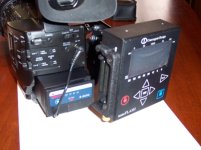
The nanoFlash can accept most any type of battery chemistry.
We state 6.5 to 19.5 VDC, but we can actually go down to about 5 Volts DC.
Lithium Polymer batteries are fine. Just understand that we speaking of actual voltage and not "Advertised Voltage".
A 14.4 volt battery can easily be 16 volts or more, when immediately taken off the charger.
The nanoFlash can handle this easily.
The nanoFlash is protected from brief applications of reasonable over-voltage conditions and the same applies to reverse voltage situations.
The nanoFlash uses a 4-Pin Hirose Power Connector, the battery cable end would be a 4-Pin Female Hirose, with Pins 1 and 2 Positive and Pins 3 and 4 Negative.
(Note, Pin 1 is usually ground or negative, but not in this case.) One may connect just Pin 1 (+) and Pin 4 (-) if desired, but connecting 1 and 2, and 3 and 4 is desirble.
Caution: Please do not create a 4-Pin Male Hirose Cable to a 4-Pin Female Hirose Cable.
This cable is dangerous, as the 4-Pin Male Power Outputs on some cameras are limited to around 200 milliamps and one can cause serious camera damage when exceeding that level.
Other cameras can output 1.5 amps. But, one day, the cable may be used on another camera and thus cause $4,000 to $5,000 worth of damge.
Thus, we do not make, nor sell the 4-Pin Hirose to 4-Pin Hirose cable.