AF100 / AF101 + nanoFlash

Dear Friends,

The nanoFlash can accept most any type of battery chemistry.

We state 6.5 to 19.5 VDC, but we can actually go down to about 5 Volts DC.

Lithium Polymer batteries are fine. Just understand that we speaking of actual voltage and not "Advertised Voltage".

A 14.4 volt battery can easily be 16 volts or more, when immediately taken off the charger.
The nanoFlash can handle this easily.

The nanoFlash is protected from brief applications of reasonable over-voltage conditions and the same applies to reverse voltage situations.

The nanoFlash uses a 4-Pin Hirose Power Connector, the battery cable end would be a 4-Pin Female Hirose, with Pins 1 and 2 Positive and Pins 3 and 4 Negative.
(Note, Pin 1 is usually ground or negative, but not in this case.) One may connect just Pin 1 (+) and Pin 4 (-) if desired, but connecting 1 and 2, and 3 and 4 is desirble.


Caution: Please do not create a 4-Pin Male Hirose Cable to a 4-Pin Female Hirose Cable.
This cable is dangerous, as the 4-Pin Male Power Outputs on some cameras are limited to around 200 milliamps and one can cause serious camera damage when exceeding that level.

Other cameras can output 1.5 amps. But, one day, the cable may be used on another camera and thus cause $4,000 to $5,000 worth of damge.

Thus, we do not make, nor sell the 4-Pin Hirose to 4-Pin Hirose cable.
 
Dear Henry and Filippo,

Thank you for sharing your experiences.

For those that want to build their own, a 4-Pin Female Hirose cable with bare leads at the other end is available from www.nanoFlash.net.

It does appear that the nanoFlash and AF100 were just made for each other.

I am working on specific power solutions for the AF100 and nanoFlash.

Some pictures of the Nanoflash with the AG-AF100/101:
http://www.filippochiesa.eu/?p=269#more-269

Panasonic AG-AF100 test II mixed with Canon 5D MK II BTS footage (you can see the Nanoflash on the camera):
http://www.filippochiesa.eu/?p=226#more-226
 
Dear Mr. Keaton,

We're planning on purchasing at least one NanoFlash unit in the next sixty or so days. Our best efforts at research have led us to conclude your product is the best external recording option.

However -- there is one headache looming for which I have not yet found a resolution.

What we want is some kind of compact mount that holds both the battery (I assume we'll want the four cell thing) and the NanoFlash unit together -- that can easily be mounted to a hotshoe or rails or screw or anything on the camera.

In other words, at this point it appears to me that if I don't want to mess with using the camera battery (and we're not going to want to, because one of the whole selling points on your unit is that we can use it with most any camera) -- then I'm left with an external battery that just dangles from a cable -- and that's obviously unacceptable.

So -- does this combination mount exist? If not, is there an easy solution to handle this issue? If not, can your company come up with one in the near term?

Meaning -- it would be wonderful if I can just connect a unit (both the battery and the NanoFlash) to any camera quickly and easily and be ready to roll.

Thank you.
 
I currently use D-Tap with my Swit Ex1 batteries and just mount the nano to the back of the camera. This works like a dream. I just hope if I do go with the AF-100 that there's a similar type of battery. Hopefully Swit develops one
 
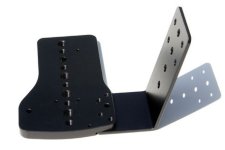
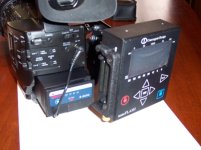
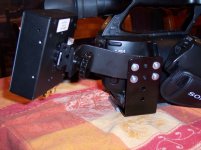
Do a wing mounted to a baseplate. You can have multiple mounting points on the wing with cold shoes or holes for 1/4-20 screws. Olof is doing up a system right now. Olof's site: http://westsideav.com/

{I hope for a D-tap battery too and some are supposed to be in development, but that's not what AGMedia asked about.}

Here's the one I use on my EX1 (not Olof's) but similar. It actually makes it easier to balance the camera too.
BPArmTop.jpgNanoArmRearS.jpgNanoArmII RtS.jpg
pencil.png
 
Here are 3 photos of currently available NanoFlash mounting system I make, I will be adapting it for the AF100 as soon as I get my pre ordered camera. the shoulder mount is optional. There are 2 different "arms" available one straight and one curved, a battery can be mounted to the arm as well, I have a few options there. I am currently researching batteries. I will also have a solution that uses IDX V-mounts or AB Goldmounts for powering the AF100 and the NF and even an on camera light ore wireless receivers.

These systems also can incorporate a VCT-14 wedge. A popular option that works very well with the Canon TA-100 system as well.

10.jpg
35.jpg

12.jpg


If you are interested you can contact me. I will be looking for Beta testers.
603.383.9283

These systems are currently available from NanoFlash.net or from my website below.

PS. I have applied for information to become a sponsor here.
 
Last edited:
What we want is some kind of compact mount that holds both the battery (I assume we'll want the four cell thing) and the NanoFlash unit together -- that can easily be mounted to a hotshoe or rails or screw or anything on the camera.

Please feel free to call me Dan.


If you are going to use the AF100 Battery, which is fine for many people, then one can use one of our two cell Lithium-Ion batteries and power the nanoFlash for about 3 hours.
This is a very light-weight solution and the battery charges fairly quickly.

We are expecting some of our production models of a small battery pouch we designed for this battery soon. It screws into the side of the nanoFlash and then holds the battery.

I expect that we will be showing this design next week.

I hope this helps.
 
I used my Nanoflash during the Panasonic AG-AF100/101 test in Japan: it works great!
In my opinion, is the right choice for the new Panny!

Grazie Filippo! Ho visto i video che avete registrato in Giappone.

For those of you who have problems understanding the above:
Thank you Filippo! I have seen the videos you recorded in Japan.

Best regards.
 
Thank you, Dan (and everyone else) for your comments and suggestions. As usual this was very helpful!
We will be looking into equipping our cameras with the nanoFlash for our productions.
Thanks again.
 
Yes, and always will be as long as it uses MPEG-2.

If you record at the lower bitrates, it's 8-bit 4:2:0 (like 35mbps or 25mbps). But probably anything from 50mbps on up is 4:2:2.
 
is the nano still 8bit 4:2:2 ?

Dear Vagarob,

Yes, as Barry stated correctly, the nanoFlash is an 8-Bit recorder.

And it will record 4:2:2 at 50 Mbps and above, 4:2:0 at 35 Mbps and below.

And there are a lot of misconceptions about 8-bit.

Some, with an agenda, will argue that 10-bit is the only way to record.

Of course, I have an agenda also: I want everyone to realize the 8-Bit recordings can be very good.
(If I could wave a magic wand, we would have a 10-bit option on the nanoFlash today, just to put this issue to bed.)

Some will say, I have to record in 10-bit, but they have an 8-Bit camera, thus no advantage.

There are a lot of 8-Bit cameras out there, including the AF100, the Sony PDW-700, the PDW-F800, the Sony F900, all DSLR's as far as I know, many Panasonic Pro Cameras, all HDMI cameras (at least at this time, as far as I know). If one checks the manufacturers specs, if it does not specifically state 10-Bit HD-SDI, it is probably 8-Bit HD-SDI.

Then there are 10-bit cameras which are not low enough in noise to justifiy recording in 10-bit.

And it depends on what you are doing. All Broadcasts are in 8-Bit. Planet Earth was in 8-Bits.


In the past, some less than stellar codecs, were 8-bit, and one could detect banding in some recordings.

As far as I know, due to the quality of our nanoFlash recordings, due to the quality of our codec, no one has ever reported banding to us.

Then there is the efficiency concern. Recording 10-bit takes up more bits. 176 Mbps 8-Bits would require (approximately) 220 Mbps in 10-bits.

For quite some time, people stated that 10-bits = 1024 colors and 8-Bits = 256 colors.

What was not typically stated, is that these numbers are "per color".

A more accurate number would be for 10 bits: over a billon colors and over 16 million colors for 8-bits.

Many people are very successfully using 8-bits for acquisition and then editing in 10-bit (if necessary and appropriate).

When recording in 8-Bits, for most cameras, I recommend white balancing in camera, (in other words, attempt to get close to the "look" you want before you record).

Recording, in 8-bits, with the "look" drastically different that what you actually want may get you in trouble.

(I digress: Just recently, someone recommended that when using the Sony EX1/EX3, to not white balance in-camera to reduce noise. We will be researching this technique.)

And our 8-Bit recorder has been fully appproved, for 100% content, by the BBC, National Geographic, Sky HD, and many others.

And one less thought. Not all 10-Bit codecs are low noise codecs. Our 6th or 7th generation codec is known as a low-noise codec.

The proof is in the images, not in the numbers. Just ask anyone who records with a nanoFlash.
 
Does anyone know if the AF100 puts anything out when in overcrank mode? I believe I saw that it doesn't put out SDI... does it put out HDMI? If so, does anyone know what it puts out, and whether Nanoflash/KiPro Mini/Ninja will be able to acquire it? It would be useful for monitoring to have it out of HDMI as well of course.

Probably wishing for the moon here... it isn't the end of the world as getting 1080p 50 fps is an amazing achievement even if it has to be recorded in AVCHD. But the real sweet spot of the camera is starting to look like prime lenses -> AF100 -> Nanoflash/KiPro Mini/Ninja on something like a Redrock rail system with decent follow focus, and autofocus for one-man steadicam/figrig shots. That's sounding like a full HD 4:2:2 & XLR sound digital cinema set up for under £10,000, light enough to shoulder mount and carry around... and the external recorder would also permit dual media recording, so if anything does futz out, you've hopefully always got the AVCHD recorded on camera to fall back on.

Anyone know if it is possible to monitor/record via HDMI in overcrank?

Cheers, Hywel.
 
Dear Hywel,

I do not have specifics on the AF100, but most all cameras, when in over and under-cranked mode, output standard HD-SDI at the regular frame rate.
 
Does anyone know if the AF100 puts anything out when in overcrank mode? I believe I saw that it doesn't put out SDI... does it put out HDMI?
The AF100 is always outputting a signal at all times, and (unless you've chosen 1080/24PsF mode) it's outputting a 1080/60i signal, with frames embedded in pulldown. 1080/60i is the tv and broadcast and video standard, and so that's what it uses. When shooting 24p, it outputs 3:2 pulldown. When overcranking, it slices frames into fields and uses pulldown as appropriate, to output the 60i signal.

Same thing with HDMI. The HDMI gets the same output as the HD-SDI.

There is no video signal standard for 1080/60p, so it doesn't output 60p. And even if there was such a video signal, HD-SDI couldn't output it anyway. HD-SDI is a 1.5gbps standard, and just has enough bandwidth to accomodate 720/60p and 1080/60i. 1080/60p requires twice the bandwidth and that's why there's a new 3GSDI standard (which is basically dual-link HD-SDI, all in one cable). 1080/60p output today would require dual-link HD-SDI.

So -- yes you can monitor, that works fine, but you wouldn't want to record it as it would be half-res.
 
I would like to follow up on my previous post, as we since purchased our first nanoFlash and just started testing it in real-world settings today in preparation for an important job coming up.
Here is what we found:

- We chose the nanoFlash because some of the video we need to produce needs the technical specifications it offers (4:2:2 rather than 4:2:0, high bitrate, etc.)

- We tested it to enhance some of the capabilities of the HMC150, since wo don't yet have the AF100. Although it may duplicate some of the features already included in the AF100, the nanoFlash does well to offer similar options for other cameras that don't offer them. Example: time-lapse and crank. So nanoFlash makes it very convenient for that.

- Although some would say that they would not use the AVCCAM codec, I must say that we were particularly impressed with the quality of the AVCCAM codec when compared with the output from the nanoFlash, and would agree with what Barry Green stated elsewhere, that for most uses the AVCCAM at its highest settings holds very well. However, as stated, we needed the 4:2:2 and extra bitrate, so the nanoFlash serves us well at what we consider as a fair price, compared to the purchase of a separate camera.

Although the big plus is the ability to use it with different cameras, and obtain the same encoding from all of them, we also had a very positive surprise. The unit we had purchased from a dealer had an issue, and we cold not work with it. So we called two days ago to resolve it. Time was an important factor for us, since we needed to test it first before taking it to an actual job. I was the one who made the call, and I must say I was absolutely impressed at the response and service I received. We received a replacement unit this morning, and were able to test it during most of the day. Now, if everyone could just offer this kind of support...! I was, and still am, impressed with the people at Convergent Design.
 
Now, if everyone could just offer this kind of support...! I was, and still am, impressed with the people at Convergent Design.

Letus offers that kind of customer service. I'm glad to hear Convergent Design does -- as I'm on the verge of becoming a customer.

It would be wonderful if you could elaborate on your experience using the NanoFlash. I'm especially curious how it interacts with the 150 -- as that's one of the things I may be doing.

Also, anyone used it with a Canon V-DSLR? Or, can it be used with a Canon V-DSLR?

Thanks.
 
Dear Luciano,

Thank you for the kind words. We try hard to be responsive to our customer's needs.

Dear AGMedia,

At this point in time, the nanoFlash is not recormmended for use with the Canon DSLR's, if one wants a high-quality recording.

The Canon DSLR's, were not designed with a very high-quality HDMI output, high enough quality to allow and external recorder to be worthwhile.

Of course, we expect this to change in the future. But right now, no.

The nanoFlash will work fine with the HMC150.

Please send me a message, I will respond with all of my phone numbers and attempt to assist you in your purchase of a nanoFlash and 24/7 after sales support.
 
The Nano would work well with Panasonic GH2 which Philip Bloom reports as having a clean 1080 HDMI signal output.
 
The Canon DSLR's, were not designed with a very high-quality HDMI output, high enough quality to allow and external recorder to be worthwhile.

Of course, we expect this to change in the future. But right now, no.

The nanoFlash will work fine with the HMC150.

Please send me a message, I will respond with all of my phone numbers and attempt to assist you in your purchase of a nanoFlash and 24/7 after sales support.


I'll send a PM when I finish this.

Let me be more specific. The 7D offers full HD HDMI output that can be clean (except for a red dot if you hit the record button), which is different from the 5Dm2, 60D, and T2i -- all of which downscale to SD. Why would the 7D full HD HDMI not work?
 
Back
Top