

Navigation
Install the app
How to install the app on iOS
Follow along with the video below to see how to install our site as a web app on your home screen.
Note: This feature may not be available in some browsers.
More options
You are using an out of date browser. It may not display this or other websites correctly.
You should upgrade or use an alternative browser.
You should upgrade or use an alternative browser.
AF-100 Wishlist/Suggestion Discussion Thread
- Thread starter Luis Caffesse
- Start date
- Status
- Not open for further replies.


Peter J. DeCrescenzo
Veteran
Hi Jan: Every time I see you posting anywhere I can't help but think, and now say, again, thank you.
I know you are "only" doing your job, but some folks may not realize how unusual & truly special this part of your job -- or your interpretation of your job description -- is.
With few exceptions, I rarely if ever see a senior employee of a major video production equipment manufacturer or its marketing arm do what you do, week after week (for years!) in public forums like this.
I'm talking about companies at the scale of Panasonic, Sony, Canon, Nikon, etc. Sure, RED's owner & senior staff is arguably an exception, but by comparison RED is a vastly smaller company who understands they need to leverage the internet to their advantage.
Anyway, I'm not trying to get brownie points with you. And I know most folks around DVXuser are well familiar with your history here. But for those who don't know or are new to this industry, please appreciate how important it is to have Jan sharing her official, inside, and personal viewpoints on whatever Panasonic professional video production product-related topic is at hand.
It might "only" be her "job", but regardless, her service is pure gold. It's up to us to appreciate and put to good use the info she provides.
To the best of my knowledge, Jan's participation in online video production forums is pretty much unique in this industry both in terms of frequency and depth. Given how long she's been at it makes it that much more remarkable.
Thanks, Jan!

Rick Burnett
Section Moderator
I'd love it if panasonic made an official adapter to mount canon (or nikon) lens to the AF100 that could be controlled electronically.
I have a lot of lens that I REALLY like that I don't want to give up that do not have manual aperture control. The only 4/3 conversion rings I have seen are non-electronic.
I have a lot of lens that I REALLY like that I don't want to give up that do not have manual aperture control. The only 4/3 conversion rings I have seen are non-electronic.

Jan_Crittenden
Veteran
The AF100 offers at least two huge and massive benefits over the EX1 -- a massive chip for shallow DOF, and interchangeable lenses. If you see no value to those items, by all means get and keep an EX1 and be happy with it. But the rest of us do happen to see huge and substantial benefits to those two items, and we don't think an EX1 is a match at all. The EX1 is a handycam video camera with a small chip and a fixed lens. The AF100 is a digital cinema camera with a cinema-sized sensor and interchangeable lenses.
To draw out what Barry is saying I put the figures into a focal length calculator, PCAM, and then into the depth of focus calculator on that same amazing little app for the iPhone. Let's take a stoke kit lens for 35mm shooting a 50mm, for a 1/2" chip that would equate to a 14.5mm, in the 4/3" camera that lens would be a 39.2mm. Now with the subject at 16 feet from the camera and the focus set on the subject, with the F stop at F4, then the total depth of focus would be 36' or so with about 8' in front of the Object to about 28 feet behind the object. Same deal on the 4/3"s, again F4, total depth of focus would be 6'4", with about 3 feet in front of the subject to about 3 feet to the rear.
Now I used F4 as that is a fairly slow lens and is typical of the cheap lenses. If we go to F2, things improve a bit, on the 1/2" the distance to in-focus subject is about 4 feet and to the rear its about 7 feet. on the 4/3"s the front distance narrows to less than 2 feet and to the back is less that 2 feet as well.
There is a distinct difference between these two cameras starting with the imager and moving all the way through to the AVCHD codec, which will run rings around MPEG2.
I hope this helps,
Jan
Jan_Crittenden
Veteran
Sorry but depth of focus is equally correct.*depth of field not depth of focus
*f4 is a faily slow aperture not f4 is a fairly slow lens
And it is equally fine to call a lens a slow lens due to an aperture, been in this business for 35 years and I call fast lenses with anything faster than an F2.8 and a slow lens a F4 or higher.
- sorry to be pedantic but otherwise things get misleading, also f4 is a standard aperture to shoot at as well as f5.6, slow is f8+
We can have our differences in what we call something but an f4 in my world is slow. As long as I am specific in what i am calling slow I can call it anything I want. To me f4 is slow, especially when there are lenses that will get me to 1.4, 2.0 and 2.8.
All the best,
Jan

Enough with the specs about DOF, imager size, etc.
Man (or woman) . . . can we please consider making it look just a little sexier?
Just a little?
Perhaps move somewhere from a Yugo where it is now closer to a Ferrari?

Man (or woman) . . . can we please consider making it look just a little sexier?
Just a little?
Perhaps move somewhere from a Yugo where it is now closer to a Ferrari?

Otis Grapsas
Carbonite Member
Sorry but depth of focus is equally correct.
And it is equally fine to call a lens a slow lens due to an aperture, been in this business for 35 years and I call fast lenses with anything faster than an F2.8 and a slow lens a F4 or higher.
We can have our differences in what we call something but an f4 in my world is slow. As long as I am specific in what i am calling slow I can call it anything I want. To me f4 is slow, especially when there are lenses that will get me to 1.4, 2.0 and 2.8.
All the best,
Jan
The correct terms are depth of field on the subject side of the lens and depth of focus on the film/sensor side of the lens. Depth of focus is tiny compared to DOF and they are in opposite sides of the aperture, definitely not interchangeable.
You can call a lens slow if it's maximum aperture is relatively small. If you can't get a faster aperture, you obviously need a faster lens
Before the DOF craze, F4 to F8 were the typical apertures in full frame cameras, so F4 is not that slow. It's as fast or faster than the typical kit lens and most affordable zooms for consumers. It's also quite common in 35mm cinematography. But F4 is very slow on an 1/3" camera, even consumer models have f1.8 on the wide end. It's all relative.
Jan_Crittenden
Veteran
Hi Otis,
I actually shoot more photography than I do video, odd I know. My slowest lens is an F4. And I put that one on, knowing I will have my challenges as I do not shoot anything but available light. So its not like folks didn't understand. You all did.
Best,
Jan
I actually shoot more photography than I do video, odd I know. My slowest lens is an F4. And I put that one on, knowing I will have my challenges as I do not shoot anything but available light. So its not like folks didn't understand. You all did.
Best,
Jan

Ben_B
Veteran
Hi Otis,
I actually shoot more photography than I do video, odd I know. My slowest lens is an F4. And I put that one on, knowing I will have my challenges as I do not shoot anything but available light. So its not like folks didn't understand. You all did.
Best,
Jan
Yes. And f/4 might be a reasonable aperture for shooting at, but since most lenses don't perform best wide open that means you probably have to be at around f/8 till you get the best performance out of an f/4 lens, which means that the lens will fit anyone's definition of slow.
Barry_Green
Moderator
Yes, but again that's largely irrelevant on these types of cameras because the huge sensor and comparatively low resolution means you don't NEED killer sharpness out of the lens. It's not like we're trying to get a 12-megapixel frame out of it, we only need 2 megapixels worth of resolved detail from the lens.Yes. And f/4 might be a reasonable aperture for shooting at, but since most lenses don't perform best wide open that means you probably have to be at around f/8 till you get the best performance out of an f/4 lens, which means that the lens will fit anyone's definition of slow.
If you needed maximum performance out of the lens across the whole frame, then a prime would cost almost as much as the entire camera (even on relatively low-cost cine lenses such as the RPP's). It is a happy coincidence that the lens performance needs are so much lower on the large-sensor HD cameras, as it allows much less expensive glass to be used and still deliver all the sharpness that the camera needs.
robertrogoz
Carbonite Member
Barry, first of all EX1 and EX3 have pretty much the same Fujinon 14x lens, except (of course) EX3 is interchangeable. Looking at some footage in the past, shot with EX1 and 3, we could not tell any visual difference between the two. So unless I would already have some 1/2" lenses around I would not buy EX3.Robert, I simply do not understand you. At all. You're making no sense.
You say that the AF100 will "just match" the EX1. Do you recognize the difference between interchangeable and fixed lenses? Sony does -- they make pretty much the exact same camera, the EX3 and EX1, and one of them offers interchangeable lenses. And they charge about $2300 more for it. So if interchangeable lenses matter, you should be comparing the AF100 against the EX3. And if interchangeable lenses don't matter, you should be mocking Sony for producing the EX3, when it only "matches" the EX1.
So, assuming that interchangeable lenses DO matter, you're talking about an AF100 at $6000 that matches an EX3 at $8320. Substantial difference, yes? I can't imagine how someone could argue against that.
Now, secondly -- I listed many ways that the HPX370 embarrasses the EX3, and you came back with "yeah, but the EX3 has bigger chips." So even though the EX3 DOESN'T match the HPX370 for codec quality or ergonomics or form factor or sensitivity or for noise performance, and it only manages to match it for resolution, you still think the EX3 is somehow better because it has "bigger chips."
Okay, applying your logic, a chip that performs no better, but only "matches" another, but happens to be slightly bigger, is therefore "better." Why then is an AF100 not PROFOUNDLY better than the EX1, when the AF100's chip is bigger... and by bigger, I'm not talking about the measly difference between 1/3" and 1/2", I'm talking about a chip that is OVER SEVEN TIMES LARGER. Seven times as big.
Either big chips matter, or they don't. Either interchangeable lenses matter, or they don't.
The AF100 offers at least two huge and massive benefits over the EX1 -- a massive chip for shallow DOF, and interchangeable lenses. If you see no value to those items, by all means get and keep an EX1 and be happy with it. But the rest of us do happen to see huge and substantial benefits to those two items, and we don't think an EX1 is a match at all. The EX1 is a handycam video camera with a small chip and a fixed lens. The AF100 is a digital cinema camera with a cinema-sized sensor and interchangeable lenses.
The point is that there are a bunch of cameras already producing a really good, quality footage on the market, with more on the way. My worry is the lens supplied, as there was talk about using a lens from GH1, which I think is sub-standard. With F4 it will yield DOF of EX1 at 1.9, will be even worst low light. So like I wrote before, unless there is a lens with F2.8 or less supplied with the camera the DOF will just match EX1.
So no, bigger isn't necessary better, unless there is a lens to match it.
BTW, right now EX1 is on the market, AF100 is a design- reading your posts and articles you have a tendency to overstate things.
Okay, applying your logic, a chip that performs
I heard my name... Since we meet again, my request is for Panny to keep the cam open for future firmware development (warranty voided, they will limit liability).
Did you guys see the other thread?

Chris Light
Veteran
"ChipG...a chip that performs."
man, i laughed. i won't lie.
man, i laughed. i won't lie.
Jan_Crittenden
Veteran
Robert, did you read my post. The difference in DOF difference is huge between the the AF100 and the EX1. The EX1/EX3 will not be just a match for the AF100 under any circumstance. And since at this point the plan is not to release the camera with a stock lens the point is moot, but if we did offer the standard lens that came with the GH1, it has an F4. Please purchase a Depth of field calculator..
The point is that there are a bunch of cameras already producing a really good, quality footage on the market, with more on the way. My worry is the lens supplied, as there was talk about using a lens from GH1, which I think is sub-standard. With F4 it will yield DOF of EX1 at 1.9, will be even worst low light. So like I wrote before, unless there is a lens with F2.8 or less supplied with the camera the DOF will just match EX1.
Best regards,
Jan
He's not that far off. The difference for the same field of view / depth of field, would be similar to that between the 2/3" chip cameras and s35mm, around 2.5 stops I think.
2.5 stops of light is a lot though, under real world shooting conditions, it would make it that much tougher to pull off.
I'm glad that the AF100 isn't going to come with a mediocre consumer zoom, I would rather pay less for the camera and not have it. I would definitely be keen on getting a cine style wide zoom (14-24mm range) with minimal breathing and good range of focus marks - it's a big hole right now on what's available out there to use. The Olympus still lenses just aren't designed for that. I hope Panasonic could design something like that, perhaps with a partner like Leica
Robert, did you read my post. The difference in DOF difference is huge between the the AF100 and the EX1. The EX1/EX3 will not be just a match for the AF100 under any circumstance. And since at this point the plan is not to release the camera with a stock lens the point is moot, but if we did offer the standard lens that came with the GH1, it has an F4. Please purchase a Depth of field calculator.
Best regards,
Jan

J Davis
Veteran
At some point (if you are going to go serious about lenses for video) you/we would need to start referring to T stops not f stops.
This in itself highlights an irony in the proposal of an AF-100 or any consumer ENG body with cmos
ie making a video cam with a 4/3rds mount - without cine 4/3rds lenses to accompany it.
Assuming Pana move forward and release this cam and Canon and other brands similarly follow with cmos in ENG style bodies,
a need for cine lenses will surely be a logical following step.
Or at the very least, versions of still lenses that are better set up for shooting video as they may not be up to full cine standards because
of the consumer price bracket.
Last edited:
Otis Grapsas
Carbonite Member
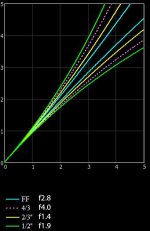
The EX3 with an f1.6 lens has practically the same DOF to f4 on 4/3 in any calculator that does the math correctly. The EX1/EX3 with the bundled f1.9 zoom is not very far. On the attachment you can see a 50mm lens equivalent on some common sensor sizes, the scales are in meters and the COC is chosen for single pixel blur diameter (COC) on 1920x1080 output.
Attachments
- Status
- Not open for further replies.