
[EDIT] After further discussion, .66 is sufficient (vs. .58), which matches what e.g. ARRI did with the Alexa for HD: 2880/.66 = ~1900. [/EDIT]
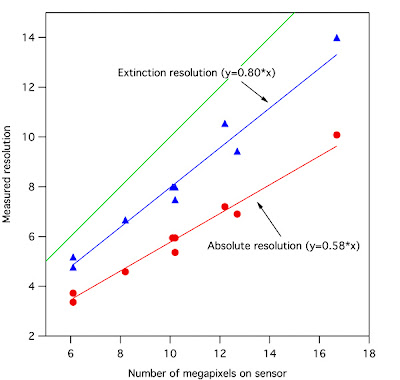
Recently there has been discussion regarding 4K vs. 1080p and actual camera resolution. After spending $16,000+ for a C300 II, I was a bit disappointed to see aliasing in 4K. After a bit of debate, research, and computer graphics tests to simulate sensor sampling & Nyquist, I reached the same conclusion as Jao did here, ".58 & .8" multipliers for Bayer sensors: http://lagemaat.blogspot.com/2007/09/actual-resolution-of-bayer-sensors-you.html
The summary in the real world (which matches Nyquist sampling theory), is Bayer sensors provide .58x the photosite resolution before aliasing begins, where extinction of detail occurs at .8x:
Here is my 2x sampling simulation (2 pixel black & white pairs), showing extreme aliasing when rotated:

Nyquist shows us we need >2x sampling to eliminate aliasing, thus here's 3 pixels instead of 2 to represent a line:

Jao measured many real-world test charts for Bayer sensors, and he found .58x before aliasing, pretty much the same as predicted by the 3-pixel line test (where 4 pixels would be even better). 1/1.5 = .67, 1/2 = .5, (.67 + .5)/2 = .58! http://lagemaat.blogspot.com/2007/09/actual-resolution-of-bayer-sensors-you.html. So .58x is pretty much an excellent predictor of alias-free resolution possible with a Bayer sensor. More images and info here:
http://www.eoshd.com/comments/topic/25630-why-shooting-4k/?do=findComment&comment=205652
This explains why the C300 II, C200, and to a lesser extent, the C700, all alias in 4K: in order to get alias-free 4K, we need 3840/.58 = 6620 Bayer photosites.
One reason the Alexa (ALEV III sensor) looks so good is 2880*.58 = 1670, which is 83% of 1920, vs. 3840*.58 = 2227, which is 58% of 4K (e.g C300 II sensor). The key here is aliasing: whenever aliasing occurs, even if not substantially visible (such as Moire), unconsciously we can see it, which hurts perceived image quality. That's why Alexa sensors and film tend to look better to most people, and one of the secrets to the film look (along with sufficient organic noise/grain to provide dithering and texture).
Here the Sony F65 with its "8K" (kinda) sensor shows alias free 4K performance:
Where the C300 II (raw):
C200 (raw):
C700 (raw):
Varicam Pure (raw):
Varicam LT (raw):
All alias, as predicted by the math as they don't provide sufficient Bayer photosite resolution for alias-free 4K sampling.
When shopping for a new 4K camera, use .58x the Bayer photosite resolution to compute alias-free resolution performance. Additionally, the OLPF must be tuned to filter out frequencies higher than .58x, else aliasing will occur. The Alexa 65 with 6.6K meets the "True 4K" requirement as does the Sony F65 (and I'm sure their new CineAlta release due shortly). I haven't seen test charts for Red: they could also provide True 4K performance at 6.6+K, depending on OLPF used.
Recently there has been discussion regarding 4K vs. 1080p and actual camera resolution. After spending $16,000+ for a C300 II, I was a bit disappointed to see aliasing in 4K. After a bit of debate, research, and computer graphics tests to simulate sensor sampling & Nyquist, I reached the same conclusion as Jao did here, ".58 & .8" multipliers for Bayer sensors: http://lagemaat.blogspot.com/2007/09/actual-resolution-of-bayer-sensors-you.html
The summary in the real world (which matches Nyquist sampling theory), is Bayer sensors provide .58x the photosite resolution before aliasing begins, where extinction of detail occurs at .8x:
Here is my 2x sampling simulation (2 pixel black & white pairs), showing extreme aliasing when rotated:
Nyquist shows us we need >2x sampling to eliminate aliasing, thus here's 3 pixels instead of 2 to represent a line:
Jao measured many real-world test charts for Bayer sensors, and he found .58x before aliasing, pretty much the same as predicted by the 3-pixel line test (where 4 pixels would be even better). 1/1.5 = .67, 1/2 = .5, (.67 + .5)/2 = .58! http://lagemaat.blogspot.com/2007/09/actual-resolution-of-bayer-sensors-you.html. So .58x is pretty much an excellent predictor of alias-free resolution possible with a Bayer sensor. More images and info here:
http://www.eoshd.com/comments/topic/25630-why-shooting-4k/?do=findComment&comment=205652
This explains why the C300 II, C200, and to a lesser extent, the C700, all alias in 4K: in order to get alias-free 4K, we need 3840/.58 = 6620 Bayer photosites.
One reason the Alexa (ALEV III sensor) looks so good is 2880*.58 = 1670, which is 83% of 1920, vs. 3840*.58 = 2227, which is 58% of 4K (e.g C300 II sensor). The key here is aliasing: whenever aliasing occurs, even if not substantially visible (such as Moire), unconsciously we can see it, which hurts perceived image quality. That's why Alexa sensors and film tend to look better to most people, and one of the secrets to the film look (along with sufficient organic noise/grain to provide dithering and texture).
Here the Sony F65 with its "8K" (kinda) sensor shows alias free 4K performance:
Where the C300 II (raw):
C200 (raw):
C700 (raw):
Varicam Pure (raw):
Varicam LT (raw):
All alias, as predicted by the math as they don't provide sufficient Bayer photosite resolution for alias-free 4K sampling.
When shopping for a new 4K camera, use .58x the Bayer photosite resolution to compute alias-free resolution performance. Additionally, the OLPF must be tuned to filter out frequencies higher than .58x, else aliasing will occur. The Alexa 65 with 6.6K meets the "True 4K" requirement as does the Sony F65 (and I'm sure their new CineAlta release due shortly). I haven't seen test charts for Red: they could also provide True 4K performance at 6.6+K, depending on OLPF used.
Last edited:


