C100: 7 Weeks to NAB - Anyone hearing anything besides conjecture about a C100 MKIII?

ARRI can't make an "affordable" model (unless one counts a $40,000 Amira as affordable) due to the cost of production and the historical market position. (I know Eric was joking) I doubt they'd even discount the Alexa line, should the new 6K sensor be passed down from Alexa65. They'll just have $100,000 Alexas and $250,000 Alexas.

And, with a month and a half to go until the NAB, a bunch of official announcements ought to be on their way. Unlike JP, I think there'll be plenty of new pro products there.

The Varicam proves that a 4K high DR camera should really be possible, but I don't know if Arri has access to the technology to create it the same way the Japanese manufacturers do. Canon and RED haven't managed to, either, and only Sony in the near future might.
 
) I doubt they'd even discount the Alexa line, should the new 6K sensor be passed down from Alexa65.
As I understand it it's the same sensor, just two stitched together (or maybe rather a bigger piece of the wafer) in the Alexa65... so nothing to pass down as it was already passed up...
 
I believe the Alexa 65 is four Alexa sensors stitched together. I don't really see the point of the 65 as you could just buy four regular Alexas, put them next to each other, and get the same results, plus then you'd have four Alexas for 3.4k mulit-cam shoots.
 
And the main rumor site mentioned again today that Sony is about to drop another "BIG" announcement in April.

Would be perfect for a 4K/60p A7SIII, but I guess other cameras are "supposed to" receive an update before it.

A7S line is not really a "broadcast" market product, so unlikely to appear at NAB. I wonder if F5/F55 replacements are on the way though? The rumour sites have been touting those since two NAB's ago!
 
As I understand it it's the same sensor, just two stitched together (or maybe rather a bigger piece of the wafer) in the Alexa65... so nothing to pass down as it was already passed up...
Three of them (5.7 MPX x 3).

In terms of the technology, Alexa's/Amira's ALEV III sensor was made on order (by STM, I believe, or a company that was acquired by STM after the delivery was well underway) but it's about to be seven years old. I suppose ARRI will have to decide whether they are going to stick with s35, move toward full frame/Vista Vision like Red or bring down the price of Alexa'65. If the trend is with the 8K, then they'll have to do some'fin.
 
I believe the Alexa 65 is four Alexa sensors stitched together. I don't really see the point of the 65 as you could just buy four regular Alexas, put them next to each other, and get the same results, plus then you'd have four Alexas for 3.4k mulit-cam shoots.
You're not incorrect. At least, not entirely so. A stacked projector system can double the effective resolution by dividing the screen coverage in the assigned spaces. In other words, four 2K projectors can do 4K and four 4K's can do 8K, the latter of which is what Canon has been doing for its 8K demos.

A dual-Alexa setup, however, will only give you a 3-D image. For 8K off Alexa'65, one would need some form of upscaling. Considering that the latest s35 Alexa (XT/SXT) can roughly double its innate resolution in body, a similarly powered processor just might be able to do the job.

PS. I mentioned this in another (GH-5 related) thread. Olympus EM1/EM5 series can do the in-body pixel shift upscaling in a photo mode by taking eight shots instead of one. It takes several seconds to process it - which is why it's not for portraits - but the resolution is significantly improved (from 16 MPX to the stated 40). And it does it with an $1,100 camera.

https://www.youtube.com/watch?v=FlGffGBz8uQ
 
Yes, but I was talking about a quadruple Alexa setup. One Alexa has double Ds, two Alexas is 3D, three Alexas is time travel, and four Alexas is inter-dimensional travel...
Which reminds me of an old (like 35-year old) Steven Wright joke - "I put instant coffee into a microwave oven and almost went back in time".

But, on purely a resolution note, I do wonder how long it will be for the in-body upscaling becoming ubiquitous and not a domain of a super high end product.
 
To me c100 is a great cam for low-budget documentary, but I'm tired of not having TC-in...is it that much to ask ?

- 4K 4:2:0 8 bits 25fps
- HD 4:2:2 8 bits 120 fps
- SDI out and TC-in

I'd go for it.
 
To me c100 is a great cam for low-budget documentary, but I'm tired of not having TC-in...is it that much to ask ?

- 4K 4:2:0 8 bits 25fps
- HD 4:2:2 8 bits 120 fps
- SDI out and TC-in

I'd go for it.

I'd be surprised if Canon puts TC in or out, genlock or SDI on the next camera, unless it's not the C100 MKIII and is, in fact, a C200 or something higher price point.
 
Canon is extremely conservative with their EOS Cinema features sets and model delineation, unfortunately for us. There are many cameras below the C100's original price point that have SDI out and TC I/O, might even be a couple with genlock even. The more I think about it, besides how necessary it is that Canon have a sub $10k 4k camera, they need to revise the form factor for the entire line. After shooting with it, I dream of the "shoebox with a VF where a VF should be" form factor. Imagine a $9,000.00 C200 in the form factor of a 2/3 size and weight C700 body/layout. That camera, for under $10k, with at least 4K 60p, a GOOD VF in the correct position, like the C700 has, only smaller and not so full spec'd out, would bury the FS7 MKII, not that I really care, the FS7 MKII is a nice camera, I wouldn't mine having one, but I would miss the Canon colors, DPAF and having to use all of my EOS lenses manual focus only on a Sony.

I could live without true 4K high speed on this Canon though, if it just had 4K 60p and perhaps 90 or 120 FPS 1080. Canon could really own the market, granted at the cost of losing some C300 MKII sales, temporarily, until they revise it to the C300 MKIII with the new form factor. Once they released this new (actually old) form factor (shoebox with a lens? Sony F3, F5, F55, FS700 anyone?), the whole lineup, C300 MKIII, C500 MKII (if there ever will be one) and C100 MKIII would have to follow suit but what a great cameras those would be. I never understood the EOS Cinema form factor, it is dumb. It's like the then still camera engineers at Canon thought that we wanted to shoot our video cameras like a still camera, holding it out in front of our bodies, out to our face?!?! Who ever thought that was a good idea? I look at the F55, Varicam LT and C700 form factor with envy. I am buying a Zacuto Recoil V2 system for my C100 and rental C300 MKII and other cameras, but when you look at it, the EOS Cinema form factor is kind of dumb and I have to buy $3,500.00 worth of Zacuto stuff to make it behave like it really should from the factory (balanced on the shoulder, VF at your eye). At least they got a clue with the C700, there is hope for the rest of the lineup.
 
I like the C100 Mark II's current form factor.

Great for tripod, slider, monopod, jib, dolly, Steadicam, and Glidecam. Only thing it is not good for is shoulder mount where you need various rigging. Some people do lots of shoulder mount, others (like myself) do not, so for people like me, I like the current form factor. The camera handles pretty well handheld without going on the shoulder, so I find shoulder rigging is only necessary during long duration shoots such as reality TV, and not most of my C100 bread and butter which is interviews and b-roll.

The placement of the LCD on the back and back left of the camera is pretty perfect for me. If I'm doing a slider shot, I want the LCD as close to my eye as possible so I can see focus and such, not forward toward the front of the camera as it is in most shoulder mounted designed cameras. Same for Glidecam, and, well, all of those other non-shoulder mounted setups I just mentioned.

With the C300 Mark II I often struggle with re-positioning the LCD screen for various scenarios, which takes time and slows me down, and I can never get it to be in the same place it is on a C100 Mark II. Kind of nice that it can be relocated, but ideally it wouldn't need to be. With the C100 Mark II, I rarely feel the need to have the LCD in a different location, except if I were doing shoulder mount, in which case I'd either use a front heavy rig that allows the camera to be in front of me, or a third party viewfinder or LCD screen with a balanced rig. Or, I'll just use the C300 Mark II with a Zacuto rig and the LCD up front.

A side handle attached directly to the camera body is also super useful for non-shoulder mounted shots.
 
Last edited:
Great for tripod, slider, monopod, jib, dolly, Steadicam, and Glidecam. Only thing it is not good for is shoulder mount where you need various rigging. Some people do lots of shoulder mount, others (like myself) do not, so for people like me, I like the current form factor. The camera handles pretty well handheld without going on the shoulder, so I find shoulder rigging is only necessary during long duration shoots such as reality TV, and not most of my C100 bread and butter which is interviews and b-roll. The placement of the LCD on the back and back left of the camera is pretty perfect for me. If I'm doing a slider shot, I want the LCD as close to my eye as possible so I can see focus and such, not forward toward the front of the camera as it is in most shoulder mounted designed cameras. Same for Glidecam, and, well, all of those other non-shoulder mounted setups I just mentioned.

With the C300 Mark II I often struggle with re-positioning the LCD screen for various scenarios, which takes time and slows me down, and I can never get it to be in the same place it is on a C100 Mark II. Kind of nice that it can be relocated, but ideally it wouldn't need to be. With the C100 Mark II, I rarely feel the need to have the LCD in a different location, except if I were doing shoulder mount, in which case I'd either use a front heavy rig that allows the camera to be in front of me, or a third party viewfinder or LCD screen with a balanced rig. Or, I'll just use the C300 Mark II with a Zacuto rig and the LCD up front.

A side handle attached directly to the camera body is also super useful for non-shoulder mounted shots.

Definitely different strokes. When I shoot tripod mounted or on the slider, I too have few issues with the EOS camera form factor. But I find lately, shooting on some action shows and running all over a city, following around a subject with lots of walk and talks, jump in a taxi, hop out, shoot talent walking around landmarks, hop back into another taxi, etc. type of shooting, the EOS form factor is a nightmare. I have pieced together a shoulder mount of sorts, it's actually not bad and was cheap. But the balance is not ideal, it's a compromise. My rig is also really long, inconvenient for getting in and out of vehicles and I have to move the shoulder pad off balance to get the camera back onto my tripod (Sachtler Touch & Go head). So a VCT tripod plate and the Zacuto VCT Baseplate will mitigate that issue.

I really, really like shooting shoulder mounted for a certain style and subject matter, mainly being up close and intimate with people subjects from 1' to 10' away as they and the camera are moving through environments. We are shooting an intimate portrait of a musicians homecoming to his old haunts, the clubs where he got his start so handheld and going on the journey with him will be super important, I don't want an observational/voyeuristic feel, we want a camera view as being a friend that this person is showing around various places. I can really only get that "tagging along" with the talent feel through handheld and or gimbal shooting for much of this project. That's why spending a stupid amount of money to get the right ergonomics is in the cards for me. Generally, in real documentaries, I would rather see good hand held camera work than almost anything else. It has something that gimbal and Steadicam just don't. I shoot a lot of corporate stuff off of tripod and slider because most of the corporate stuff I shoot is understaffed and I am often running between two cameras myself, or messing with audio so handheld is not as prevalent there. But for docs, handheld is everything for some of them.

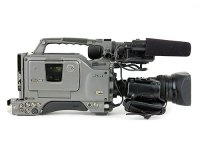
Like you said, the form factor totally works for most other styles of shooting but is lousy for handheld, even with the full Recoil rig, it is still a compromise. I too come from the days of Betacams, F900s and Varicams, that form factor has yet to be surpassed for simple, effective doc style shooting. So essentially, I am paying to turn my funky ergonomic, digital cinema camera back into the Betacam form factor. One step forward, two steps back. Funny, but my dream camera would be the look and features and sensor size of the C300 MKII, built into the exact size, weight, and form factor of the Sony DSR-500 DVCAM, which we used for years. Smaller and lighter than a Betacam, F900 or Varicam (it was like a 3/4 size Digibeta camera) but enough weight, stability and body size to be just about perfect as a documentary camera. Really miss that feel when shooting. Pair that camera with the CNe 18-80 servo zoom and I would be so happy.

sony_dsr500.jpg
 
Last edited:
Definitely different strokes. When I shoot tripod mounted or on the slider, I too have few issues with the EOS camera form factor. But I find lately, shooting on some action shows and
I really, really like shooting shoulder mounted for certain style and certain subjet matter, mainly being up close and intimate with people subjects from 1' to 10' away as they and the camera are moving through environments. We are shooting an intimate portrait of a musicians homecoming to his old haunts, the clubs where he got his start so handheld and going on the journey with him will be super important, I don't want an observational/voyeuristic feel, we want a camera view as being a friend that this person is showing around various places. I can really only get that "tagging along" with the talent feel through handheld and or gimbal shooting for much of this project. That's why spending a stupid amount of money to get the right ergonomics is in the cards for me. Generally, in real documentaries, I would rather see good hand held camera work than almost anything else. It has something that gimbal and Steadicam just don't. I shoot a lot of corporate stuff off of tripod and slider because most of the corporate stuff I shoot is understaffed and I am often running between two cameras myself, or messing with audio so handheld is not as prevalent there. But for docs, handheld is everything for some of them.

View attachment 121684

Wow with you description of that project I could only think of "Sonic Highways" as a comparison. Loved that series on HBO
 
Back
Top