1940's Dialog Sound/Microphone - What is it?

Relinked it a couple of times, last try seems to work. However plain tex

"http:/www.gettyimages.com/detail/video/1940s-black-and-white-medium-shot-pan-boom-stock-video-footage/868-103"

It is actually a boom mic but is a couple of feet above the actors heads.
 
Analog audio has a quality to it that no digital system managed to fully compete with yet. Which is why I still listen to vinyl records (along CDs).

I would have agreed with this, in the early/mid 1980s. By the 1990s, not so much. By the turn of the century digital not only competed with analog, but won in just about all categories. Now in 2016 I've lost all interest in fully analog recordings. My old collection of vinyl, including a large amount of the old Sheffield direct to disk issues, is now completely neglected.

I'm just sayin' that I understand what drives you because it used to drive me too. Just not anymore.

But if vinyl still makes you happy, have at it. Vive la difference.
 
Actually, Scott, direct sound on film (single system) came out in the 1960's. Prior to that it was all double system. For some strange reason, I cannot think of when crystal sychronized double system sound came out.

Yes optical sound goes back quite a ways, but it was added at the master negative stage of film production. I seem to recall that it took a rather massive bit of machinery to do that part of the job.

One thing for sure, in 1944 you did not have a guy running around the sound stage with a microphone on a fishpole, nor did you have wireless microphones. Boom stands, probably for sure. Microphones were rather large back then too.

Well sorry but that is not the case. Single system cameras were developed in 1925 and were used by the Movietone newsreels and the US signal corps in WWII.
http://movietonesoundsystem.blogspot.com/

But studios were using double system optical recording, which is what I was talking about not single system.

Crystal sync would be magnetic recorder era. The optical recorders were I'm sure locked together the same way all those dubbers in the photo were, which is a biphase signal keyed to the sprocket holes. Once locked they all move as one.
 
We had those well into the 1990s at Skywalker. R-DAT tapes were transferred to full coat. 80 or 100 tracks on film. I never got tired of watching those reels roll back and forth. They made it sort of a show room with big windows so visitors could watch it work.

That actually looks a bit like the Skywalker machine room. Everyone I know is kicking themselves for not recording those rooms when they were working. The sound of a wall of them grinding up to speed was marvelous.
 
ADR (Automatic Dialog Replacement) is a comparatively modern technology. Post sync sound as practiced in the 1930's was the actors watching themselves on film and recording the dialog to match their unrecorded voice in the film. Wasn't always exactly in sync...

The recording method I mentioned in that previous post was done on a 16" transcription disk that was cut as the film was being shot, synchronization was by the ubiquitous clap-board method. Transcription disks were in common use up to about 1955 or so when mag tape had mostly replace them.

Do you have any reference for that? Transcription disks were used to record radio shows but I have never seen or read anywhere that they were used in film production. There was a brief early time when Vitaphone (I think) used a sound on disk for playback and may well have used it for recording. But they switched to sound on film in the 20's. Sync with sound on disk was just too temperamental.

There are a ton of references to production recording to film as being standard. And they would have had to transfer the disks to film to edit, and you can't stop and start a disk, so every take would require a new disk... Just seems really unlikely work flow.
 
Saw this interesting note on microphones.

Western Electric 639 A/BIn the late 1930s, Western Electric, drawing on ribbon technology for the first and only time, produced the first switchable multi-pattern microphone, combining its well-respected 630A omni-directional dynamic unit with a uniquely crimped bi-directional ribbon assembly. Its output impedance, as with all previous Western mics (excepting condensers), was 50 ohms. It offered a selection of R (ribbon/bi-directional), D (dynamic/omni-directional) and C (cardioid or combined pattern). The 639B added another three variations of the combined pattern for a total of six patterns. In the early forties, Electrical Research Products Inc. (ERPI), a division of Western, redesigned the acoustic cage of the 639 for motion picture use, designating it as the RA-1142 transmitter.
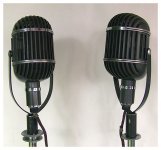
 
Saw this interesting note on microphones.

Western Electric 639 A/BIn the late 1930s, Western Electric, drawing on ribbon technology for the first and only time, produced the first switchable multi-pattern microphone, combining its well-respected 630A omni-directional dynamic unit with a uniquely crimped bi-directional ribbon assembly. Its output impedance, as with all previous Western mics (excepting condensers), was 50 ohms. It offered a selection of R (ribbon/bi-directional), D (dynamic/omni-directional) and C (cardioid or combined pattern). The 639B added another three variations of the combined pattern for a total of six patterns. In the early forties, Electrical Research Products Inc. (ERPI), a division of Western, redesigned the acoustic cage of the 639 for motion picture use, designating it as the RA-1142 transmitter.


Everything you ever wanted to know (and more) about these old studio mics:

http://www.coutant.org/altec639/

mic.jpg
 
That actually looks a bit like the Skywalker machine room. Everyone I know is kicking themselves for not recording those rooms when they were working. The sound of a wall of them grinding up to speed was marvelous.

There is someone that may have a recording of it. PM sent.
 
There were a lot of RCA 44s

Yes, I keep googling around for this, and keep hitting the famous RCA 44. It seems that during this time period, the dominant brand was RCA, and the dominant model was the 44 (specifically the 44BX ?). In side-by-side tests on Youtube, the RCA 44's quality stands out from other mics remarkably (for example, RCA ribbon microphones, by Big D Broadcast Exchange). Just google "RCA 44" and you'll find lots of love.

You could try to find such mics on eBay, for high prices and questionably condition. But ribbon mics are still in production. In fact one particular company seems to want to keep the RCA 44's legacy intact and has made microphones like it, Audio Engineering Associates (AEA) founded by Wes Dooley.

For example see this video, where the two interviewees are recorded with AEA's A440 ($5,000):


You can see the mic in the shot. The two men also wear lavs, but a caption at 2:44 says that the lavs weren't used, only the A440.

More reading:

Wes Dooley & Audio Engineering Associates. Ribbon mics especially the 44, Wes Dooley and the foundation of his company AEA, how ribbon microphones sound different from other types, and how the right preamp makes a big difference.

AEA A440. Review. This mic (the one in the video) is like the RCA 44 but with a modern level of output and phantom-power compatibility.
 
Last edited:
Ribbon mic's are lovely but just getting one is only half of the equation as you need a really really good mic amp to go with it as they need a lot more gain.

The BBC used coles 4038 and 4033 ribbon mic's a great deal and they still sound fab but you tend to need a high end old console or mic amp to get the best out of them as they are very low gain and impedance.

A lot of the 60's and 70's studio booms had AKG D20/25 mic's on them and in the 70's and 80's we used a neuman U87 or a KM84 on our Fischer booms.
 
Last edited:
…
Magnetic tape didn't arrive till post WWII (the nazi's invented it) when a US soldier shipped a couple of units home in pieces and spend years perfecting them with the idea of selling Hollywood on using them.
…
Well, it wasn't the Nazi's who invented magnetic tape recording, it was invented by a German called Fritz Pfleumer on 1927 and was patented on 1928. See https://en.wikipedia.org/wiki/Magnetic_tape and https://en.wikipedia.org/wiki/Fritz_Pfleumer . Hitler was appointed Chancellor on 30 January 1933: https://en.wikipedia.org/wiki/Nazi_Germany . However, wide-spread use of magnetic tape recording was done in Germany during the Nazi regime and only after the end of WWII it was introduced to the rest of the world.
 
... Post sync sound as practiced in the 1930's was the actors watching themselves on film and recording the dialog to match their unrecorded voice in the film. Wasn't always exactly in sync...
That's how it was done in many places outside of Hollywood into the 1980's. And actors had to do a lot of VO takes.

PS. I did use the term ADR incorrectly but ... eh, colloquially.

PPS. Ribbon speakers (tweeters) are considered more "jazz/classical", whereas the moving coil (tweeter and midrange drivers) are deemed more suitable for rock music. In terms of music fidelity, speakers carry a far greater importance than any modern source, even a heavily compressed MP3. For the jazz/classical listening - and there are listening clubs forming around these days - a tube amp and a reel-to-reel tape player are often the preferred combo but the higher end CD/SACD players do just fine as well.
 
Weeeeee.....

Aren't we going off in all kinds of directions...

Digital/analog: Both are good, contrary to what the affictionatos of one or the other say. I still have cassette decks, and sold my turntable set up just a couple of years ago to someone who wanted one badly.

Kind of like the digital video/16mm arguments. However, these days, both reel to reel tape and 16mm film are real expensive to use. That does not keep some people from using them. They must think they are worth the expense.

The internet is an interesting place. Just yesterday I was watching a youtube about the coming water raise from global warming. Guy said people should move to the Ozarks because the ocean was going to be up to the Blue Ridge Parkway. Now I live a couple of miles from the Parkway, my parking lot according to my GPS is right at 3000', the Ozarks are in the 2500' range. People would get kind of wet there if he was correct. Funny thing is, not much believing what people tell me, when this global warming stuff first came up I did a little reseach and some simple arithmatic. I am not going to tell you the results, but will give you an idea where to look. First floating ice will not raise water levels at all. Second look up the area of ice over land, and the thickness. Third figure out how many cubic miles of ice that is (lots and lots). Fourth spread that out evenly over the square miles of ocean in the world. Now, how much higher are the oceans going to be? You will find that there are a lot of nuts in the world.

Actually, this thread has had me looking at all kinds of strange things on the web. Funny how precise a google search isn't these days.
 
I own two Coles ribbon mics. The 4104B 'Lip Mic'. For years this was the "standard" in the field for tracking, especially in noisy environments. You could literally be in the middle of rock concert and cut tracks and you'd never hear anything but the reporter. We honestly used to cut tracks ON the football field after games and you would not hear any background noise. I believe I still carry one in my truck, but they don't see much use today, because a lot of talent don't understand them and don't like using them(as the name implies, you have to hold the mic against the top lip, for them to work properly). Also, most of my audio guys do not like the sound of them compared to what we get out of our MD-46's. Plus, standards and expectations have changed(read: fallen) dramatically over the last 5-10 years and even if we half-assed it, we're still giving them quality above and beyond what they expect, now.
 
;~) well that takes it over the edge!

And yes sea rise is not going to reach 3,000 feet. It would be nice if folks on both sides would keep at least close to the facts, they are scary enough. 15' rise and you will have a lot of new neighbors who lived on what was the coast...

I have a hard time seeing any argument in favor of 16mm. It's a lousy format, relatively poor resolution and absolutely awful sound. Supper 8 has better sound than 16mm. There is a rare 16mm format that had a magnetic sound track but it never really caught on so you are stuck with mono optical and the academy curve and no noise reduction.

Reel to reel I mis in some ways, though you can't touch digital editing for control and flexibility. Never liked cassettes from a functional standpoint, but that's just me. I don't think LP's sound "better" than any decent digital version but the experience is certainly different. You are basically forced to listen to an album side as a unit. Some albums benefit from that more than others. And you are also forced to listen to some songs you don't like that much because they are in the middle. It's more like hearing a performance since you are not really in control of the play list.
 
;~)You are basically forced to listen to an album side as a unit. Some albums benefit from that more than others. And you are also forced to listen to some songs you don't like that much because they are in the middle. It's more like hearing a performance since you are not really in control of the play list.


Not real experienced with records are you? No problem dropping the tonearm on the track you want to hear, and lifting it when that track is done. Disk jockeys do it all the time. With two playback and one recording table, editing is easy including over dubbing. And as soon as a track is cut it can be played back, no waiting.
 
Yeah records are, to use a computer talk, "random access" at least the side that's up if the operator is willing to move the tone arm.
Aside from the convenience factor of that era, I didn't like the Philips Cassette, though I used them a lot. I didn't like the 8-trk cartridge much either with the cross-talk and such, and most were playback only.

Here's a picture of dearest Marilyn on the set of The Misfits (1961). I have no idea what mic that is ??
Monroe-boom.jpg
 
Back
Top