I just watched Experiment Perilous (1944, George Brent Hedy Lemarr) on TCM. I noticed that the men in the film all had this 'resonance' in their voice. This is something I've heard many times in films of that era including Humphrey Bogart (To Have and Have Not) and Bing Crosby (Going My Way) movies. Does anyone know if it was one particular microphone that made that sound or was it another part of the process, perhaps the optical film track, that made it sound that way? I really like that sound and I'd like to be able to reproduce it.

Navigation
Install the app
How to install the app on iOS
Follow along with the video below to see how to install our site as a web app on your home screen.
Note: This feature may not be available in some browsers.
More options
You are using an out of date browser. It may not display this or other websites correctly.
You should upgrade or use an alternative browser.
You should upgrade or use an alternative browser.
1940's Dialog Sound/Microphone - What is it?
- Thread starter Paul F
- Start date
Richard Crowley
Veteran
Part of it was the stage-acting delivery style, including the slightly-British accent of the "upper crust". But I suspect most of it was the old sound-stage, set construction, and requirement for high light-levels, combined with an era before good directional microphones (hyper-cardioid or interference-tube, etc.)
I would think that a mid-frequency "bump" would reproduce that "tubby" sound.
I would think that a mid-frequency "bump" would reproduce that "tubby" sound.

GaryNattrass
Veteran
Ah the "old days" when production really had to consider sound and the environment that it was being recorded in.
The camera's were so noisy that they had blimps the size of a small car and apart from ADR being done a lot more the sound stages had to be substantial and the equipment top notch with probably just one mic on a boom used at any one time.
This followed through to the advent of radio mic's and lav's and you can see movies in the 60's and 70's still being recorded with old dynamic mic's on mole richardson booms with the odd long shotgun and hyper cardioid mic in huge blimps to protect them from the elements etc.
Now it is all about slapping a radio mic on everyone and multi tracking to suit the production and even then if the location is too challenging ADR is still the way to go but it all ends up in the digital domain and sadly that removes a lot of the old school tape saturation and warmth that was de facto with high end kit.
Optical did have it's own unique sound but it was actually very limited but it still had more tonal character than any digital multi channel compression system to suit surround sound.
As a side note I listened to some of my old music tracks that I recorded in the 80's on a high speed 4 track cassette home studio (RSD Studio 4 with dolby B) and they still had more character and warmth than anything that my pro tools set-up has ever spat out to the digital world. Also at work (SKY TV UK) I sit in front of the latest Calrec Apollo digital consoles that are fed with the latest sennheiser radio mics and other high end schoeps etc but there is just something not there and missing from the sonic landscape.
Oh well what price progress as they say and at least we can churn it all out cheap and quickly now so they can sort it all out in post !!!
Content is king as someone once said! :0)
Analog audio has a quality to it that no digital system managed to fully compete with yet. Which is why I still listen to vinyl records (along CDs).…
Optical did have it's own unique sound but it was actually very limited but it still had more tonal character than any digital multi channel compression system to suit surround sound.
As a side note I listened to some of my old music tracks that I recorded in the 80's on a high speed 4 track cassette home studio (RSD Studio 4 with dolby B) and they still had more character and warmth than anything that my pro tools set-up has ever spat out to the digital world. Also at work (SKY TV UK) I sit in front of the latest Calrec Apollo digital consoles that are fed with the latest sennheiser radio mics and other high end schoeps etc but there is just something not there and missing from the sonic landscape.
…

graywolf
Well-known member
That is an interesting question.
Audio tape was a post WWII product, at least in the USA. I doubt they were using wire recorders, but could have, I guess. Optical on the film? Not too likely. So cutting to a phonograph disk, and thus not much better than AM radio level sound? Sometimes in those kind of recordings you hear a real soft motorboating. So likely.
I kind of had the idea that low budget sound was done with an RCA 77 hanging above the center of the stage, and not real close mic'd. Notice how often the speaker seems to be stage center in the shots.
Above is mostly speculation on my part but, based 1950's tech experience. I wonder how I could research that sort of thing from where I am located? University here started in 1970. Public library does not save old material. How often I wish I was back in a big city somewhere, and how often I am glad I ain't (grin).
Non-Hollywood films were mostly ADR.
Something that used to drive me nuts was how one could watch a scene where an actor was far away from the camera's (or, at least, the angle/lens chosen made him seem far) while the audio dub was very cleanly spoken into a mic fewer than six inches away from the actor's mouth.
On the other hand, the director rarely had to worry about the actor flubbing his lines.
Go to Wikipedia and follow the provided links.That is an interesting question.
Audio tape was a post WWII product, at least in the USA. I doubt they were using wire recorders, but could have, I guess. Optical on the film? Not too likely. So cutting to a phonograph disk, and thus not much better than AM radio level sound? Sometimes in those kind of recordings you hear a real soft motorboating. So likely.
I kind of had the idea that low budget sound was done with an RCA 77 hanging above the center of the stage, and not real close mic'd. Notice how often the speaker seems to be stage center in the shots.
Above is mostly speculation on my part but, based 1950's tech experience. I wonder how I could research that sort of thing from where I am located? University here started in 1970. Public library does not save old material. How often I wish I was back in a big city somewhere, and how often I am glad I ain't (grin).
As a benefit, I will usually click on the German language page - inventors of the Magnetophon, which then Jack. T. Mullin appropriated and Bing Crosby popularized - and run it through an auto translator.
graywolf
Well-known member
Also check out:
https://en.wikipedia.org/wiki/Mid-Atlantic_accent
Apparently that mid-Atlantic accent was common for actors in the 30's and 40's.
https://en.wikipedia.org/wiki/Mid-Atlantic_accent
Apparently that mid-Atlantic accent was common for actors in the 30's and 40's.
graywolf
Well-known member
Non-Hollywood films were mostly ADR.
Something that used to drive me nuts was how one could watch a scene where an actor was far away from the camera's (or, at least, the angle/lens chosen made him seem far) while the audio dub was very cleanly spoken into a mic fewer than six inches away from the actor's mouth.
On the other hand, the director rarely had to worry about the actor flubbing his lines.
ADR (Automatic Dialog Replacement) is a comparatively modern technology. Post sync sound as practiced in the 1930's was the actors watching themselves on film and recording the dialog to match their unrecorded voice in the film. Wasn't always exactly in sync...
The recording method I mentioned in that previous post was done on a 16" transcription disk that was cut as the film was being shot, synchronization was by the ubiquitous clap-board method. Transcription disks were in common use up to about 1955 or so when mag tape had mostly replace them.

Noiz2
Sound Ninja
Sheesh, lots of old grumping and some really far off "facts".
The OP was talking of 1944 not some time in the 60's. In 1944 sound was recorded to optical recorder. Basically a 35mm camera for sound. The only other way at that time in the US would have been lacquer disk recorders but they are a one shot thing with no reliable way to keep in sync and no way to edit.
Magnetic tape didn't arrive till post WWII (the nazi's invented it) when a US soldier shipped a couple of units home in pieces and spend years perfecting them with the idea of selling Hollywood on using them.
Crosby tried to use lacquer disks to record his radio show so they could play the disks for the other time zones instead of the normal practice of performing a show over again for each time zone. The network refused so he canceled his show and only reluctantly resumed the next season. Then he came across the engineer who had shipped the tape machines back and had been perfecting them and he invested a huge hunk of change into a small company to make them Ampex.
With tape in hand he went back to the networks and won. It was fought against by the musicians union because these shows all had orchestras and there were strict runes in place about not allowing any prerecorded music on radio. Crosby though was HUGE and had the clout to make it happen, which inadvertently made DJ's possible later on.
ADR was never heavily used in Hollywood, except for musicals, still isn't. You can often spot it in older films because with recording to optical film your editing was limited to 1/4 frame on 4 perf or 1/3 on 3 perf film, and that is a LONG way to be off sync wise. Basically if the actor didn't nail the sync there isn't much an editor could do.
The "analog" folks get rhapsodic about is not optical film recordings with no noise reduction and an academy curve slapped on. The fact that a lot of old films sound pretty good on video is that they have undergone a bunch of restoration in the transfer. Actual optical tracks are noisy and have a lot of snap crackle and pop going on.
As to the vocal sound. It's probably a lot of factors. First everything was shot on sound stages. Even when you have a bunch of location shots you are almost always back on a sound stage when there is dialog, it was just too hard to do location sound. Mics would also come into play. I'm not sure what they were booming. Crosby most singers and pretty much all radio shows used ribbon mics (RCA44 I think was the one seen all over the place) but I doubt they would use that on sound stages, low output and heavy, but? They would have gotten the mic as close as humanly possible because of the camera noise and the lack of being able to really do any "fix in the mix".
Also these are all mono which narrows down the sound field and means everything is going through the same speakers so they would have had to EQ and mix so none of the added tracks got in the way of the dialog. Because of the noise floor you couldn't go low in volume with out getting in trouble so the dialog is probably more compressed than it is in films today. And of course you had the Academy curve to deal with.
"The response is flat between 100Hz and 1.6kHz. Response is reduced 7dB at 40Hz, 10dB at 5kHz and 18dB at 8 kHz. The severe reduction of the high end of the spectrum was specifically designed to conceal the high frequency crackling noise inherent in early film sound production." So that is a pretty tight hunk of spectrum to fit everything in.
By the 60's recording tape was the norm and by the 70's Noise reduction had vastly improved the spectrum and quality of the captured sound. Play back was still optical but noise reduction had come to the rescue there also. Then after Empire Strikes Back most theatres, at least in big markets (you had to have an approved stereo system to be allowed to plat ESB) were stereo with good noise reduction.
Last edited:
Noiz2
Sound Ninja
graywolf
Well-known member
Actually, Scott, direct sound on film (single system) came out in the 1960's. Prior to that it was all double system. For some strange reason, I cannot think of when crystal sychronized double system sound came out.
Yes optical sound goes back quite a ways, but it was added at the master negative stage of film production. I seem to recall that it took a rather massive bit of machinery to do that part of the job.
One thing for sure, in 1944 you did not have a guy running around the sound stage with a microphone on a fishpole, nor did you have wireless microphones. Boom stands, probably for sure. Microphones were rather large back then too.
Richard Crowley
Veteran
I have seen lots of variable-density sound tracks. But I have never seen a variable-area track either unilateral or bilateral.
They rather nicely evolved from recording optical tracks on servo-locked film recorders to recording magnetic tracks on "full-coat" sprocketed film with the same magnetic coating as we used for analog (and digital) mag tape. I got to see probably the last generation of film-stock based audio recording and mixing in the 1970s. There were large rooms full of 35mm mag film players and recorders all servo-locked together like this. Those were "the days".
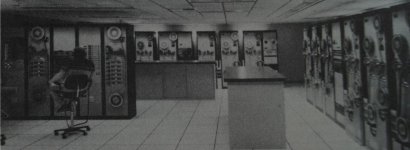
By that time the tape-based Nagra (and Uher for us low-budget guys) were taking over. With various magnetic sync-track schemes used for picture/sound sync.
They rather nicely evolved from recording optical tracks on servo-locked film recorders to recording magnetic tracks on "full-coat" sprocketed film with the same magnetic coating as we used for analog (and digital) mag tape. I got to see probably the last generation of film-stock based audio recording and mixing in the 1970s. There were large rooms full of 35mm mag film players and recorders all servo-locked together like this. Those were "the days".
By that time the tape-based Nagra (and Uher for us low-budget guys) were taking over. With various magnetic sync-track schemes used for picture/sound sync.
graywolf
Well-known member
So, Paul, coming full circle, my best guess is a combination of actor training, and the audio equipment of the period.
The most interesting discovery, from researching this thread, for me is Amy Walker and her accents. She has a set of youtube videos that will teach you how to talk like an American (chuckling).
The most interesting discovery, from researching this thread, for me is Amy Walker and her accents. She has a set of youtube videos that will teach you how to talk like an American (chuckling).
Like many other people, I'm sure, I had the idea of doing a short film imitating those noir movies from the 30's and 40's. Sound is a big issue. But you've got to start even earlier. The actors spoke in a certain way, not just the accent, but the cadence and profession-specific mannerisms. I was long fascinated by how people sounded in bygone eras, and we only have recorded sounds going back less than 150 years, even less than photography. That's barely a blip in the scale of human history. We will never know how ancient Romans sounded. Nor will we ever know how our founding fathers sounded. Or people during the Civil War.
With the advent of recorded sound, we have some idea. But a lot of what our ideas are about that sound is based upon movies and radio - and that's where the devil is in the details. First, actors, broadcasters, announcers and so on, did not necessarily all have accents like the common man in the street - they had a certain RP or Mid-Atlantic accent that's an artifact of the broadcasting environment, which is how you were "supposed" to sound - you rarely had someone come in and start talking in a broad regional accent (and even less for minorities). Then there were certain conventions that developed, partially in response to the theater, stage and vaudeville. Think of how the people whom you hear on NPR sound - there is a specific mannerism that is ridiculously removed from real life: nobody talks like that outside the studio. So if you want to know how people sounded back in the day, movies and radio are imperfect guides.
That said, me and my friends who have watched a lot of very old movies, developed a little inside joke, where we try to imitate the 40's tough guy patter - cracks us up every time. But, you can imitate the talk, but how it ultimately sounds is heavily dependend on the recording process and environment. Like I said, I tried to do a short film like that once, and it was a huge FAIL - we couldn't come up within a country mile of getting that sound. I'm sure part of it was the equipment used back in the day, but trying to recreate it in post I'm sure is possible... just outside of our abilities/knowledge. I'd be really curious to see if a real sound pro took a crack at trying to re-create that sound, how close would they come?
combatentropy
Veteran
I just watched Experiment Perilous (1944, George Brent Hedy Lemarr) on TCM. I noticed that the men in the film all had this 'resonance' in their voice.
After watching a clip, I think it has more to do with the microphone than the recording medium.
First, the microphone sounds very close. I'm curious where it was. It sounds as close as lavalier, but I thought lavaliers didn't sound that rich.
Which brings me to my second point, it sounds very rich, which makes me think it was probably a ribbon microphone, especially since that was the kind commonly used back then, based on my short time googling:
While Germany preferred the condenser microphone, the rest of the world used ribbon microphones for broadcast, movie sound, and orchestral recordings up until the early 1960s. . . . In the 1960s the ribbon was more and more replaced by condenser microphones. . . . Ribbon microphones sound full, rich, and smooth. They’re more detailed than moving coil dynamic mics, yet less harsh in the treble range than condensers.
--- https://www.thomann.de/dk/onlineexpert_page_ribbon_microphones_history.html
The old style of vocal training, inherited from stage acting, which was more about sounding pleasant than modern acting styles, also has something to do with it.
Last edited:
Yes, that clip is a good example of what I'm talking about. Every man in that movie has the same characteristic.
I'm hoping it was the microphone and that it can be re-produced. It's difficult to describe what I'm talking about, but the best description I can come up with about the sound is that it sounds something like wax paper against a comb. You know, that kazoo buzz. When they say their vowels, they all have this characteristic somewhat fuzzy sound. It's almost as though they all talk like Kelsey Grammer, who has this characteristic in his voice naturally.
I'm hoping it was the microphone and that it can be re-produced. It's difficult to describe what I'm talking about, but the best description I can come up with about the sound is that it sounds something like wax paper against a comb. You know, that kazoo buzz. When they say their vowels, they all have this characteristic somewhat fuzzy sound. It's almost as though they all talk like Kelsey Grammer, who has this characteristic in his voice naturally.
graywolf
Well-known member
A clip supposedly from a tv studio made in the 40's showing the mic setup:
http://www.gettyimages.com/detail/video/1940s-black-and-white-medium-shot-pan-boom-stock-video-footage/868-103
Kind of looks like what I described. Gee, I get to pat myself on the back (ow, that hurt).
http://www.gettyimages.com/detail/video/1940s-black-and-white-medium-shot-pan-boom-stock-video-footage/868-103
Kind of looks like what I described. Gee, I get to pat myself on the back (ow, that hurt).
Last edited: