C200: $1,000 Price Drop.....C500MKII coming soon?

Back to the original topic, I wonder if this new camera will have Canon's new R mount as an option (and I wonder how much an advantage if any that would be). The new Canon R lenses seem super expensive for still lenses, but seem like they would play really nicely with a full frame cinema camera.
 
Back to the original topic, I wonder if this new camera will have Canon's new R mount as an option (and I wonder how much an advantage if any that would be). The new Canon R lenses seem super expensive for still lenses, but seem like they would play really nicely with a full frame cinema camera.

By all accounts, the new lenses are great, but the real advantage would be like E mount on Sony cameras, you could adapt other lenses to it easily.
 
Back to the original topic, I wonder if this new camera will have Canon's new R mount as an option (and I wonder how much an advantage if any that would be). The new Canon R lenses seem super expensive for still lenses, but seem like they would play really nicely with a full frame cinema camera.

I had the thought that the R mount might cause problems with the integrated ND filter on the cinema due to space considerations. The RF mount and the R lenses are a big step up from the EF mount, but Canon might need to reengineer the ND filter set-up before they start including the RF mount option.
 
I had the thought that the R mount might cause problems with the integrated ND filter on the cinema due to space considerations. The RF mount and the R lenses are a big step up from the EF mount, but Canon might need to reengineer the ND filter set-up before they start including the RF mount option.

What about this?

 
What about this?


Yeah, that works great as an adapter for an ef lens, but the RF mount puts the lens so close to the sensor that It might be difficult for Canon to design an integrated ND filter. I mean, I'm sure it wouldn't be impossible to fit something between the lens and the sensor, but Canon generally takes their time to make design changes so I am guessing that is why it is rumored that the next generation of cinema cameras will not have the RF mount, yet.
 
Yeah, that works great as an adapter for an ef lens, but the RF mount puts the lens so close to the sensor that It might be difficult for Canon to design an integrated ND filter. I mean, I'm sure it wouldn't be impossible to fit something between the lens and the sensor, but Canon generally takes their time to make design changes so I am guessing that is why it is rumored that the next generation of cinema cameras will not have the RF mount, yet.

Should be easy enough for Canon. Sony does it with E and FZ, both of which are shallower.
 
Should be easy enough for Canon. Sony does it with E and FZ, both of which are shallower.

Yes, I just checked the specs and i see you are right. I just wished that Canon would release an RF cinema camera and I don't know why they aren't doing it for the next camera. The fine control of the aperture with the control ring on the new RF lenses is a huge improvement for video work.
 
Yes, I just checked the specs and i see you are right. I just wished that Canon would release an RF cinema camera and I don't know why they aren't doing it for the next camera. The fine control of the aperture with the control ring on the new RF lenses is a huge improvement for video work.

In fairness to Canon, their two most recent ILC's (R and RP) are both in RF. Their last "pro" video camera C200 came out a year prior.

PS. Matt Allard of Newsshooter believes that there will be a bunch of new products at IBC in September.
 
In fairness to Canon, their two most recent ILC's (R and RP) are both in RF. Their last "pro" video camera C200 came out a year prior.

PS. Matt Allard of Newsshooter believes that there will be a bunch of new products at IBC in September.

I'm mostly going by the canonrumors.com info. All of their rumors have stated that the next gen cinema camera will still be ef mount.
 
So I mentioned that all the new releases - whether videocentric hybrids or pro style cameras - will have to compete with the upcoming S1H, which has a 6K sensor for around $4,000 (the exact price is currently in the Panasonic executives heads). Well, S1H is about to become old news. Off the continuously uploaded unboxing videos, Black Magic Design Pocket 6K is creating a major buzz. 6K Raw, blah-blah-blah for $2,500. The early, and often hastily captured and graded, footage looks quite nice also.

And it has an EF-mount to boot.
 
A great way to summarize a camera when all one cares about are specs and price.

No, actually, they all think that the image quality is outstanding, even compared to the 5K/6K Red cameras. And BMD Pocket 6K is $20,000-$30,000 cheaper.

But, hey, if you like to splurge $40,000 for Faux 4K, it's your prerogative.
 
Right, again, image quality is just one part of what makes a camera good, and I think 3.2k ProRes from an Arri camera looks way better in terms of image quality than 6K RAW from any other camera in existence (though the Sony Venice isn't too much of a slouch). You constantly ignore the other parts aside from image that make a camera good, to quote you describing them, "blah, blah, blah."

But whatever. There will always be people who don't use cameras in high end professional environments who may never understand the benefits of higher end cameras. We try to educate you, but you continually fail to understand. And then we get to have fun (because I'm bored right now) trying to educate you on an online forum.

My professional opinion is every Black Magic camera so far (including the new one) has been an unprofessional tool that is good for hobbyists on a budget. That's not to say that they can't work in a professional environment, just that they often don't as they are poorly designed to do so.

I just think it would be better if you stopped making posts implying the latest cheap and unprofessional camera which has good specs is some high end professional tool that out-dates all the higher end camera systems which are factually (not a matter of opinion) better for most high end productions. Just look at what big budget movies and shows are being shot with for factual proof.
 
Last edited:
... I just think it would be better if you stopped making posts implying the latest cheap and unprofessional camera which has good specs is some high end professional tool that out-dates all the higher end camera systems which are factually (not a matter of opinion) better for most high end productions. Just look at what big budget movies and shows are being shot with for factual proof.
I think you're being both dismissive and insulting to your fellow professionals. You deem both their gear and their skills as unworthy of your self-anointed excellence.

I think this attitude will catch up with you sooner rather than later, both professionally and personally.
 
Different folks have got different business model and hence use different cameras. No point in fighting whose toy is better.

Lets wait for canon to respond.
 
I think you're being both dismissive and insulting to your fellow professionals. You deem both their gear and their skills as unworthy of your self-anointed excellence.

I think this attitude will catch up with you sooner rather than later, both professionally and personally.
I'm not intending to put down people who use lower end equipment. Lower end equipment is suitable for lower end production, and many people work in that world and there's nothing wrong with that. What I'm having a problem with is when someone from that world implies that that same lower end equipment is perfectly suitable for high end production, when it is not. That's all.

You keep sounding like you're saying the latest under $4k camera that has cool specs is going to out-date and replace all these high end cameras that cost $40k+ and sometimes have worse specs (while having much better feature-set and image quality), and it's just not the case. It's a possibility of the future, but in the present, as I said, people aren't going to start selling their Arris to buy the latest Blackmagic 6K RAW camera because the Arri is hands down better suited for high end production.

And yeah, I'm going to be dismissive of someone who disagrees with that when the proof is so obvious it shouldn't really be considered a matter of opinion; no big shows or movies use Blackmagic cameras as A-cams; it's mostly Arri, along with some other high end camera systems that are not Blackmagic. If you would like to disagree with this and list out a good number of big budget shows or movies that use Blackmagic as their A-camera, please feel free to do so. And I don't think there is a valid argument that every high end DP who chose not to use Blackmagic cameras is just an uninformed idiot. So if you can't come up with that list, I think it's best to stop making it sound like anything from Blackmagic is a high end camera.

On the other hand, if someone were to make a statement that say a Panasonic Varicam 35 or Sony Venice are better than Arri, considering some high end DPs do prefer those cameras and use them on big budget productions, it then becomes a more subjective opinion of which I would not be so dismissive of others' opinions on that matter even if I personally considered Arri better.

Or perhaps I'm just misinterpreting your excitement at a newly announced well speced camera at an affordable price. But, you did imply me spending $40k+ on a low speced ("Faux 4K") camera was a waste of money, so...
 
Last edited:
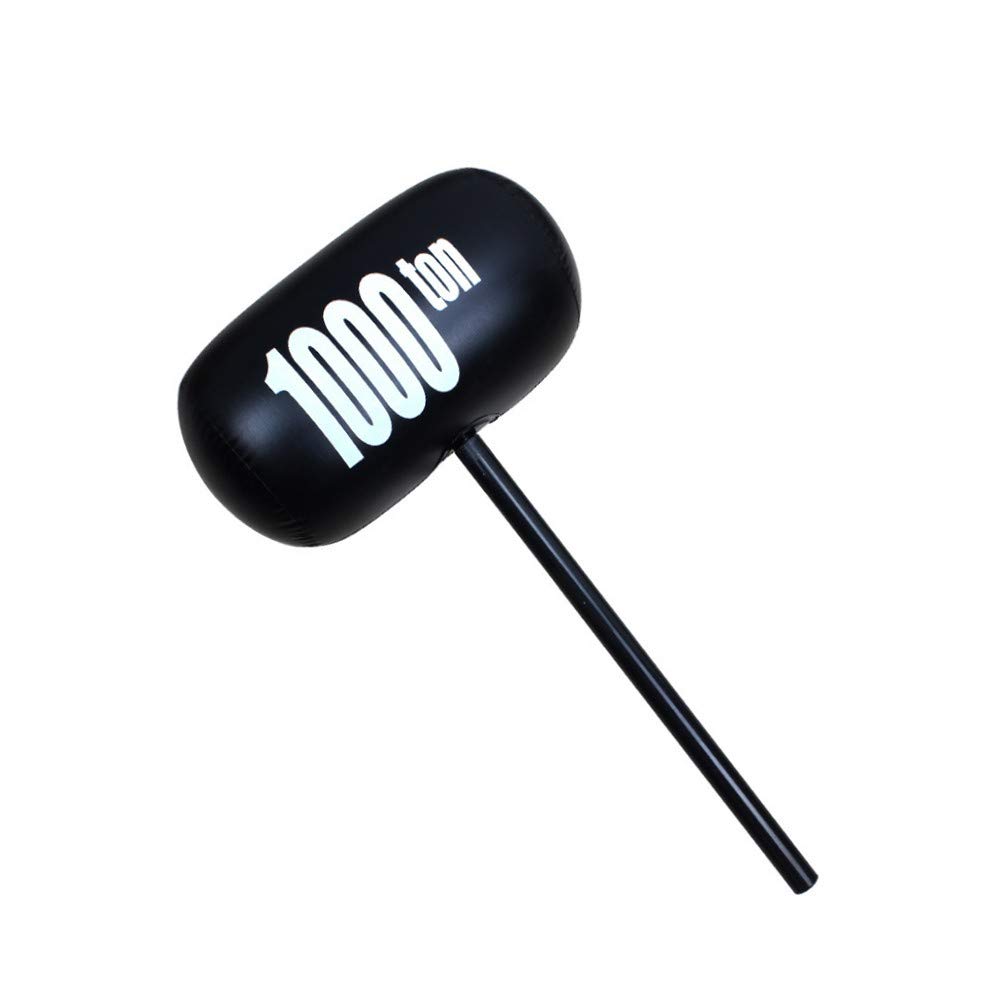
Don't know how much ya'll follow the construction industry news, but there's this new toy hammer that popped up on Amazon and has great specs and a great price. It's called the XGao Homyl Inflatable hammer.

51mlJ1P878L._SL1000_.jpg


Spec wise we're talking a 27" x 16" hammer that costs just $6.93 and even has written on it, "1000 ton." "1000 ton," man, what a great spec, and just $6.93. Meanwhile, all these old timers in the industry are sticking with their outdated metal hammers, like the metal Estwing Hammer which weighs a mere 16 ounces and spec dimensions is 13" x 6", less than half the dimensions of the XGao Inflatable.

41qF-JHviBL.jpg


And you know what's crazy? The hammer industry still thinks it can get away with charging a whopping $20.97 for their old non-toy metal hammers. That's more than three times the price of the inflatable one which has better specs.

Now, a lot of ole' "professional" naysayers in the construction industry are complaining about this XGao Homyl Inflatable hammer, calling it a "toy." They say things like it's not even capable of hammering a nail in and therefore isn't suitable for high end construction work. But guys, "1000 ton," twice the size. Just look at the specs. And buy now to use on your latest construction project and let's only hope the rest of the construction industry catches on.
 
Last edited:
Gotta say I agree with Eric here. It’s fair to say that you can shoot an indie darling on a lower end camera and no one would be the wiser, but to say or imply that that same lower end hardware can be swapped in on a crewed show isn’t something I think is all that realistic. In the indie scenario, you’re making a lot of compromises that wouldn’t fly in other spaces, and I’d take that faux-4k over any of the higher res lower priced options because the specs are only part of the value and usefulness of a camera imo.

The lower end cameras are getting great, and you can do good work with them and the gear is no longer holding you back from making said work if you’re willing/able to compromise, but these cameras are just "the best we can afford", not even close to "the best there is" when you look at the whole picture.

Honest question: This is your big break, and your rep and livelihood are on the line. You have a crew and a modest budget to make magic with. Do you rent an Arri (or that class of camera), or do you buy a Blackmagic Pocket camera and shoot 6k?

To me the only time not using the Arri-level gear in that scenario makes sense is if you are going to get marketing press from your camera choice like Tangerine did.
 
Last edited:
What I havent seen delineated in this discussion very much is the difference between crew served cameras and single op cameras, that seems to be a large differentiator. I work on several shows like The Handmaids Tale, Homeland, Prison Break as well as features here and there and no small inexpensive cameras are used as A or even B cameras in this type of production. I don't see that changing anytime in the near future. As long as you have two or three ACs for each camera, the form factor kind of has to be larger with a crew side and an operator side. I've been on set on a few indie/student films that tried to utilize small cameras like the XT-3 fully rigged and even the HVX200 back in the day. Those type cameras for that type production are a hindrance, they literally slow down production and end up costing more to use than a large professional camera because workflow issues come up that have to be solved and solving problems on set costs a lot of money.

Where I see cameras like the Pocket Cinemas and the S1H gaining a foothold is in documentary, some reality and some event type shoots. I've used large, heavy, bulky cameras like the Varicams, REDs amd Arris for that type of production and they are often a hindrance in situations where you are trying to be low key, fit into a crowd, shoot in public without permits, getting in and out of vehicles while shooting. I don't think either type of camera is intrinsically better than the other, it all just depends on the situation. I agree, I don't see cameras like the S1H being used by Hollywood on "bigger" productions, other than as plant cams, car cams, etc. I don't think that paradigm will change anytime soon. I see fewer and fewer larger cameras being used in Documentary and BTS type production too, why would we when we have tools that are as capable and unobtrusive as mirrorless rigs?

There is no one type of professional camera. In the right context, even crappy Go Pros can be professional cameras. To me, shooting documentary programming requires just as much professional acumen as being an operator on a high-end show or feature, it's just a totally different mindset with different requirements. When you are crew on a 200 person crew project, you are merely a cog in the machine, whereas in a four person documentary crew, you are the machine, you have to have a totally different, wider context about drawing out and capturing your story at all times, whereas when I crew on big productions, I just listen to the ADs who tell us what we're doing next. 100% different mindset and gear requirements. I enjoy both. I get Eric's points about specs versus actual output. My C200 with careful lighting and post shooting RAW can look almost indistinguishable from an Arri. But the Arri is much better built, and is superior for any kind of crewed production. But for documentary shoots, I'd rather have three C200s running around than one Amira, even though the Amira is objectively a better tool. Coverage trumps quality, in that situation, for me. But If I am shooting my centerpiece interviews with my main talent, I'd typically rather use an Amira than the C200, because that extra 15% better picture quality might actually make a difference in the end product. Not a huge difference but a significant difference. For an interview, I don't generally need ACs, but I'd still always use the better camera, given that choice. So many variables though.
 
Last edited:
What I havent seen delineated in this discussion very much is the difference between crew served cameras and single op cameras, that seems to be a large differentiator. I work on several shows like The Handmaids Tale, Homeland, Prison Break as well as features here and there and no small inexpensive cameras are used as A or even B cameras in this type of production. I don't see that changing anytime in the near future. As long as you have two or three ACs for each camera, the form factor kind of has to be larger with a crew side and an operator side. I've been on set on a few indie/student films that tried to utilize small cameras like the XT-3 fully rigged and even the HVX200 back in the day. Those type cameras for that type production are a hindrance, they literally slow down production and end up costing more to use than a large professional camera because workflow issues come up that have to be solved and solving problems on set costs a lot of money.

Where I see cameras like the Pocket Cinemas and the S1H gaining a foothold is in documentary, some reality and some event type shoots. I've used large, heavy, bulky cameras like the Varicams, REDs amd Arris for that type of production and they are often a hindrance in situations where you are trying to be low key, fit into a crowd, shoot in public without permits, getting in and out of vehicles while shooting. I don't think either type of camera is intrinsically better than the other, it all just depends on the situation. I agree, I don't see cameras like the S1H being used by Hollywood on "bigger" productions, other than as plant cams, car cams, etc. I don't think that paradigm will change anytime soon. I see fewer and fewer larger cameras being used in Documentary and BTS type production too, why would we when we have tools that are as capable and unobtrusive as mirrorless rigs?

There is no one type of professional camera. In the right context, even crappy Go Pros can be professional cameras. To me, shooting documentary programming requires just as much professional acumen as being an operator on a high-end show or feature, it's just a totally different mindset with different requirements. When you are crew on a 200 person crew project, you are merely a cog in the machine, whereas in a four person documentary crew, you are the machine, you have to have a totally different, wider context about drawing out and capturing your story at all times, whereas when I crew on big productions, I just listen to the ADs who tell us what we're doing next. 100% different mindset and gear requirements. I enjoy both. I get Eric's points about specs versus actual output. My C200 with careful lighting and post shooting RAW can look almost indistinguishable from an Arri. But the Arri is much better built, and is superior for any kind of crewed production. But for documentary shoots, I'd rather have three C200s running around than one Amira, even though the Amira is objectively a better tool. Coverage trumps quality, in that situation, for me. But If I am shooting my centerpiece interviews with my main talent, I'd typically rather us an Amira than the C200, because that extra 15% better picture quality might actually make a difference in the end product. Not a huge difference but a significant difference. For an interview, I don't generally need ACs, but I'd still always use the better camera, given that choice. So many variables though.

Here is where me and Dan part ways, most of the time. I actually think, most of the time, that the larger cameras are easier to use as a one-man band, because cameras like my VariCam were designed to go on the operators shoulder from the get-go. They have a large, native VF. You’re not rigging up a monitor or a third party VF. I drop my wireless into the slot and it is connected and powered by the camera. It’s not hanging off the side by rubber bands with a mess of cables. TC isn’t an issue, either. And one battery powers it all. It’s just so much easier and more efficient. Even over fixed lens handycam type cameras. And oh yeah, the lens on a big camera...

If you’re just out shooting some b-roll or pretty pictures, sure, the little cameras can be just fine, but otherwise, they are just such a compromise and pain to actually operate.
 
Back
Top