Need camera advice

So, $7000? If you put all of that into getting the people you need who already have the gear required, instead of buying/renting gear separately and ending up with a less-than-ideal solution, you might be better off.

Also, to be brutally honest, “gross points all around” means absolutely nothing. Do you have distribution lined up? Do you have a guaranteed price to sell this film? Have you ever done this before? Crew pretty much know that an offer of points on the back end has little-to-no chance of actually paying out.
Hi Alex, thanks for your input and moderation, it's been spot on. it's a wonderful enlightenment for me that perhaps the right crew will have the right gear, that would be great. And several are saying the same things.

I love your brutal honesty. What a gift that you made this post, I didn't expect it. I have a working relationship with distribution and am getting about $1 a view from several streamers, so that's my basis.

I hesitated to throw in the gross points comment for reasons you point out. While most production companies don't plan to be non-profit, I do in that I want talent to get 50% of gross, so gross from distribution directly to escrow and distributed to talent from there, 40% to ongoing marketing, and I'm fine with a dime no worries just like the operating costs and transparency of any non-profit. So, not monkey points by intention.

For me, it's the principle because my part to play is the projection of concepts. Such a projection takes place in the project, sure, but starts and ends with talent making the project and transparency with them. I won't know the customers, I will only know the people I work with, and so that is where I make my stand. I know, I'm crazy by Santa Monica/west side standards, but I don't live there anymore.

I was compelled to come here because I needed good advice, I believe I am getting the best advice. Great advice is never what you think it will be, that's why it's great: It's not the gear, it's the talent. It's been perfect.
 
I hesitated to throw in the gross points comment for reasons you point out. While most production companies don't plan to be non-profit, I do in that I want talent to get 50% of gross, so gross from distribution directly to escrow and distributed to talent from there, 40% to ongoing marketing, and I'm fine with a dime no worries just like the operating costs and transparency of any non-profit. So, not monkey points by intention.

Certainly a conversation to have with your talent, but I wouldn’t add it to the conversation with crew. Speaking as a crew member, any time I’m offered points, it makes me question the project. Just wanted to throw that out there, and I’m glad that’s something you get.
 
Thanks so much for taking the time to provide me with all this info, it's not wasted on me, I will study your words.

I have worked with green screens in DaVinci, so it will be challenging, but it's what i have to work with. I have studied lighting scenarios, seen a 6 light model work to get rid of shadows, you are correct about the 10 feet back, didn't think of that, so I will increase set depth.

The field monitor with false color is a good idea, been considering it, like ninja?

Why do you suggest MFT and Blackmagic or Lumix? Full frame is the standard and I've ruled out super 35, APC-S and 4/3, but not from an expertise, just industry chatter and recommendations. I've studied Blackmagic and Lumix cameras a bit, I like them all, these have beautiful color, cinematic which is what gives me a good feeling. Sony is more popular now, so you think Blackmagic or Lumix with MFT will be better than Sony A7s iii for my project? Was also looking at used Panasonic EVA1, Canon c300 mkii or R6 mkii. Why do you suggest those cameras, if i can ask? Is it higher resolution or supersampling that causes you to suggest them, or something else, like 12-bit color, RAW or log outputs?

I'll keep it in mind about a fake rack focus and rotoscoping. This input is great. and I think these concepts will work great with the nature of the narrative. And I hadn't thought of them. I was thinking everyone in focus, but that may work well with my subject matter.

I will check out these mics, so I understand your sound suggestion from the patterns. I was considering Audio Technica and zoom. I have seen the Tascam product, didn't know anyone was using it, it looks better than zoom, but I haven't gotten there yet.

Wow, what a great post thanks so much, I'm sure others will benefit from your words. I really didn't expect anything so nice. Tom
In practical terms, without getting into the weeds of physics, smaller sensors will yield a deeper depth of field at a given focal length than full frame, as Doug mentioned. Wider focal lengths will yield a deeper depth of field than telephoto focal lengths. Closing down the iris will yield a deeper depth of field. You can combine these techniques to find the sweet spot for your project.

When you're shooting green screen, you need a deep depth of field to ensure that an actor's ears don't fall out of focus, making it difficult to get a clean key. A deep depth of field is particularly important in your case, where there's multiple actors on stage at different distances.

You want to shoot at your camera's native gain/ISO to keep the noise floor low, otherwise you'll have a very difficult time trying to pull a clean key out of noisy footage.

Motion blur doesn't key well, so you can shoot at a higher than normal shutter speed, and apply simulated motion blur in compositing.

You need to select bright enough lights for your desired ISO/gain, aperture, shutter speed, and factor in fall off due to diffusion/modifiers and the inverse square law.

There are marketing lies that can lead you astray when selecting lights: inaccurate TLCI rating, inaccurate kelvin rating, inflating the lux output by rating it off a hot spot from a poorly designed reflector dish, inflating the lux output of bi-color lights by rating them with both the tungsten & daylight LEDs on, etc. You have to do your research to confirm that the specs sheet and marketing claims are true.

Davinci Resolve's Fusion page is better for compositing, although more complex.
 
I have owned an FS7 since the week after they were launched. I used it professionally for five years.

For a locked off greenscreen shoot it might be good. Even on sticks with a wide at the back of a concert/conference it is good.

Venture into the 'real world' you are better with an AF mirrorless.

Every day I go out and choose to leave it at home.

-poor screen, poor to position screen, heavy, no af, crummy software and menu will mess you up.

-nice ND audio and sdi, file is fine.

*manual focus mixed with small shiney poor screen for the solo operator is the killer combo that breaks you. Im all for cine folk pulling forucs on thier 27in monitor in a black tent with a preston and terribledeck.
Sounds like you made the wrong choice at the time if your experiences of the FS7 brings you to such dire conclusions. Obviously all based on your experiences, but for many thousands of operators around the world, me included. I think I, and they, may have some opinions and experiences that might be diametrically opposite to yours on the pros and cons of the FS7. Even today, the FS7 is quite popular.

Chris Young

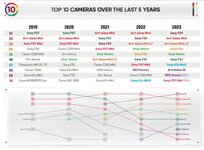
https://www.televisual.com/news/the-top-10-rental-cameras-full-report-2/

Rental cameras.JPGfs7 hire.JPG
 
Last edited:
Hi Chris,
Thanks for taking the time to help me. We are of the same mind, dude, the FS7 was my first thought, you can get them for a thousand. The problem is that they use a discontinued data card which was only made at that time, to buy it now is like $500 a card, and a guy who bought 2 this year said they didn't even work. It's a shame but I'm glad I found out before I jumped. I think the Panasonic EVA1 looks good for under $2k, and the Canon c500 mkii looks great but is still $4k used, you can get a the current fav Sony A7s iii for 2500 or so, all good choices. I settled on BlackMagic to get the 12-bit raw to get the control in DaVinci. I can get an Ursa for a thousand or so even though some still go for 3 or 4 thou, or I can rent for 300 for a week. Glass next.
Thanks again, Tom
Tom. I don't know where you got the idea that XQD cards are no longer available. The earlier series, yes, are discontinued. But Sony still have a massive user base of FS7 and FX9 users and rental houses worldwide out there, and have stated they will continue to produce them. Like with the older SxS cards, they are still producing for the EX. PMW and F5 / F55 market. And believe me, XQD cards can be cheaper these days than a lot of the CFExpress cards I'm using on the FX6.

Chris Young

BH Photovideo and in stock:

https://www.bhphotovideo.com/c/product/1433124-REG/sony_qd_g120f_120gb_qxd_memory_card.html
 
Sounds like you made the wrong choice at the time if your experiences of the FS7 brings you to such dire conclusions. Obviously all based on your experiences, but for many thousands of operators around the world, me included. I think I, and they, may have some opinions and experiences that might be diametrically opposite to yours on the pros and cons of the FS7. Even today, the FS7 is quite popular.

Chris Young

For sure the FS7 was a worthy upgradce to me EX1 FS100 and F3... (shows the 0000s Ive given to sony for half baked fails)

It is from a time. A time before AF.

A time when people were super happy not to wong $100k on a 2/3 and pro zoom lens combo

Or were they..? how many 2/3 folk stuck with 2/3 or cursed the day they were handed the sad mess that was the FS7.

Afaik a lot of pro material is still 2/3 because folk could not do the math and did not understand that 2/3 at 1.8 has similar 'cinematic DOF' as a curummo stills zoom on S35-F4. 2/3 and a fast zoom looks cool enough!

But the fs7 is miserable as it was sold as some sort of cinematic doc camera.
Soft screen pixelated punch in. Lost luts. Diver menu. Lost audio on HFR.. everthing geared to ensure the missed the shot , missed the audio or got the shot soft.

The burrito is coming close to an actual adult professiona large format doc camera as is the C400. These might outdo 2/3 and a pro xoom lens. The fs7?..no.

Pinmped with a $1500 monitor or $2000 EVF the FS7 began to work for doc. If you could get around the psspoor lens choices. Manual focus EF 24-105f4 any one? eeeugh!

Again today a 1080 monitor is £125 on amazon which is a huge help. Back then.. £1250

Today the fs7 can work as an excellent lockoff camera or as part for a crew cinema shoot (1stAc) and cinelenses. As can the F3 or F5/55

Today a mirroless camera with modern sticky AF and a crispy evf. and in body IS . is a radically better film making tool for small crews.

--

My BEEB chum just (2024) dumped his 2/3 camera and went to a A7 and Autofocus.( 24-200 lens I think) Its a big deal I think. Well he has the 2/3 cam as a backup and to hook to the sat truck but doenst choose it any moere.
 
Certainly a conversation to have with your talent, but I wouldn’t add it to the conversation with crew. Speaking as a crew member, any time I’m offered points, it makes me question the project. Just wanted to throw that out there, and I’m glad that’s something you get.
Thanks for insight, I will not mention points with crew. This is the answer to a question swirling in my head.
 
Tom. I don't know where you got the idea that XQD cards are no longer available. The earlier series, yes, are discontinued. But Sony still have a massive user base of FS7 and FX9 users and rental houses worldwide out there, and have stated they will continue to produce them. Like with the older SxS cards, they are still producing for the EX. PMW and F5 / F55 market. And believe me, XQD cards can be cheaper these days than a lot of the CFExpress cards I'm using on the FX6.

Chris Young

BH Photovideo and in stock:

https://www.bhphotovideo.com/c/product/1433124-REG/sony_qd_g120f_120gb_qxd_memory_card.html
Hi Chris,
wow! Thanks for that insight. sometimes someone posts on reddit or YouTube and really doesn't know their stuff. I was thinking AQD was the only card. If FS7 uses same card as FX9, it must be supported. That's great info, I made my conclusion based on a wrong info. Just a newbie in this field myself, that's why I'm so thankful to be able to get pro input on this forum, without it I'm making newbie errors.
Thanks again, Tom
 
Sounds like you made the wrong choice at the time if your experiences of the FS7 brings you to such dire conclusions. Obviously all based on your experiences, but for many thousands of operators around the world, me included. I think I, and they, may have some opinions and experiences that might be diametrically opposite to yours on the pros and cons of the FS7. Even today, the FS7 is quite popular.

Chris Young

https://www.televisual.com/news/the-top-10-rental-cameras-full-report-2/

View attachment 5712303View attachment 5712304
Hi Chris,
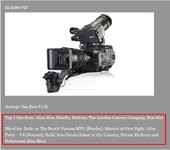
This is great info, even if the top 10 varies for other areas or apps, it is wonderful to know that the FS7 and FS7 mkii are so widely used in the last five years because the FS7 MKii is so reasonable used or for rental. Also checked XQD cards and you are right on that point, too. Sony will continue support and they are not outrageous price. As a newbie, trying to chart a course is very difficult in any area, so I want to know what pros are doing, they are doing the job I need to get done.
Thanks again, Tom
 
For sure the FS7 was a worthy upgradce to me EX1 FS100 and F3... (shows the 0000s Ive given to sony for half baked fails)

It is from a time. A time before AF.

A time when people were super happy not to wong $100k on a 2/3 and pro zoom lens combo

Or were they..? how many 2/3 folk stuck with 2/3 or cursed the day they were handed the sad mess that was the FS7.

Afaik a lot of pro material is still 2/3 because folk could not do the math and did not understand that 2/3 at 1.8 has similar 'cinematic DOF' as a curummo stills zoom on S35-F4. 2/3 and a fast zoom looks cool enough!

But the fs7 is miserable as it was sold as some sort of cinematic doc camera.
Soft screen pixelated punch in. Lost luts. Diver menu. Lost audio on HFR.. everthing geared to ensure the missed the shot , missed the audio or got the shot soft.

The burrito is coming close to an actual adult professiona large format doc camera as is the C400. These might outdo 2/3 and a pro xoom lens. The fs7?..no.

Pinmped with a $1500 monitor or $2000 EVF the FS7 began to work for doc. If you could get around the psspoor lens choices. Manual focus EF 24-105f4 any one? eeeugh!

Again today a 1080 monitor is £125 on amazon which is a huge help. Back then.. £1250

Today the fs7 can work as an excellent lockoff camera or as part for a crew cinema shoot (1stAc) and cinelenses. As can the F3 or F5/55

Today a mirroless camera with modern sticky AF and a crispy evf. and in body IS . is a radically better film making tool for small crews.

--

My BEEB chum just (2024) dumped his 2/3 camera and went to a A7 and Autofocus.( 24-200 lens I think) Its a big deal I think. Well he has the 2/3 cam as a backup and to hook to the sat truck but doenst choose it any moere.
Hi Morgan,
Thanks so much for taking the time to write such a thorough explanation, then even I can understand, well...most of it. But it helps me a lot.

I can see the value of BM 12-bit RAW for keying a greenscreen shoot, but that is a task of skill. After I see the expertise displayed in this forum, as Alex said, I think I will be better served to get the best DP I can who likes my project and go with their advice. That's the value to me shown here- I didn't even think that route was possible for me. Even though I'm a quick study, in any endeavor there is no substitute for years of experience. It's the difference between "What am I looking at?" and "here's what you do".

This shooting is like interviews on greenscreen, head and hands movement, maybe a step or two at most. Do you think the 12-bit RAW is needed for green screen keying problems? I live in post, so keying can be daunting, each character has a white robe and hood because it made keying easy, no loose hairs. With 12-bit, maybe I can more easily do a 2nd or 3rd key zooming in on a pesky blended color. Maybe it can be done without 12-bit RAW.

Several have given me advice here coming from their own experience, there is no substitute for this, but my main question for you now that I see your field expertise is: if you were going to shoot this type of scene, would you still use your R6 and 24-70 or another route? Would you use a newer, full frame, mirrorless, AF or older cam with fancier options?

Continuing thanks, Tom
 
Rember it is cheap used.. cos no one wants it.

As it happen for a static greenscreen shoot it could be a winner!
I guess we are on the same page, you answered the question i just asked, but you did it 9 minutes before I asked it. Now, that's a pretty good skill, Morgan!
 
In practical terms, without getting into the weeds of physics, smaller sensors will yield a deeper depth of field at a given focal length than full frame, as Doug mentioned. Wider focal lengths will yield a deeper depth of field than telephoto focal lengths. Closing down the iris will yield a deeper depth of field. You can combine these techniques to find the sweet spot for your project.

When you're shooting green screen, you need a deep depth of field to ensure that an actor's ears don't fall out of focus, making it difficult to get a clean key. A deep depth of field is particularly important in your case, where there's multiple actors on stage at different distances.

You want to shoot at your camera's native gain/ISO to keep the noise floor low, otherwise you'll have a very difficult time trying to pull a clean key out of noisy footage.

Motion blur doesn't key well, so you can shoot at a higher than normal shutter speed, and apply simulated motion blur in compositing.

You need to select bright enough lights for your desired ISO/gain, aperture, shutter speed, and factor in fall off due to diffusion/modifiers and the inverse square law.

There are marketing lies that can lead you astray when selecting lights: inaccurate TLCI rating, inaccurate kelvin rating, inflating the lux output by rating it off a hot spot from a poorly designed reflector dish, inflating the lux output of bi-color lights by rating them with both the tungsten & daylight LEDs on, etc. You have to do your research to confirm that the specs sheet and marketing claims are true.

Davinci Resolve's Fusion page is better for compositing, although more complex.
Hi Imamacuser,
Thanks so much taking the time to provide filming advice, all of this makes sense, I am taking notes and will apply.

You basically answered a question sitting in my mind: practically speaking, what are the considerations to make this shoot work best.

I wasn't aware of these issues with lights, which is my next study after the camera.

I will study the Fusion page in DaVinci.

I really like the way to approach an issue: watch for this and this and this.
Thanks again, Tom
 
Several have given me advice here coming from their own experience, there is no substitute for this, but my main question for you now that I see your field expertise is: if you were going to shoot this type of scene, would you still use your R6 and 24-70 or another route? Would you use a newer, full frame, mirrorless, AF or older cam with fancier options?

Continuing thanks, Tom
I think I mentioned my lack of expertise in greenscreen shooting.

Certainly a 12bit file will be good. Probably an old 'cinema' camera .. the king being the sony F55 with global shutter.

The FS7 is a little thin on the codec, Black magics are good.

The r6 has jello. Its not a camera I would choose for a greenscreen job and the codec is not strong also the miicro hdmi is not good on a 'set'
Thanks, Morgan, just the insight I needed. Tom
 
Tom, you might need to do some light noise reduction if you shoot RAW, as it bypasses in-camera noise reduction, and noise reduction that's a biproduct of compression.
 
Hi Chris,
wow! Thanks for that insight. sometimes someone posts on reddit or YouTube and really doesn't know their stuff. I was thinking AQD was the only card. If FS7 uses same card as FX9, it must be supported. That's great info, I made my conclusion based on a wrong info. Just a newbie in this field myself, that's why I'm so thankful to be able to get pro input on this forum, without it I'm making newbie errors.
Thanks again, Tom
Tom, look. Everybody has an opinion on what camera is best. That's a load of old horse s**t. You know what they say about opinions? They are like a rear piece of your anatomy. Everyone has one.

There is no perfect camera, as production needs can be totally different from production to production. Some people love the FS7 and some hate it. On today's used market, they offer great value at the low $$$s you can pick one up for. You will as a matter of course have to evaluate your situation, shooting requirements and budget to come to a suitable conclusion, hopefully a successful one. As a doco camera, the FS7 camera is a very capable piece of kit that can shoot everything from green screen to sports, entertainment, news, corporates etc. etc. It's only a tool. I know, I've shot all of the above for various broadcasters around the world on FS7s. In the end it's your story telling ability and your skill in the depiction of your ideas that will define the lack of or success of anything you produce.

An interesting aside. A few years ago, when working in Europe, on a free night the whole crew went to see, because it sounded interesting, "Magnetic", in the cinema in 4K. It looked amazing, and I'm pretty jaded with images, having worked with them for decades. It takes a bit for me to say "wow!", and on seeing Magnetic, I was pretty amazed. The cinema was using Sony's CineAlta 4K projectors. If you know anything about Thierry Donard and his Nuit de la Glisse series of international award-winning documentaries you will know he and one of his cameramen, Simon Favier are extreme filmmakers. Filmmakers who push the boundaries of film making. Extreme boundaries that can put equipment under a lot of duress. So don't let anyone tell you the FS7 is no good for docos. And don't forget. Millions of feet of film and video have been shot very successfully before modern AF technology. I have nothing against AF. I use it a lot on both my FX6 and A7... and even on the FS7, which with the latest AF lenses, works surprisingly well.

Interestingly, I found out later that the bulk of Magnetic was shot on the FS7 and FS5's. Two of the lenses they used a lot were the now ancient 28-135 mm zoom and the tiny, cheap 10-18 mm zoom. Both lenses a lot of people love to beat down on. To see the results from the FS7 camera and those two el cheapo mass-produced lenses projected onto one of Paris' largest cinema screens in 4K was quite outstanding. I would never have believed it unless I had seen the projected quality myself. Magnetic was shot in S-LOG3, not RAW.

It's because they chose the FS7 that Sony ended up supplying them with three kits to shoot Magnetic. Why did they choose the FS7? If you want to find out, watch from around 33 minutes onward in "Filming under pressure with Nuit de la Glisse" and you will hear the reasons as to why they went with the FS7. Plus a whole host of other interesting reasons and points about the production as a whole. And the FS7 was a few years old when they chose it.

All that camera capability is now available for $1k to $2k. We live in amazing times. The rest is up to you.

Chris Young
Magnetic trailer.

Filming under pressure with Nuit de la Glisse
 
Chris im not mystically 'knocking' the fs7.

It seems you cannot read through my possibly rambling posts :)

Im saying that in 2024 for cheap solo doc shooting it may not be the best tool to choose. Other spends of the same dollar may deliver more.

Im saying the FS7 was to some extent mis-sold. As doco 'gold' - nah it was more of a fiddle.

As with hundreds of other mid level shooters it was the best camera at the time and im pleased to have and to own it. I was not too pleased to add £1500 of smallHD and other 'upgrades' to make it 'functional'

I think you cannot argue with my notes.
-the monitor in punch in mode is pixelated.
-luts are lost on playback or HFR
-the is no tool for evaluating RGB levels in your scene.
-pre roll is 'forgotten' when you exit HFR
-there is no journey from HD HFR to 4k without a huge menu dig.
-there is no audio recorded in HFR.

You cant argue with them because they are true.

Are they important? For solo doc shooting Id suggest so. For shooting narrative on a greenscreen Id suggest not.

Hense my suggestion that this could be a good budget tool for our OPs project.


----
As it happens in an era when one can buy the canon R7 for $1500 (and probably a better sony) Id also suggest folk may be ill advised to buy. anything off the dream list from the past without good knowledge and reason.
F35, F23, Red One, Alexa heavy FS700, C500i, C300, Super 16 film camera, Super35 film camera etc.
 
Last edited:
In regards to shooting on green/blue screens, some notes from my experiences.

Because some cameras force a tradeoff of resolution against codec, I've talked to compositors about which is more important to their workflow. The majority have said they'd take the resolution first. So I've delivered plenty of 4:2:2 greenscreen footage at 4K or more without any complaints. Although given the option, I'd obviously deliver 444.

A fully uniform green/blue screen is nice to provide, but hardly critical as it once was. Comp software is remarkably forgiving now. Even the crazy cheap Blackmagic ATEM Mini switchers have a robust enough keyer built into them to pull live keys from backgrounds with a fair amount of variation. However there are things that complicate keying in post significantly. Haze or atmosphere is one. Better to shoot clean and recreate that later (or shoot a smoke pass live, generally preferred against black). I've also seen the challenges of keying out of focus elements in the frame, where the green blends with the edge of the object or person. If one is able to separate elements into depth planes and shoot them separately with every element in focus, it's much easier in post to build the comp first and then blur the various subjects as desired to recreate the desired depth of field for a given shot.

Spill was mentioned earlier--having as much distance as possible from backing to talent is ideal. If the lighting is low-key, it's that much more critical. For particularly dark lighting style, I'll often bring in large solids behind and to the sides of the subject right to the edge of the frame to minimize spill (with a green/blue screen that continued on significantly to the sides).

What has really helped me in recent years to achieve the correct look is to work with live comps on set. As I mentioned above, the Blackmagic switchers all have a workable keyer and can be had for so little now, it is so much easier and more enjoyable. I helped out a group of young filmmakers who were also doing a fan-fiction style greenscreen shoot earlier this year, I came in with my cart and pulled live keys with their supplied backgrounds. They'd done a bunch of these shoots but never had that capability before, and were totally blown away with the experience. It's more gear to wrangle of course (switcher and laptop, and a bit of attention on the day to coordinate the background files) but it might be worth looking into to improve your experience.
 
For sure the FS7 was a worthy upgradce to me EX1 FS100 and F3... (shows the 0000s Ive given to sony for half baked fails)

It is from a time. A time before AF.

A time when people were super happy not to wong $100k on a 2/3 and pro zoom lens combo

Or were they..? how many 2/3 folk stuck with 2/3 or cursed the day they were handed the sad mess that was the FS7.

Afaik a lot of pro material is still 2/3 because folk could not do the math and did not understand that 2/3 at 1.8 has similar 'cinematic DOF' as a curummo stills zoom on S35-F4. 2/3 and a fast zoom looks cool enough!

But the fs7 is miserable as it was sold as some sort of cinematic doc camera.
Soft screen pixelated punch in. Lost luts. Diver menu. Lost audio on HFR.. everthing geared to ensure the missed the shot , missed the audio or got the shot soft.

The burrito is coming close to an actual adult professiona large format doc camera as is the C400. These might outdo 2/3 and a pro xoom lens. The fs7?..no.

Pinmped with a $1500 monitor or $2000 EVF the FS7 began to work for doc. If you could get around the psspoor lens choices. Manual focus EF 24-105f4 any one? eeeugh!

Again today a 1080 monitor is £125 on amazon which is a huge help. Back then.. £1250

Today the fs7 can work as an excellent lockoff camera or as part for a crew cinema shoot (1stAc) and cinelenses. As can the F3 or F5/55

Today a mirroless camera with modern sticky AF and a crispy evf. and in body IS . is a radically better film making tool for small crews.

--

My BEEB chum just (2024) dumped his 2/3 camera and went to a A7 and Autofocus.( 24-200 lens I think) Its a big deal I think. Well he has the 2/3 cam as a backup and to hook to the sat truck but doenst choose it any moere.
My .02, the Fs7 was a toy and the stock VF was hot garbage that was only half-way useable if absolutely nothing or no one was moving.

I’m actually doing more work with my 2/3” ENG cams now, than I have in years.
 
Back
Top