Gimbal project 2024!

rob norton

Veteran
I recently bought a DJI ronin 4s pro. I put together a custom rig that allows me to go from dana dolly to compact jib via dovetail on tripod head. This set up has been great - previously operating a tripod head while sliding was not an option and operating while the camera changed height on a jib was absolutely not an option. I know it can be done but not with any of the fluid heads I ever have access to.

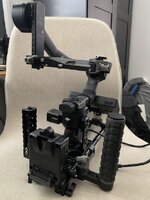
This post however, is about a handheld gimbal set up. The same rig described above (will share photos soon) lets me hold everything in my hands easily enough. I also have the tilta advanced ring, which works as intended. These are both fine for short takes but still somewhat limiting in terms of range of motion. For gimbal rigs, I am really not a fan of ready rig or easyrig. They definitely have their place for eliminating or decreasing fatigue, but it's such a shame that with so much equipment involved, you're still so limited with camera placement. Readyrig can be put in a range of positions in between shots, rather than making large changes in height during a shot. Same with panning, where you're either front on, or you adjust the rig to side on, with no real option to transition between the two during the shot. The easyrig allows for pretty free flowing pans, but you quickly hit height restrictions.

All this to say I'm sold on the steadicam/arri trinity/tilta float set up for handheld gimbal operating and this is where I need help.

I'm looking to put something together somewhere in between the tilta float ($1,300) and arri trinity ($70k). I'm thinking off the shelf steadicam parts but also DIY. I'll share the design here as things unfold.

I think after sorting out a vest/arm, the rest won't be too difficult to figure out. We can review this statement in a few months.

Initial questions:

- For steadicam payloads, I believe this is in reference to the camera package, not the sled or counterweights/monitor you add to the cross bar, is this right?
- I'm guessing you also need to check total weight is within the vest/arm limit? Except I assume the counterweight required for a camera package at the payload capacity can only be so much (anymore and rig won't be balanced), so if you balance a camera within the stated payload, it's probably within the total payload limit for the arm/vest?

- Can I buy pieces off the shelf like Steadicam arm/vest/gimbal/gimbal handle, then add a metal pipe inside the gimbal? Either with the ability to telescope/change length or fixed. I won't be operating for other people, so in theory could balance for a single set up, find out where to attach the (steadicam) gimbal, then commit to that position.

DJI Ronin 4s pro weighs 1.2kg with a 4.5kg capacity - 5.7kg/12.5lbs. The custom build probably takes everything to the 8kg/17.6lb range. I haven't weighed all the bits and pieces, this is just a guess. But if we say 17.6lbs, does this make the A-30 arm with A-30/Zephyr vest the most appropriate to look for?

Basically since I hope to mount the monitor to the (steadicam) gimbal handle, I'm wondering if it's possible to save $$ buying hardware that doesn't include power/SDI connections, possibly excludes length adjustments, as well as other pieces that a steadicam rig would require but wouldn't be needed for this project. But these pieces may not exist.

Thanks for reading, let's keep it fun and safe. I'm bracing for a reality check from Charles but am not ready to give up on the dream just yet!
 
Last edited:
In on location. Worse typing than usial

Diy trinity is my long project.

A30 stradivam arm and vest off shelf.

Commissioned cimbal.
Commissioed vlock holder

(Commissioned - laser cut to my drawings)

1 inch pipe for spar.

Vlox for bottom mass


Read and under stand.You need the camera to be level when the spar is at 45 degrees - or you need a second “head” operator

Acheiving this maybe physical or software.

The software does not exist on my movi

And that is my current dead end for solo operated solution.

Min will work eith a second op sometime in future
 
Steadicam arm can be a problem through doors. Width

Ready rig probem through doors. Height.

Pick your devil.

I went woth steadicam because i can hard miunt the arm on my rickshaw/van
 
Last edited:
- For steadicam payloads, I believe this is in reference to the camera package, not the sled or counterweights/monitor you add to the cross bar, is this right?
- I'm guessing you also need to check total weight is within the vest/arm limit? Except I assume the counterweight required for a camera package at the payload capacity can only be so much (anymore and rig won't be balanced), so if you balance a camera within the stated payload, it's probably within the total payload limit for the arm/vest?
Payload is indeed measured as what goes on the top stage of the Steadicam. And unless you have some particularly oddball rig, the weight of the lower sled will be accomodated within the total payload that goes on the arm. For instance, the Steadicam Aero 30 has a 20 lbs payload and the arm can lift 30 lbs.

- Can I buy pieces off the shelf like Steadicam arm/vest/gimbal/gimbal handle, then add a metal pipe inside the gimbal? Either with the ability to telescope/change length or fixed. I won't be operating for other people, so in theory could balance for a single set up, find out where to attach the (steadicam) gimbal, then commit to that position.
Yes, all the parts can be purchased separately either new or used, and given the state of the industry I would well believe great deals could be had at present.

DJI Ronin 4s pro weighs 1.2kg with a 4.5kg capacity - 5.7kg/12.5lbs. The custom build probably takes everything to the 8kg/17.6lb range. I haven't weighed all the bits and pieces, this is just a guess. But if we say 17.6lbs, does this make the A-30 arm with A-30/Zephyr vest the most appropriate to look for?
I think the A30 would be a fine choice in terms of payload and performance.

Basically since I hope to mount the monitor to the (steadicam) gimbal handle, I'm wondering if it's possible to save $$ buying hardware that doesn't include power/SDI connections, possibly excludes length adjustments, as well as other pieces that a steadicam rig would require but wouldn't be needed for this project. But these pieces may not exist.
Not quite sure what this is specifically referring to. If the idea of mounting the monitor on the handle is so you can invert the system during a shot Trinity-style, you've got some complications in terms of cabling (how is it routed so it won't catch on parts of the rig etc). With that weight of rig you'll need some form of counterweight at the bottom of the rig--presumably you can power the 4D off a battery on the base of the sled.

I've never flown a gimbal on a Steadicam myself so I won't pretend to be an expert of any kind on it. I do have one thought about this setup though. The point of the 4D as I understand it is that it stabilizes the Z axis (up/down) which is missing in most (all?) other gimbals. However, the Steadicam arm also does this. So it doesn't really seem like an ideal combo vs a different type of gimbal that wouldn't have some of the restrictions of the 4D (like limited lens options). But it sounds like you already have the 4D so, that's the gimbal you have.
 
Chsrles.
My current rickahaw build will be the osmo 4d on the a30 arm.

The 4d is heavy to handhold. It seems to pair well with the a30 arm and the double z axis seems great.

Before they called me they were hard mounting the 4d on a bike rack and broke it - clearly the boom range on the 4d cannot accommodate potholes
 
But once one has a steadocacm arm one wonders if the 4d is needed.

All tests practice amd the bigger picture… being what other shots you need to acheive with the same camera
 
Thanks Charles!

All valid concerns. I actually have the Ronin 4s Pro (DJI product names not for the win).

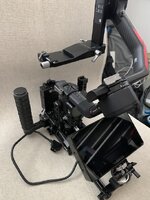
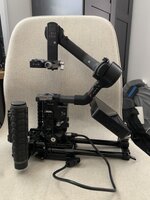
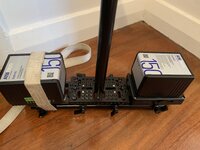
My in the hands/slider/jib set up, funnily enough, looks similar to the 4D. It's just a tilta power base, which replaces the handle-battery you see in most mirrorless gimbal rigs, which lets you power the gimbal from any battery with d-tap. Underneath the power base is a traditional camera baseplate with rods, where I attach battery plate, small monitor, mini tx and 2x handles.

No idea if this will work but I made the images spoilers, still don't think non-members should be able to see images. EDIT: when signed out, you can still click to reveal the spoilers! Will keep thinking of ways to beat the system.

I'm still playing around with what goes where. Balance isn't really a big deal since it's on a dovetail, but for easier balance, the battery plate can be at the front. Not pictured is the mini tx. If it's in my hands the monitor is required, but for slider/jib, I use a separate monitor, but have still been using the small monitor to avoid mounting the tx to the camera. It's not a big deal adding the transmitter to the camera, but easier not to, plus I'd rather the 5" monitor take the hit with any cable strain, vs. the poor little mini tx.

Spoiler: images

IMG_5878.jpg IMG_5880.jpg
img_5879-jpg.5712163


Yes, ideally I could operate like a trinity in trident mode or easily changing height. Moving back to the project I described, from the above set up, I'd likely lose the handles and run a small battery if needed. Even a handful of 45Wh batteries would be worth it if this all works. For the steadicam gimbal handle mount, my plan is to do this all wirelessly, so it'd be coming up with a way to rig mini rx, 5" and small battery. Do you think a handle-mounted 5" wireless is too ambitious?

The right hand grip on the tilta advanced ring grip lets you control roll, pan and tilt, as well as resetting to neutral position. After removing from the ring grip, it's free to position anywhere you like. In some of the trinity videos I've seen their own joystick equivalent fairly close to the monitor. There's space for a battery inside the grip, so in theory this could go anywhere. This is the plan so far, with counterweight on a cross bar looking like they'd be actual weights, since the monitor has been moved up, plus everything being powered at the camera package. Or alternatively I still add a one or more battery plates to act as storage for more batteries.

Another question is with the gimbal effectively acting as an in-built riser, does this just mean more counterweight vs. if balancing a camera mounted to the top stage?
 

Attachments

  • IMG_5879.jpg
    IMG_5879.jpg
    604.8 KB · Views: 21
Don't know why I read 4D instead of 4S! Ugh. My poor brain.

The Trinity builds I've seen are quite long, I think to maximize the range of lens heights. In your case that would also serve to manage your counterbalance concerns, instead of adding weight you can have a longer post. Knowing now that you have a gimbal that can take a variety of cameras, I think you'd be better off with a telescoping post than a fixed one so you can trim for a given payload.

As you said the Tilta base accepts external power. I know I'm coming at this from a particular perspective but I have always believed that a functional battery is better than a battery being used as ballast/storage, and certainly better than "dumb" weights. And especially, powering everything off one battery is far better than multiple batteries around a rig that you have to keep track of. The latter is something that I've proselytized for decades here and elsewhere. The idea of having a battery for the camera, another one for the monitor, a little USB one for an accessory--completely bonkers to me. You lose picture during a setup and have to figure out which of the batteries is the one that went down, and/or have to constantly check charge level over multiple batteries to avoid such a thing. What I saw a lot of people do to combat that was to go to larger multiple batteries. My DSLR rigs had a gold mount battery on the back and voltage conversion for the given components (before you could buy a tidy plate with regulated voltage ports on Amazon for a song) which avoided ALL of that (and helped with elusive fore-aft balance too). All this to say that I think you should be using a battery at the bottom of the rig that powers everything above it! This will reduce your carry weight, as you are removing batteries from the top which means less counterweight needed at the bottom, and simplify keeping track of charge level. Even if you end up using an aluminum tube for your center post, it's still not hard to run a cable through it to pass power up to the top. Personally, I think the difference in price between an A30 vest and arm and a complete A30 is reasonable enough that you are better off just getting the complete package and not having to design and fabricate all the intermediate components (and hey, you also will have a complete functional Steadicam at that point, which who knows, you might find speaks you for certain projects more than the gimbal version!)
 
The guy in this video swapped out the springs in his Merlin arm to fly a 25lb rig, he must like to live dangerously. I suppose he's fine, as long as the bearings and pins can hold the weight.

 
All this to say that I think you should be using a battery at the bottom of the rig that powers everything above it! This will reduce your carry weight, as you are removing batteries from the top which means less counterweight needed at the bottom, and simplify keeping track of charge level. Even if you end up using an aluminum tube for your center post, it's still not hard to run a cable through it to pass power up to the top. Personally, I think the difference in price between an A30 vest and arm and a complete A30 is reasonable enough that you are better off just getting the complete package and not having to design and fabricate all the intermediate components (and hey, you also will have a complete functional Steadicam at that point, which who knows, you might find speaks you for certain projects more than the gimbal version!)

If using a complete Aero 30 system, does a battery on a battery plate mounted to the cross bar provide power to the d-tap on the stage? Is there an internal cable inside the post?

So the counterweight battery could provide power to the camera package, then the same battery could power the monitor, it'd just need its own cable run, but better than an extra battery at the monitor.

The full Aero 30 would definitely be a great excuse to try out traditional steadicam operating. For the record, I still love the steadicam and handheld look. Re gimbals, I think I'll be much more excited if I increase the area of operating range in every single direction.
 
If using a complete Aero 30 system, does a battery on a battery plate mounted to the cross bar provide power to the d-tap on the stage? Is there an internal cable inside the post?
Affirmative! All of the Steadicam models have power and video that runs through the post.
So the counterweight battery could provide power to the camera package, then the same battery could power the monitor, it'd just need its own cable run, but better than an extra battery at the monitor.
Music to my ears!
 
The guy in this video swapped out the springs in his Merlin arm to fly a 25lb rig, he must like to live dangerously. I suppose he's fine, as long as the bearings and pins can hold the weight.

That's horrifying. Of course the arm is overbuilt to a degree, but in no way is it meant to carry more than 3x its intended payload. He's asking for trouble.
 
Affirmative! All of the Steadicam models have power and video that runs through the post.

Before actually looking at the manual, I was wondering how an internal cable would make a 90 degree turn from cross rod (no longer calling it cross bar after reading the manual), to the post, but of course it's just a separate cable from battery plate to base of the post, then an internal cable inside the post to the stage.

I've got a devin graham glidecam that I've never used, which I'm using as a proof of concept to at least test ballpark balancing. There are fairly cheap X-10 (for glidecam 4000 or devin graham glidecam) vest/arms on ebay. Let it be known, I am only dabbling with glidecam gear as proof of concept testing before heading to the steadicam, I'm under no impression that glidecam is better!

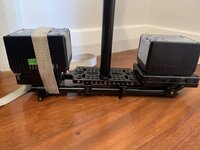
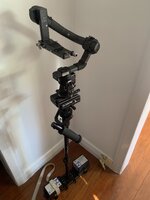
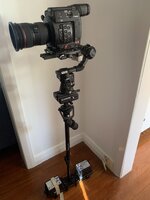
Below is the current progress. Makeshift baseplate for the batteries, the strap is there because I've only got one gold plate, the other v-mount. The strap is just mimicking a hard mount. I got rid of the camera baseplate now that it's not needed to hold accessories. Photos below have glidecam plate mounted directly to the power base.

I guess next steps are to properly balance the rig. As a bonus I'll see if I can shoot something, except it's pretty heavy without a vest/arm.

Have you seen the trinity pendulum? I'd like to know how much it's doing but knowing Arri, they obviously think it's quite important.

IMG_6116.jpg IMG_6117.jpg

IMG_6118.jpg IMG_6119.jpg
 
that's looking fun! I'm not familiar with the power base but I assume that is as low-profile as you can make it (i.e. distance from lens to the Glidecam gimbal is as short as possible? If you were to extend the post longer, could you balance it with only one battery vs two? It's a lot of extra weight to carry. I'd be happier seeing you with one battery under the post, or two 98wh batteries fore and aft.

The pendulum is a clever way to keep the system always a little bottom heavy, so that it seeks level. When the camera is on top, the pendulum hangs downwards which pulls the center of gravity of the base of sled lower. And then when the rig is inverted, the pendulum remains downwards which effectively shifts that mass towards the camera, maintaining the bottom-heaviness, so the rig continues to behave the same. Without that, it is most logical to neutrally balance the system top to bottom, but this will mean that it will have a tendency to wander and become off-level. That won't affect the shot directly, since the Ronin will correct for it, but you may find yourself with the rig positioned at a weird angle unintentionally.
 
Rob - this is intriguing and I'm trying to follow along... but now not sure I do with the Glidecam photos. (I had a friend / colleague who bought that glide cam back in the HVX200 days - and was always amazed how heavy that light. small camera became without a vest when trying to operate it).

I guess if you care to explain - what's your end goal - or maybe better put what kind of shoot or type of shot would you be most likely to attempt with the gimbal / steadi combo? (ie - how will you operate both the joystick of the gimbal - while maneuvering the post / gimbal on the steadicam??) Maybe I've missed something in your description?

For reference, I own the Steadicam Pilot. It's great for mirrorless cam weight - say up to about 8 lbs or so. I also own the DJI Ronin SC gimbal... but I'm not sure what combining the two might possibly give me an advantage on - unless I had a 2nd person operating just the pan/tilt etc of the gimbal?
Also -fyi- I do not market myself as an "operator". :)
 
that's looking fun! I'm not familiar with the power base but I assume that is as low-profile as you can make it (i.e. distance from lens to the Glidecam gimbal is as short as possible? If you were to extend the post longer, could you balance it with only one battery vs two? It's a lot of extra weight to carry. I'd be happier seeing you with one battery under the post, or two 98wh batteries fore and aft.
Yes, as short a distance as possible. The power base is pretty low profile, it's the base of the gimbal with screen/control interface that adds height. A single battery wasn't enough, I imagine a pair of 98wh batteries would be a nice sweet spot.

The pendulum is a clever way to keep the system always a little bottom heavy, so that it seeks level. When the camera is on top, the pendulum hangs downwards which pulls the center of gravity of the base of sled lower. And then when the rig is inverted, the pendulum remains downwards which effectively shifts that mass towards the camera, maintaining the bottom-heaviness, so the rig continues to behave the same. Without that, it is most logical to neutrally balance the system top to bottom, but this will mean that it will have a tendency to wander and become off-level. That won't affect the shot directly, since the Ronin will correct for it, but you may find yourself with the rig positioned at a weird angle unintentionally.
Very cool, it should be easy enough sourcing some type of pendulum, but that's jumping the gun.
I guess if you care to explain - what's your end goal - or maybe better put what kind of shoot or type of shot would you be most likely to attempt with the gimbal / steadi combo? (ie - how will you operate both the joystick of the gimbal - while maneuvering the post / gimbal on the steadicam??) Maybe I've missed something in your description?
Basically I'm figuring out how to get the most of out using a gimbal. It's more than just finding a rig that makes things bearable for longer takes. Changes in height during a shot and option for horizontal spear mode are huge.

Other requirements would be ending up with something I feel comfortable with. Bestboy adam is great, but some of his projects are too much hack job for me.


Here's something I shot while holding the tilta ring in my hands, no other rig (EPILEPSY WARNING)
password DVX2024

Only 1.5-3 seconds of the shot was actually used, but it's cool providing a handful of different shots from a single 50 foot walk. The rig was fine in that scenario, but still not as precise as I'd like. This is just one quick example of how I'd use it.

With steadicam being the leader for type of rig, it's time for experimentation and reality checks!

I don't know yet how realistic operating a la trinity is with what I'll have access to. Maybe even the DJI joystick not being good enough will be the biggest hurdle. Even with this ability removed, the gimbal doing most of the work would still be fine with me. If only having a reset button (double tapping to reset gimbal), that'd still be nice. Re controlling post/gimbal at the same time, it'd be the same philosophy as a trinity operator:

For reference, I own the Steadicam Pilot. It's great for mirrorless cam weight - say up to about 8 lbs or so. I also own the DJI Ronin SC gimbal... but I'm not sure what combining the two might possibly give me an advantage on - unless I had a 2nd person operating just the pan/tilt etc of the gimbal?
Other than what's mentioned above, I think it's pretty much:
- panning at your fingertips vs. flexing/extending your wrists.
- steadicam arm should provide further stabilization. I wouldn't call the rs4 pro extremely smooth, steadicam arm should be one step closer to what the gimbal is supposed to do in the first place.
 
Last edited:
Here's something I shot while holding the tilta ring in my hands, no other rig (EPILEPSY WARNING)
password DVX2024

Only 1.5-3 seconds of the shot was actually used, but it's cool providing a handful of different shots from a single 50 foot walk. The rig was fine in that scenario, but still not as precise as I'd like. This is just one quick example of how I'd use it.
Got it. And yes. The slow-mo there certainly helps with any bumps, etc. from footsteps - looks good.

Other than what's mentioned above, I think it's pretty much:
- panning at your fingertips vs. flexing/extending your wrists.
- steadicam arm should provide further stabilization. I wouldn't call the rs4 pro extremely smooth, steadicam arm should be one step closer to what the gimbal is supposed to do in the first place.
Cool. And thanks for the explanation and for posting. I'm interested to see how things turn out... so will continue to look forward to progress reports.
I played around very briefly, when I first got the gimbal, with attaching my SC gimbal to my pilot - but then just never found a "use case" for most of the work I do. That probably says more about my work - than specifically that combo. I'm either getting short shots with the gimbal handheld. Or for longer walking / following shots, then maybe the Pilot gets used... in either case it's the A7sIII that is current camera of choice.
Good luck & cheers!
 
FYI, one thing that often mars the results of shots done with Trinity and similar rigs is the lack of appropriate response in tilt. Various Steadicam operators and I have a text chain where we swap shots and marvel at the sloppiness of headroom adjustment. Joysticks really don't have a place in this type of operation. The best results are certainly done where a separate operator is controlling pan and tilt (see the McConkey brothers work on Marvelous Miss Maisel). What makes Steadicam both so challenging to operate yet rewarding to watch is that in the right hands, the precision of control is exquisite--the ability to alter the speed of a given pan or tilt mid move (like an complex force curve) would be extraordinarily hard to recreate (if at all) with a joystick.
 
Thanks for the reference, I'll check out Marvelous Miss Maisel.

I watch any trinity owner/operator videos with a grain of salt, especially since they likely just financed equipment in the $50-$100k range and have large incentives to talk up the technology. In reality, I'm sure some people have been disappointed finding out two crew members are required when they maybe thought the solo trinity op could do everything.

I love the Steadicam brand, look and technology. I'm just not sure about spending time getting "good" while not being a career operator. Vs. the gimbal, despite likely inferior results, is somewhat plug and play, sort of like the state of the industry - things are worse but more convenient.

Except it'd be great to prove my theory wrong and the complete A-30 idea is fantastic - options to explore both and I might catch the steadicam bug.
 
Back
Top