Writer's Guild Going on Strike

I've always considered unions in the film industry to be more gate keeping institutions than anything else. The desire to be a writer/actor/director/cinematographer/G&E is much higher than the actual demand from the studios, so part of the way that unions keep pay high is keeping down the supply of labor for those jobs. Don't let people in until they've "proven" themselves. How many other unions work that way?
All minimum/floor price caps keep a certain amount of potential employees off the payrolls. However, most entry level writers don't last in the industry. There's a high turnover and those with talent stick around at far above the minimum/scale.

Historically, the number of shows on the air was controlled by three networks. When Fox appeared, it both lured top talent and diluted the audience. Studios tried to produce similar programs as before but, when additionally WB and Paramount came on the scene, the talent dilution and financial constraints made too many shows unwatchable. Then game and news replaced the dramas and the sitcoms. Streaming created an illusion of limitless budgets for all artisans - from writers to actors to directors and so on - but there's a pullback during a down cycle along with price hikes for the subscriptions. And that will determine the total number of available jobs.

PS. A friend of a friend worked on Seinfeld. Of the script he wrote, he recognized a couple of lines after Larry David got done with it. And it wasn't that Larry wanted to screw the guy (the original writer got paid fully). It's just that the show runners and their top underlings are tasked with maintaining a certain level of quality.

PPS. Seinfeld, unlike the Simpsons, for example, wasn't a "writers room" show.
 
All minimum/floor price caps keep a certain amount of potential employees off the payrolls. However, most entry level writers don't last in the industry. There's a high turnover and those with talent stick around at far above the minimum/scale.

Interesting. It looks like the payscale under WGA is pretty good, at least compared to the amount of money I make as a freelancer. It is also more than most of the other unions. Of course, the writers are stuck in the same type of gig economy system as the rest of us, which seems to be the basic framing of their strike. My main question is how somebody manages to get enough points to actually join the WGA. This seems to be the major gate keeping method. We can talk about "talent", but I've always found "connections" to be more important than "talent" in this industry. Also, the concern about AI would seem to suggest that talent isn't the most important criteria.

What I find more interesting, though, is the framing of this being about the WGA fighting against the heads of the studios. Do the heads of the studios directly control the AMPTP? Do the studios themselves consist of more than just a handful of absurdly overpaid studio heads? If the WGA gets what it wants, who will actually end up losing out?
 
Also, the concern about AI would seem to suggest that talent isn't the most important criteria.

This just seems like a smart thing for them to ask for. Will they get it? Who knows.

There's a parallel movement coming from the opposite direction. Voice actors are being made to surrender to AI their voice rights (which don't even exist yet.)

Today, voice actors sitting down to record for games companies are forced to begin each session with “My name is ______ and I hereby grant irrevocable permission to train an AI with my voice and use it any way you see fit.”

Let’s be clear here: there is — at present — no firmly established copyright over voiceprints. The “right” that voice actors are signing away as a non-negotiable condition of doing their jobs for giant, powerful monopolists doesn’t even exist. When a corporation makes a worker surrender this right, they are betting that this right will be created later in the name of “artists’ rights” — and that they will then be able to harvest this right and use it to fire the artists who fought so hard for it.

https://doctorow.medium.com/the-ai-hype-bubble-is-the-new-crypto-hype-bubble-74e53028631e
 
I've seen some green shoots of AI writing dialogue in the style of narrative drama or comedy. Wherever there is algorithm/formula, there is potential for the computer to learn to reproduce it.

But it's silly to think the computer will handle the job on its own. Purely as a matter of cost-benefit analysis, the program will be far better off having humans in the mix even if AI plays a role. And there's lots of anecdotal reporting of people using AI and chatgpt as a sort of co-writer, helping them clear writer's block, etc. They ask it for story ideas about a certain topic and maybe find inspiration in something. They ask it to summarize what they've already written to try to get a better sense of what they have and where they're going.

It's not crazy to think that people will ask AI to write a scene between well-established characters where something specific happens. Then they take that as a first draft and run with the ball from there. It could give them a head start in the process.

The problem with learning Midjourney as a cinematographer is that you're probably abandoning what you actually like doing. Anyway, the industry won't be completely destroyed.

this makes a lot of sense to me.
 
From Natasha Lomas' article in ZDnet, 2011 - As long as humans have been inventing new tools and technologies, we've been worrying about what our creations might do to us.

For Greek philosopher Socrates, who lived in what was primarily an oral culture, writing was the threat to society - he argued it would "introduce forgetfulness into the soul of those who learn it".

The invention of the printing press in the 1440s kindled fears that religious teachings would be undermined by the false prophets of fake bibles.

In the 18th century, the invention of the telephone caused concerns that the eerie disembodied voices it spawned would tear apart the fabric of society by removing the need for people to meet face-to-face. Telephones would make people lazy or deaf or simply send them mad, contemporary commentators feared.

And when commercial radio and TV broadcasting came along in the 20th century, people hadn't learnt to stop worrying - now they feared this new technology would brainwash everyone."


Artificial Intelligence - This too shall pass.
 
Artificial Intelligence - This too shall pass.

Back in 1995, I would the very first issue of the Scenario magazine. It featured an Oscar winning script of the "Silence of the Lambs" by Ted Tally, "Four Weddings and a Funeral" by Richard Curtis and an unproduced screenplay by Jules Pfeiffer, which was essentially a sequel to the "Carnal Knowledge". ( guess the collector edition is available).

https://www.amazon.com/Scenario-Maga...s=books&sr=1-7

The last one is my main point. The script was good - some might say, very good - but it was never made. Because, in order to be produced, it would need Jack Nicholson and Art Garfunkel to join and neither was interested in rehashing the old characters ten years later as much as their creator and the original writer. Sequels work in novels, but not in screenplays. And so it remained.

And that's because Hollywood has control over the movie making process - from top talent to the budget and the distribution of films. But it's all about to disappear with the digital creation tools like Midjourney. At this point, all one needs is a screenplay. Everything else can be done by a visual artist somewhere in India or Estonia for next to nothing and in little or no time. It may look like a cheap version of Digman but it's capable of drawing eyeballs. A lot of eyeballs. That's the enemy not only to the WGA but to Hollywood at large. Not that people will stop going to the movies or watch crappy sitcoms made by Chuck Lorre and his ilk, but that its profits will be washed away and costs will have to be strictly contained. And what was deemed Hollywood will be no more.
 
Artificial Intelligence - This too shall pass.

Sure, humanity will survive. But we may personally be worse off. People talk on this forum all the time about how filmmaking budgets have eroded as increasingly capable technology and diminishing standards have led production to cut corners.

How much more attrition can the industry take before people like us are forced out of the industry or out of the middle class?

Hopefully, I'm just being pessimistic...

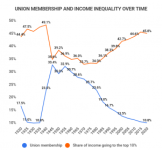
Anyway, here's a chart of union membership vs wealth going to the top 10%

union-membership-and-income-inequality-over-time.png
 
Just like YouTube democratized the creation and the delivery of content - and took a lot of eyeballs away from the "traditional sources", such as TV, radio, movie theaters, etc. - the next generation of creative technologies will accomplish it as well. The main stumbling block in the industry of moving images are their costs. The screenplay availability was never a big problem. And the costs are about to hit zero. Which will enable more and more people turn into legitimate filmmakers.

PS. What's wrong with rich people? (even if the stats are fake). Are we in the USSR?
 
What is the source of your graph Abe. That is a remarkable correlation.

That graph came from Zippia.com https://www.zippia.com/advice/union-statistics/

I've seen a wide variety of similar or related graphs cited by left-leaning economists over the years.

https://www.google.com/search?client...h=702&dpr=2.81

Or course, correlation does not imply causation. And there are contemporaneous historical forces at play (WWII, automation/off-shoring). But it shouldn't come as a surprise that the size of unions might impact class wealth distribution.

And wait until conservatives who pine for the 1950s get a load of those marginal tax rates...
 
Last edited:
Just like YouTube democratized the creation and the delivery of content - and took a lot of eyeballs away from the "traditional sources", such as TV, radio, movie theaters, etc. - the next generation of creative technologies will accomplish it as well. The main stumbling block in the industry of moving images are their costs. The screenplay availability was never a big problem. And the costs are about to hit zero. Which will enable more and more people turn into legitimate filmmakers.

PS. What's wrong with rich people? (even if the stats are fake). Are we in the USSR?

It's not clear to me that it will be easy to find an audience if so many people are able to churn out movies. So you might be left in a situation where expensive advertising still determines success.

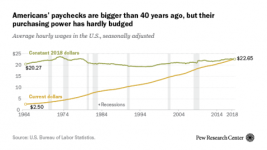
The problem with a few people getting super rich is that everyone else is working harder and staying in place.

Click image for larger version  Name:	FT_18.07.26_hourlyWage_feature.png Views:	0 Size:	88.6 KB ID:	5702344

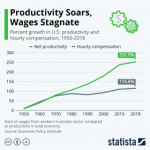
people just want to pocket some of the wealth they're creating

By the way, statistics like these are somewhat difficult to fake since all the data is publicly available; it's not clear why they would want to fake it in this direction; and we're a businesses-obsessed society that depends on good data.

It's like how Noam Chomsky says that financial journals are the most honest newspapers because if you think the US is about to win a war that it's actually about to lose, you could lose a lot of money.

Click image for larger version  Name:	HFNnYrqruqvI_-Skg2C7ZYjdcXp-6EsuSBkSyHpSbm0.png Views:	0 Size:	52.0 KB ID:	5702345
 
Last edited:
It's not clear to me that it will be easy to find an audience if so many people are able to churn out movies. So you might be left in a situation where expensive advertising still determines success.

YouTube doesn't stop Hollywood studios from coming up with the super expensive blockbusters. But stuff like Midjourney will (probably)
play even a bigger role than hybrid digital cameras because, with cameras, you still need actors, lighting, editing, etc. With Midjourney - and whoever is going to compete with it - you got everything in one place. It's obviously not going to be he same quality as the current mid-range camera footage but it won't be necessary either.

And I had a few exchanges about Chomsky on the "I disliked it the USSR" Facebook group. The ex-citizens of the motherland don't have high opinions about him.
 
If you are a good and sought after writer, you don't need the union. If you are a terrible writer, the union works for you. I have never in my career had any benefit from being in a union and I have been in two real unions and one association. I was one of thousands, unloved and the union sucked as much out of me as they could get. I left and saved the subscription. Here in the UK, membership is not compulsory for any job. If the screen writers go on strike - everybody loses, yet the standard of many productions is dire. I'm just not sure they really do any good, because if they push it, non-union talent or AI will keep the productions going. I've been self-employed since 2004 and that's when I decided quality of life was more important than money. I rarely got more for any repeat job. If I ask more, somebody else (maybe in the same union) got the job. Luckily, I remained on a lot of lists and works has been steady. People who have full time jobs with holidays, sickness benefits and pensions make me laugh - I've never had any of these.
 
YouTube doesn't stop Hollywood studios from coming up with the super expensive blockbusters. But stuff like Midjourney will (probably)
play even a bigger role than hybrid digital cameras because, with cameras, you still need actors, lighting, editing, etc. With Midjourney - and whoever is going to compete with it - you got everything in one place. It's obviously not going to be he same quality as the current mid-range camera footage but it won't be necessary either.


What I mean is that it takes 60 million or more to make a national advertising push for a film release and that puts a floor on the scale of budgets that Hollywood is willing to work on and release. There have been some notable successes for low budget films breaking through the crowd that have had guerrilla marketing campaigns where the marketing was just as much a part of the story as the movie itself, such as Blair Witch Project or paranormal activity.

Writing and directing will still be the most important elements of filmmaking and I do agree that it will be easier for the next Steven Spielberg or Stanley Kubrick to get off the ground if they can make a polished looking film without any money even if it takes them a long time to get noticed and by the same token it will be a boon to people who come from poor backgrounds who aren't able to raise the meager Capital necessary to make even a low budget film.

this discussion assumes that they'll actually be able to make photorealistic moving pictures with AI soon which certainly hasn't been proven yet but I think is more likely than not

I do think that you will see specialized and bespoke AI tools in the industry which will set apart the Productions that use them. For example you have trey Parker and Matt Stone starting up their deep voodoo AI driven special effects company, which seems like a natural foray into what the technology can currently do or will soon be able to do since special effects is already largely computer generated

I don't actually think that cheaper digital cameras or iPhones for that matter make a big impact on the fundamentals of Film Production but certainly if you could make a proper looking Hollywood film with just AI then that would

And I had a few exchanges about Chomsky on the "I disliked it the USSR" Facebook group. The ex-citizens of the motherland don't have high opinions about him.

Sounds like a bunch of single-minded partisans. Chomsky was not pro ussr. He has Choice words for imperialists everywhere. What you said about him doesn't address the his comments on American data reporting even tangentially but if you want to make an argument by Authority against him, I would counter by saying that he's literally the most commonly cited intellectual of the modern era

his 3,874 citations in the Arts and Humanities Citation Index between 1980 and 1992 make him the most cited living person in that period and the eighth most cited source overrall--just behind famed psychiatrist Sigmund Freud and just ahead of philosopher Georg Hegel.
https://news.mit.edu/1992/citation-0415
 
If you are a good and sought after writer, you don't need the union. If you are a terrible writer, the union works for you. I have never in my career had any benefit from being in a union and I have been in two real unions and one association. I was one of thousands, unloved and the union sucked as much out of me as they could get. I left and saved the subscription. Here in the UK, membership is not compulsory for any job. If the screen writers go on strike - everybody loses, yet the standard of many productions is dire. I'm just not sure they really do any good, because if they push it, non-union talent or AI will keep the productions going. I've been self-employed since 2004 and that's when I decided quality of life was more important than money. I rarely got more for any repeat job. If I ask more, somebody else (maybe in the same union) got the job. Luckily, I remained on a lot of lists and works has been steady. People who have full time jobs with holidays, sickness benefits and pensions make me laugh - I've never had any of these.

That seems to undercut the idea that the union is scamming its members because if they don't like it they can just leave. Meanwhile, membership votes on strike authorizations and they vote on their contracts. In many ways, it's a democratic Institution. I do think that unions for employees in passion Industries are probably less influential then in areas like sanitation. I've heard amazing things about the benefits and perks that sanitation workers have achieved for themselves via their Union. Anyway, I would think that there is some Middle Ground between sought after and terrible and that there are probably some people who the union serves well. But there's also issues like set safety or getting health insurance. And I read all the time about when Tech employees get laid off and they get screwed out of outstanding sick pay or bonuses that they were owed and they always say we should unionize to make sure we don't get exploited on our way out the door
 
What I mean is that it takes 60 million or more to make a national advertising push for a film release and that puts a floor on the scale of budgets that Hollywood is willing to work on and release. There have been some notable successes for low budget films breaking through the crowd that have had guerrilla marketing campaigns where the marketing was just as much a part of the story as the movie itself, such as Blair Witch Project or paranormal activity.

Writing and directing will still be the most important elements of filmmaking and I do agree that it will be easier for the next Steven Spielberg or Stanley Kubrick to get off the ground if they can make a polished looking film without any money even if it takes them a long time to get noticed and by the same token it will be a boon to people who come from poor backgrounds who aren't able to raise the meager Capital necessary to make even a low budget film.

Here's what is likely to happen. Someone will write a screenplay (or a bunch of screenplays) and make a short or full feature via Midjourney type site/software. Then s/he will place it on a streaming site - could be YouTube, should be Vimeo or Rumble - and then wait for a response. Out of hundreds of thousands made that way, some will stick out (I thought some of Eric's clips were quite good ... they also won a few prizes, I believe). Those would move onto the next tier - paid and/or curated sites - and try to be monetized on the next level. The best of the best will get signed up by studios - could be independent studios - and financed to make other films (or remake the already noted projects but with a higher quality across the board).

They won't need photo-realism, much like a show like "Digman" doesn't even remotely aspire to it. As the text-to-image technology improves and the filmmakers get better at it, it will become a part of the creative marketplace. And likely push the traditional pipelines to the curb.

NSFW language (I didn't see this before; it's a full pilot episode).

 
II have never in my career had any benefit from being in a union ….. Here in the UK, membership is not compulsory for any job.its and pensions make me laugh - I've never had any of these.


Well here in the US we don’t have universal health care like the NHS. For some reason Americans think socialism means universal health care like the rest of the world has.

Being in the union for local 600 means I get “decent” health care for myself AND my family.

Im sure you’re going to say the NHS is rubbish but it’s pretty decent. I’ve lived in the UK. I’ve experienced the NHS and can compare. You don’t understand what it means to have health care tied to employment till you’ve worked in the US. And the union for freelancers means health care (and pensions)
 
Well here in the US we donât have universal health care like the NHS. For some reason Americans think socialism means universal health care like the rest of the world has.

Being in the union for local 600 means I get âdecentâ health care for myself AND my family.

Im sure youâre going to say the NHS is rubbish but itâs pretty decent. Iâve lived in the UK. Iâve experienced the NHS and can compare. You donât understand what it means to have health care tied to employment till youâve worked in the US. And the union for freelancers means health care (and pensions)

Thankyou Doug for bringing in some sanity to the anti union junk that's thrown around. Unions aren't angels but they sure have saved a lot of lives. Does no one read. The NYT times just did a piece on child workers as young as 13 working in slaughterhouses. Meatpacking one of the most dangerous jobs in America.
 
Back
Top