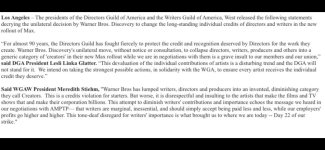
Writer's Guild Going on Strike

I am somewhat amazed they still have writers in Hollywood. Sure fooled me considering that writing is restricted to corporate brand stenography.
Very different from the days of Sterling Silliphant and Richard Matheson.

Hollywood really is like Soviet-era cinema where talented people were passed over because populism was considered decadent and the last thing they wanted was to have ethnic Russian artists making cultural content aimed at ethnic Russians. It had to be a one-size fits all approach and cultural identity was bad. You are a comrade, not a person.

A Pixar executive explained one time that Hollywood sees film like a cookie--and instead of making cookies that appeal to different tastes--they try to make one that has a little something for everyone but never satisfies anyone. However, that assumes that Hollywood sincerely wants to entertain or inform people and that absolutely is utter nonsense based on present reality. No one says anymore that the reason movies are so poorly-made is because that is what the people want. Why do they put men on swimsuit magazine covers? That's not about commerce or selling.

There's an agenda which is anti-populist and extremely culturally antagonistic and atavistic. It's anti-intellectual to a fascinating degree--it is like an organism breaking down into a mass of cellular mush.

It is interesting that China is letting in Hollywood films--I suspect it is to "educate" the Chinese citizens on the fruits of multiculturalism. Softening them up via Black Panther etc.

I'm from Canada and all the stuff happening now with Hollywood started in Canada--it was an incubator. 30 years ago people were saying why were Canadian movies so bad--well--it was partly because Canada, like the Soviet Union, restricted cultural production to bureaucrat-controlled apparatchiks. One of Canada's Eisensteins was Atom Egoyan. Your average Canadian has never seen an Egoyan film.
And yet the Canadian press called him the greatest Canadian filmmaker in the 1990s.
How many Russians can name Soviet-era filmmakers?
Probably not many because the films didn't speak to them.
Hollywood started with some kind of American or at least European heritage influence but over time-as mergers happened and the changing of the guard, it became more and more alien. It rejects the European or any distinct cultural identity. Who is the audience for this stuff?

Hollywood is like a car manufacturer that has come to hate tires. The tire is the traditional European heritage cultural factor--and now they are saying: we can make cars without tires.

Okay. We'll see how that works out when the car heads out of the showroom.
 
There's a huge fissure between "Hollywood" and "TV" these days in the post peak TV world. Once again, most of the ill informed commentary is clearly from those who have nothing to do with narrative drama work.

This is a long but very accurate summation of what's going on...

https://mattstoller.substack.com/p/can-a-writers-strike-save-hollywood?utm_medium=android


"
But something wasn’t right with the streaming model Netflix introduced. There was no way to know ratings or box office take, since Netflix held its own data without third party auditors. Its then-CEO, Reed Hastings, pretended Netflix used its data to scientifically know what users wanted. But that wasn’t true. (See “The Algorithm is a Lie.”) Netflix was just overpaying for content, and losing money to acquire market share, a technique known as predatory pricing (that used to be illegal until the Supreme Court de facto legalized it in 1993.)
"


And

"In an attempt to monopolize, studio-streamers accidentally transformed a high-wage, high-profit business into a low-wage low-profit commodified one. For a time, this decline in industry health wasn’t obvious. Netflix had told Wall Street a story that its overall goal was to get customers locked in, and this convinced the street to give the capital to make lots of content regardless of profit. Other studios followed, overpaying for content in the hopes of being the last man standing, in the era of what was known as “Peak TV.” As Discovery board member John Malone put it, “Everyone went for this mad Oklahoma land rush of streaming … That was a fool’s errand.”

The lock-in was a mirage, as consumers switched services to find content they wanted to watch. No one, as it turns out, wanted a streaming service, they wanted individual shows and movies. Vertically integrated streaming services, contrasted with markets where consumers pay for what they want, aren’t very profitable. HBO, Peacock, and Paramount all lost money in the first three quarters of 2022, and this year, Disney’s streaming services raised prices and removed content, and still can’t make a penny."

and

"Netflix’s model was an attack on the bargain between creators and studios at the heart of the industry. This bargain is that everyone who makes movies or shows - production houses, studios, writers, actors, or directors - split the profits from any individual piece of content, profits generated by selling movies or shows into actual markets. Producers, for instance, often retained the intellectual property of a show, and licensed it. Traditional labor compensation packages, known as ‘residuals,’ are based on theatrical releases, or what ratings TV shows achieved when broadcast. Additionally, both categories might qualify for additional compensation through syndication or DVD sales, foreign market sales, and sometimes streaming. (It’s why the cast of Friends is still making millions of dollars a year even today.)

When Netflix sought to fully integrate the production and distribution, this bargain broke down, because there were no markets or prices to use to value anything. Netflix paid creators an upfront fee, and then that content was on Netflix, with no opportunity to syndicate or sell it elsewhere. Beyond breaking down price signals, Netflix wouldn’t even tell creators how their shows did in terms of ratings. It also refused to allow American production houses to retain IP. Other studios copied Netflix, upending the labor model for content. No one knew what anything was worth."


and finishing with

"And that’s why this fight is existential. For the strikers, the problem is how to negotiate a deal providing a reasonable living making commercially viable TV shows and movies. For the studio-streamers, however, preserving a domestic creative industry is fundamentally unimportant."
 
That's a nice overview Doug. Looking back a few years as this was developing, I think everyone knew that the gold-rush mentality was going to have consequences. This is a normal cycle we've seen again and again when something new comes along; crypto-coin being another recent example.

The Guild had no choice but to strike to clear up these issues. The Guild is strong and unified in this regard and somehow, they are able to hold out to get what they want.
 
Doug, I recall you have some bug in your browser that corrupts your posts--can you not go in after the fact and edit out the glitches? I'd like to read what you have to say but it's pretty tiresome to have to wade through those landmines.

Also, it is nice to have another Local 600 member in here, which position do you generally work in?
 
It's classic negotiating tactics. There you are negotiating on a set of issues that you MUST have or you won't make a deal. The negotiations stall because no one will move. Then your opponent suddenly makes a ridiculous demand that wasn't even on the table. You are outraged. It puts you on your heels. Now your opponent has you trying to figure out how to get back to where you were with this new obstacle in the way. With you against the wall with this new demand, the opponent now has you in a vulnerable position without having done anything but make up a stupid demand. The opponent gets you in a "Oh yea? Well I just made negotiations 10 times worse. Good luck pal. Now I may be willing to give up this new demand if you start making concessions on the other items".
 
From Variety.com in an article - "Clack, the head writer on ABC’s “Station 19,” stated that they’re pushing for more people in the writers room, as one writer shouldn’t be expected to write every episode. “If we don’t have enough people investing into our healthcare system and to our pension plan, that’s going to go away. We need to have people working to buy into that, so that we can keep that flush for our future,” she explained."

Oh my. That's a quote new members want to read.
 
So, if a show gets cancelled and all of its salaried employees fall out to the unemployment line, does that add to the number of personnel in writing rooms?

Oh and Disney already laid off 7000 employees. Including Neil Everett.

Naturally, there's also simple attrition, when the subscriber count begins to dwindle.
 
From Variety.com in an article - "Clack, the head writer on ABC’s “Station 19,” stated that they’re pushing for more people in the writers room, as one writer shouldn’t be expected to write every episode. “If we don’t have enough people investing into our healthcare system and to our pension plan, that’s going to go away. We need to have people working to buy into that, so that we can keep that flush for our future,” she explained."

Oh my. That's a quote new members want to read.

Not sure what you are seeing as being an issue here--perhaps because of the wording you were thinking that the writers themselves are funding their pension? To the contrary, it is the employers who contribute to the pension plan, a specific percentage of the writer's earnings. I think the point being made that if fewer writers are hired, the contributions will be that much less and the pension plan will dwindle.
 
It seems there is no sympathy or understanding of what this means for writers on this forum Charles. I assume it's because many of the contributors on this forum don't work in narrative or are working in areas that don't work with WGA writers. Those of us that are directly affected by production stoppage and income loss of those WGA members bizarrely seem to understand and empathise with them. How strange hey?

I haven't worked since the strike began except for a single day and even if the strike ended tomorrow I don't think much will be back up and running before the end of the year. The studios are cost cutting and this is a great way to do more drastic cuts, cancel marginal shows and expensive talent deals. Win win.

I am a DGA and IA600 member. The DGA did a great job in my view of negotiating early with the AMPTP and I think they've had some great improvements in their new contract including dealing with AI. The DGA started on this more than a year ago and have been really really prepared for a negotiation. They are in the process of having the DGA membership vote to ratify. I think the WGA have been a bit more petulant in their tone when approaching the AMPTP, but it doesn't change my stance in supporting the WGA members negotiating for better terms.
 
Yes, your last point is the one I am trying to make. You in IATSE, me with social security, and the WGA are all participating in big Ponzi schemes of sorts. Being on Social Security, it is your payments into the plan that is feeding my checks. Most pension plans, as is Social Security, are plans that rely on current paying members to cover the costs of the retired. Social Security is heading towards a shortfall. Boomers like me are consuming all the funds. So, a message to new writers, saying that they are funding the plan (through employer payments) wouldn't give me a good feeling much as I expect those of you paying into Social Security and wondering if it will be around when you retire.

I just though it was a message best left out of the conversation. There are plenty of solid negotiation and talking points for the WGA. That sentence I quoted doesn't instill confidence for newer members.

As a side note regarding Social Security; When it was first implemented in 1935 the average lifespan of men was 59 and the benefits age was 65. So well more than half of the men paying in did not receive benefits. It was not a retirement plan. It really was for the aged. The problem is that they did not adjust the benefits age over time. If they had, the benefits age today would be 81 since the average male lifespan is 74.
 
As a side note regarding Social Security; When it was first implemented in 1935 the average lifespan of men was 59 and the benefits age was 65. So well more than half of the men paying in did not receive benefits.

When a state-supported pension system was originally passed in Germany in 1870, the eligibility age was 73. An average life span was 70. Bismarck didn't want to pass it but the socialists did and managed to talk him into it. He lived until 83.

And, as John Adams opined some 200 years ago,
democracy never lasts long. It soon wastes, exhausts, and murders itself. There never was a democracy yet that did not commit suicide
And John Adams preceded Bismark. By a few years. And in a different country.
 
Oh, so the Yellowstone is going off the air (in its original form only, one presumes). Kelly Reilly will probably stick around. Other jobs are likely gone.

Like when the original Star Trek was cancelled by Elliot Gould, sometimes you have to unplug the cord.

Which reminds me of once standing in an unemployment line next to Jennifer Anniston. She rebounded.
 
Many shows are being taken off the air because the streamers DO NOT WANT TO PAY EXPENSIVE RESIDUALS. That's why near current shows are being deleted from streaming services. Like I said the studios are in extreme cost cutting measures.

Funding and management of pension funds isn't up to the members who contribute. I'll concede the one point you've lifted from an article isn't appropriate. But I have many many WGA friends and none of them are talking about deepening the pool of contributors for pension funds. Cherrypicking this quote isn't really the bigger picture. It's very what about-ist. And I agree the whole pensions system in this country are screwed up. I much prefer my wife's Australian socialist system.
 
Yes, your last point is the one I am trying to make. You in IATSE, me with social security, and the WGA are all participating in big Ponzi schemes of sorts. Being on Social Security, it is your payments into the plan that is feeding my checks. Most pension plans, as is Social Security, are plans that rely on current paying members to cover the costs of the retired. Social Security is heading towards a shortfall. Boomers like me are consuming all the funds. So, a message to new writers, saying that they are funding the plan (through employer payments) wouldn't give me a good feeling much as I expect those of you paying into Social Security and wondering if it will be around when you retire.
.

This is a widespread misconception about social security. Although it resembles a pension plan, it has always been a transfer of income from the young to the old. Its first recipients hardly paid into the system at all.

January 31, 1940 Ida M. Fuller became the first person to receive an old-age monthly benefit check under the new Social Security law. She paid in $24.75 between 1937 and 1939 on an income of $2,484. Her first check, dated January 31, was for $22.54.
https://www.ssa.gov/history/1940.htm...f%20%242%2C484.

A Ponzi scheme pays withdrawals with money from newcomers but pretends this is an investment earning. The Social security trust fund is invested in US treasuries.

If the trust fund is exhausted, which is purely a result of the size of the boomer generation and the declining birth rate in the US, then social security would still be able to pay out 80% of expected benefits. And there is nothing stopping the government from securing new revenue for the program. The economy is expanding. The stock market is way up. There is no shortage of money around that could support the retirement of our seniors. And if the birth rate stabilizes, this problem will recede into the past anyway.

Social security is one of the most targeted and effective programs we have for reducing poverty and income disparity. You get a much higher return from your payroll taxes if you are the working poor. That is why it is under constant attack from rich people who would like nothing more than to trick poor people into opposing it. FDR and the Great Depression were a long time ago and people have forgotten what life was like before Social Security.
 
This is a widespread misconception about social security. Although it resembles a pension plan, it has always been a transfer of income from the young to the old. Its first recipients hardly paid into the system at all.


https://www.ssa.gov/history/1940.htm...f%20%242%2C484.

A Ponzi scheme pays withdrawals with money from newcomers but pretends this is an investment earning. The Social security trust fund is invested in US treasuries..

Agreed. I called them "Ponzi schemes of sorts"; not true Ponzi schemes. And yes, it can be easily fixed. But representatives are a bunch of chickens unwilling to do the right thing. The fact that the Federal budget is spending twice what it takes in, points to that. It all could be fixed so easily. A bit more taxing and trimming of fat. The fact that I paid 2% tax on $82,000 of income (and would have paid nothing if it was $72,000) and that my wife gets 3 times the Social Security than she earned and that half of income earners don't pay tax and that the rich only pay 8.4% income tax. It's all easily fixable. I'm happy to pay my part, but like everyone else, I'm not going to volunteer to do so.

If the trust fund is exhausted, which is purely a result of the size of the boomer generation and the declining birth rate in the US, then social security would still be able to pay out 80% of expected benefits. And there is nothing stopping the government from securing new revenue for the program. The economy is expanding. The stock market is way up. There is no shortage of money around that could support the retirement of our seniors. And if the birth rate stabilizes, this problem will recede into the past anyway.

Social security is one of the most targeted and effective programs we have for reducing poverty and income disparity. You get a much higher return from your payroll taxes if you are the working poor. That is why it is under constant attack from rich people who would like nothing more than to trick poor people into opposing it. FDR and the Great Depression were a long time ago and people have forgotten what life was like before Social Security.

Agreed. And it is easily fixable. There was a Social Security shortfall crisis in the past. I think it was the 1970s. It was the same discussion. SS was going to collapse. When push came to shove, they fixed it.
 
Funding and management of pension funds isn't up to the members who contribute. I'll concede the one point you've lifted from an article isn't appropriate. But I have many many WGA friends and none of them are talking about deepening the pool of contributors for pension funds. Cherrypicking this quote isn't really the bigger picture. It's very what about-ist. And I agree the whole pensions system in this country are screwed up. I much prefer my wife's Australian socialist system.

Of course the line I pulled out was ridiculous. That's why I posted it. I think it was irresponsible for the journalist to even print it. It was just an off-hand comment that should not be part of the conversation.

Many shows are being taken off the air because the streamers DO NOT WANT TO PAY EXPENSIVE RESIDUALS.

But wouldn't they want to run them to get the income? ..... or are the residuals more than the profit margin? If it's the latter, then of course, no one would want to rerun a show that is going to lose them money. Is there something more to it that I don't understand?
 
But wouldn't they want to run them to get the income? ..... or are the residuals more than the profit margin? If it's the latter, then of course, no one would want to rerun a show that is going to lose them money. Is there something more to it that I don't understand?

The streamers haven't been paying any residuals at all (or very very minimal) It's never been part of their equation. Many streamers like Netflix do an upfront buyout of the residuals rights for above the line. So a 50 million dollar film realllllly costs about 20 million to actually make. The other 30 million is a forward buyout of what used to be backend and residuals.

Some streamers are now inheriting shows that were designed to be CABLE with regular residuals and are now being inherited by the streaming version (hello Max) sooooo to air these legacy shows they have to PAY residuals which on their own commissioned streaming shows they try not to do. But they do for a HBO show that started its life on cable. It's an ongoing cost vs a cost already paid for.

And I'm sure they've done the numbers. There aren't THAT many people flocking to Max to watch season 1 of GOT and I bet they're thinking their subscriber numbers won't change much.

Streaming residuals is part of the whole WGA issue because none of the streamers want to share their numbers. Likely because sometimes they're embarrassingly small. And also because they count things differently. If 30% of the subscribers finish a show that viewers start it's considered successful. An exec I know at Netflix says they look at a new show by how many watch the the first 10 seconds, 15 seconds, 30 seconds, a minute, two minutes etc. They are very data driven and they can accurately predict what the completion audience will be. It's the same algorithm that tells you your % match. Yeah it's that individual for them, and you don't have to complete an episode for them to consider it a success.
 
Last edited:
... Agreed. And it is easily fixable. There was a Social Security shortfall crisis in the past. I think it was the 1970s. It was the same discussion. SS was going to collapse. When push came to shove, they fixed it.

An economist friend posted a couple of days ago, "we're going to have to tax the lower and the middle class". To which I replied, "this is what they do in Europe" - they start high and then go higher.

Whether it can be done in the US or not is open to a debate.

I'd rather the state goes first.
 
Back
Top