GH5 How interested are you in a GH6 anymore?

Companies pay for youtube videos. Influencing is a multi billion dollar industry. That's part of the reason i don't take it seriously, aside from the fact that these reviewers aren't actual working cameramen and have major gaps in basic usage comprehension. It would be like watching TV and assuming that something is popular because it airs a ton of commercials showing people enjoying it

Even on dvxuser, which I would argue is a forum of gearheads and early adopters, there has not been one camera that has taken the forum by storm. Probably the fx6 has the highest adoption, with some fx9. I can only think of one other a7siii owner on here. Then a mix of c500mk2, c300mk3, and c70 owners. The r5 is probably 2nd most common adoption after the fx6, with a healthy mix of R6. But none of them is ubiquitous and not everybody has acquired a body from the latest generation
 
You're engaging in semantics to defend your position, but I can't agree.

Their information, no matter what they say or what they do with it, is helping the product take the market by storm.

Your example of commercials is exactly why the mail order industry became so successful.

If you only consider a product taking the market by storm by how many people you can personally confirm own it and use it in a way you approve (in the field or on a forum) then we'll just have to agree to disagree.
 
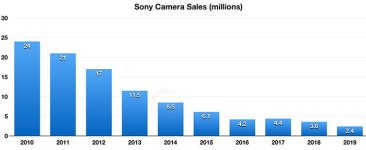
Arguably no sony or canon camera will ever sell as many units as before...

sales.jpg

Anyway, can you point to sales figures rather than youtube analytics? That's the only data that could sway my opinion

And the thing is- my appraisal of the 5dmk2 and mk3 taking the market by storm is based on them being so popular AMONG PEOPLE I KNEW that folks would say to each other, "just bring your 5D" under the assumption that the other person had one. I'm sure that there were fewer YT videos and views at that time. Because YT has grown. I don't care about YT influencer campaigns.

by "taking the market by storm" I mean becoming a camera that everyone in the industry purchases and uses. I know a lot of cameramen in various sectors and I meet new ones constantly. I simply don't observe the R5 or the a7siii matching the popularity of the 5dmk3 or the a7sii. At least not yet
 
You said this...

Being a best seller at B&H is not the same thing.

...so why would sales figures interest you, especially since you know that they cannot compete with sales figures from 2010.

Nevertheless, I'd Google them just like you if they were available to the general public. (There are some Canon press releases speaking about the R5's success, if interested.)

As far as the 5D Mark II, you keep using that example, and it's the strongest by far because it's a GOAT, but that was a different world, friend.

Less choices, for one. [Seriously, how many cameras could you name back then that weren't fixed zoom lens systems?]

But also because people never saw shallow depth of field like that in any camera they could physically touch. Its popularity was undeniable in a world where people were using the first iPhone.
 
Regardless, you said "...becoming a camera that everyone in the industry purchases and uses.", so I think this is pretty much done based on your description and understanding.
 
Arguably no sony or canon camera will ever sell as many units as before...

That's not arguable. The trend is what one calls a "prima facie" evidence.

That said, as we were discussing in the iPhone thread, at some point a camera with the A7SII performance will be sold for $500 and a 16K camera will be sold for $3,500. And pro shooters everywhere will say, "Who the heck needs 16K?" and a lot of non-shooters will say, "Eh, $500? I might as well get myself one". It's possible. But most non-shooters will remain the iPhoneusers.

As to the popularity of a given camera, the DVXUser camp has a plethora of choices. The pro sales were never as big as the consumer models. 5D MKII was pretty expensive at the time. And, as we had discussed in the GH-5 thread, GH-4 was big in 2015-2016 because it had the 4K Value market all onto itself. Now, there are dozen 4K models. They split the "value" niche into the many smaller niches. Canon, Nikon, Fuji, Sony, Panasonic, Olympus/OMD are all congregating there and, until some brand names drop out, not a single model will dominate.
 
You said this...


...so why would sales figures interest you, especially since you know that they cannot compete with sales figures from 2010.

Nevertheless, I'd Google them just like you if they were available to the general public. (There are some Canon press releases speaking about the R5's success, if interested.)

As far as the 5D Mark II, you keep using that example, and it's the strongest by far because it's a GOAT, but that was a different world, friend.

Less choices, for one. [Seriously, how many cameras could you name back then that weren't fixed zoom lens systems?]

But also because people never saw shallow depth of field like that in any camera they could physically touch. Its popularity was undeniable in a world where people were using the first iPhone.

I'm glad you agree with me - nothing has taken the market by storm like the 5dmk2 did. Nor, I would argue, the 7D and 5dmk3 and a7sii in its wake, albeit to a lesser extent.

I'd be interested in the total number of units sold rather than b&h best sellers. B&h is only one retailer and we're making only a relative comparison to their other current offerings without knowing how many more units are actually being sold, let alone relative to past models.

I don't mean that literally everyone needs to purchase. But that was how it felt with the 5dmk2/7d/5dmk3 and the a7sii. It felt like I knew way more people who owned one than didn't. And that's just not (yet) true with the r5 or the a7siii.

The 5dmk2 was a category 5. The r5 is a tropical storm. (This is less true among stills users who seem to be switching to mirrorless around the pivot point of the R5. But I'm talking about video shooters, same as with the 5dmk2.)
 
I do agree, for sure, but that's also like saying the CD player took the market by storm after cassettes.

It was never seen before, in 2008. That's like when dinosaurs were still around.

That camera changed the world.
 
. Now, there are dozen 4K models. They split the "value" niche into the many smaller niches. Canon, Nikon, Fuji, Sony, Panasonic, Olympus/OMD are all congregating there and, until some brand names drop out, not a single model will dominate.

I agree with this and, more broadly, that no model has a single knockout feature all to itself. If either canon or Sony had a monopoly on good AF, it would be a different story. I don't think internal 8K RAW is a knockout. Especially if it doesn't really work. But more to the point - it's not in demand
 
In terms of features, there are minimums and maximums. As a minimum, 4K is a must. A good AF is a must. Then it begins to split - some like ISO, some want IBIS, others want Raw, others want the lowest price, et cetera, et cetera. But there's a reason that Canon and Sony dominate the mirrorless with over 30% each. Each has an exemplary auto focus.

Side note - Blackmagic Design can serve as an example of the consumer response to the technology. In 2012, BMD announced the original 2.5K Cinema Camera and, production delays notwithstanding, it became a huge hit at $3,000. Eight years later, it announced a far superior 12K model and people yawned. Not because the camera was a bad value for its price but because 12K was not in demand. And because Canon announced an 8K camera for a much lower price. With auto focus to boot. And that shows how marginal the benefits really are.

PS. The same goes for cars too. 2022 VW Golf Sport was tested at 4.0 0-60. So, while it may not be 911, it's also $100,000 less. And then 911 becomes that wonderful extra large medium format 16K camera. It's a phenomenal achievement in engineering - turbo can do at 2.2 - but it's pretty much a track vehicle for the super wealthy while. Golf R is an every day vehicle for the masses.
 
Eight years later, it announced a far superior 12K model and people yawned. Not because the camera was a bad value for its price but because 12K was not in demand. And because Canon announced an 8K camera for a much lower price.

Even if 12K was in demand, the camera was too expensive for most.

$10K for a BRAW-only camera with a PL mount is a big investment compared to other available systems.

If it was $6K with an EF mount and ProRes I think it would have had similar success like their G2.
 
I don't. I think 8K is a plateau that's not going to be exceeded in video - in terms of streaming, media, displays and what not - for a long time On a 16K still image, one can, at least, zoom in. In video, the finer details are no longer discernible and the added bother of super large file sizes isn't worth it.

PS. I was heavy pro 4K back in 2013-14 because I thought it was a big jump from HD. Many disagreed but 4K became the dominant format just in a few years. Now 8K TV's are out but most of them only upscale the existing resolution. So, even getting to the complete 8K system is going to take a while. And 16K? Fogeaboutit.
 
I don't. I think 8K is a plateau that's not going to be exceeded in video - in terms of streaming, media, displays and what not - for a long time On a 16K still image, one can, at least, zoom in. In video, the finer details are no longer discernible and the added bother of super large file sizes isn't worth it.

I think this is pretty much true. I think Brawley said he couldn't see the difference between 8K and 12K. But that 12K could be useful for reframing/cropping in and then exporting in 8K. (Of course, that in itself gives SOME reason to shoot more than 8K...)

But if the Ursa 12K were $6k and EF mount, then it would just be offering more for the same price. So you would expect it to be at least as popular as the G2, no?

And I totally agree with DLD that excess capabilities are not a strong motivator for purchase. I would not pay 2x as much for a camera with 10x more resolution than I want/need. I would not pay anything more, in fact. Nor would I pay more for 24-bit video or 2,000,000 fps.
 
$6K and EF/RF and ProRes would have easily put it on a consideration list for many. G1/G2 was a pretty hot camera in the BM community. And at one point, the URSA Minis were probably the most popular cinema cameras in the world among the lower-end (2015/2016).

I wouldn't pay for extra resolution either, but I would have and did pay extra for 4K/60p years ago for the slow-motion which I guess was paying for resolution as well. I was so tired of upscaling 1080p in a 4K timeline (I always delivered in 4K).
 
Haha so not true. I talk with so many camerapeople in The Real World who have no idea about new cameras 6 months after they're announced. Or people who bought an R5 and got burned by overheating without ever hearing that it was a thing before experiencing it firsthand. Dvxusers are super clued in

Anyway I think we're all just excited about the timing, not NAB itself. We want announcements

While that is true I doubt NAB would change that. Clueless is clueless no matter what.
 
2,000,000 fps would be useful for watching paint dry. Jackson Pollock would probably buy one of those.
 
But if the Ursa 12K were $6k and EF mount, then it would just be offering more for the same price. So you would expect it to be at least as popular as the G2, no?

And I totally agree with DLD that excess capabilities are not a strong motivator for purchase. I would not pay 2x as much for a camera with 10x more resolution than I want/need. I would not pay anything more, in fact. Nor would I pay more for 24-bit video or 2,000,000 fps.

If you consider that the only other (in this price range) non-time-limited 8K camera option is the 30P Sony Alpha 1 at $6498, the U12K $5995 price looks reasonable in the right circumstances; you already own PL glass and even if you don't, the $175 EF mount makes it both, with internal ND, and show stopper frame rates, 8K-160 FPS, 12K-75 FPS. Who needs that? Well, 8K televisions do 60 FPS, I've got one, and although I've had very little time to play around with U12K, I can imagine that 8K-120FPS slowed down 2:1 at 60 FPS is going to blow some minds. Think about it as the ultimate B-Roll cam. You're not going to shoot that way normally, but for stock footage, even YouTube 8K/60P there are unique opportunities. And people do have 8K televisions now. I've fit the U12K into a few limited wedding roles, one pretty significant actually, a bright and colorful Nigerian wedding shot in 8K, mostly from an unmanned fixed angle but 100% relevant and extraordinarily beautiful.
 
If you consider that the only other (in this price range) non-time-limited 8K camera option is the 30P Sony Alpha 1 at $6498, the U12K $5995 price looks reasonable in the right circumstances; you already own PL glass and even if you don't, the $175 EF mount makes it both, with internal ND, and show stopper frame rates, 8K-160 FPS, 12K-75 FPS. Who needs that? Well, 8K televisions do 60 FPS, I've got one, and although I've had very little time to play around with U12K, I can imagine that 8K-120FPS slowed down 2:1 at 60 FPS is going to blow some minds. Think about it as the ultimate B-Roll cam. You're not going to shoot that way normally, but for stock footage, even YouTube 8K/60P there are unique opportunities. And people do have 8K televisions now. I've fit the U12K into a few limited wedding roles, one pretty significant actually, a bright and colorful Nigerian wedding shot in 8K, mostly from an unmanned fixed angle but 100% relevant and extraordinarily beautiful.

Oh for sure. I wasn't trying to comment on the usefulness or value proposition of the Ursa 12K in particular. NorBro suggested that it was less popular than the G2. Which I'm sure had something to do with the higher launch price. But also having a different mount makes it harder to compare and probably more expensive to own for some.

Plus, I was intentionally vague about what resolution or framerate a person actually wants. maybe it's 12K, 16K, or 32K. (For me it's still basically just 4K, although it would be nice to have the option to do 8K.) But my point is that once a camera clearly offers MORE than you need, you probably won't be willing to pay MORE to get that feature
 
Plus, I was intentionally vague about what resolution or framerate a person actually wants. maybe it's 12K, 16K, or 32K. (For me it's still basically just 4K, although it would be nice to have the option to do 8K.) But my point is that once a camera clearly offers MORE than you need, you probably won't be willing to pay MORE to get that feature

I totally understand and agree. I think it would be natural for a lot of people to look at 12K, 8K, 120P as useless overkill (and media cost for raw!), and PL as expensive. But I had been on the fence going round and round when U12K was still $10K and the alternatives were the R5 with its time limitations or the still very expensive Alpha 1, both of which had some incredible positives and a lot faster handling, but very expensive for me to start building yet another lens ecosystem that was not just a duplication but a triplication of focal lengths I already had in two mounts, PL and EF. It was the big price cut on the U12K that made all the difference or else I'd still be debating myself with the choices.

To the point about mounts, I'm not always sure or not whether people understand because I hear it often, "I wish the U12K didn't come in PL mount," when the EF mount can be purchased for only $175. Or maybe it is I who don't understand they don't want EF either. But either way for a cinema cam, it gives you the option between two giant lens universes. For Sony E-mount or Panasonic L Mount or Canon RF mount, a person would need a pretty strong belief for a cinema body that's never going to see AF, and even with such as the Sigma Art line, the compromise in focus breathing is pretty extreme with any DSLR/Mirrorless compared to PL.
 
Back
Top