Writer's Guild Going on Strike

Interesting charts Abe. I do not think ad spend = demand. It might be correlated but if demand falls the ad spend will dry up quickly. Looking at your inventory of streaming services and the very low dollar amounts you are currently paying kind of proves some points. The streaming world has a revenue vs cost issue and while you show demand for the products, if the price increases you probably will just step out of a few of the services. I think of it like 'convenient demand'. We all want it unless it is out of our window of opportunity etc... My view is that the streaming companies' true window of sustainability does not match up with the consumers' window.

I think ad spend is closely correlated to demand, although advertisers probably pay more to reach some audiences (like younger or richer viewers). The chart predicts a rise in ad spend, but obviously things could go the other way. The largest and fastest-growing segment in their prediction is FASTs, which are Free Ad-Supported TV such as Pluto TV, Tubi, and the Roku Channel. So, those services are never going to become more expensive for viewers because they're free. (Although of course the number of commercials they make you watch could increase.)

I'm paying discount prices on most of my subscriptions but the access revenue is still clearly adding up for streamers. And, as I said, I would pay about $50/month or so no problem for streamers + rentals. I'm currently paying $28, so there's room to rise. The other limiting factor for me is that I don't have time to watch everything that's available everywhere. So, I'm never going to subscribe to more than a few services at a time. I have enough patience for most movies/shows to just wait until I churn back to that service to watch the new releases.

So, let's say I had to pay full price for every service and they each cost $20. I would probably just get 2 at a time. But I'd still be paying more into the industry than I am now.

Paramount+ recently raised their subscription prices and they say they're planning to do so again soon because it didn't impact their subscriber growth.

Reflecting on the company revealing in May that the monthly price of its premium tier will go up from $9.99 to $11.99, Bakish detailed that the move did not lead to more subscriber churn or bring down subscriber growth. He added, “That proves that we have pricing power in the marketplace, given the content we’re bringing to bear on the platform,” noting that he believes “there’s a lot of room to run there.”
https://www.hollywoodreporter.com/business/business-news/paramount-price-hikes-1235584023/amp/
 
My DVRs are chock full with a pretty good catalog from TCM.

If only there were time to watch it all.

90062943_1912349585565725_7524248726487957504_n.jpg
It's not quite fair to compare TCM and new movies because TCM is curating the oldies. You probably wouldn't like most of the stuff that came out in any given year for similar reasons to why you don't like most new stuff.

But I think it's a bit like how I've been trying to convince my wife that pop music peaked in the 40s/50s (which is totally true). There was a really high standard of musicianship (especially with the influence of jazz). Those musicians collaborated extensively in person as opposed to musicians working solo in a studio today or just with a producer. Performers weren't expected to write their own music as much. Being photogenic was less important before TVs and color TVs proliferated. And there wasn't so much of a trend to simply be loud and fast and danceable, which is sort of a cheap flavoring in pop like adding sugar or salt to a dish.

But there are so many worthwhile musical styles and movements that have come around since then that are more complex or diverse. I just wish they had maintained the same standards of musicianship, etc.

There are so many new movies you wouldn't want to give up seeing that were technically impossible to make before or stylistically unheard of, such as Gravity or the Apollo 11 documentary. But I think that the basic storytellling and dramaturgical quality of so many new shows just sucks compared to what was being made in, for example, the 90s. The effects, production design, and cinematography are way better. But the essential elements of storytelling are weaker, probably in part because they used to get more practice from making 2-3x as many episodes per season. The original Twilight Zone had 36 episodes per season for crying out loud.
 
I think ad spend is closely correlated to demand, although advertisers probably pay more to reach some audiences (like younger or richer viewers). The chart predicts a rise in ad spend, but obviously things could go the other way. The largest and fastest-growing segment in their prediction is FASTs, which are Free Ad-Supported TV such as Pluto TV, Tubi, and the Roku Channel. So, those services are never going to become more expensive for viewers because they're free. (Although of course the number of commercials they make you watch could increase.)

I'm paying discount prices on most of my subscriptions but the access revenue is still clearly adding up for streamers. And, as I said, I would pay about $50/month or so no problem for streamers + rentals. I'm currently paying $28, so there's room to rise. The other limiting factor for me is that I don't have time to watch everything that's available everywhere. So, I'm never going to subscribe to more than a few services at a time. I have enough patience for most movies/shows to just wait until I churn back to that service to watch the new releases.

So, let's say I had to pay full price for every service and they each cost $20. I would probably just get 2 at a time. But I'd still be paying more into the industry than I am now.

Paramount+ recently raised their subscription prices and they say they're planning to do so again soon because it didn't impact their subscriber growth.

https://www.hollywoodreporter.com/business/business-news/paramount-price-hikes-1235584023/amp/

This pretty much proves my point. You have a $50 ceiling for your monthly spend and that might be to multiple companies. Is $20 per month sustainable for these entities to keep making great content? I do not see it especially if the customers are bouncing around throughout the year. So you might get 6-8 months of $20 if you are lucky. Miss on a few shows and people will drop the service like a dirty shirt etc...

Yes, Ads are more sustainable but getting away from ads was what started the whole streaming thing in the first place! That alone tells me a la carte streaming with direct support only just is more of a dream than reality over the long term. They need advertising to make up the revenue shortfall. Meanwhile, as a customer, I want zero ad content and would rather pay higher prices for things I enjoy like F1, Indycar etc... But they are afraid to raise the prices to where they really need to be to offer this stuff.
 
It's not quite fair to compare TCM and new movies because TCM is curating the oldies. You probably wouldn't like most of the stuff that came out in any given year for similar reasons to why you don't like most new stuff.

I didn't mean to imply everything on TCM is good or that TCM shows every good movie that was ever made, but there's enough good commercial-free content just on that one channel to fill my DVR and entertain me for the limited amount of time I care to sit in front of a screen. Add in a few things from Netflix, HBO, and Showtime and I've got more than enough content (new and old) to satisfy my needs for a really long time. Whenever Hollywood gets back to churning out their mostly half-assed crap I'm sure there will be a few good things in the mix that I will find. I look forward to some quality new material. But no hurry. The Mexican stand-off does not affect me one bit except for the loss of A Closer Look with Seth Meyers. That is the only thing I've missed during the srike.

Ever go to a Cheesecake Factory? The menu is two inches thick with a bunch of crap. I'd rather go to a restuarant that has fewer selections, but does them well.
 
I was just thinking, I could say the same thing about books if the publishing industry and writers were to go on strike. I've already read 13 fiction and non-fiction books this summer and I think only two of them were written in the last five years. If another book was never published, there's already more good stuff on the book shelves than I could ever read if I lived to be 200. I'm not saying there won't be some really good books published down the road, I'm just saying, there's plenty to read (or watch on TV) if nothing new ever comes out again.
 
Does a camera op on a legit TV show get to decide which camera support gear like the ZeeGee is used, or is that the DP's call? Or someone else?

I remember when you first shared the ZeeGee, I, quite frankly, thought to myself I don't know who in the world would buy this at this point time in modern production.

I mean, I had no doubt you were behind a remarkable product and I wanted you to make millions, but saw this as a pretty tough sale. More like a, "I'm a good friend of Charles so I'll buy it" sale.

[Keep in mind I know nothing about what people on that level would be interested in.]

Interesting take on the ZeeGee. I'll try to explain the benefit.

Let's say you are a camera operator on a movie or a TV show or a commercial etc. and the edict from the director is "we are going to shoot it all handheld, that's the look and feel I want". This is not a scenario where you as a DP or an operator can talk them out of this, you just have to accommodate it.

First scenario is moving shots, where the camera has to follow the action. In almost every situation the look the director wants is the angular motion of handheld (pan/tilt/roll) but not the spatial aspect (footsteps/Z axis error). So they may ask for "smooth handheld" in this scenario. Mounting the ZeeGee to the Steadicam vest and arm takes out the footsteps so it is now possible to walk and run with the camera without that aspect, but maintaining the desirable angular error.

Whether body-mounted or hard-mounted, the Steadicam arm delivers 2.5 ft of vertical travel, so it becomes possible to hold the frame well above or below one's eyeline, and smoothly transition during the shot. This is particularly useful for shorter operators shooting taller actors or vice versa (the latter is possible with conventional handheld by cradling the camera or holding it below the shoulder, but not easy to raise it back up during the shot).

In many narrative situations, there are plenty of setups where the camera doesn't have to move through space much, such as shooting coverage of dialogue. Traditionally, operators would just stand there holding the camera for take after take. Given that the typical production camera weighs 25 lbs and up, this can result in fatigue for the operator which translates into the footage. I've seen it for years-- B camera becomes shakier than A camera so they won't cut together well, etc. Hardmounting the ZeeGee either via the arm or directly onto a 5/8 pin removes this fatigue and creates a unity to the look that becomes obvious in the edit. That's a specific advantage for the director. As a DP, I love that the camera can be locked off onto a specific framing for lighting purposes, something that becomes a real pain on typical handheld shows.

And finally, there are many situations where the camera needs to get low or high or travel on a vehicle etc. and the ZeeGee delivers more flexibility in these situations (picture the difference between trying to operate a shot from a sandbag on the ground, vs the ZeeGee on a baby pin).

So these are the various scenarios where the ZeeGee can deliver a more consistent and flexible experience vs conventional handheld. I'd also invite you to check out the hardmount video on this page that may help illustrate the possibilities with that paradigm (which is my personal favorite). https://thezeegee.com/videos/

Happy to answer more questions on this.
 
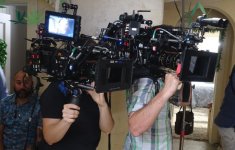
Just to add to the above--this is 7 years ago and cameras and other components have indeed shrunk since then, and we are generally better at rigging them (that big ass Noga arm alone). But chances are that for this particularly shot, there would have been zero need for my operators to have to wear the cameras if they had had the ZeeGee back then.

vcams.jpg

I also forgot to mention again that much of "The Last of Us" was shot with the ZeeGee, in many configurations. I kind of think that alone proves the point of why it serves a purpose.

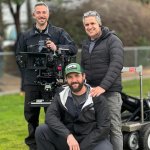
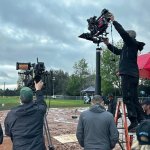
This from a recent commercial I shot. Director had said he wanted the whole thing to be handheld. We had two ZeeGees on the dolly, no arms, no bodymounting. The talent was Sebastian Maniscalco and for his closeups the director let him riff for multiple 20+ minute takes. These lads were strong like bull, but it's also sort of pointless to have to stand around with a camera on your shoulder for no reason. On the second shot, inclement weather forced us to shoot high looking down so we grabbed a Road Runner from the electrics and away we went. The alternative would have been for the operator to sit on a ladder and point down, which is a bit precarious and surely not as stable over multiple takes.

336305564_940491680303313_3515811441692101349_n.jpg

334820622_206762058704957_1324579742470470967_n.jpg
 
QUOTE=CharlesPapert;n5706035]

I also forgot to mention again that much of "The Last of Us" was shot with the ZeeGee, in many configurations. I kind of think that alone proves the point of why it serves a purpose.


[/QUOTE]

I really appreciate all the industry insight, information and experience you have offered on this forum; thank you sir.

Re: promoting the ZeeGee - would probably make sense to lead with this for the foreseeable future. Have a great weekend :)
 
Interesting take on the ZeeGee. I'll try to explain the benefit.

Let's say you are a camera operator on a movie or a TV show or a commercial etc. and the edict from the director is "we are going to shoot it all handheld, that's the look and feel I want". This is not a scenario where you as a DP or an operator can talk them out of this, you just have to accommodate it.

John Brawley said some his operators use ZeeGees and I got the impression that it was largely by their own volition. I don't know if it's part of their kit or they request the rental. I'm sure they could be ordered to use it or not use it but it seemed like the operators were the driving force in bringing it on set based on their familiarity with it and the problems they were trying to solve
 
The Washington Post reported "The Writers Guild of America said Friday that it’s open to deals with individual studios that want to ditch the group that has been negotiating on behalf of major legacy studios and Netflix and other streamers."

That's smart. That is the right way to go. Why let streamers, who don't yet have a viable business plan, hold up everyone else. SAG/AFTRA should do the same.

This is an effective way to break up the consortium that has too many stakeholders with different goals. Here's hoping for successful negotiations with the individual companies. Then the streamers can starve on their own.
 
Last edited:
The Washington Post reported "The Writers Guild of America said Friday that it’s open to deals with individual studios that want to ditch the group that has been negotiating on behalf of major legacy studios and Netflix and other streamers."

That's smart. That is the right way to go. Why let streamers, who don't yet have a viable business plan, hold up everyone else. SAG/AFTRA should do the same.

Divide and conquer works both ways.
 
Interesting Paul F, your reaction. Mine was the opposite. The move seems a desperate attempt to return some workers to an active workforce. I forsee several problems with that strategy. Divide and conquer as Run&Gun suggested working both ways describes it about right, an unequitable piecemeal approach. The workers returning to work are no longer walking the picket line. Strike solidarity which has been compromised already by interim agreements is further fragmented. How can striking workers be expected to remain true to the union goals when select others would get paychecks and conclude their solidarity by leaving the shrinking, less fortunate unworking people to man the pickets? It was already coming unglued because of the interim agreements and now they are going to compound it by doubling down with the same mistake again? Sure, it could work for certain studios and select workers but it's working both ways because the longer this goes on, the less likely that many of the out of work strikers will have jobs to return to due to entire project cancellations and staff reductions. When the strike is finally over, they don't return to the same business as usual paradigm as before. It will be a different landscape.
 
John Brawley said some his operators use ZeeGees and I got the impression that it was largely by their own volition. I don't know if it's part of their kit or they request the rental. I'm sure they could be ordered to use it or not use it but it seemed like the operators were the driving force in bringing it on set based on their familiarity with it and the problems they were trying to solve

It's an evolving thing. I was asked to bring one in to demo on a procedural last year because the showrunner had worked on another project where it was in use and he liked it, so wanted to introduce it to the other show. On "The Last of Us", one of the DP's had worked with it prior and when he reached out to the same operator to hire him, he specifically asked for the ZeeGee (and in fact there was very little Steadicam, so the operator made his rental primarily with the ZeeGee, vest and arm). So it can come from anywhere at the moment. I heard that some prominent directors have started using it as a verb, i.e. "let's ZeeGee this shot"!

Sorry about the tangent, I probably should have shifted that convo to a ZeeGee thread.
 
I don't think anyone objects to ZeeGee-related thread drift.

But on the subject of the strike:

Ongoing strikes by Hollywood actors and writers could cost Warner Bros. Discovery up to $500 million, according to a regulatory filing from the company Tuesday, after it said the financial impact of the strikes will likely persist through the end of the year amid programming delays and cancellations...

Warner Bros. Discovery said it expects between a $300 million and $500 million cut to its adjusted earnings before interest, taxes, depreciation and amortization—the process of something losing value over time—with earnings expected to be between $10.5 billion and $11 billion for the year, according to a securities filing.
https://www.forbes.com/sites/tylerro...h=405e07868d85

That's a terrible position at least in the short term, because fully giving in to strikers' demands would cost that much to the entire AMPTP.

Annual Cost of SAG-AFTRA, DGA, WGA Contracts May Be $450M-$600M a Year, Moody’s Estimates
https://www.hollywoodreporter.com/bu...ts-1235535871/

For context, the movie and TV industry has about $280B combined revenue.
https://errorcodeguru.com/movie-vs-tv-industry-profit/

And on Friday, "Fran Drescher is easily reelected as SAG-AFTRA president" with 81% of the vote. https://www.latimes.com/entertainmen...gilbert-dunbar

And from Forbes:

A majority of Americans support both strikes regardless of political affiliation, according to a poll conducted by the progressive polling firm Data For Progress. An estimated 67% of Americans support the strikes, while 18% are in opposition. The poll—which covered 1,124 respondents—indicated an estimated 59% of Americans have an unfavorable opinion of major Hollywood studios after they rejected demands by both unions.
https://www.forbes.com/sites/tylerro...h=405e07868d85
 
Last edited:
Drew Barrymore's mea culpa is not satisfying the WGA. Earlier this year, The Drew Barrymore Show host walked away from her hosting duties at MTV Movie & TV Awards in support of the writers.

"It was also in the first week of the strike and so I did what I thought was the appropriate thing at the time to stand in solidarity with the writers. However, I am also making the choice to come back for the first time in this strike for our show, that may have my name on it but this is bigger than just me. I own this choice. We are in compliance with not discussing or promoting film and television that is struck of any kind,” she added.

Apparently, the WGA does not agree.

The Drew Barrymore Show Season 4 is set to premiere on Monday, September 18. WGA is planning to picket the show starting Monday, September 11, when tapings for the new season are set to begin in New York. “The Drew Barrymore Show is a WGA-covered, struck show. It has stayed off the air since the strike began on May 2nd, but has now (unfortunately) decided to return without its writers,” a WGA spokesperson said in a statement. “The Guild has, and will continue to, picket any struck show that continues production for the duration of the strike.”

Isn't this how the other dominoes will fall? What Drew is saying is that her heart is with the strikers, and that she demonstrated some support and patience for it, but that it can't go on forever as it appears to be headed so she's "owning" a decision for the best interests of her show.

In my opinion, this doesn't end well for the strikers who persist in picketing. They go from being striking workers, to simply unemployed. There is an old cliche in Hollywood, the show must go on.

Drew's heart is in the right place. You own a 10 million dollar home but only $10 goes into the church collection basket. She is well liked. Of the 67% of Americans who say they support the strike, will they boycott Drew's show? I bet not. Are there other entertainers closely watching? I bet so, and I expect Drew will not be ostracized by her peers, nor the guests that appear on her show.

And what of solidarity does this send a message? The corporations will find a way to get what they need. They always do. In war you would ask, is this worth dying for? Certain shows carrying interim agreements get to move forward. The actors and writers get their money and don't work the picket lines. Others on the picket could end up with no job, nothing. Seriously, what could they be thinking? They are not being mislead to believe they will be showered with wealth and riches are they? Yet if fate decides who sinks in the deep end of the drowning pool, who is really headed there? The mega wealthy tech titans? I don't think so. If the union leadership persists in extending the duration of the strike, those loyal picketers with the least to give and the most to lose will be the forgotten, sacrificial lambs.

Okay, I'll just say it directly. I don't think the strikers are being served by their union leadership.

https://www.msn.com/en-us/tv/news/d...e&cvid=04af7931f41147ebb43e64b4f234eb22&ei=24
 
Time seems to always be on the side of the corporations. They will swoop in now, offer a lesser deal and it will have a chance to end. Hopefully there will be some gains for those who went on strike but it is always a risky move when you work in a freelance style environment. The corporations can always find a way forward without you.
 
Isn't this how the other dominoes will fall? What Drew is saying is that her heart is with the strikers, and that she demonstrated some support and patience for it, but that it can't go on forever as it appears to be headed so she's "owning" a decision for the best interests of her show.

In my opinion, this doesn't end well for the strikers who persist in picketing. They go from being striking workers, to simply unemployed. There is an old cliche in Hollywood, the show must go on.

How many shows can actually go on without writers? Talk shows maybe. But there could be repercussions down the line for her in the form of union reprisals.

Anyway, Warner Bros is now reporting losses this year on account of the strikes to the tune of half a billion dollars in its most recent regulatory filing. A little while ago, you were arguing that time was on their side because the strikes would help them report diminished losses. That seems already to have changed.

Last I read, the unions were trying to strike deals with individual studios, a la divide and conquer (which the AMPTP had tried to do against union membership by publicly releasing their offer -- a tactic which failed by evidence of Drescher's strong reelection result). I don't know if that's even feasible but it would make an awful lot of sense. As I see it, there's Netflix and then there's everybody else. Linear TV in particular is basically in a fight for its life. In a way, the stakes for them are higher than for the strikers. The union members' lives will go on. They can find other work. The corporations could die or be sold off as a consequence of this fight.
 
Last I read, the unions were trying to strike deals with individual studios, a la divide and conquer (which the AMPTP had tried to do against union membership by publicly releasing their offer -- a tactic which failed by evidence of Drescher's strong reelection result). I don't know if that's even feasible but it would make an awful lot of sense.

They've already done this with A24 and Neon. Admittedly, tiny studios compared to the big ones, but an indication that it's possible. Also a reminder that it is possible for studios to come to terms with the unions—IF AMPTP is willing to negotiate in good faith (which they have not been willing to do, by all accounts).

I recently heard on a podcast that the unions offered the studios what sounds like a very reasonable option for dealing with data and residuals: basically, have an independent third party review the data on streaming and provide relative numbers rather than absolute ones (e.g., show X had twice as many views as show Y) to determine compensation. This would have allowed for some transparency and a system of compensating people who work on shows that make the execs money while also keeping the specific data private. The studios, apparently, refused.
 
Back
Top