Wireless lav with built-in recording?

Grug

Veteran
Hi guys,

I got burned a little by my Rodelink wireless lav kit on an instagram shoot last week. It was essentially a press junket, and I was grabbing BTS material of the talent going through the junket.

Mic'd her up at the start, and everything was coming through fine. But once the junket itself started (I'm assuming because of all of the radio signals from the press' kit) interference really made a mess of the signal - and at that point, I wasn't able to get anywhere near the talent to try and fiddle/correct things.

Ultimately it didn't matter too much the content we were shooting (and there were usable bits at certain points), but it got me thinking that it would be great to have a wireless lav setup that included a recorder built into the transmitter, so that whatever happens to the wireless signal itself, there's always a clean recording of the actual lav audio.

As someone who only actually pulls out their audio kit 3-4 times a year it's not a pressing need for me. But especially since I'm not overly comfortable with audio anyway - I'd love to find a more fool-proof system if possible.

Does such a thing exist?
 
The rode link freaked me out as I realised it dropped out on a golf course shoot with paid talent . I wasn’t monitoring as close as I could ( I was shooting handheld, directing and trying to get in and out of the prestigious course ASAP as we were meant to be there but not wanted) and only realised In post. It actually only happened on a take I didn’t use, but it shook me... I ended up using a zoom h1 and rode smartlav as a backup for many shoots after that, that’s correct I used 2 systems. The talent ask a question or don’t even care but I figured they do it for news anchors, so what’s the big deal... now I only use it on high profile non repeatable stuff , I still use rodelink and it’s generally great , you just never know where it’s gonna drop out, it’s not like my Sony UWP...

Hi guys,

I got burned a little by my Rodelink wireless lav kit on an instagram shoot last week. It was essentially a press junket, and I was grabbing BTS material of the talent going throughout ugh the junket.

Mic'd her up at the start, and everything was coming through fine. But once the junket itself started (I'm assuming because of all of the radio signals from the press' kit) interference really made a mess of the signal - and at that point, I wasn't able to get anywhere near the talent to try and fiddle/correct things.

Ultimately it didn't matter too much the content we were shooting (and there were usable bits at certain points), but it got me thinking that it would be great to have a wireless lav setup that included a recorder built into the transmitter, so that whatever happens to the wireless signal itself, there's always a clean recording of the actual lav audio.

As someone who only actually pulls out their audio kit 3-4 times a year it's not a pressing need for me. But especially since I'm not overly comfortable with audio anyway - I'd love to find a more fool-proof system if possible.

Does such a thing exist?
 
Does such a thing exist?

Yes. Zaxcom TRX, for example. But there are other options outside the US (where Zaxcom's patent applies), such as the Audio Ltd A10-TX or, much cheaper, the new Deity HD-TX. But if you are an occasional user and have a Rodelink, why not just add a Tascam DR-10C between the lav and the wireless transmitter (which is what it is designed to do)? See: https://www.newsshooter.com/2018/07/19/tascam-dr-10cs-review/

Cheers,

Roland
 
Not available in the States I believe because of some Zaxcom patent issues. The Tascam DR-10CS unit is a system that accepts a Lav mic and then loops that through to a wireless TX unit. In the process it records to an SD card in high quality PCM so if in the end your wireless signal is screwed in any way you can always revert back to the SD card to recover the recording. I believe the DR10L is available in the States which records to an SD card but with no loop through to the TX unit. The DR-10CS is pretty popular here in Aussie. The DR-10CS also has a range of interchangeable top plates to accommodate a variety of different mics and wireless TX units. I don't own one but know a few shooters who swear by them.

A couple of year old reports but still totally applicable:
https://www.newsshooter.com/2018/07/19/tascam-dr-10cs-review/
https://www.youtube.com/watch?v=BG4-Xom2SLs

Available outside the US of A:
https://bit.ly/2uNJaOn

Chris Young
 
I’ ve been very happy with a Sennheiser AVX digital wireless 1.9 gHz kit. Soundmen don’ t like it because you can’t defeat the intelligent AI leveler built in to the system, but that makes it ideal for solo shooters. Set recording level on your camera and forget it.
The frequency band is a reserved consumer white space used mostly by garage door openers and motion sensors. It actively channel hops to avoid interference. Never had any interference issues, even in RF dense areas like downtown Manhattan or London where you would likely run into serious wi-fi or TV band interference.

https://en-us.sennheiser.com/avx
 
Last edited:
Agreed I've never had any interference problems with the AVX system in major city use in Europe and Australia.

The only issue I have with them in PAL is their 19 millisecond latency when trying to mix them with a boom on an interview. That 19ms ends up sounding like reverb. Easy enough to fix on the timeline if your NLE supports sub-frame adjustment of audio tracks to re-sync. A PAL frame is 40ms an NTSC frame is is 33ms. So in PAL that's half a frame out and on it's own not an issue but it is noticeable when mixing with other low latency wireless or cable mics. After investigating this issue, we didn't anticipate it until we ran across it in post, we found that the Sony digital UDP wireless systems had about 0.35ms latency vs the AVX. A 0.35ms latency is totally acceptable and you can't pick it. In the unlicensed public band wireless spectrum mics I found you could get away mixing the 2.4GHz Rode Rodelink wireless mics with their 4ms latency along with hard wired cable mics without having to realign channels on the timeline. Value for money for solo ops the AVX is small clean and great for working with small shooting rigs. Still like the AVX for that type of shooting vs the rather large Rodent sized Rodelinks

Chris Young
 
I used to use AVX on solo shoots because it's easy when it works. I also briefly tried the Rode, AT System 10, Sennheiser XS. But I found wi-fi wireless just isn't reliable in certain situations. Like press podiums where there are a lot of other wireless systems working, near heavy electrical interference like server rooms, transformers, mix consoles at concerts and events, wireless video villages. Wi-fi is surprisingly good most of the time but has a high failure rate in those specific environments. And you can't do anything about it because the frequency selection is automated and the interference often seems to cross every wi-fi channel on the system. I sold all of my AVX systems. I rely on radio systems for critical sound but you have to stay on top of the frequencies. The fact that you can change channels is key since you can move away from interference if there's clear space. Really, you need a sound guy if you truly want peace of mind. There is no foolproof automated system, though Tentacle Sync just came out with a timecode recorder with 32bit float. If it has a passthru and plug in power that would be an ideal backup since it's so small. Just gaff it to your transmitter. I don't think you can monitor audio from it so would be risky to run wild. You wouldn't be able to hear if clothing was brushing across a taunt lav cable or mic or the dozens of other things that ruin sound.

Since I've also been doing production sound, i've upgraded all my wires to Lectros and I've not had a problem with them. Higher power systems with front end tracking rejects interference better than anything I've used. Unfortunately, I haven't found anything cheaper that does it as well. I got all my gear used so that helped. But I always keep a couple sets of G3s just in case for IFB and hops.
 
Last edited:
Thanks guys, this is all super helpful. My sound recordist mate told me about the Zaxcom (which he has) which sounds amazing, but one look at the price told me that it's one to leave to the professionals!

The Tascam unit looks like the simplest way to get what I need. I'm a bit worried about the overall bulk though (the Rodelink is already a pig size-wise, and always difficult to mount) so adding a second contraption to the mix might be iffy.

Has anyone used the Tascam recorder inline with the itsy bitsy Rode Wireless Go units? If I could get it to work with the smaller Rode unit, that would at least make attaching them to talent less painful (also, being able to use my bluetooth earbuds to monitor the audio would be a sweet, SWEET blessing over trying to operate with my full-sized Sennheiser headphones on my head).

The Tentacle Sync E looks really interesting too (and probably a bit better than the Tascam if it allows for passthrough). The literature on it is a bit vague on passthrough/working with a transmitter - but it lists it as having mic/line output, and this picture shows it connected to a set of headphones, so I'm guessing that it's possible to mount it inline with a transmitter:

Tentacle-Sync-TRACK-E-2-640x494@2x.jpg
 
Do yourself a favor and avoid the Røde Wireless Go, barely good enough for YouTubers standing 5' from their cameras.
Wait for the Tentacle Track E, they're not shipping them until after NAB is what they told me.

The conclusion I've found with wireless is you 100% get what you pay for. The good stuff is Lectro and it's $3k per unit.
A few others are good too but all cost in the same ballpark, Zaxcom, Wisycom and Audio Ltd. but Lectros are the industry standard.

Step down from there and you are into the Sennheisers, Deity Connect, Røde you are already using. None of these systems are as bulletproof as
the good UHF stuff. The Sennheiser EWs are good but with the mods you want, over $1k per set and they're still not nearly as good as a good used Lectro.
The 2.4Ghz systems can all sound really good but they are limited as to range and where they might work well and where they are useless. I have your same
Røde and the Deity Connect and under the right circumstances, they can sound decent. But when they don't work, they just don't work and you are SOL.

The best strategy is to have both 2.4Ghz and good UHF and some Tascam DR10s or the Tentacles when they ship. Then you have three layers of alternatives and
if things are crap for UHF AND 2.4Ghz (it's happened to me twice), you can still get good audio as long as you know how to rig a lavaliere correctly with the DR10 or the Tentacle. Thats the best
you can do.
 
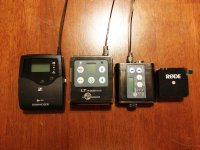
Yeah, I've been trying the Rode Go as a hop. People laugh when I pull this out of my bag but it's actually much smaller and far lighter than my other transmitters. Camera guys like that. I wanted to make as much room as possible in A1 block for congested areas and limit intermod issues in my bag. Works decently for very short range like from my recorder to my Helix mounted camera or working in the same room with a camera. It doesn't have much range beyond that. Line of sight only. Does have decent battery life, though the sound quality isn't great. That works since I don't want lazy editors to use my scratch audio. As you can see, the Rode Go is smaller than everything that I have including the G4, SMQV and LT.

Rode comparo.jpg
 
Last edited:
The Tentacle Sync E looks really interesting too (and probably a bit better than the Tascam if it allows for passthrough).

The Tascam DR-10c also has passthrough (which works even if the unit's battery dies), which is pretty essential for such devices. The DR-10l version is crippled by having no passthrough, but that was made for the US market where the Zaxcom patent applies. But yes the upcoming Tentacle Sync E recorder may prove a better bet.

Cheers,

Roland
 
Do yourself a favor and avoid the Røde Wireless Go, barely good enough for YouTubers standing 5' from their cameras.
Wait for the Tentacle Track E, they're not shipping them until after NAB is what they told me.

The conclusion I've found with wireless is you 100% get what you pay for. The good stuff is Lectro and it's $3k per unit.
A few others are good too but all cost in the same ballpark, Zaxcom, Wisycom and Audio Ltd. but Lectros are the industry standard.

Step down from there and you are into the Sennheisers, Deity Connect, Røde you are already using. None of these systems are as bulletproof as
the good UHF stuff. The Sennheiser EWs are good but with the mods you want, over $1k per set and they're still not nearly as good as a good used Lectro.
The 2.4Ghz systems can all sound really good but they are limited as to range and where they might work well and where they are useless. I have your same
Røde and the Deity Connect and under the right circumstances, they can sound decent. But when they don't work, they just don't work and you are SOL.

The best strategy is to have both 2.4Ghz and good UHF and some Tascam DR10s or the Tentacles when they ship. Then you have three layers of alternatives and
if things are crap for UHF AND 2.4Ghz (it's happened to me twice), you can still get good audio as long as you know how to rig a lavaliere correctly with the DR10 or the Tentacle. Thats the best
you can do.

I definitely think I'll wait for the Tentacle Sync E, the control interface of the Tascam just looks too finicky for someone using these things as infrequently as I do.

And I've no doubt you get what you pay for with these things, but with the recorder added inline between the lav and the transmitter, that would seem to take a lot of the pressure off the wireless system - as you no longer need it to be 100%.

The sound quality comparison tests I've seen between the Rodelink and the Wireless Go (when both are paired with lavs), seem close enough to make little difference for my needs - so if having the Wireless Go makes mounting both the transmitter and recorder to talent less of an issue overall, then that seems like a reasonable compromise to me.
 
And I've no doubt you get what you pay for with these things, but with the recorder added inline between the lav and the transmitter, that would seem to take a lot of the pressure off the wireless system - as you no longer need it to be 100%.

Indeed, you can almost look at this the other way round: with a (decent) body-worn recorder you have a wired lav, and wireless monitoring! Obviously, workflow-wise, many professionals need multiple channels of decent wireless, but for others without such needs this means decent quality recording (with monitoring) at modest cost.

Cheers,

Roland
 
The sound quality comparison tests I've seen between the Rodelink and the Wireless Go (when both are paired with lavs), seem close enough to make little difference for my needs - so if having the Wireless Go makes mounting both the transmitter and recorder to talent less of an issue overall, then that seems like a reasonable compromise to me.

You are right in terms of sound quality. I picked up a Rode Wireless Go when they first came out - for a very specific purpose, aware of the limitations (which are well reported and tested: e.g. line of sight, limited range etc. etc.) - and, putting it through its paces, I was pleasantly surprised: and this comes from being no lover of wireless fullstop!

Cheers,

Roland
 
The sound quality comparison tests I've seen between the Rodelink and the Wireless Go (when both are paired with lavs), seem close enough to make little difference for my needs - so if having the Wireless Go makes mounting both the transmitter and recorder to talent less of an issue overall, then that seems like a reasonable compromise to me.

Just know that the other major hurdle you have with the Wireless GO is that you lose pretty much all of its effective working range if you put the transmitter on the talent’s back. It just doesn’t have a decent transmission output, and a human body will absorb most of it. These systems have to be completely line-of-sight in order to work.
 
Just know that the other major hurdle you have with the Wireless GO is that you lose pretty much all of its effective working range if you put the transmitter on the talent’s back. It just doesn’t have a decent transmission output, and a human body will absorb most of it. These systems have to be completely line-of-sight in order to work.

Yes, that is the well-reported major limitation. Though, of course, the tiny transmitter can be hidden under clothing facing the receiver. Not so good if the talent is twisting and turning, or in a crowd. But, the odd drop-out is less of an issue if the body-worn recorder is the primary recording, as the OP seems to be wanting.

Cheers,

Roland
 
Between the FCC selling off our bands and RF interference and dropouts I've pretty much given up on wireless and have gone to the Tascams and then the Tentacle in April when it drops...
 
Between the FCC selling off our bands and RF interference and dropouts I've pretty much given up on wireless and have gone to the Tascams and then the Tentacle in April when it drops...

If you're willing to spend $3k per channel, the latest Lectros sound great, as long as you do a lot of scans. But $3k per channel puts them directly in the line for F/T sound mixers, not video shooters.
 
If you're willing to spend $3k per channel, the latest Lectros sound great, as long as you do a lot of scans.

For those who still haven’t completely abandoned the idea of wireless, there are two things that can be very helpful in minimizing issues.

First, roughly $140 can get an RF Explorer. I keep one in my bag, and it comes out whenever I start a new production day (even in the same location as the day before, because things can change). No wireless system in my experience has a very reliable clear-scan function. It’s good at finding frequencies that are clear in that brief moment that it’s sweeping the spectrum, but isn’t good at seeing long-term or intermittent issues. Defeating squelch before doing a clear scan can help, but it’s still only momentary. The RF Explorer will show you everything that’s active in the area with constant readout. This is a much better way to avoid interference, and it’s much faster than waiting for the receiver to scan through.

Second, many of the newer systems out there are available in wideband: frequency blocks that cover several of the traditional blocks. Sennheiser’s ew512 in the AW+ band covers blocks 470, 19, and 20, and part of 21. Same with the Sony UWP-D21, but it doesn’t cover as much of block 21. On the high end, Lectro’s SRc (and certain transmitters) in their new A1 designation also cover 470, 19, 20, and part of 21. B1 covers the rest of 21, plus 22 and 23. Zaxcom’s wideband receiver covers 500MHz through 700MHz bands. Wysicom systems cover blocks 470 through (most of) 25. Versatility is key, especially in the US as more and more of our white space gets sold off.
 
Back
Top