C100: Why is a C100 Worth Over Twice the Cost of a BMCC?

They are made for different needs, but really after trying the C100 I dont understand for what need it is made for.

I partially own a C300 and it serves its purpose well (TV reportage work), and was thinking about buying the second working cam but the C100 is really dissapointment to me. The things which are the best on C300 (EVF, Codec) are really crippled on C100.

First, I hate the idea in using a C100 with non-secure ext. recorder. If you want to use it with ext. recorder you basically have to rigg it like Blackmagic and then all talk about the form factor goes into the water. If you dont want you are stuck with not so great codec

Second, viewfinder is awful, for real work you have to buy another one just like the BMC...

BMC seems like a great camera for its own work (cinema, commercial), but you need rigging and more time in post and then you surely can get better results then C100/C300 series.

C300 is nevertheless great for TV/doccu. Good form, built in ND (which are great on that camera because it allows you to soften up the sharp C300 image), good codec, pretty baked-in image (which is great in terms of workflow), for serial production work its great.
 
They are made for different needs, but really after trying the C100 I dont understand for what need it is made for.

The need is for people who want to have the ability to have a nice, interchangeable lens camera with good dynamic range and fully resolute 1080p and not spend over $10k for it.

I partially own a C300 and it serves its purpose well (TV reportage work), and was thinking about buying the second working cam but the C100 is really dissapointment to me. The things which are the best on C300 (EVF, Codec) are really crippled on C100.

I would not call the C100's AVCHD "crippled" exactly. You have the ability to get every bit of quality from the C100 as you can from the C300 with an external, and for times when you want to be really low-key, the AVCHD is some of the absolute best I've ever seen from that format. It's frankly amazing what Canon has been able to do with it in this camera, and it's half the space of the XF codec (remember, XF is MPEG-2 while AVCHD is MPEG-4).

First, I hate the idea in using a C100 with non-secure ext. recorder.

I did too, but I used it just a few days ago in a very run-and-gun environment and zero issues with any connectivity.

If you want to use it with ext. recorder you basically have to rigg it like Blackmagic

Please, not at all. Ninja-2, articulating arm, done. You don't even have to do anything except hit record on the camera. It's the same amount of rigging and time it would take to hook up a single external monitor. And it's still light enough to legitimately hand-hold.

If you dont want you are stuck with not so great codec

Again, stop bashing AVCHD on the specs and actually play with it. Outside of it not being 4:2:2, it's exceptional on the C100.

Second, viewfinder is awful, for real work you have to buy another one just like the BMC...

I will grant you this. Slightly more useable when you take the top arm off, but then it's still a small window through the viewfinder! Even so, most cameras could use a third-party EVF because the rear placement is just not ideal.

BMC seems like a great camera for its own work (cinema, commercial), but you need rigging and more time in post and then you surely can get better results then C100/C300 series.

I agree that the BMC will give you arguably better results after all that rigging and post work...but some of us don't want that all the time. Sometimes, AVCHD is more than plenty for a project, and a lot of times BMCC would be overkill.

C300 is nevertheless great for TV/doccu. Good form, built in ND (which are great on that camera because it allows you to soften up the sharp C300 image), good codec, pretty baked-in image (which is great in terms of workflow), for serial production work its great.

And the C100 is right there with it. If you're shooting TV/docu, then I fail to see why 4:2:2 is crucial. AVCHD can handle a light grading well (especially if you're baking in the image already), the file sizes are smaller, SD cards are cheaper (and I personally don't care for the CF card format), and the camera can be used in a much more compact way (the LCD is not attached to the handle).

Frankly, I agree, the C300 is a terrific camera and much stronger than the C100 in a variety of ways...but it is $8500 stronger? Personally, I don't think so.
 
The need is for people who want to have the ability to have a nice, interchangeable lens camera with good dynamic range and fully resolute 1080p and not spend over $10k for it.


I would not call the C100's AVCHD "crippled" exactly. You have the ability to get every bit of quality from the C100 as you can from the C300 with an external, and for times when you want to be really low-key, the AVCHD is some of the absolute best I've ever seen from that format. It's frankly amazing what Canon has been able to do with it in this camera, and it's half the space of the XF codec (remember, XF is MPEG-2 while AVCHD is MPEG-4).


I did too, but I used it just a few days ago in a very run-and-gun environment and zero issues with any connectivity.


Please, not at all. Ninja-2, articulating arm, done. You don't even have to do anything except hit record on the camera. It's the same amount of rigging and time it would take to hook up a single external monitor. And it's still light enough to legitimately hand-hold.


Again, stop bashing AVCHD on the specs and actually play with it. Outside of it not being 4:2:2, it's exceptional on the C100.


I will grant you this. Slightly more useable when you take the top arm off, but then it's still a small window through the viewfinder! Even so, most cameras could use a third-party EVF because the rear placement is just not ideal.


I agree that the BMC will give you arguably better results after all that rigging and post work...but some of us don't want that all the time. Sometimes, AVCHD is more than plenty for a project, and a lot of times BMCC would be overkill.


And the C100 is right there with it. If you're shooting TV/docu, then I fail to see why 4:2:2 is crucial. AVCHD can handle a light grading well (especially if you're baking in the image already), the file sizes are smaller, SD cards are cheaper (and I personally don't care for the CF card format), and the camera can be used in a much more compact way (the LCD is not attached to the handle).

Frankly, I agree, the C300 is a terrific camera and much stronger than the C100 in a variety of ways...but it is $8500 stronger? Personally, I don't think so.

Gary thank you for your answer. And I tend to agree with your conclusion to some level as C300 being overpriced in some sort of a way (but you dont have much competition for TV/docs kind of works). Thats maybe a reason why I emotinally over-reacted about C100, because I really wanted it to work so I can buy second cam on more affordable basis. But in the end, I realize that the things why I love the C300 the most are left out: like great codec, great EVF, and built-in ND is not essential but also quite handy (as on sharp C300 when you see the influence on images you will use it most of the time :)). And sorry AVCHD is OK but in todays world of new camera/s is not good enough for me (if that is a case I would look for some even cheaper cameras).

And I agree about BMC which requires more time, thats why it is best solution to have camera that fits your needs best or to have both cameras for different purposes (C300/C100 - tv, docs; BMC - controled enviroment like film, commercial, ...)

What is your honest experience with Ninja-2 on C100, I am realy interested in your experience??? Did you find any problems and how did it fit into form factor?
 
I realize that the things why I love the C300 the most are left out: like great codec, great EVF, and built-in ND is not essential but also quite handy

It kind of sounds like you don't realize that the C100 has built in NDs. And I'd say they are essential.

Codec is a non-issue but EVF sucks, as you've correctly stated.
 
I realize that the things why I love the C300 the most are left out: like great codec, great EVF, and built-in ND is not essential but also quite handy

As Andree correctly pointed out, the C100 has ND filters. It would be a total no-go without that. The EVF is much better on the C300, but at the same time I feel like investing in a third-party one is a much more ideal option, considering that you can mount it more to the front-side of your camera (I've used EVFs that are mounted on the rear and it just makes shoulder rigs incredibly heavy due to needing to balance out the camera/lens combo). I still believe you are severely underestimating AVCHD for the most part.

And I agree about BMC which requires more time, thats why it is best solution to have camera that fits your needs best or to have both cameras for different purposes (C300/C100 - tv, docs; BMC - controled enviroment like film, commercial, ...)

Exactly. Ideally, I would have both. We'll see what happens when my m4/3 BMCC is finally ready for pickup.

What is your honest experience with Ninja-2 on C100, I am realy interested in your experience??? Did you find any problems and how did it fit into form factor?

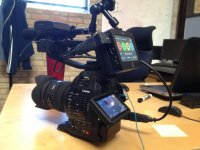
Here's the rig:

IMG_0469[1].jpg

It may look heavy, but the Ninja-2 is actually very light. I had no issues hand-holding it and no issues concerning the HDMI connection (and you can always purchasing locking HDMI cables as well). I shot ProRes 4:2:2 HQ and the Ninja-2 is terrific because it receives timecode over HDMI along with start/stop flags. You can literally forget all about it if you want. But, here's the thing:


I bought the Ninja-2 recorder because my next learning opportunity involves shooting a project in C-log and doing a DaVinci Resolve Lite color pass. Outside of that, I'd be perfectly happy with just internal AVCHD.
 
Gary how are those Rokinon lenses? I need a set that's not going to cost a bucket (based on budget for day shoots on these jobs) and can take a little hard work and sweat - think dusty humid unpleasant places where you wouldnt want to take your nice glass out.
 
Noel, those Rokinon's aren't bad, especially the 35 and 14 (I don't really have use for the fisheye 8mm). The 24 is okay, but it's soft wide open, and has a haze over it that's very similar to the Nikkor 35mm f/1.4 (non-AIS) wide open. The housing is plastic, but that keeps the weight down, and the lenses feel pretty solid. The aperture ring has just enough resistance, and I do happen to like the consist 77mm threads on the 24/35 (can't mount any filters to the 14).

If I was in the market for some new primes, I would definitely take a look, but my Nikkors are serving me just fine right now, and I think my next major lens purchase is going to be the 24-105.
 
hi,
i'm on the best way to purchase a C100..
There's still one question that kinda bugs me. I have a Zacuto EVF and want to use it on the C100.
Is there a option to see the full Videooverlay (with all the Data, WFM and Magnification-function) over HDMI ??

Regards
Steffen
 
Gary how are those Rokinon lenses? I need a set that's not going to cost a bucket (based on budget for day shoots on these jobs) and can take a little hard work and sweat - think dusty humid unpleasant places where you wouldnt want to take your nice glass out.
The Rokinons are nice. SOme people say they are better than the canon equivalents. THe focus ring is nice and long and the iris is de-clicked. Now all they need to do is make a 50 1.4 so a set could be complete.
 
I bought the Ninja-2 recorder because my next learning opportunity involves shooting a project in C-log and doing a DaVinci Resolve Lite color pass. Outside of that, I'd be perfectly happy with just internal AVCHD.

Nice test. I'm surprised how well the AVCHD compares. Other than a few shots where you can see more detail in the water and grass they look almost identical. For my purposes the AVCHD would work fine. In general the slight increase in quality with ProRes would not be worth the additional gear, weight, and data storage of the Ninja for me. Of course I have a C300, but if I hadn't gotten it already I think I might get a C100. I'd like to see some 10,000 and 20,000 ISO tests with the C100 to see how it compares noise-wise with the C300.
 
Nice test. I'm surprised how well the AVCHD compares. Other than a few shots where you can see more detail in the water and grass they look almost identical. For my purposes the AVCHD would work fine. In general the slight increase in quality with ProRes would not be worth the additional gear, weight, and data storage of the Ninja for me. Of course I have a C300, but if I hadn't gotten it already I think I might get a C100. I'd like to see some 10,000 and 20,000 ISO tests with the C100 to see how it compares noise-wise with the C300.

I can't post direct comparison shots, but currently shooting with C100 and have previous experience with C300. My subjective impression is that the C100 is actually "better" in that the AVCHD hides some grain and chroma noise. This is not really better after grading, but out of the can the C100 is a tiny bit better at high ISO while retaining resolution.
 
Last edited:
hi,
i'm on the best way to purchase a C100..
There's still one question that kinda bugs me. I have a Zacuto EVF and want to use it on the C100.
Is there a option to see the full Videooverlay (with all the Data, WFM and Magnification-function) over HDMI ??


thank you for your answere, but can you confirm that the overly with the WFM, Peaking, Zebra and Magnification works on your C100 - HDMI Out ??
I have had a c100 for a short time to test these settings, but i had no chance to bring the Zebra, Peaking etc.. on my HDMI-Screen (only the Dataoverlay works for me)

thanks again
Steffen
 
There is an option where you set the zebra settings to display them on the external monitor.

I dont think that the Wave forms appear on the external monitor.
 
Here's the rig:

View attachment 63807

It may look heavy, but the Ninja-2 is actually very light. I had no issues hand-holding it and no issues concerning the HDMI connection (and you can always purchasing locking HDMI cables as well). I shot ProRes 4:2:2 HQ and the Ninja-2 is terrific because it receives timecode over HDMI along with start/stop flags. You can literally forget all about it if you want. But, here's the thing:


I bought the Ninja-2 recorder because my next learning opportunity involves shooting a project in C-log and doing a DaVinci Resolve Lite color pass. Outside of that, I'd be perfectly happy with just internal AVCHD.

Thanks Gary. Probably one of the most useful little demonstrations on the adequacy of well done AVCHD that I've ever seen on this forum, and its just about nudged me into pulling the trigger on the C100 (I'm almost totally over my Ikonoskop delirium--maybe it was the christmas egg nog). I really need a B camera for my interview setup though, do you do a lot of 2 camera? I'm doing the AF100/GH2 thing with smart slate, fool proof but I'm sure I have as much invested in audio and TC gear as cameras for the moment. Is there any way to jam a smart slate from a Ninja? a C100?
 
The Ninja can record time code from the C100 over HDMI, but I don't think there's any way to generate time code outside of the C100 at this moment.

I seriously think that you could end up getting pretty damn close matching with a GH2 and the C100. Would require a lot of tweaking and testing to get you there, but from my comparison test I feel that it's doable.
 
They are made for different needs, but really after trying the C100 I dont understand for what need it is made for.

I partially own a C300 and it serves its purpose well (TV reportage work), and was thinking about buying the second working cam but the C100 is really dissapointment to me. The things which are the best on C300 (EVF, Codec) are really crippled on C100.

First, I hate the idea in using a C100 with non-secure ext. recorder. If you want to use it with ext. recorder you basically have to rigg it like Blackmagic and then all talk about the form factor goes into the water. If you dont want you are stuck with not so great codec

Second, viewfinder is awful, for real work you have to buy another one just like the BMC...

BMC seems like a great camera for its own work (cinema, commercial), but you need rigging and more time in post and then you surely can get better results then C100/C300 series.

C300 is nevertheless great for TV/doccu. Good form, built in ND (which are great on that camera because it allows you to soften up the sharp C300 image), good codec, pretty baked-in image (which is great in terms of workflow), for serial production work its great.

Let me tell you what C100 is for.

I just got myself a C100 after weighing all the pro and cons. I am upgrading from 5D2 and 1 of the most impt consideration is that the new cam must work well with all my existing 5d2s. 5D3 doesn't have much of an improvement and is pretty disappointing. Sony is out of the way as the picture look very much diff and i do not want to spend time in post making them look similar. FS100 or 700? Nah....I never use slow mo all theese years and don't forsee myself using it anytime soon. I will rent one if I need it next time. Furthermore the Sony has poor ergonomics.

Basically I need a cam that is easy to work as I am more into weddings for run and gun and other simple corporate jobs. BMCC although looks good but is impossible for weddings. Too slow to operate and lousy low light capability crop factor of 2.3X.

C300 is good but the price is overkill for weddings. As we run multiple cams for wedding (3-5 5D2), in business sense it is unwise to buy 3-4 C300. It's gonna take a long time to recoup back the investments. But for C100 we can buy 3-4 sets and will make back the $ fast enough.

In conclusion C100 is not for everyone but is targeted at the event shooters who has no time to light up a scene yet want a better quality image than 5D 2/3 and doesn't want to spend more than 10k for a cam. AVCHD is fine for me as I only do light color correction and grading.
 
@ Gary Huff...
You seem to be rationalizing quite a bit with all of your detailed analysis/comparisons.
If the c100 is so great as you seemed to be defending it to be, why on earth would anyone ever buy the c300 or c500 for that matter at a much, much greater cost???
Answer:
Because the c100 is crippled in several areas, otherwise the "better" c300 and 500 would not exist.
 
Back
Top