
David W. Jones
Veteran
This may help with understanding crop factors. http://www.abelcine.com/fov/

Follow along with the video below to see how to install our site as a web app on your home screen.
Note: This feature may not be available in some browsers.

yes, he has it backwards, but, if reversed, it is still.a valid point. different focal lengths not only have different fov, but render the scene different. longer focal lengths have more spatial compression and thus are more appealing to shoot people with (and the reason we often do not shoot close-ups with wide angle lenses)this all being said, back to the OP's question, or sorta. as a previous poster said, i simply think about my focal lengths choices in regards to the format i am shooting. thankfully, the majority of film-like cameras are very close to Super-35 sized (save for the 2/3" varicams and such). i would just use the lenses for awhile. after a shoot or two, you won't even think about it.You've got it completely backwards. Pulling back on GH2 to match the crop of T2i with a same lens would produce images with completely different perspectives. You should be putting a wider lens on GH2 and leave the cameras in the same position.
great link. i should have thought of this earlier to post!This may help with understanding crop factors. http://www.abelcine.com/fov/
You've got to be kidding me right?? That's simulation supports exactly what I've been arguing.great link. i should have thought of this earlier to post!
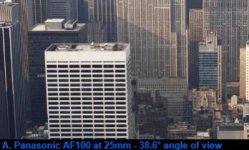
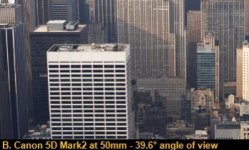
IN THE REAL WORLD...mm, focal length, field of view are all the same. If you're shooting with a cropped sensor camera (still or video) in a comparison to 35mm/Fullframe sensor, you must consider the crop-factor when choosing a lens. For example, with Panasonic AF100, the crop factor is 2x. If you need a 50mm, you don't go out and buy a 50mm. Instead you buy 25mm. There's nothing confusing about that! It's a simple math. Of course, you would still call a 25mm lens a 25mm lens but you use it as a 50mm lens. Thus, 25mm becomes 50mm.
I'm not that old nor have ever shot on film but I've shot with both FF and crop sensor cameras along side each other plenty.
The crop factor is always in relation to the 35mm full frame sensor, which what the lenses are based upon.In my opinion the only time you should be using a full frame 35mm still format as a comparison when determining lens selection and crop factors with your current camera, is if you are also shooting video with something like a Canon 5DmkII, which is a full frame camera. So while it is true that if you are comparing the 50mm lens from the FS100's S35mm size frame to a Canon 5DmkII's Full frame, the angle of view goes from 39.6 degrees to 26.6 degrees, and with the 1.5X crop from 50mm to 76.2mm. But, if you were to compare your FS100 to the industry standard Super 35mm film, then you are looking at a 1.1X crop factor. So that 50mm lens on a Super 35mm motion picture camera with a 27.9 degree angle of view, acts like a 52.6mm lens on the FS100 with a 26.6 degree angle of view. Not much difference at all really. Same holds true with the AF100 you mentioned having a 2X crop factor. It's really only 1.4X when compared to Super 35mm film. So a 35mm lens on an AF100 will act like a 50mm lens on a Super 35mm film cam.
Just the thoughts of an old guy who has shot on both sides of the road.
All the Best!
Dave
I guess that's your choice but that still doesn't change the facts.I will have to disagree.

I guess that's your choice but that still doesn't change the facts.
http://vimeo.com/videoschool/lesson/127/crop-factor
The Crop Factor is based on the 35mm lens system. The sensor size the variable factor but it's always in relations to the 35mm lenses and its focal length. Even lenses made specifically for 4/3 sensor (2x crop factor) are based on 35mm platform.
You can compare the difference in crop factor ratio between different sensor sizes but it all derives from 35mm platform.
Full frame sensor will ALWAYS have zero crop factor. You can claim that FF sensor would have an "x" crop factor to a medium format, for example, but that's really irrelevant for the most part.
| Manufacturer | Crop Factor |
| Canon | 1.6x |
| Nikon | 1.5x |
| Olympus | 2.0x |
| Pentax | 1.5x |
| Sony | 1.5x |
FOV is only one aspect of lens selection, and people place too much emphasis on it. Even though 25mm on a 4/3 sensor has the same FOV as 50mm on a full frame, the way they render images is way different. The perspectives of the two lenses are completely different.