Why are they calling this 50mm telephoto?

Since it's a E-mount lens, it's really 75mm whereas most other 50mm could be either 50 or 75mm depending on the body you put it on. But the classification is completely up to the manufacturer. Canon has their crop-sensor only 50mm listed as a "Medium Telephoto".
 
I know the guys with the 400s would beg to differ, but I really would consider a 50 a medium...pretty tight
 
Since it's a E-mount lens, it's really 75mm whereas most other 50mm could be either 50 or 75mm depending on the body you put it on. But the classification is completely up to the manufacturer. Canon has their crop-sensor only 50mm listed as a "Medium Telephoto".

it is really a 50mm lens. You can say it acts like a 75mm lens would on a full frame body in relation to FOV, but a 50mm is a 50mm is a 50mm.
 
it is really a 50mm lens. You can say it acts like a 75mm lens would on a full frame body in relation to FOV, but a 50mm is a 50mm is a 50mm.
This lens would be 50mm on a full frame sensor. But since it's E-mount, it's a crop-sensor-only lens. It can never be used on a full frame sensor body -- it will not cover the FF sensor. Essentially, the widest this lens can be is 75mm.
 
This lens would be 50mm on a full frame sensor. But since it's E-mount, it's a crop-sensor-only lens. It can never be used on a full frame sensor body -- it will not cover the FF sensor. Essentially, the widest this lens can be is 75mm.

In relation to the FOV it would provide on a FF sensor (if it were capable of doing so, which it isn't). 50mm is still 50mm, it's the image format you place the 50mm in front of that affects the FOV you'll get from that lens.
 
50mm is the focal length. That never changes, no matter what camera it is mounted to. FOV changes, yes. But it does not become a 75mm lens. By the way, I do not consider 28mm to be a "normal" lens for APS-C cinematography. I consider 35mm to be normal, as it is considered a normal lens in super 35mm terms.
 
50mm is the focal length. That never changes, no matter what camera it is mounted to. FOV changes, yes. But it does not become a 75mm lens. By the way, I do not consider 28mm to be a "normal" lens for APS-C cinematography. I consider 35mm to be normal, as it is considered a normal lens in super 35mm terms.

I second that. For years I have read Hollywood cinematographers referring to the 40mm as their "Normal" lens, but with the Super 35mm that works out to about 35mm. I have a 35mm Nikkor f2.8 for my FS100. I really like the lens and that FOV.
 
Okay, now everyone's confusing me...

I know that when I put a 50mm on a 5D and place it next to a fs100 with a 50mm...it will look different. We obviously know why, but I don't like the sound of a 50mm is a 50mm on a FS100? It's a "50mm" because that's what the lens is, so we can't say a 50mm lens is a 75mm lens, but it's giving you a tighter shot (like a 75mm), so it's a 75mm POV, yes?

Or am I confused?
 
Yes, 50mm is 50mm. I'm simply trying to answer OP's question. The FOV or "length" of 50mm becomes 75mm on FS100, and that is why Sony classifies E-mount 50mm as a telephoto while their FF 50mm is listed as a normal lens.
 
Okay, now everyone's confusing me...

I know that when I put a 50mm on a 5D and place it next to a fs100 with a 50mm...it will look different. We obviously know why, but I don't like the sound of a 50mm is a 50mm on a FS100? It's a "50mm" because that's what the lens is, so we can't say a 50mm lens is a 75mm lens, but it's giving you a tighter shot (like a 75mm), so it's a 75mm POV, yes?

Or am I confused?
Haha you've got it right. Everyone is getting caught up on the semantics. Like you said a 50mm has the same field of view as a 75mm on FS100 sensor -- it doesn't become a 75mm. But when you choose a lens for a crop sensor, the FOV difference cause by crop factor is the decisions factor, not what's written on the lens. So you would be using 50mm as a 75mm lens for the most part.
 
Okay, now everyone's confusing me...

I know that when I put a 50mm on a 5D and place it next to a fs100 with a 50mm...it will look different. We obviously know why, but I don't like the sound of a 50mm is a 50mm on a FS100? It's a "50mm" because that's what the lens is, so we can't say a 50mm lens is a 75mm lens, but it's giving you a tighter shot (like a 75mm), so it's a 75mm POV, yes?

Or am I confused?

It all gets very confusing because for many of us old-timer image makers, our first forays into image making were with 35mm still cameras (an image format people refer to these days as 'full frame'). Because 35mm still film usage was so wide-spread, as smaller S35mm-sized sensors emerged with the earliest DSLRs, their crop-factor (when compared to 35mm still film) was used as a common reference point to help people get their bearings - so that they understood that on a cropped sensor (DX/APS-C) a 35mm lens was equivalent to the 50mm lenses they used as 'standard' primes on 35mm still cameras.

The problem now, is that a lot of shooters these days never actually shot on 35mm film (or shot enough to see it as a standard), so when people refer back to it (i.e. 50mm becoming 75mm on an FS100) they're referring back to a standard that many people have never known personally, and can't really rationalise as a frame of reference in their own minds.

Which naturally makes the whole thing very confusing.

I think the easiest way to think of it all, is to simply determine what focal length creates a 'standard' FOV on the particular image format you're shooting in:

Full-frame = 50mm
S35mm = 35mm
4/3" = 25mm

And simply consider your wide-angle and telephoto options in relation to that 'standard' FOV for the image format you're shooting on (which is roughly the FOV you see with your own eyes).

Hope that helps.
 
As folks have pointed out, the focal length is a factor of the lens, it doesn't depend on what camera you put it on. The field of view is measured as an angle, not in mm, and is a factor of the focal length relative to the sensor size.

Commonly, a lens whose focal length is the same as the sensor diagonal size, or a little longer, is considered "standard". So on 35mm still photography, with a diagonal size of 43mm, a 50mm lens is considered standard. Super 35, including the FS100, has a sensor size around 27-28mm, so you might consider a 30mm lens, or a 35mm, to be standard -- there's no really clear definition of what a "standard" field of view is, it's rather subjective.

Frequently people refer to a lens on a specific camera as having a field of view equivalent to a different lens on a 35mm still camera. While convenient if you're used to still cameras, this gets confusing pretty quickly. "A 50mm on Super 35 is like an 80mm on 35mm"...! I prefer to just know my sensor size, and think about the focal length relative to that.

Anyhow, significantly longer than standard is tele; significantly wider is wide-angle. On an FS100 a 50mm would be pretty much the first "tele" lens -- bear in mind that tiny increments don't make a heck of a difference. 50mm would be great for portraits.
 
IN THE REAL WORLD...mm, focal length, field of view are all the same. If you're shooting with a cropped sensor camera (still or video) in a comparison to 35mm/Fullframe sensor, you must consider the crop-factor when choosing a lens. For example, with Panasonic AF100, the crop factor is 2x. If you need a 50mm, you don't go out and buy a 50mm. Instead you buy 25mm. There's nothing confusing about that! It's a simple math. Of course, you would still call a 25mm lens a 25mm lens but you use it as a 50mm lens. Thus, 25mm becomes 50mm.

I'm not that old nor have ever shot on film but I've shot with both FF and crop sensor cameras along side each other plenty.
 
This isn't a new 'problem' -- it just happens most users don't have much experience with different formats. Back in the day, we shot with 35mm stills cameras and knew that a 50mm lens was 'normal', we shot with 2 1/4" Hasselblads and knew that 80mm was a 'normal' lens, we shot with a 135 Rollei (a half-frame camera) and a 25mm lens was normal ... Each format has a different lens as normal -- the focal length of a lens only indicates the angle of view if you also know the frame size. 35mm Full Frame as we seem to now call it was only one of many formats -- for most of my career, it wasn't even the format used in 'serious' photography.

Similarly, 'depth of field' was a given -- and it was manipulated to be shallow, or deep, or something in between. Now there seems to be an assumption that 'depth of field' means 'shallow depth of field' ... but of course it doesn't -- DOF can be shallow, or not -- and you generate the one you want to suit your subject. To speak as if DOF only means 'shallow' misses the point ...

Rant over.

Cheers,
GB
 
IN THE REAL WORLD...mm, focal length, field of view are all the same. If you're shooting with a cropped sensor camera (still or video) in a comparison to 35mm/Fullframe sensor, you must consider the crop-factor when choosing a lens. For example, with Panasonic AF100, the crop factor is 2x. If you need a 50mm, you don't go out and buy a 50mm. Instead you buy 25mm. There's nothing confusing about that! It's a simple math. Of course, you would still call a 25mm lens a 25mm lens but you use it as a 50mm lens. Thus, 25mm becomes 50mm.

I'm not that old nor have ever shot on film but I've shot with both FF and crop sensor cameras along side each other plenty.

FOV is only one aspect of lens selection, and people place too much emphasis on it. Even though 25mm on a 4/3 sensor has the same FOV as 50mm on a full frame, the way they render images is way different. The perspectives of the two lenses are completely different and in my eyes the 50mm will always be a more attractive looking focal length, regardless of what format sensor you're shooting on.

I use the same set of primes with my T2i and GH2 (Nikon 35, 50, 85) and aside from having to pull further back with the GH2 compared to the T2i I wouldn't really consider finding 4/3 equivalents to achieve the same FOV as on the T2i. Once you get into the ultra-wide lenses they start to make things look weird.
 
FOV is only one aspect of lens selection, and people place too much emphasis on it. Even though 25mm on a 4/3 sensor has the same FOV as 50mm on a full frame, the way they render images is way different.
NO...
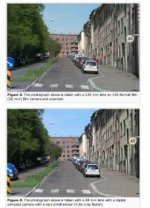
Look at the two photos of the street in the following example found on this webpage. Notice they are vastly different focal lengths but both look identical in terms of perspective etc. one lens is 135mm, the other 28mm...
Screen shot 2011-12-14 at 4.53.15 PM.jpg
 
NO...
Look at the two photos of the street in the following example found on this webpage. Notice they are vastly different focal lengths but both look identical in terms of perspective etc. one lens is 135mm, the other 28mm...

As you get wider though, like say the 7-14 @ 24 on a m4/3 compared to a 24mm on a full frame, the 24mm is going to be normal while the 7-14 might have a little distortion, but thats an extreme case.
 
FOV is only one aspect of lens selection, and people place too much emphasis on it. Even though 25mm on a 4/3 sensor has the same FOV as 50mm on a full frame, the way they render images is way different. The perspectives of the two lenses are completely different and in my eyes the 50mm will always be a more attractive looking focal length, regardless of what format sensor you're shooting on.

I use the same set of primes with my T2i and GH2 (Nikon 35, 50, 85) and aside from having to pull further back with the GH2 compared to the T2i I wouldn't really consider finding 4/3 equivalents to achieve the same FOV as on the T2i. Once you get into the ultra-wide lenses they start to make things look weird.
You've got it completely backwards. Pulling back on GH2 to match the crop of T2i with a same lens would produce images with completely different perspectives. You should be putting a wider lens on GH2 and leave the cameras in the same position.
 
Back
Top