Why are colorists reducing whites?

I've been noticing the past year or so that colorists must be reducing the whites of their images down to 80-70IRE. Specular highlights rarely seem to surpass 80IRE. Can anyone shed any light as to why this seems to be/is a practiced technique?

Thanks All!
 
One reason might be to slightly restrict luminance values is that the closer the luminance goes to fully black or fully white the less you have the ability to use color and saturation.
So if you want to give your highlights a certain tint you have to restrict your luminance.
 
Last edited:
You are correct in that white is often not hitting 100%

Various reasons..

Art.

Least bad look from crappy cameras.

--

Art - old photos and or film fades and degrades so if you want to create a vintage look then you probably wont hit pure white.

--

Crappy cameras transition from bright to blown in a very unstable manner.. the worst being colour channel clipping (crazy doghnuts) seen round hotspots like ceiling lights or worst of all around blue LED lights.

There are various techniques to kill these video looks. Typically reducing highlight saturation and the like.. often you are forced to hide the horrors of the camera under some form of 'art' (see above!).


--

If I were presented with a 'bright poppy' fashion video, maybe, on a white cove I would be looking to hit 100%

S
 
You can guarantee that not every monitor will be calibrated like the one a film is graded on.
Therefore by reducing the whites it insures that the highlights are less likely to blow out with other monitors.
It also provides the ability to color or texture an image in the highlights which keeps the eye within the frame and focused on the subject.
 
I agree with a lot of the comments made in this thread about technical reasons though I think it seems to be more of an in-vogue stylistic choice than anything else.

And it is not something that is restricted to low-budget stuff or trying to cover up poor quality footage, nor is it associated with making the images look 'retro' or degraded. It just seems to be a current trend is to make footage look... well... not as good as it should.

It seems as though the reason so many people are doing is that "everyone else is doing it".
 
I never for the life of me understood how "milky shadows" and an overall low-contrast look got so popular. Contrast and tonal range, in general, tends to make stuff look good/more dramatic.
 
I thought about this thread last night watching Altered Carbon. There was an outdoor scene graded bluish with blown facial highlights that were very blue.
 
me too, but made me think of netflix's 'bloodline' which seems to often be a more saturated flavour of LOG, and then way more obvious is the one episode of 'black mirror' where it's the army zombie one and it looks to be left 100% ungraded log footage. Looked terrible imo lol
 
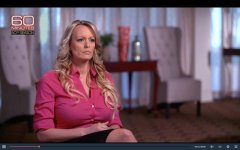
I know broadcast interviews aren't held to the highest standards but this is 60 Minutes and a very high profile piece...those blown out highlights are pretty rough and then they apparently tried to suppress the one between her face and the logo bug, mmph.

29060602_10155719292933173_4294054826377569600_o.jpg
 
Man. I would never have seem that without you calling attention to it. Now I think it’s weird they didnt touch the others...I could do that with native NLE tools and no masking!
 
I know broadcast interviews aren't held to the highest standards but this is 60 Minutes and a very high profile piece...those blown out highlights are pretty rough and then they apparently tried to suppress the one between her face and the logo bug, mmph.


Definately Not some of 60 Minutes best work. Her eyes were not even sharp. I couldn't tell if it was focus or something they did to it in post, but I had a hard time watching this one. I also found the medium-wide shot to be just an excuse to show her body. You never see that angle in a 60 Minutes piece. On the other hand, Anderson Cooper's shot looked great, which I'm postive he made sure of . . . and he should. Compare that segment with a story featuring Oprah a couple of weeks ago, now that one was firing on all cylinders. Beautiful stuff. Her sweater choice was perfect. You can tell who really demands top-notch work (Cooper and Oprah) and who does not.
 
Last edited:
Having shot a bajillion interviews I can see a scenario where a high profile subject is coming in so they prelight hours before the interview, then H/MU takes an hour longer than expected. By this time the sun is doing all sorts of things to that curtain you didn't expect.

Sadly on these interviews there's no allowance for a scout, you rely on a quick scan of your Sun Survey app and pray the curtains are thick enough to prevent sun hits from burning out. Once you discover there's a problem there's very little you can do. Producer doesn't want you to fuss over it because they don't want it to disrupt the interview.

I'm not saying this IS what happened, but I can very easily understand how this scenario plays out. Oh, btw, you don't get to pick the location, contribute to the blocking and may be limited by a modest lighting kit.
 
That's all true, Bill, but my point being...this is 60 Minutes and I would expect that certain of those concerns (modest lighting kit, for one) should really be less of a factor at that level. Network level broadcast shooting has come a long way in recent years--I'm not a sports fan but I'm always impressed by the difference in how it is covered now vs 10 or 20 years ago. Same for live shows, concerts etc. I'd like to think that they send the 60 Minutes shooters out with something better than a hatchback sized lighting package, especially given the unpredictability factors you mentioned. A 12x12 rag of diffusion clipped to the back of the curtain rail would have taken care of those highlights.

Years ago a room in my house was renovated on an HGTV show. It had four old-school skylights and during the first shooting day, the cameraguys were having to work around the searing shafts of sunlight. Subsequently I went up on the roof and covered them with white sheets held down with bricks. The next time the crew came, they realized what I'd done and were of course immensely grateful. I was like--it's what we do...!
 
I know broadcast interviews aren't held to the highest standards but this is 60 Minutes and a very high profile piece...those blown out highlights are pretty rough and then they apparently tried to suppress the one between her face and the logo bug, mmph.

View attachment 130127

The OP (long gone) talked about reducing whites.

This image did not absolutely need a larger lights package or more control. They needed a proper camera/post setup.

The correct LUT or look or profile or whatever would have made this look fine if the 'look' rolled the high end to have no colour saturation and to not go beyond 95/100 then it would just look fine.

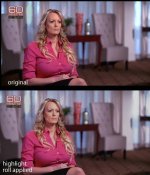
What is horrid here is the typical sony colour clipping in a single channel (blue) which gives the blown areas the nuclear dough nut and the fact that the fully blown areas here hit 100.

The correct profile/lut/look will not not allow any luminance level to hit 100/100 - even sun straight in the lens - the exact reason 'colourists are reducing whites'
 
Here I applied a desaturated roll off and nothing hits pure white. Only problem is it is catching her face too, but one would sort that on location with zebras.

pinkshirtRoll.jpg
 
Is it not safe to assume that this piece was shot 709 so, nothing they could do after the fact?

I just did something after the fact, but ideally it could be done 'live' with the right use of camera.

Assuming you had a great monitor, balls of steel and a sony FS7 (or many 'higher' cameras) you could apply such a lut in camera and 'burn it'.. or with various boxes just provide a lutted live feed or proxy file for broadcast while recording the log for future use.

Applying a lut in camera is the same as old school 'painting' of a camera but you just do it simply on the computer rather than deep in the unfathomable camera menus?
 
That's all true, Bill, but my point being...this is 60 Minutes and I would expect that certain of those concerns (modest lighting kit, for one) should really be less of a factor at that level. Network level broadcast shooting has come a long way in recent years--I'm not a sports fan but I'm always impressed by the difference in how it is covered now vs 10 or 20 years ago. Same for live shows, concerts etc. I'd like to think that they send the 60 Minutes shooters out with something better than a hatchback sized lighting package, especially given the unpredictability factors you mentioned. A 12x12 rag of diffusion clipped to the back of the curtain rail would have taken care of those highlights.

Years ago a room in my house was renovated on an HGTV show. It had four old-school skylights and during the first shooting day, the cameraguys were having to work around the searing shafts of sunlight. Subsequently I went up on the roof and covered them with white sheets held down with bricks. The next time the crew came, they realized what I'd done and were of course immensely grateful. I was like--it's what we do...!

I've shot for 60 Minutes, albeit, a while ago, and it was no different than shooting for MTV. Although it paid a lot less.
 
The OP (long gone) talked about reducing whites.

This image did not absolutely need a larger lights package or more control. They needed a proper camera/post setup.

The correct LUT or look or profile or whatever would have made this look fine if the 'look' rolled the high end to have no colour saturation and to not go beyond 95/100 then it would just look fine.

What is horrid here is the typical sony colour clipping in a single channel (blue) which gives the blown areas the nuclear dough nut and the fact that the fully blown areas here hit 100.

The correct profile/lut/look will not not allow any luminance level to hit 100/100 - even sun straight in the lens - the exact reason 'colourists are reducing whites'

Morgan is 100% correct. It's very possible highlights were protected on set.
 
Back
Top