Where is the D90 stronger than the 550D?

at the same time, low light comparisons are rather idiotic; who TRIES to shoot in practically no light conditions; in a real world environment one uses a LOT of light and filters it down, and you shoot for the lowest ISO/ASA/sensitivity or the sensors native sensitivity and expose properly.

Again, I don't understand what part of that statement people do not understand. If you shoot with available low light no matter how good the camera it will look like a low budget crappy production. Even if you shoot with real film. You HAVE to lit your sets properly.
 
i disagree. no light can be beautiful if you know what you're doing, even on film. especially on a low budget, since very few prople can do something good with a redhead kit. those of you who've checked out my fuerteventura trailer have seen parts of a feature done completely without lights. nb that i said if you know what you're doing, it's true that many amateurs and even pros have little idea how to shoot in low light. it's not just the camera, but the camera makes it possible. oh by the way shooting at high iso's is useful under artificial lights too, very few people can afford to light a large set to more than a couple of footcandles, i doubt many d90 users have multiple 18k's available, or even a genny to run them. if you have at least 3200 iso or so you can light even large outdoor night sets with a couple of blondes.
 
I agree with you, it's better to understand light then to rely on a camera's low light sensitivity. By understanding light you can get the "look" you want... All the grain or none of the grain. But.... But, you can always add grain in post, you can't pull it out. If you want flexability in post you should always record the most information the cleanest that you can (I'm not saying shooting for a look is bad, I love doing it myself). Just food for thought.
 
if you have the time and budget to both light for a low iso and go through a "flexible" post chances are you're not shooting with an slr, unless you're doing it for stealth and/or logistical reasons, but then again those pretty much rule out big light rigs anyway. i have a feeling those who say you always need plenty of light have most of their experience from shooting interviews and small indoor scenes. i wonder if they have any idea of what is involved in lighting big scenes to low isos and high stops. like a night beach exterior, one location we would never have access to without the exceptional low light sensitivity of the d90.
 
oh, and there are things you just can't light, like a night sky; pitch black on low isos, beautiful shades of blue, green and orange on higher.
 
I'm going to be shooting my third feature in two weeks and we're shooting on 2 t2i's 1 gh1(3) an hvx200 and an hmc150. We're renting a large HMI package for our 75% night shooting because, from my previous film experience, we want to shoot for as flexible a post as possible.

You can shoot plates for that night sky. You can also use after effects to motion track it and replace it later.

I think that everyone on here who is saying that you need more light is coming from more of a non indie production model. I've shot both ways and will tell you that if you don't have the money to rent a proper lighting package there are plenty of ways to get more light for cheap (home depot). If your shooting anything you should know what look your going for. Even with no lights that may mean that you should shoot day for night (if you want to shoot for a lower iso). If you want to make a grainy film then you need less lights, but you should still be thinking about how the lighting you do have is effecting your scene. Far too often people forget that just because a film is grainy doesn't mean it wasn't well lit (see Eraserhead).
 
Far too often people forget that just because a film is grainy doesn't mean it wasn't well lit (see Eraserhead).

If you are shooting film, and you want it to look grainy, you can select a different film stock, or you can make that choice in developing (or printing). But you don't do it by not lighting.

DSLRs don't get grainy when you don't light. They get ugly. Add grain in post if you really want it.
 
If you are shooting film, and you want it to look grainy, you can select a different film stock, or you can make that choice in developing (or printing). But you don't do it by not lighting.

DSLRs don't get grainy when you don't light. They get ugly. Add grain in post if you really want it.


100% agree. Shooting 800asa film stock or pushing/pulling/cross processing/bleach bypass etc... is totally different from a dslr's sensor having it's electronic gain boosted. But, for the sake of argument... If you want your film to look "Ugly" (and there are times when you'd want to do that believe it or not, ie... if your shooting something that's supposed to look "home videoish" or "security camera" etc...) than that's your choice.

:beer:
 
yes you can shoot plates and light with hmi's, but i'm talking about when you don't want to. my background is in a mix of big productions as well as small, and to me the requirements are always different. for my feature (as a director, i've produced and worked camera crew on several) high iso was a must. and i don't know the size of your hmi package but in my experience unless you have 18k's you still need high iso. i did a short where we struggled to get an f-stop with 500 asa neg and 6k's, it's depends on the size of your rig.
 
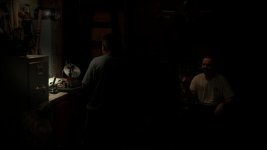
I thought I would offer a real world example of this.

These are two frames from our upcoming movie. The one graded near to the directors intent (I need to bring out the actors just a touch more) and one showing how it was shot.

Note that in the darkened version, the blacks are inky black and not blocked up. This is what happens when you shoot with adequate light.

The idea here in terms of cinematography, is to set a base level. Basically set something like I did where 15FC is your base light level. You want to choose a light level that allows the camera to record that with little grain or noise. This becomes "black". Then you light everything else proportionately. Like your whites will be 7 stops hotter than your base level. In our case, we were shooting with a lens that had a max aperture of F4.0. And unfortunately, I only had 3 practicals to work with on set, so I could only get 4 stops above base level.

What SHOULD happen if this is done properly, is that when you drop the levels in post, the parts of the scene recorded at base level drop to 0 IRE, and the brightest parts of the scene fall to about 40-60 IRE. This gives plenty of room to play with highlights in post, and the blacks become inky and noise free.
 

Attachments

  • 1153_BasicGradeA.jpg
    1153_BasicGradeA.jpg
    20.1 KB · Views: 0
  • 1153_ungraded.jpg
    1153_ungraded.jpg
    52.9 KB · Views: 0
yes you can shoot plates and light with hmi's, but i'm talking about when you don't want to. my background is in a mix of big productions as well as small, and to me the requirements are always different. for my feature (as a director, i've produced and worked camera crew on several) high iso was a must. and i don't know the size of your hmi package but in my experience unless you have 18k's you still need high iso. i did a short where we struggled to get an f-stop with 500 asa neg and 6k's, it's depends on the size of your rig.


Also the speed of your lenses, the look your trying to go for etc etc... But if your not able to rent the lighting package you need to get enough light for the scene you should know the result of shooting at high iso's(not everyone on these boards do). So maybe if your trying to shoot a large outdoor night scene and you can't afford to rent enough lights, use the best free light you can for an outdoor night scene... The sun. A high iso is never a "must" unless it's for a look or because your schedule is too tight to set up proper lighting (which is understandable but you should also know the end result will exhibit the image qualities that result in shooting without enough light to really get clean footage). Check out:

www.ididntcomeheretodie.com

They made a feature on a gh1 shooting day for night and using plates (as far as I can tell). And as PerroneFord was saying, you can always crush the blacks and drop the overall brightness of your footage without adding noise but you cannot add light without introducing it.
 
you're constantly referring to the "results" of shooting at high iso, but that's the whole point isn't it? would you still light for 200 if you could get super clean results at 1600? that's what low light performance means, cleaner at higher isos, not grainier.

the main problem people who think they don't have to light have seems to be that they get ugly pictures, not that the light level isn't enough, i mean shooting under direct sunlight without fill isn't exactly easy to do either, although there are ways, just as there are ways to shoot interesting night exteriors without lights.

as for reasons to shoot high iso there are many more than those you mention. there are many locations where it's not practical to light, where you're not allowed to, or simply where you don't want people to see that you're making a movie, and so on. i'm not sure where you got the idea that everybody makes movies the same way as you. ;-)
 
I thought I would offer a real world example of this.
but that's a different issue altogether, and true for any iso you happen to be shooting at. contrast ratios work the same way whether your "base level" was set at 50 iso or 1600. low light doesn't mean underexposure, it means increasing the sensitivity so you don't.
 
but that's a different issue altogether, and true for any iso you happen to be shooting at. contrast ratios work the same way whether your "base level" was set at 50 iso or 1600. low light doesn't mean underexposure, it means increasing the sensitivity so you don't.

The issue is getting a clean image into the camera. Which is decidedly easier at ISO 200 than ISO 1600 in the real world. Whether we're shooting film or digital. Yes, contrast ratios are the same regardless of base level, but though low light doesn't mean underexposure, it DOES mean noisy exposure. And I'd rather prevent that.
 
The issue is getting a clean image into the camera. Which is decidedly easier at ISO 200 than ISO 1600 in the real world
hence the need for better low light performance, right?!? i do agree that lighting is generally necessary to get a nice image, for the reasons of contrast and depth you mentioned, but the level of light does nothing per se. a camera that produces a clean image at 1600 iso will let you light to lower levels, which is exactly why people want it. it's the same with film, people don't generally choose 500 film to get more grain (even though it certainly happens) but to be able to shoot better in available light, longer into the magic hour, to use smaller rigs, and so on, in short to use less light.
 
hence the need for better low light performance, right?!?

Hence the need at actually LIGHT a film.

i do agree that lighting is generally necessary to get a nice image, for the reasons of contrast and depth you mentioned, but the level of light does nothing per se. a camera that produces a clean image at 1600 iso will let you light to lower levels, which is exactly why people want it.

What people? Have you shot a film at ISO 1600? I don't want to work in an environment that dark all day. And even if you can shoot "cleanly" at ISO 1600, shooting at ISO 400 is is going to be cleaner still. This is just the nature of things.

it's the same with film, people don't generally choose 500 film to get more grain (even though it certainly happens) but to be able to shoot better in available light, longer into the magic hour, to use smaller rigs, and so on, in short to use less light.

I've seen any number of film shoots on ISO 500 (well actually ISO 320-400 since that seems to be where the majority of Cinematographers rate 5218/5219), and you know what I see? I see them using just as many lighting instruments as they do when when they shoot ISO 100. They are not doing it because they have to. They are doing it because crafting the light the way they want, requires instruments.

The only people I find clamoring for cameras to shoot cleanly into the ISO ranges above 1000 are:

1. People who can't afford lights.
2. People who don't understand how to use lights.
3. People who are too ignorant to know they need lights.

I suppose a fourth category could be added for people who can't use lights because they are filming in places they don't have permits to film, or people who can't control the set in front of the camera and don't want to draw attention to themselves. But that really gets back to an issue of budget.


Clearly, you and I see this issue differently, and that's fine. You'd seemingly want a camera that allows for quality imagery in the dark. I prefer to light my movies, and rarely push beyond ISO 400 for anything.
 
The reality is that for a film to look good in the dark YOU NEED TO LIGHT IT PROPERLY. There is no other way around it. And that is why they have people specializing in that. Anybody can argue and argue that you don't but you do. It is an essential part of creating a professional looking piece. Like I friend of mine use to tell me, light is the photographers brush. In this case the cinematographers brush.
 
The funny thing is I'm reading what mattsand and PerroneFord have to say and both are actually saying the same thing and agreeing with each other. It's just alot of back and 'fro because there's an underlying sexual status thing going on.
 
The funny thing is I'm reading what mattsand and PerroneFord have to say and both are actually saying the same thing and agreeing with each other. It's just alot of back and 'fro because there's an underlying sexual status thing going on.

Maybe you could interpret, because I surely don't get how we are saying the same thing.

And I have no idea what you mean by "sexual status".
 
Oh my God do you really want me to explain the sexual status reading of the conversation? Fine but you'll resent me for it...


Hence the need at actually LIGHT a film.

Yes we all agree, except under the circumstance which you have conceded "I suppose a fourth category could be added for people who can't control the set in front of the camera and don't want to draw attention to themselves. But that really gets back to an issue of budget."

I'd say more about creative intent than budget. Sky rises, motorway traffic, vast landscapes, outer space, wildlife, war, documentaries etc.

Sure we can light like no tomorrow, shoot plates, composites build from scratch with CGI. Or we can acknowledge the extra set of toolkits offered such as say 500 or 800 ISO film as mentioned, and even these crazy DSLRs - Nikon D90 and especially the D3S look really clean at ISO 1600 if I recall. Anyone that's used these cameras under such strenuous situations - or watched the Zacuto shoot out knows. We all agree on the possibilities, no disagreements here.

The subtext of your argument, and choice of words is that you think everyone else is a lazy cheapskate so they're using a high ISOs as an excuse, no? :P If that's how you only think then fair enough. No need to act catty about it haha.


PerroneFord said:
I've seen any number of film shoots on ISO 500 (well actually ISO 320-400 since that seems to be where the majority of Cinematographers rate 5218/5219), and you know what I see? I see them using just as many lighting instruments as they do when when they shoot ISO 100. They are not doing it because they have to. They are doing it because crafting the light the way they want, requires instruments.

mattsand said:
it's the same with film, people don't generally choose 500 film to get more grain (even though it certainly happens) but to be able to shoot better in available light, longer into the magic hour, to use smaller rigs, and so on, in short to use less light.

Both said the same thing here.


PerroneFord said:
The only people I find clamoring for cameras to shoot cleanly into the ISO ranges above 1000 are:

1. People who can't afford lights.
2. People who don't understand how to use lights.
3. People who are too ignorant to know they need lights.

Clearly, you and I see this issue differently, and that's fine. You'd seemingly want a camera that allows for quality imagery in the dark. I prefer to light my movies, and rarely push beyond ISO 400 for anything.

The bullet-pointing the obvious and veiled insult... and justifying with "I, [am better than you] prefer to light my movies." is abit condescending and insecure no? It's like a relationship a wife would say to a husband after a funny spat.

That's where the sexualness comes from :Drogar-Smoke(DBG):
 
Back
Top