
Navigation
Install the app
How to install the app on iOS
Follow along with the video below to see how to install our site as a web app on your home screen.
Note: This feature may not be available in some browsers.
More options
You are using an out of date browser. It may not display this or other websites correctly.
You should upgrade or use an alternative browser.
You should upgrade or use an alternative browser.
Where is Panasonic in this game?
- Thread starter Phil1076
- Start date

"Of which is strictly your opinion based on nothing. We're too early into the game to know what the potential resale value is. And if the photography world moves towards mirrorless cameras (of which I provided evidence of one photog's opinion) then that outlook is good.
Nonsense - I back up my points with multiple facts. And you counter act your own argument - my point EXACTLY was that it's too early too know if the format will be here to stay. Too early indeed.
"I would never trust that method. But then, I usually don't just "run out of the house", because professional results demand a professional workflow."
Never's a long time Brother.
"Is that all you're doing? Because, if so, I fail to see what your ultimate point is."
Wow. I think Bill Murray said it best:
"Lighten up Francis."
Fact is, MFT has at least one distinct advantage over larger sensors. For those of us that shoot documentaries, or prefer the handheld cinema-verite look, a light cine-style zoom lens is critical. Theoretically, the MFT size offers the possibility to design a 10:1+ lens that is relatively fast, relatively light and optically superior.
I say "theoretically" because thus far one does not exist. I bought my AF last February, confident in my heart that Panasonic would be intelligent enough and far-sighted enough to predict this very discussion and introduce, or cause to be introduced, a functional zoom for the camera. I bought the cheapest lens available, the Zuiko 14-54mm, positive that NAB would reveal something like a manual iris, faster, re-worked version of the 14-140 - a lens that exists in the Panasonic arsenal, is small and light, and with tweaking could have mitigated this whole thread.
It's true that at the price point, the AF100 is unique. However, it will be ultimately trampled in the dust if they don't step forward and take advantage of the camera's positive attributes - all these cameras use Canon, Nikon and PL mount lenses (well, admittedly, the Canon is screwy in that regard).
I will keep my AF for use with my Leicaflex and Canon FD primes, but after growing weary of waiting for a zoom, I bought an HPX250, which I've heavily modified for hand held use, and it will now be used for 80%+ of my work. True, Panasonic didn't lose a customer, but never-the-less, I am disappointed in their planning.
Bassman2003
Veteran
Mac, you raise a good point. In a way, there is still hope for a fixed lens Scarlet type of camera and the AF-200 could be that camera with some forward thinking. It does not need to be fixed lens but if they offered an 8x or 10x constant wide aperature motor driven servo lens I think it would be a big hit with the 1/3" chipper crowd that wants a little less DOF from time to time. A 24-240mm or even a 24-200mm lens (35mm eq.) would cover a lot of bases. (if it is possible!)

Erik Naso
Veteran
Mac, you raise a good point. In a way, there is still hope for a fixed lens Scarlet type of camera and the AF-200 could be that camera with some forward thinking. It does not need to be fixed lens but if they offered an 8x or 10x constant wide aperature motor driven servo lens I think it would be a big hit with the 1/3" chipper crowd that wants a little less DOF from time to time. A 24-240mm or even a 24-200mm lens (35mm eq.) would cover a lot of bases. (if it is possible!)
I would buy a fixed lens version of the AF-100 in a New York minute. That would be a excellent event or ENG style cam for that type of work.
if they offered an 8x or 10x constant wide aperature motor driven servo lens I think it would be a big hit with the 1/3" chipper crowd that wants a little less DOF from time to time. A 24-240mm or even a 24-200mm lens (35mm eq.) would cover a lot of bases.
Just look at the Sony F3 14x T3.9 - T6.8 servo zoom lens. It's big, it's ugly, it's slow, and it costs $10,000. Is this what you really want for the M4/3 format ?
Sony SCL-Z18X140 Motor Zoom Lens
Well, if you want increased resolution and more latitude (which are knocks on the AF100), then you have
to increase the sensor size. A lot of technology has been developed to improve bias and conveyance .. but
for CMOS sensors .. you're stuck to:
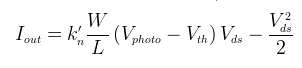
So, increasing the size of the sensor gives you more current and less noise since you can decrease bias.
The problem with smaller sensors is they have to bias higher, and that cuts down on latitude.
Higher currents means they can also read the sensor faster .. so that allows for more resolution.
So, there's the number of pixels . but, there's also the size of the pixels that matters too. Make them
bigger (physically), and the number of photons per pixel sensor goes up .. and the quantum charge conversion is
higher ... latitude is better .. noise is lower.
That's why I argue Panasonic should get an S35 (or larger) sized sensor ...
Combined with AVC-100 ... and that would be super cool....
jeff
to increase the sensor size. A lot of technology has been developed to improve bias and conveyance .. but
for CMOS sensors .. you're stuck to:
So, increasing the size of the sensor gives you more current and less noise since you can decrease bias.
The problem with smaller sensors is they have to bias higher, and that cuts down on latitude.
Higher currents means they can also read the sensor faster .. so that allows for more resolution.
So, there's the number of pixels . but, there's also the size of the pixels that matters too. Make them
bigger (physically), and the number of photons per pixel sensor goes up .. and the quantum charge conversion is
higher ... latitude is better .. noise is lower.
That's why I argue Panasonic should get an S35 (or larger) sized sensor ...
Combined with AVC-100 ... and that would be super cool....
jeff
Last edited:
That's why I argue Panasonic should get an S35 sized sensor
Everything you wrote makes sense in theory, but how do you explain Philip Bloom's Xmas daylight tests, where the GH-2 ( the smallest sensor ) had the highest visible resolution?
I strongly suspect that sensor manufacturing and the electronics that process the signal is not a level playing field, thus sensor size may only be part of the solution, but not the whole solution.
There are a lot of trade-offs in video sensors regarding size of pixels and how they read them. Still cameras have
the luxury of being to read all the pixels at a leisurely pace. If you don't care about time, the size of the pixel
doesn't directly relate to resolution .. it's the number of pixels. But, when you have to sense and read quickly, the
quality of the read (noise) factors in.
I haven't seen the Xmas daylight test .. but I would be much obliged if you could send a link (please)?
Last edited:
Make sure to log in and download the MP4 file to play it at full resolution, in order to see what is going on...
Philip Bloom Xmas Shootout Part 1
Philip Bloom Xmas Shootout Part 2
Philip Bloom Xmas Shootout Part 1
Philip Bloom Xmas Shootout Part 2
Well, if you want increased resolution and more latitude /QUOTE]
But not everyone wants more resolution - I use diffusion on almost everything to knock down the edgy look already - I really dislike most of the big sensor, look how shallow my DOF is, overly crisp images - and I know many others do as well. We're not all nature or wedding photographers, and most of the 5D-style story-telling I've seen is absolutely hideous. My opinion, and I have the right to it.
Latitude, yes - but I firmly believe that can be improved without the need of a larger sensor.. I mean, look how far we've come in only a few years.
And with MFT that zoom lens doesn't have to be as big as that horrible slow and heavy Sony - that was the point of my comment above if you'd take the time to read it.
And with MFT that zoom lens doesn't have to be as big as that horrible slow and heavy Sony - that was the point of my comment above if you'd take the time to read it.
I read your post, but I thought it was very unrealistic. A dedicated MFT "cine" lens is going to be priced like all other dedicated "cine" lenses, which means it's going to be very expensive. If this lens is also fast with a long zoom range, then we're getting closer to the price range of the Canon / Cooke / Zeiss PL zoom lenses which most of us can barely afford to rent, let alone own. ( new car price range )

Mike Harvey
Veteran
I would buy a fixed lens version of the AF-100 in a New York minute. That would be a excellent event or ENG style cam for that type of work.
I think a LOT of people would buy it in a New York minute. Whether they can do it and keep it at this price point is another matter
But you don't need a "cine" lens, especially in regards to the situation that jmarkham was referring to.
The best we can expect at an affordable price are the two new lenses that Panasonic has in the works: 12-35mm f/2.8 and 35-100mm f/2.8
Hopefully these lenses will have smooth zoom/focus controls and be parfocal. I expect these lenses will be priced in the $1,400+ price range. ( like their Nikon / Canon equivalents )
Bassman2003
Veteran
I will admit my post was from a desire point of view and might not be founded in practical reality. But, it seems lens manufacturing gets better and better all of the time. How hard would it be for the two lenses you mentioned above to be combined into a 12-100mm f2.8 with a servo motor? I think a lot of people would pay $3,500 for this lens if it was high quality. It might be large but it would cover a lot of shooting situations and make the camera much more "live" or event friendly.
And they could be a lot less than $1,400.
Yes, they could. I am hoping for lenses that are of the same quality as the Nikon 17-55mm f/2.8 ( sharp wide open, constant aperture, smooth focusing, solid construction, parfocal ) which B&H Photo currently sells for $1,400. The Canon 17-55mm f/2.8 is a little more than $1,000, it's a very nice lens, but I think the Nikon trumps it in terms of physical construction. Panasonic knows that many of us want to use these new lenses for video work, so we are expecting an extremely high quality lens, and quality costs.
When you look at Canon / Nikon 70-200mm f/2.8 AF IS lenses, the price shoots past $2,000. Yes the Pansonic 35-100mm f/2.8 will be a much smaller lens than either the Canon or Nikon 70-200mm, but I don't know how much difference this makes in the manufacture of an extremely high quality lens. Materials might be a bit cheaper, but I would imagine that the amount of work and the super tight construction tolerances aren't any different, so I'm expecting the Panasonic lens to be less expensive than the Canon / Nikon, but it still might sell in the $1,400 - 1,700 range. It would be great if the lenses were less expensive, but not if this sacrifices optical or mechanical performance.
How hard would it be for the two lenses you mentioned above to be combined into a 12-100mm f2.8 with a servo motor? I think a lot of people would pay $3,500 for this lens if it was high quality.
...A couple of things:
1- Panasonic also want to sell these lenses to still photographers, otherwise they won't sell enough lenses to justify the manufacturing costs. This pretty much nixes any dedicated "cine" lens unless they can charge a significant amount for it.
2- Building a 12-100mm f/2.8 lens is a huge deal. Forget the servo motor, just building a lens with this range at this aperture, puts you in to the dedicated "cine" lens category. A Zeiss 16.5 - 110mm T2.8 Master Zoom costs $58,000 and this only covers the Super35 format. ( not much bigger than M4/3 ) Even a RED 17-50mm T2.9 zoom costs $6,000, with no IS, no AF, no servo.
DSLR/EVIL lenses can only be low cost if they sell really well. Exotic cine lenses cost a fortune because they are the "exotic birds" of the camera world, and they sell in tiny numbers compared to consumer lenses.
Mark Smith
Veteran
Lenses and their manufacture are not subject to Moore's law. Their component parts need to be of a certain size , shape, with high precision and there is that thorny problem of optics and physics that gets in the way and really dictates the hardware you need to focus light for for a given sized sensor.