What F stop are Hollywood movies generally shot at?

1. I definitely have seen more stuff with shallow focus, not that I like it.

2. Hollywood of the second half of the 20th century had two main formats, "flat" and "scope," and neither was Super 35, which didn't become popular until the 21st century.

Flat. 21.95 x 11.86. This has a crop factor of 1.73. So if you're using full-frame, you would close down almost 2 f-stops to match it. I agree with many of the above who said f/4-f/5.6, maybe f/2.8 for a night scene, was popular in Hollywood. So to match that in full frame, you're looking at f/4 to f/11.

Scope. Which was their nickname for anamorphic. Which actually has an optical diagonal (45.5mm) almost identical to full frame. I don't know what f-stops that Hollywood used for scope, if it was any different from flat. I would think they would adjust it down a stop or two. But many anamorphic films seem to have shallower focus, so maybe they shot those at f/4 or f/5.6 too.
Not quite. Super-35 was resurrected as a format in the early 80s and became fairly popular by the end of that decade. Jim Cameron was a champion of the format, working out a complex custom frame line ground glass that didn’t use a common top line but instead a weight towards the top inner frame extraction. This allowed mastering multiple deliverables from the same negative for different presentation formats. A digression, but an unusual one. Notably Cameron hated shallow depth of field as it made his action and effects work more difficult.
 
I like a consistent t-stop within a scene and sometimes throughout an entire movie. The reason being that my eye and brain get comfortable to a certain level of exposure and that leads to a consistency in the lighting. I would generally shoot around a T2.8 in Super-16 and a T4 in Super-35. This gives a nice depth of field that I don’t find distractingly shallow while maintaining good separation. On a feature I could usually put down my meter after a couple days because I’d always be lighting to the same level and I just got used to it. Only for special shots like high frame rate or deep focus to make a reflection work required me to adjust light levels.

A few recent productions have been shooting on much larger sensor cameras such as the Alexa 65 and shooting with a wide aperture for an extremely shallow effect. Frankly I don’t see much reason to bother with those formats unless this is your goal, but it’s only been really utilized on a handful of productions. I’m not a fan of the movie Joker but the use of shallow depth in the film did work with the subject to increase the main character’s isolation from the world around him. But it’s a rare example.
 
I just don't see how an audience would be bothered by a changing f-stop. Realistically, if you really wanted to maintain consistency, I feel like you'd need to try to maintain the same depth of field. As we know, depth of field changes based on distance to subject, focal length, and aperture, so if one actually cared about maintaining depth of field, they'd need to keep all three of those the same throughout a movie, which is not really practical. So even if your f-stop stays the same, typically your distances from the subject and perhaps your focal lengths are changing between shots and scenes, meaning your depth of field is constantly changing, at which point, how does having the same f-stop throughout really help you?

In fact, I would argue that having a constant f-stop often leads to less consistency. As a basic example when I shoot interviews I often have a wide and a tight shot, and the wide I shoot around f/2-f/2.8 and the tight around f/4-f/5.6, as with the longer focal length the depth of field is shallower so stopping down means the depth of field is more similar between the wide and the tight shots.


On a side note, why do people use the term "T-stop" when referring to depth of field when the light transmission aspect of T-stop has nothing to do with depth of field, and f-stop is a more accurate representation of depth of field?


I like a consistent t-stop within a scene and sometimes throughout an entire movie. The reason being that my eye and brain get comfortable to a certain level of exposure and that leads to a consistency in the lighting.
What do you mean by "comfortable to a certain level of exposure"? One can obviously maintain exposure while changing the t-stop.
 
Last edited:
What do you mean by "comfortable to a certain level of exposure"? One can obviously maintain exposure while changing the t-stop.

I believe he is saying that if he shoots at a constant stop then he gets used to what the light levels look like to his naked eye and he can then quickly 'light by eye' without a meter or looking at the camera/monitor, etc.
 
On a side note, why do people use the term "T-stop" when referring to depth of field when the light transmission aspect of T-stop has nothing to do with depth of field, and f-stop is a more accurate representation of depth of field?

Because most "cine" lenses are marked in T stops and, except in extreme cases, the difference is pretty minimal between the actual T stop and f/stop. For example, a Canon CN-E 85 T1.3 is an f/1.2 lens, so if you're shooting at Tx, it's usually very, very close to the corresponding f/stop. Some outlying exceptions are the Sigma Classics that are the exact same f/stop as the "super speed" versions, but because of the difference in coatings(or lack thereof) the Classics are about a measured T stop slower.
 
how does having the same f-stop throughout really help you?

A reason for maintaining a stop is so that you don't have to re-light. If you change stops between, say, the wide and the tight, you either have to add ND in front of the lens(es) or you have to adjust all your lighting accordingly. Standard practice is to light the scene to a chosen stop and shoot everything in the scene at that chosen stop. At times there are light sources in the scene such as natural daylight that are not easy to deal with, "constants" in the scene. If you were to change stops it might entail having to add scrim or ND to a window in order to keep a source "falling" where you want it to "fall" in relation to your other sources, or add ND to the camera(s). Or there may be a practical source that when dimmed changes color temp or that practical may already be at full power and unable to be increased in output. Simply put, altering the stop makes a mess of things and it is far easier to light a scene to a stop and remain at that stop for that scene.


credits: The Hunt, Greenbook, The Big Short, Greyhound, The Highwaymen, Deepwater Horizon, The Beguiled, Magnificent Seven, Geostorm, Dawn of the Planet of the Apes, Self/less, The Maze Runner, Tallgirl, Slim and Queen, True Detective, Treme, Ender's Game, 2 Guns, Twilight- Breaking Dawn, A Bullet to the Head, Broken City, Hot Pursuit, Bad Moms, Free State of Jones, Daddy's Home, American Horror Story- Freak Show, Hot Tub Time Machine 2, Abe Lincoln: Vampire Hunter, When the Game Stands Tall, Now You See Me, Best of Me, American Ultra, Pitch Perfect, Get Hard, Backwater, New in Town, Return to Sender, Kristy, Mr.Right, Green Lantern, Dukes of Hazzard, Kidnap, Unhinged, Quarry, Banshee, Lovebirds, Antebellum, All of Me, Black and White, Killing Them Softly, Battleship, Bug, Battle L.A., Girls Trip, Underwater, Bodycam, Queen Sugar, Claws, Beautiful Creatures, Orleans, The Dirt, Jonah Hex, Mr.3000, The Librarian, Vampire Bats, Preacher, Astronaut Wives Club, No One Lives, NCIS- New Orleans, Solitude Point, Eve's Bayou, Fait Accompli, Hurricane Season, 21 Jump Street, All the Kings Men, Welcome Home Roscoe Jenkins, The Curious Case of Benjamin Button, Big Momma's House 2, The Last Holiday, Carjacked, Ray, The Reaping, The Skeleton Key, Pride, The Client, Heaven's Prisoners, Pelican Brief, Candyman 2.
 
Well if you have a built in ND or are not afraid of changing ISO than changing f-stop would not require relighting the scene or any real amount of time. That said, I think I moreso meant DPs who keep the same f-stop for an entire film while obviously there are different lighting setups for different scenes.
 
Depth of field functions on some basic mathematical properties. If you switch dramatically between focal lengths then this would be jarring no matter what the aperture is set to. In general I remain within a certain range, and in fact I’ve shot entire movies on a single lens. It builds a form of visual consistency.

Don’t confuse depth of field and APPARENT depth of field. The focal length of the lens is not at play in depth of field, but the magnification is. A small object may be out of focus but because it is not magnified much it might not be noticeable as not in focus.

If I’m always lighting to the same brightness levels my eyes get used to it quickly. Then it becomes quite easy to match shot for shot and scene for scene. So my aperture remains the same as a side benefit to this. But if I’m always shooting a medium on a 35mm, a wide on a 24mm and a close up on an 85mm, then it builds another form of visual consistency. And maintaining that apparent depth of field provided by each of those given focal lengths for their given use will help in that consistency. At 800 ISO and 24fps to shoot with an aperture of T4 requires 25 footcandles to be at key. Of course you can always choose how far you wish to be from that to get the effect you desire but if you maintain that discipline then your eye gets used to it very quickly. Back in the film days Gordon Willis would lock his printing lights for dailies and then he could use this to monitor his own consistency as well as that of the film stock batches and the lab processing day to day. I saw lots of dailies and rough cuts that were exposed and printed this way and you could really tell who were the guys who knew their craft because they were so dead on consistent shot to shot. Gordy’s stuff was rarely off by a single printer point which is just nuts, but then again he’s the one who insisted his crew use two layers of 1/8 CTO because he didn’t like the quality of regular 1/4 CTO.

These are just examples but they get the general idea across. I want a movie to have a consistent, coherent look unless I’m going for a specific effect at a certain moment. I shot a film entirely on a 32mm until we have a moment of discovery for the main character and I shot his reaction on a 24mm with the camera moved a little bit closer. The difference was subtle but enough to feel that something had changed, which was the point. On another film I was shooting everything at a T4 aperture, but then for a 300mm exterior walk & talk shot I pulled the ND from the matte box and shot at a T8. I wanted to give my AC a bit of help and the compression of the frame was already so jarring in the shot (and the point of the lens choice) that there was no need to maintain the T-stop.
 
I’ve shot entire movies on a single lens.

Very cool.

if I’m always shooting a medium on a 35mm, a wide on a 24mm and a close up on an 85mm, then it builds another form of visual consistency.

Yes, that you stay about the same distance from the subject.

In general I think movies and videos everywhere are too cutty. I would appreciate a return to long takes on a tripod. Take it at an interesting angle, of course.

As for constancy in f-stop or depth of field, and I'm less convinced of the value, although I do get distracted by extremes. For example, in Inception the focus was sometimes shallower than the traditional movie. Now in a head-and-shoulders shot, you expect the background to be blurry, the bokeh is pleasant to look at. But shallow focus in medium or wide shots, where the f-stop must have been f/2 or even wider, is distracting and I think would be best reserved for a special effect, like a dream or something. But I hate it so much that I probably would not use it even for that.

Deep focus can be distracting too, especially if the shot is not a wide but a close-up or medium shot. So the old Hollywood recommendation of around 5.6 is, if nothing else, pleasant.

I'm not laying down absolute laws, of course. These are artistic choices. Y'all do what you want (at your peril!).
 
Last edited:
Yes, that you stay about the same distance from the subject.

I think this is a big thing. Zoom lens can you make you sloppy. You just keeping zooming for framing - rather than physically moving and finding/staging a shot with a small set of primes (say 4 options: 24, 35, 50, 85). Shooting with primes builds a natural consistency. Whenever I shoot on zooms, I try and use the zoom as a "variable prime" and only use 3 or 4 focal length settings on the zoom and not be tempted to cheat in between.

You brought up another interesting point through this which is, f/stop as it varies between focal length. it's one thing to quote sort of the standard rule of thumb on which to base things off, however, how does that vary between a 24mm, 50mm, and 85mm?

I assume the f/5.6 middle ground we speak of is on a 35mm S35 / 50mm FF. But on an 85mm, that looks shallower. And on a wide angle, it looks deeper - yet for a wide angle, often times we may want deeper focus. Do we compensate beyond the way focal length changes the apparent DOF of any given f/stop?
 
In general I think movies and videos everywhere are too cutty. I would appreciate a return to long takes on a tripod.

Tangent/side note: I agree and I think this falls into the same category as overly shallow DoF being overused. I noticed this cutting footage for a local agency who does work for Nike. I thought their camera work SUCKED!!!

Here's the thing - the final product looked great after I cut it, because every shot is only about 1 second long. But what struck me was how mediocre their camera operators are/were. Sloppy takes, only a couple shots I would not be embarrassed to hold on the screen for 5 seconds. In my own OMB privately produced work I usually have takes that could stand for 6-8 seconds easily, and I prefer longer shot lengths of 3-4 seconds. Maybe it's because I first experienced most movies in the 90s, but I've also thought that a reliance on overly quick cuts are a way of "covering up" poor camera work. Granted, it's a hip style right now and that doesn't need to be true at all (I've cut my own stuff at a really quick pace with great results for certain use cases) but after seeing where the sausage is made on some this big budget stuff, I got a major confidence boost... if that agency wasn't using a lot of quick cuts the sloppiness of their work would be seen!
 
I think this is a big thing. Zoom lens can you make you sloppy. You just keeping zooming for framing - rather than physically moving and finding/staging a shot with a small set of primes (say 4 options: 24, 35, 50, 85). Shooting with primes builds a natural consistency. Whenever I shoot on zooms, I try and use the zoom as a "variable prime" and only use 3 or 4 focal length settings on the zoom and not be tempted to cheat in between.

To each his own. I think that can get a little dogmatic. There's a good argument to be made about consistency within a scene, such as matching coverage on characters having a conversation (or specifically opting to not match their sizes if that effect is desired). If shooting a closeup of a character inside a small room and then in the next scene they are outside with a distant background, I'd challenge anyone to notice whether the focal length is the same by at a good 20mm.

That said, I agree that thinking of a zoom as a variable prime is a good notion so that there is some thoughtfulness to the process, rather than parking the sticks and punching in. This is ironically how a great deal of television is made but that because of multiple cameras and speed more than anything else. I have probably shot hundreds of closeups on long lens that I would have rather moved the camera closer simply because it would have gotten into the simultaneous wide shot.

Often for me it is more about framing the background just so rather than sticking to a specific focal length. In other words, framing a specific size on an actor at a given focal length, I may find that we are just missing a practical, clipping the ceiling or including a protruding set element. In those instances I will move the camera and compensate on the zoom to keep the same size on the actor but change the magnification of the background. Chances are those focal lengths are not going to end up being prime sizes.

As always, these are not one-size-fits-all. There is something lovely about the formality of primes and limiting ones choices as a creative exercise and when I get to do it, I am reminded of the benefits. It's part of the reason I bought a prime set last year. I'm just hesitant to think that even a savvy viewer can really feel the difference between an 85mm prime and 72.3mm on a zoom.

Lastly: there was a time 20 years ago when the 40mm was a bit of a unicorn (Mitch can help me here with his insane encyclopedic brain, but I feel like it was exclusively a Primo size and then others followed suit). Sometimes directors would tell us "the 40mm is so beautiful--so much better than the 35mm". Once we covered up the number on the 35mm with a filter badge and handed it to the director on a finder when he called for the 40. After lining up the shot, he took the bait "damn, I love the 40 so much" etc.
 
Tangent/side note: I agree and I think this falls into the same category as overly shallow DoF being overused. I noticed this cutting footage for a local agency who does work for Nike. I thought their camera work SUCKED!!!

Here's the thing - the final product looked great after I cut it, because every shot is only about 1 second long. But what struck me was how mediocre their camera operators are/were. Sloppy takes, only a couple shots I would not be embarrassed to hold on the screen for 5 seconds. In my own OMB privately produced work I usually have takes that could stand for 6-8 seconds easily, and I prefer longer shot lengths of 3-4 seconds. Maybe it's because I first experienced most movies in the 90s, but I've also thought that a reliance on overly quick cuts are a way of "covering up" poor camera work. Granted, it's a hip style right now and that doesn't need to be true at all (I've cut my own stuff at a really quick pace with great results for certain use cases) but after seeing where the sausage is made on some this big budget stuff, I got a major confidence boost... if that agency wasn't using a lot of quick cuts the sloppiness of their work would be seen!

I can't speak for that job but I have done jobs over the years where the mandate is to operate "badly" (of course there will be a buzzword used like "energy" or "organically") with the intent of quick cuts...the more continuous "searching" within the frame that is done, the more opportunities to retain that look in the spot. Certainly that makes the raw footage look pretty awful, but if that's what they are going for, that's how you do it.
 
Last edited:
In general I think movies and videos everywhere are too cutty. I would appreciate a return to long takes [...]

I agree [...] I usually have takes that could stand for 6-8 seconds easily, and I prefer longer shot lengths of 3-4 seconds.

LOL, I meant more like 30 seconds, even whole scenes. But I guess if you're fighting against 1-second shots, bring on the 4-second ones :cheesy:

Sometimes directors would tell us "the 40mm is so beautiful--so much better than the 35mm".

Weird, I thought Gordy was the only one enamored with the Forty.
 
... That said, I agree that thinking of a zoom as a variable prime is a good notion so that there is some thoughtfulness to the process, rather than parking the sticks and punching in. This is ironically how a great deal of television is made but that because of multiple cameras and speed more than anything else...
Multiple camera per scene or multiple units shooting with multiple cameras (although, I assume they'd be from a single brand)?
 
Multiple camera per scene or multiple units shooting with multiple cameras (although, I assume they'd be from a single brand)?

Multiple cameras per scene.

Say for example you are shooting single camera, you start with the master at 24mm then want to move into coverage on a medium shot on a 35. Your preference is to shoot wider lenses than long lenses for whatever reason, like you watched that interview with Roger Deakins ;). On a multiple camera show (which is virtually all episodic and feature work I've shot in the past decade), if you tried to do both of those setups at once, the A camera would be photographing B camera. So with the B cam pulled back out of A camera's shot, now it is shooting that same size medium shot at maybe 80mm.
My syntax was a little confusing in the post above...I should have said ""rather than parking the sticks and punching in, which ironically is how a great deal of television is made"
 
Last edited:
One of the nicest aspects of wireless control systems is that they allow the human beings to remotely do their work. This means that it's easier to get multiple cameras covering a scene without seeing each other. In shot / reverse shot coverage the cameras can get a bit closer to the eyeline. Every little bit helps.

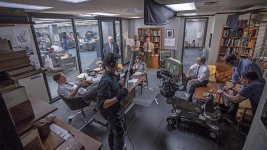
Spielberg likes his sets as practically built as possible and he famously likes to work fast. On The Post, much of the lighting was built into the set and the Camera Operator and AC worked remotely when in tight spaces. This allowed a lot of actors to get into a normal-sized practical set without flying walls. Even when working single camera this added interesting efficiency to the shoot. Spielberg got the idea after visiting Stanley Kubrick on the set of Eyes Wide Shut. Kubrick was always a minimalist, and for several intimate scenes everyone but the actors and a remote controlled camera would be in another room. When Tom Cruise and Nicole Kidman have an intense argument while sitting in their bedroom clad only in underwear, Cruise handled the slate and Kubrick changed film mags so that everyone stayed outside. A great way to work when appropriate.
 

Attachments

  • the-post-movie-production-bts-spielberg.jpg
    the-post-movie-production-bts-spielberg.jpg
    99 KB · Views: 0
Last edited:
Good points, Mitch. I used to own a set of Hot Gears (as seen in the picture you posted--I assume those are Mitch Dubin's). Very handy for remote operation, quick conversion to and from conventional operating mode. They were great for many things including what you described.
 
Back
Top