I'm starting to learn that the farther away from all white walls you get the more interesting a scene looks when you are trying to light it. Right now I'm trying to figure out a way to get a low key bedroom scene but because the walls in the room are all white it's hard to keep it from looking high key. I've been thinking of buying some dark colored room dividers such as these http://www.ebay.com/itm/6-ft-Tall-F...208?pt=LH_DefaultDomain_0&hash=item519822cbd0 or http://www.ebay.com/itm/6-ft-Tall-W...279?pt=LH_DefaultDomain_0&hash=item2a158c3ba7 and propping them against the wall to get some darker color and texture. Can anyone else suggest some ways to make walls more interesting without painting or adding wallpaper to them?

Navigation
Install the app
How to install the app on iOS
Follow along with the video below to see how to install our site as a web app on your home screen.
Note: This feature may not be available in some browsers.
More options
You are using an out of date browser. It may not display this or other websites correctly.
You should upgrade or use an alternative browser.
You should upgrade or use an alternative browser.
Ways to get rid of white walls for cheap?
- Thread starter dtjohns1
- Start date

David W. Jones
Veteran
Try adding a cucoloris and maybe a gel into the equation.

Can you find a different bedroom to shoot in?
@David Jimerson Sadly I can't. I'm in college now in a place i'm not originally from so pretty much the only people I have to ask around me are people in college style apartments and dorms with little to no thought as far as interior design goes. BTW I picked up the lighting for film and television dvd a while back and just wanted to tell you it was GREAT! I let someone borrow it like 4 months ago and still haven't seen it since  . I remember you guys had a section about good lighting starting with the location you choose on there.
Last edited:

Jarrett P. Morgan
Well-known member
Art department is awesome in times like this. Perhaps you can put posters on the wall? or pictures? (depending on what the scene is of course)

Hawk Teflon
Veteran
JPM is right. Decorate the wall as best you can. Just watch out for really glossy things like posters or anything of the like that will reflect any lights you have set up. Canvas pictures / paintings work great as well.
Keep your subject as far from the walls as possible, control spill so light isn't splashing all over any walls or ceiling, use a fast dropoff source and flag everything off the walls. Let them drop down a stop or two if you can this way. Add back a little texture on the wall in frame with a window blind or a cookie that simulates one. Trite but effective. Or hit the wall with some reflected light from a mirror you've taped up on the back and hit with a hammer. Put it on a dimmer and just get a little something something going on back there. Use a large aperture for shallow depth of field. And good luck, white walls stink.

Denis Haineault
Well-known member
For the walls these will help:
Posters, picture frames, drapes (even if not actually covering a window), bookshelf. Something like skis or a broom in the corner or leaning on the wall, add a coat hanger...pretty much anything that is plausible.
You can also add something like a small table/desk/nightstand in the shot (even just partially), add a lamp, a chair, move the bed to a different angle. Having part of a window or door frame in the shot will also help in removing some blandness.
Lastly, definitely don't rely on cucoloris as your main "solution". It won't do.
Greg Smith
Veteran
Seriously, the cheapest and easiest way to deal with the problem might be to paint the wall, do your shoot, and then re-paint in the original color.
"It is easier to ask forgiveness, than permission."
- Greg
"It is easier to ask forgiveness, than permission."
- Greg

Michael Carter
Veteran
I'm with Greg - if your room is small, and you just have to have furniture or talent right up to it, you have three choices:
Dress the hell out of it - posters, whatever - that's a very specific sort of "age" for your characters;
Fabric - either stretched tight (requiring at the least a lot of staple gun holes which will need to be filled) or draped (again you get into genre and setting issues);
Or "real" - paint or wallpaper, either of which take some prep time and post-cleanup. And if you paint a white wall dark, you'll need a few coats to return it to normal, and may have to paint the whole room to match.
The best way to go could be for daytime: very motivated window light that falls off quickly - night time: practicals that are warm and fall off quickly, with some spot fresnels to dial in focus on characters and settings.
The big picture is: why do your characters inhabit a stark, white room? Or a room with little "character" on the main wall? Or is that not at all how your character would live in that particular shot or scene? Answer that question, and address it with art direction. Sometimes a stark, white room could say more than two pages of script.
j1clark@ucsd.edu
Veteran
Learn to love white/light walls... because if you don't you are going to be frustrated with many location shoots...
Here is a 'set', but the walls and other elements, like the Refrigerator in the back ground, are predominantly 'white/light'. The image is small, but I think instructive...
Notice how the light is on the subjects and with appropriate flagging, blackwrap, and shaping of the light, I think you can get the walls to be 'lower' in value than the subjects.
While this shot is a 'in the light' shot, the point is, notice the value of the walls in back. For a more 'night/dark' shot, one needs to learn how to have just the subjects lit, while keeping
the light off the walls.
Night lighting tends to be from the side or even below depending, not from the top.
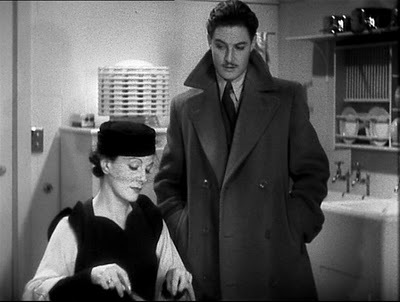
From "39 Steps"(1935).
Here is a 'set', but the walls and other elements, like the Refrigerator in the back ground, are predominantly 'white/light'. The image is small, but I think instructive...
Notice how the light is on the subjects and with appropriate flagging, blackwrap, and shaping of the light, I think you can get the walls to be 'lower' in value than the subjects.
While this shot is a 'in the light' shot, the point is, notice the value of the walls in back. For a more 'night/dark' shot, one needs to learn how to have just the subjects lit, while keeping
the light off the walls.
Night lighting tends to be from the side or even below depending, not from the top.
From "39 Steps"(1935).
Denis Haineault;2474020Lastly said:Agreed, but I like a good brancholoris that's a real tree branch with just a little movement of the leaves like you get from a breeze outside. Has to be deftly and subtly, of course.
Yes, a Kino Flo and in the Mila over-the-shoulder it's a kicker for both of them. When the camera turns around that lamp either doesn't play or is knocked down to next to nothing.Thanks everyone for you responses. The scene will pretty much have a feeling like this. Two young adults 27+ talking in a bedroom that is suppose to look like the motivation is coming from table lamp light. BTW can anyone explain to me how this scene was lit during the conversation portion? I see the female is being lit from camera right but I don't see a shadow from her head anywhere on the pillows or the wall. I'm guessing it's a kino flo tho from the shape of the light you see when she lifts up the book 0:44. Idk.
It's an interesting example of the fact that an audience is not doing lighting forensics in their heads unless you do something ridiculous. For example, I make adjustments all the time when moving from master to medium and CUs and nobody notices but the artists look better.
Michael Carter
Veteran
Watching that clip, I was thinking I'd have done the lamp a hair warmer and given her a little warm edge-lighting from it. It's just "there", looks like the brightest source in the frame, yet her face is in shadow on that side.
Just goes to show - if the light looks natural enough, the audience won't pickup on this stuff.
Just goes to show - if the light looks natural enough, the audience won't pickup on this stuff.

starcentral
Veteran
Good call Michael, its a bit odd for me to see the lamp have a cool look to it when all other practical lamps are "warm". Had she been up against a window perhaps it could have been sold as an outdoor street lamp or moon light with the difference in color temperature.
I have to say this thread has been inspiring. I am shooting scenes for a music video this coming weekend in a rented condo and yep you guessed it all the walls are white, as well the furniture. I tried hard to get something that wasn't white, so now my thinking cap is on in full force and I'll think of some ways to make it work.
I have to say this thread has been inspiring. I am shooting scenes for a music video this coming weekend in a rented condo and yep you guessed it all the walls are white, as well the furniture. I tried hard to get something that wasn't white, so now my thinking cap is on in full force and I'll think of some ways to make it work.
starcentral
Veteran
The ultimate white-everything shoot!
The ultimate white-everything shoot!
As mentioned in my last post I had a music video shoot this weekend and was shooting in a rented condo with white walls, white couch (where talent would be performing) and white end-tables and a coffee table (yes that was white too!).
In general white fit the mood and tone of the video, and below is a glimpse from behind the scenes to give you an idea of what I did to spice it up:

I kept most of the furniture in the original position but moved the couch away from the wall and put some blue light behind it. This kept the talents shadow off the wall and cast a really nice glow of blue from around the couch that would go up the walls and gradually fade out. I keyed the artist from the left using a daylight source and the fill on the right was done using tungsten sources. Not seen in the reference photo there was also a table lamp on the right side of the couch which I kept tungsten to match the color of fill used. I put a small spot of tungsten on the left corner of the room hitting part of the background that helped balance out the look of the back wall. Care was used to avoid spill on the top part of the back wall to keep a nice dark looking grade for the wide shots.
The end result with the white balance dialed in between 4000 and 4400 was a nice "cool" look on the talent with a hint of warm/yellow from the tungsten sources around him. The blue glow behind the couch just an extra added "artistic" touch.
The ultimate white-everything shoot!
As mentioned in my last post I had a music video shoot this weekend and was shooting in a rented condo with white walls, white couch (where talent would be performing) and white end-tables and a coffee table (yes that was white too!).
In general white fit the mood and tone of the video, and below is a glimpse from behind the scenes to give you an idea of what I did to spice it up:
I kept most of the furniture in the original position but moved the couch away from the wall and put some blue light behind it. This kept the talents shadow off the wall and cast a really nice glow of blue from around the couch that would go up the walls and gradually fade out. I keyed the artist from the left using a daylight source and the fill on the right was done using tungsten sources. Not seen in the reference photo there was also a table lamp on the right side of the couch which I kept tungsten to match the color of fill used. I put a small spot of tungsten on the left corner of the room hitting part of the background that helped balance out the look of the back wall. Care was used to avoid spill on the top part of the back wall to keep a nice dark looking grade for the wide shots.
The end result with the white balance dialed in between 4000 and 4400 was a nice "cool" look on the talent with a hint of warm/yellow from the tungsten sources around him. The blue glow behind the couch just an extra added "artistic" touch.
starcentral
Veteran
As a follow up to my previous behind the scenes post, here is close to what it will look like in the final grade:




starcentral
Veteran
Thanks for your comment.
Yes eventually I learned to like lighting after hating it for so long because I didn't know how to do it. I'm still learning in fact, but it does seem to somehow get easier.
Lighting is very important regardless of how well cameras perform in low light. I don't care what anyone says. Shooting high ISO's in natural light does have its place for sure, but for me high ISO means I can use 10's or 100's of watts instead of needing 1000's. All of the sudden I'm able to use my old Lowels, and combine use of a 150w flood light or 60w lamp bulb.
For the lighting setup I used in this high-rise condo, all glass windows were taped up with black and I used a total of 1400 watts in lighting from about 5 different light sources in total. For close-ups, I even added an ND filter to increase depth of field.