
Navigation
Install the app
How to install the app on iOS
Follow along with the video below to see how to install our site as a web app on your home screen.
Note: This feature may not be available in some browsers.
More options
You are using an out of date browser. It may not display this or other websites correctly.
You should upgrade or use an alternative browser.
You should upgrade or use an alternative browser.
Wasp 100-C LED Light
- Thread starter Bern Caughey
- Start date

nyvz
Veteran
The Zylight F8-200 is 200w power draw, and about the same size and weight as a 1K Fresnel (10.25 lbs for Zylight). It's not that cheap at around $3,000, though.
Something to keep in mind is that some bi-color products are a lot less bright than a daylight or tungsten only version. The Zylight is said to be a 2K equivalent, and since it's daylight only, it's going to be more likely to be closer to that 2K figure. Something like the Wasp is likely lowering power by being bi-color putting its 100w power draw closer to a 500-650w tungsten Fresnel since it's likely not using the full 100w at the most used color temps of 5600k and 3200k. Of course bi-color has advantages. I know the Astra's specs show it doesn't loose that much (I think only 10-20%) brightness with the bi-color version, while the Practilite is said to lose about 40% brightness. So I guess the max power draw utilization between 3200k, 4300k, and 5600k depends on how the light implements the bi-color feature?
That zylight has photometrics around a 650-1k... And bicolor doesn't necessarily hurt brightness, it depends whether the output is designed to be limited by the emitters or the electronics. Lights like astras user powerful emitters and run them at lower output and get even output independent of color temp and daylight version is the same output. Other leds are emitter limited and are just brightest when all the emitters on, making bicolor twice as bright at 4300k than daylight or tungsten but it still is as bright as non-bicolor at its ideal color temp.

Jon Edward Miller
Member
@Jon: I am curious about color quality at various CCT settings. The listing says CRI 98, TLCI 97 and gives numbers for extended CRI patches, but I figure these represent a best case scenario at a particular setting?[/QUOTE]
Sorry for the slow response to this question we have been busy with the holidays but as we have only 48 hours left in the campaign I have been trying to reach out and answer questions I may have missed over the course of the campaign.
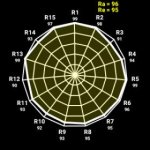
Yes the 98CRI is the best case scenario, in general you never go below a 94CRI and the rating peaks at a 98.5/99CRI depending on your meter. The best CRI range is from about 3200K - 6000K as it full engages all of the chips creating the fullest most even spectrum. The CRI drops down to about 92 at the extreme end of 1650K and 94 at 8000K. Of course we do see about 2 points in CRI fluctuation between different spectrometers we use Asentek and Sekonic as well as some higher end Minolta meters. I have added some images of a reading with a pocket spectrometer, it is giving me a 96 CRI with the light set to 3200K. The meter is seeing it as a little cooler and rating it 3300K. Which really speaks to the reality that cameras, meters, our eyes and lights are often going to disagree slightly about the exact same source. But please see below:
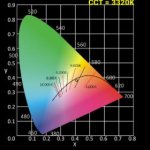
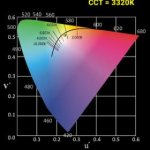
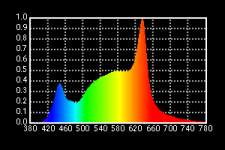
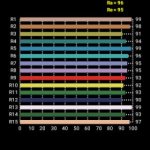
CCT : 3320 K
CRI(Ra) : 96
Re(R1~R15) : 95
CQS : 94
CIE1931 x : 0.4105
CIE1931 y : 0.3828
CIE1976 u' : 0.2424
CIE1976 v' : 0.5087
λp : 637 nm
λD : 584 nm
Purity(Pe) : 38%
Duv : -0.0046
SP Ratio : 1.6
PPFD : 23.54 μmol/s.m^2
TLCI(Qa) : 93.1
GAI : 75.7
TM-30-15 Rf : 92
TM-30-15 Rg : 105
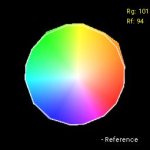
Here is another set of readings of the light set to 5600K:
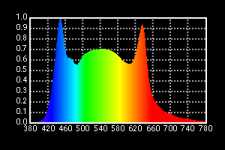
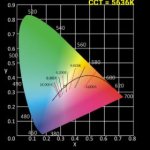
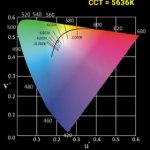
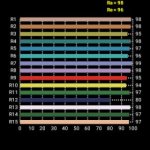
CCT : 5637 K
CRI(Ra) : 98
Re(R1~R15) : 96
CQS : 96
CIE1931 x : 0.3294
CIE1931 y : 0.3420
CIE1976 u' : 0.2044
CIE1976 v' : 0.4776
λp : 449 nm
λD : 524 nm
Purity(Pe) : 2%
Duv : 0.0019
SP Ratio : 2.3
PPFD : 23.81 μmol/s.m^2
TLCI(Qa) : 96.9
GAI : 95.5
TM-30-15 Rf : 95
TM-30-15 Rg : 101
Sorry for the slow response to this question we have been busy with the holidays but as we have only 48 hours left in the campaign I have been trying to reach out and answer questions I may have missed over the course of the campaign.
Yes the 98CRI is the best case scenario, in general you never go below a 94CRI and the rating peaks at a 98.5/99CRI depending on your meter. The best CRI range is from about 3200K - 6000K as it full engages all of the chips creating the fullest most even spectrum. The CRI drops down to about 92 at the extreme end of 1650K and 94 at 8000K. Of course we do see about 2 points in CRI fluctuation between different spectrometers we use Asentek and Sekonic as well as some higher end Minolta meters. I have added some images of a reading with a pocket spectrometer, it is giving me a 96 CRI with the light set to 3200K. The meter is seeing it as a little cooler and rating it 3300K. Which really speaks to the reality that cameras, meters, our eyes and lights are often going to disagree slightly about the exact same source. But please see below:
CCT : 3320 K
CRI(Ra) : 96
Re(R1~R15) : 95
CQS : 94
CIE1931 x : 0.4105
CIE1931 y : 0.3828
CIE1976 u' : 0.2424
CIE1976 v' : 0.5087
λp : 637 nm
λD : 584 nm
Purity(Pe) : 38%
Duv : -0.0046
SP Ratio : 1.6
PPFD : 23.54 μmol/s.m^2
TLCI(Qa) : 93.1
GAI : 75.7
TM-30-15 Rf : 92
TM-30-15 Rg : 105
Here is another set of readings of the light set to 5600K:
CCT : 5637 K
CRI(Ra) : 98
Re(R1~R15) : 96
CQS : 96
CIE1931 x : 0.3294
CIE1931 y : 0.3420
CIE1976 u' : 0.2044
CIE1976 v' : 0.4776
λp : 449 nm
λD : 524 nm
Purity(Pe) : 2%
Duv : 0.0019
SP Ratio : 2.3
PPFD : 23.81 μmol/s.m^2
TLCI(Qa) : 96.9
GAI : 95.5
TM-30-15 Rf : 95
TM-30-15 Rg : 101
Attachments

Run&Gun
Veteran
Received this Friday:
Hi all,
It is Friday and we wanted to give you a quick update on progress. For the rest of the month of February we will be giving an update every Friday to let you know how things are progressing as we keep pushing to begin shipping in March.
The good news. We continue to receive first articles and the fit and finish have been great. Mechanically things are fitting together and progressing well. Here are some photos of finally pieces that have been built together before we send them off to paint:
https://ksr-ugc.imgix.net/assets/01...0&fit=max&v=1486756622&auto=format&q=92&Front
3/4 view without reflector or front vent screen
https://ksr-ugc.imgix.net/assets/01...?w=700&fit=max&v=1486756692&auto=format&q=92&
Back 3/4 view without electronic controls or sockets.
The not as good news, we have had a couple minor delays (about a week or two) in some of our electronics. What does this mean for you? Realistically not every backers order will ship in March, some will probably be shipping in April. Right now we don't have a breakdown, on how many are March vs. April, but we will be shipping in order of your pledge number.
Also as a point of interest some modifications we have added to the final product based on user feedback and our own testing since completion of the Kickstarter.
- registration pin for front reflector mount making fit more secure.
- shorter knobs and switches on the back controls, making it harder for them to be damaged in transport and use.
- front venting allowing for more reflector and softbox options without any heat concerns.
- recessed venting to allow for airflow even when mostly covered by photo accessories.
Okay that is it for today. We hope everyone has a great weekend and we will be back next Friday with more updates as our delivery timeline and manufacturing progresses.
- Team Hive
Last edited: