I was told before that it's essential for indoors, but people tell me that my dialogue and on location recorded foley, is too dry, and I need to add reverb and ambience to it, in post. I kind of figure if that's what I need, perhaps I should have saved my money and stuck with the shotgun, since it already comes with some of that, during location recording. I know a lot of audio people, like to add everything afterwords, but I am kind of old school and like to get as much done on set. It saves more time and money in post, and on equipment sometimes, plus natural reverb and ambience from the room gives it a more natural sound in my opinion. So why use a hyper if it's too flat, that it just creates more post work, if that's the case?

Navigation
Install the app
How to install the app on iOS
Follow along with the video below to see how to install our site as a web app on your home screen.
Note: This feature may not be available in some browsers.
More options
You are using an out of date browser. It may not display this or other websites correctly.
You should upgrade or use an alternative browser.
You should upgrade or use an alternative browser.
Was there any reason for me to get a hypercardioid?
- Thread starter ironpony
- Start date

paulears
Veteran
No - it's a different kind of sound altogether. The shotgun in a small room emphasises the early reflections that the shotgun 'collects'. The hypercardioid is a better choice if you can't use a cardioid close in. You get a bit more distance, but not as prone to letting you hear the walls - which I've always thought shotguns do really well - hear everything bouncing off the walls behind the subjects.
That said, they can sound dry - exactly what is wanted. Warming it up in post is artificial of course, but so much better than uncontrolled reflections and that boxy sound. You don't need swim my reverb, just something gentle to soften the edges a bit.
The real secret is to always use headphones when recording because then you can be a bit more selective - distance wise.
Okay thanks. I always wear headphones so far, but cannot dell much a difference between the two until afterwords. I was told it was the sound recorder, as the monitor output does not give as good of quality of sound to be accurate, and that I believe, as it sounds better and more distinct when playing it back through headphones, on my computer later.

recordingwhiz
Well-known member
It is ussualy the goal to first and foremost get the cleanest least reverberant sound possible and it sounds like you're doing a decent job at that. you want this so later in post production you can add the proper amount of 'room' or reverb as needed to make the scene work.
remember sound is for the most part only additive, you can add but its extremely hard to take away, especially when it comes to reverb or echo.
and the Hypercardioid is still the better choice for most indoor situations.
Cheers
remember sound is for the most part only additive, you can add but its extremely hard to take away, especially when it comes to reverb or echo.
and the Hypercardioid is still the better choice for most indoor situations.
Cheers


ZazaCast
Major Contributor
You're kidding, right? There was an analog world well before there was a digital one you know.Okay thanks. But what about before all this software was available? What did they do back in movies from the 80s, 70s, or before?
(damn, I feel old again!)

David W. Jones
Veteran
Ha, and there was no form of information available before the Internet.
FWIW, I had a rack full of delays and reverbs.
FWIW, I had a rack full of delays and reverbs.

I was told before that it's essential for indoors, but people tell me that my dialogue and on location recorded foley, is too dry, and I need to add reverb and ambience to it, in post... I know a lot of audio people, like to add everything afterwords, but I am kind of old school and like to get as much done on set. It saves more time and money in post, and on equipment sometimes, plus natural reverb and ambience from the room gives it a more natural sound in my opinion.
One should always capitalize Foley. It's a proper name. Also, unless you performed those sounds to playback of the picture, they aren't Foley. They're FX. It's important to know the difference.
As for your mic question, I'll echo the others. Clean, clear, dry dialog is your goal in production. And while a shotgun indoors can emphasize reflections and muddy up the dialog, the reason a hypercardioid works in the same space is not that it rejects all reflections but that it responds more naturally to them.
Further, "old school" does not entail getting as much audio on set as possible. In fact, what became the art of "Foley" started with live performance in a theater alongside silent film.

John Willett
Veteran
I was told before that it's essential for indoors, but people tell me that my dialogue and on location recorded foley, is too dry, and I need to add reverb and ambience to it, in post. I kind of figure if that's what I need, perhaps I should have saved my money and stuck with the shotgun, since it already comes with some of that, during location recording. I know a lot of audio people, like to add everything afterwords, but I am kind of old school and like to get as much done on set. It saves more time and money in post, and on equipment sometimes, plus natural reverb and ambience from the room gives it a more natural sound in my opinion. So why use a hyper if it's too flat, that it just creates more post work, if that's the case?
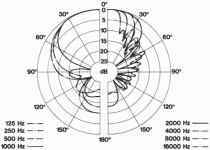
A gun microphone has a rear lobe and can also have lots of side lobes that cause comb-filter effects.
This is clearly shown in this polar-pattern of the MKH 816:-
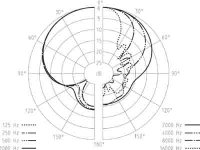
In a short gun, they are not so prominent, but they are still there:
Compare this to the polar pattern of a similar super-cardioid mic. (MKH 50 in this instance):
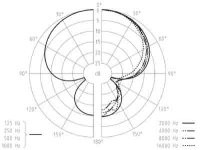
You can see that the super-cardioid still has the rear lobe, but there are no side lobes to cause comb-filtering.
If, however, you want a slightly broader response with no rear pick-up you should look at a cardioid mic. - response below is teh acrdioid MKH 40:
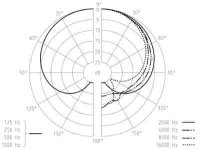
I have chosen polar-patterns from the same manufacturer for consistancy and clarity.
I hope this helps to make it clear.
unclebob6958
Well-known member
... people tell me that my dialogue and on location recorded foley, is too dry...
Who tells you that? One of your most constant complaints is that there aren't any other filmmakers in your area, so who would have the knowledge to give you a reliable, professional critique?
I am kind of old school and like to get as much done on set.
You haven't even finished one short as of yet, Harmonica44... I mean ironpony. How can you be "old school" when you haven't even completed one project?