GH13 Want to swap out CCDs on a GH1 and GH13

sublime.f

New member
I have finally gotten hold of a hackable GH1 and its now painlessly hacked to GH13.
In the process of tracking down a hackable body I have aquired a spare GH1 that isn't hackable but yes you guessed it, has a much better CMOS than the hackable one. :cry:

I've already had one of them in bits to clean the mic grill, accessory shoe, LCD dust and just your typical engineers peek inside electronics pr0n urge hit.
But I didn't get as far as removing the main PCBs to get at the firmware chip or the CMOS.

What I'd like to know is whether or not the CMOS lives on and is attached permanently to the same board as the firmware chip?
Not sure if it will be in the repair manual but I'm surfing in that direction now also.
Basically if they are on different boards and swappable, they're getting swapped!

Appreciate any and all input.
 
Last edited:
First of all it's not a CCD it's a CMOS sensor. I am not sure if there's that much variation in the sensors in the GH1s...have you done exact side by side tests to confirm this? Everyone always says "oh I have a bad sensor, I have a good sensor" but I think it's all totally subjective.
 
I'd like to see the insides too!
A very minor comment - CMOS as opposed to CCD.

A brain fart moment if there ever was one.... duh :Drogar-BigGrin(DBG)

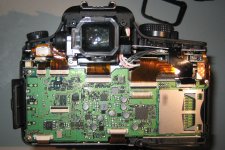
Here is a shot with the back casing removed from when I was cleaning the first GH1 I got hold of.

gh1-guts.jpg

The service manual gives me the impression the CMOS unit is cabled to the main PCB, detachable. I'll do a bit more research and convince myself, get important things that need doing out of the way, bust some dust, put the kettle on and give it a go. This will be at a later date.
Believe me, even though I have the background it takes balls to do it.
It would be nice to hear from anyone who has ever toyed with the idea or even done it.

I'd hate to see some service/repair menu pop up telling me to do procedure "x" else it won't accept the new host PCB.

I'll post lense removed (body cap on) dark CMOS grabs with settings to show you the noise profile if interested.
 
First of all it's not a CCD it's a CMOS sensor. I am not sure if there's that much variation in the sensors in the GH1s...have you done exact side by side tests to confirm this? Everyone always says "oh I have a bad sensor, I have a good sensor" but I think it's all totally subjective.

Place holder for pics

I'll post and you can decide what subjective means.
Trust me... I have them side by side and I'm like... WTF :2vrolijk_08:
Although I have to admit thats via each body's LCD so there could be something there too.
I'll be covering all angles.
 
Last edited:
I bought the PDF version of the service manual from some guy on eBay. It cost me like $4.00 after the "best offer" was submitted. It has drawings and diagrams, was worth the $4.00. It does discuss the eye sensor but not removing the image sensor at all.
 
I remember looking at the pictures in the service manual. The sensor has a cable that clips into the board. The sensor seems to be replaceable - it has a part number - so I see no issues ( outside of competence in actuallly doing the replacement ) that should get in the way.

YMMV
 
I would be very careful about doing this. Even if the sensor is replaceable, you need to look in the service manual on what steps need to be taken to calibrate the camera with the new sensor. Manufacturers don't just assemble a series of parts and send the camera out the door. Normally, there are calibration steps that are done on each camera to get it to expose within factory specifications. Just replacing the sensor may not have the effect you want because you would be running with the other (maybe poorer) sensor's calibration data. Read the service manual very carefully and see if there are any post sensor replacement calibration steps. If you don't have that equipment or software, then best to leave well enough alone.
 
If you don't have that equipment or software, then best to leave well enough alone.

Damn... I wish I had someone to take pics when I had my soldering iron in there last week!
As I said, I'm an engineer so I'm just asking to see if anyone has been down this path before.
The points you raised are perfectly valid but as I have two of each then a swap back to original is the solution to that particular problem should it present itself.

The only thing I have noticed calibration wise is the AWB is very different.
Greenish on one and blue-whitish on the other.

btw - the service manual doesn't contain much I found as its geared more to field repair type swap outs as opposed to real fault finding and repair. I guess they don't expect us engineers to desolder components anymore. Just find the bad module and swap out.
From a technical aspect, sadly the only schematics it has are of the auxillary PCBs and not of the main PCB.

The soldering iron comment wasn't a joke.

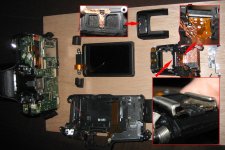
gh1-cleanup.jpg

Its a bit of a mixture of before and after in that shot.
The mic grill and cloth is a post cleaning shot.
The hot shoe is pre-cleaning in the photo but all cleaned up now.
Flexis don't like heat and rework. A service engineer would typically dispose of this flexi during removal and install a new hot shoe together with a new flexi.
 
Last edited:
I don't think it is good idea.

Normally you need special software and make different calibrations.

Instead, proper approach is MCP desoldering and reballing (it is Elpida BGA chip).

And firmware dumping. Probability that you'll be able to resolder it to MB afterwards is quite low :-(

Plus dumping hardware cost thousands :-) I have exact list of necessary hardware.
But all we really need is money and firm who'll help us.
 
If I pluck up the courage and get the time I'm going to give it a crack.
I've got pressing work on at the moment as I try to launch Japan's first FPV radio control website.

For the time being I'm cooking the GH1 with the 'noisy system'.

On the topic of 'burning in'... I've read/heard some very bizarre explanations as to what the process may or may not do including the entertaining notion that the burning in process 'burns off' a 'film' covering the image sensor.

Burning in is a term sometimes given to running electronics that are fresh of the production line in order to show up any chances of failure.
i.e. if you were to run a product for 24 hours or so powered up, you are likely to encounter any electrical/electronic failures a typical user may or may not encounter in the first few weeks of normal use simply based on the fact that your typical user might use the equipment for a few hours a few times a week or the equivalent of the burn in period.

When talking about mechanical products, now these can really be 'run in', for example an engine or motor when run for an extended amount of time will normally smooth out and run more efficiantly (think of it like breaking in a new pair of shoes).

From an engineers point of view, I see little to be gained from 'burning in' other than potentially accelerating any potential failures. The good news is that if it doesn't fail early on its likely not to fail at all.

Having said that mines been on for 48 hours now and either it will fix itself or the placebo effect will work on me.
Or I'll swap the CMOS over.
 
I have finally gotten hold of a hackable GH1 and its now painlessly hacked to GH13.
In the process of tracking down a hackable body I have aquired a spare GH1 that isn't hackable but yes you guessed it, has a much better CMOS than the hackable one. :cry:

I've already had one of them in bits to clean the mic grill, accessory shoe, LCD dust and just your typical engineers peek inside electronics pr0n urge hit.
But I didn't get as far as removing the main PCBs to get at the firmware chip or the CMOS.

What I'd like to know is whether or not the CMOS lives on and is attached permanently to the same board as the firmware chip?
Not sure if it will be in the repair manual but I'm surfing in that direction now also.
Basically if they are on different boards and swappable, they're getting swapped!

Appreciate any and all input.

it would make more sense to wait for the hacking of the unhackable firmware rather then play with hardware.
 
I think the most promising idea on the "burn in" is that there is a noise reduction system that needs to adapt to the sensor. I have no proof of this other than after I do a pixel refresh, I have worse banding than I did before. Leaving the camera on for an hour or so seems to make that banding disappear.
 
Good Luck in your adventure sublime.f.
Do you have this service manual ORDER NO. DSC0905029CE B26 I have a pdf version if needed
 
Back
Top