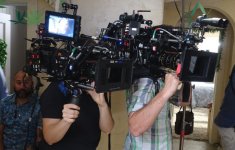
VaricamLT: Visit to Panasonic, Osaka with the VaricamLT team

Noel Evans

Mod V3 New and Improved
Staff member
Sorry no pics.

Wednesday last week I spent the afternoon with the VaricamLT team at Pana HQ in Osaka. I was not paid to do this. I happened to be in Japan and was invited.

Here's what I learned.

First and foremost Pana wants to make Cinema cameras that we want to use that deliver beautiful images. Theyre also aware that person to person as far as workflow and form that they can't please every user, so the image must be right. They want to create cinema cameras that not only deliver that beautiful image, but deliver options for the users. Dual ISO, recording modes etc.

Panasonic delivered a working camera, that does require some slight changes to suit users needs and theyre aware of them.

Theyre listening to us and working out ways to improve on many fronts, user experience, marketing etc etc

Issues discussed:

LT Codec workflow: At the moment the only software that reads it is Resolve and there's an issue in how it's doing it. They are working with BM to fix this and deliver LT codec support to all NLE's as a matter of urgency.
Audio control: Firmware is coming that enables you to see audio monitors on the EVF and CP screen, in addition the iris control will be able to be switchable between iris and audio level control. I've seen the firmware in action, as have others.

There are a number of other components they are working on at the moment that I can't discuss here, however all for the good. In addition, I asked for the upper handle to be given a NATO type rail option so you can QR handle and EVF mount as required. Theyre looking at it, although a third party may be better to deliver this. It's something I want however.

Sorry, but that's all I can add for the moment. Our discussions went for around 4 hours which covered a lot more than that.

EDIT: To add, I strongly suggested they give us all Frame Rates at all resolutions. This essentially means to do so they would need to line skip or pixel binning like the FS7 to do it. Important to note that none of the existing options do this. My point was, let us have it and decide if we want to use it or not. They seemed quite open to doing it.

EDIT 2: WHilst in Japan I had dinner with Takuro Ishizaka, a Japanese DP, http://www.imdb.com/name/nm1359837/ we talked a lot about VaricamLT, he bought one and loves it.
 
Thank you for sharing that information!

Just wondering, if I may, have you discussed the 240fps with them? Something is not right with the way the camera shoots HFR.
 
Good to know they are listening.

Not that I believe there is any chance it would happen. But since you have a direct channel to them:


  • A "global" shutter.
  • A sensor which gives actual 4K after debayering
  • A more elegant raw workflow which doesn't depend on Codex and their big systems.
  • Make the V35 shorter. It's too long. Cinema cameras are better if they are taller rather than longer. It's better for jibs and cranes, for steadycam and even sticks. TV cameras are the models which benefit from more length because they live more on the shoulder, such as ENG cameras. The V35 is ENG shaped.

I like a lot about the V35, specially the two-piece design and dual ISO. But the above and a couple of other small things keep it from reaching that top spot.

Like I said, I know it won't happen with this camera. But maybe for the next generation of Varicams.
 
Hey Noel, thanks for sharing this info.

So those pixelated images from the 240fps are the ones that Resolve doesn't interprete correctly? Or those are something in camera? As stated above they don't look quite right...
Any info regarding the possibility of 4k burst mode (internal or external) to the LT (since the sensor can do 120fps at 4k)?

Tnks again.
 
Thank you for sharing that information!

Just wondering, if I may, have you discussed the 240fps with them? Something is not right with the way the camera shoots HFR.

Yes, mate. This is to do with the way Resolve is interpreting the LT codec. Should have a fix and across the board NLE support soon.

Good to know they are listening.

Not that I believe there is any chance it would happen. But since you have a direct channel to them:


  • A "global" shutter.
  • A sensor which gives actual 4K after debayering
  • A more elegant raw workflow which doesn't depend on Codex and their big systems.
  • Make the V35 shorter. It's too long. Cinema cameras are better if they are taller rather than longer. It's better for jibs and cranes, for steadycam and even sticks. TV cameras are the models which benefit from more length because they live more on the shoulder, such as ENG cameras. The V35 is ENG shaped.

I like a lot about the V35, specially the two-piece design and dual ISO. But the above and a couple of other small things keep it from reaching that top spot.

Like I said, I know it won't happen with this camera. But maybe for the next generation of Varicams.

These are all directed for the most part at the V35 and I specifically discussed the LT. However:

- A global shutter - yeah maybe next gen, however how does this impact your shots?
- A sensor which gives actual 4K after debayering - Where are the numbers to say its not actual 4K. I'm not debating, Im asking as I havent seen them.
- Codex - Yep, agreed.
- Well the back half can be removed for jib etc, but yeah like the Alexa size can be a pain.

Any hints about their product map going forward, Noel?

The only thing I can say is there is one. haha.

Hey Noel, thanks for sharing this info.

So those pixelated images from the 240fps are the ones that Resolve doesn't interprete correctly? Or those are something in camera? As stated above they don't look quite right...
Any info regarding the possibility of 4k burst mode (internal or external) to the LT (since the sensor can do 120fps at 4k)?

Tnks again.

Yes, unfortunately the LT Codec is not fully sorted. Will be soon.

No info on burst mode Im afraid.
 
Awesome! Please keep us posted.

I hope they keep supporting this camera and updating it as much as they can.

Please make it very clear to them that they can truly have a winner here if they show it a lot of love. People like firmware updates and new features.

Times have changed and many aren't dropping $16,5 on a body anymore unless it's very worth it. And it certainly can be even though that's all opinion, and it may be more than worth it to someone as it is now.
 
  • Make the V35 shorter. It's too long. Cinema cameras are better if they are taller rather than longer.
Nope.

NopeNopeNopeNopeNope.

As someone who's currently in the middle of shooting a feature on an old Sony F35, I can tell you with absolute confidence, that taller is NOT better.

Balancing a taller camera is a nightmare compared to a longer and lower one, it makes your centre of gravity too high.

I was testing the Alexa Studio for a job recently, and even though it's heavy enough to make even the F35 seem like a lightweight (18kg in a barebones configuration compared to 14kg with the F35) the lower centre of gravity and superior weight distribution makes the big Alexa notably easier to handle.

I know that the V35 is really long (and a little awkwardly so), but I don't think building upwards is the solution.
 
[/LIST]
Nope.

NopeNopeNopeNopeNope.

As someone who's currently in the middle of shooting a feature on an old Sony F35, I can tell you with absolute confidence, that taller is NOT better.

Balancing a taller camera is a nightmare compared to a longer and lower one, it makes your centre of gravity too high.

I was testing the Alexa Studio for a job recently, and even though it's heavy enough to make even the F35 seem like a lightweight (18kg in a barebones configuration compared to 14kg with the F35) the lower centre of gravity and superior weight distribution makes the big Alexa notably easier to handle.

I know that the V35 is really long (and a little awkwardly so), but I don't think building upwards is the solution.

That is a strange reply. It reads like if I had suggested a 2x6 shaped camera. Or if I had said it should be taller than it is long, instead of what I actually said, which was it is better if they are taller rather than longer.

As for your F35 complains, I will risk a guess that you are using the F35 with one of the monitor recorders? If so, no wonder you find it badly balanced. It was designed to be used with a recorder docked to the back. If you are using only half the camera, in this case only the camera head, it's hardly fair to point fingers at the camera for a problem caused by your decisions.

With a recorder docked to the back the camera is one of the most well balanced, specially for handheld. It feels like a film camera. I'm not saying it's light. It's a full sized cinema camera. But the weight is just perfect for stable handheld.

If you are using a monitor recorder on top, and no recorder on the back, it's not surprising you find it top heavy and prefer the longer Alexa. But again, this has nothing to do with the camera if you are not using it as it was designed to be used.

I shoot with the F35 with a rear docked recorder all the time. On the shoulder, on sticks, on a jib and I would never wish to be shooting with a low rectangular camera like the V35.

Furthermore, center of gravity is also affected by your tripod head and your rig. A beefy head will do the job properly. The F35 is a full sized camera. But again, if you are only using half the camera you can't be helped. If your rig adds even more height to the already handicapped by the missing half shape, I can see where your trouble is coming from. If your half F35 is sitting on a VCT14 based shoulder brace and then on top of the tripod head, with a monitor on top of it all, you have promptly built yourself a tower. Blame the prep guy. :)

The V35 is definitely too long though. And I stand by my opinion that a cinema camera is better if taller rather than longer. Do you find yourself more often running out of space vertically than horizontally on location? I can't even tell you how many times I was spared from having to switch to a crashcam and put up with the image drop. All just by being able to dock the recorder to the top of the camera and backing it up those several inches. With a V35 I would have had to switch cameras, make a hole in the wall or use it tethered, if that's possible.
 
But you can separate the camera head from the recorder on the V35 for precisely those situations I thought? It's like having a regular Alexa that can transform into an Alexa-M without an significant compromise.

To my mind that's a far more elegant solution than building upwards and dealing with the havoc that has on balance.

And adding more weight out the back of the F35 doesn't fix its balance issues. Balancing it on that front/axis is easy with Arri dovetails (whether on a tripod, shoulder or whatever). It's the distribution of the weight that's problematic. There's too much weight up high, and off to the sides, that's what causes issues.


If you think having an umbilical cord in the way is more elegant than the recorder neatly docked up top, then we will have to agree to disagree. But the F35 can go tethered too, if that’s what you like.

The F35 absolutely does not have any balance issues. Not when properly configured. Maybe your head is just too small for the camera you are trying to use. Or you have not properly configured the camera.

Adding weight to the back to complete the camera absolutely makes for better balance.

Have you actually used the F35 with a proper recorder docked to the back or are you speaking from hypothetical experience? I’m not talking about just throwing a 7Q to the back. I’m speaking of the proper dockable recorders.

Well, I have extensive experience shooting this way with the F35 and I can tell you, any imbalance problems you may be having comes from your chosen configuration.

The F35 although a bit larger, is quite similar in shape and proportions to the Alexa Mini. Which by the way is also a taller camera. And the F35 is also only about 4cm or so taller than the Alexa XT. But a recorder docked to the back of the F35 adds to a great length for balancing. As for the weight off to the side, the EVF and recorder panel off set the weight back to the other side. As well as any accessories which go on the operator side. This is most likely not by accident either.


Like I’m saying, on the shoulder it feels great. Stable, solid and well balanced. The recorder hangs from the back adding stability.

The F35 basically works like many film cameras and has a very similar body design. It's layout was most likely inspired by them. You can dock the mag up top or at the back of some film cameras and balance is not a problem with the proper head, grip gear and configuration.

But I don’t think we should keep discussing F35 related topics here and hijack the thread. There is a dedicated F35 forum and if you are having problems I’m sure people at the F35 section will be glad to help you work through your configuration challenges I only brought up the above points because you name dropped the F35 in the thread.

One of the biggest issues the F35 has in its second life at the hands of indies is people trying to use it as a DSLR. I’m not saying this is what you are doing. But your complains are definitely configuration related. Weight balance is, well, a balancing act. With the proper support gear and configuration the F35 is a very easy camera to use. Very uncomplicated, specially when you compare to many of the newer offerings. Push RUN and you are set. It was designed with a certain use and configuration in mind. Go against that at your own risk. But don’t blame the camera then.
 
Well, I did use the F35 back in the day when we had the SR tape deck module. I'm going to assume that's not the one you are using, because the camera was a friggin' beast in that configuration. Used the SR-R1 a few times, that was certainly more manageable.

The F35's body shape can be traced (via their collaboration with Panavision on the Genesis) back to the original Panaflex which debuted on Spielberg's first film "Sugarland Express". I spent many hours with flexes on my shoulder (and the dedicated Steadicam body, the LW) so I know that form factor well. What that "meatball" shape has going for it was width, which adds more stability in the roll axis.

I too disagree that higher is better. It's not an issue for a good fluid head that has enough strength in the counterbalance to manage it, but it is absolutely better for handheld and Steadicam to have a low center of gravity. I've never had an issue with that on jibs and cranes either--we always used to backmount the mags when going on remote heads.

It's a challenge to get many of today's cameras to properly balance on the shoulder fore-and-aft because they are so light. As a result you often have to drive them back so far that the lens port is on or even behind the shoulder, which is a little odd. Yes, the F35 with a rear-mounted recorder is a good alternative...but so is the length of the V35. Which I don't feel is ridiculously long, by the way, it's only a bit more so than the Alexa. It does create issues in tight spaces like cars, and I looked into the kit that breaks it into a head and separate recorder but my rental house didn't carry it.
 
Charles, it looks like we are agreeing more than not.

But I feel like I have to explain what I meant with taller. I thought it was well implied in plain English, but given it’s clear there is some confusion, I guess not. So I better reiterate. Again I never said a camera should be taller than it is long. That would be awkward. When I said taller rather than longer, I meant, if a camera is getting too long, it’s better to cut a bit of that length and add to the height, if you need the space. If you cut 15cm at the back and add that along the rest of the body, maybe you will make it about 2-3cm taller along. Way better than over long.

The V35 is too long for me. It’s hotdog sausage shaped. Yes, hard to work with in confined spaces as we know. Detaching the recorded and going tethered is an option. But when it comes to 2-piece camera designs I think the best solution is what Panavision and Sony did with the Genesis and F35. The cameras are cubic, like many Panavision film cameras as well as the Alexa Mini. And you have the choice to dock the recorders on top or rear, just like a film mag. This gives you a lot of flexibility. In studio mode, most film cameras are/were used with the mag on top. Once it goes on the shoulder or steadycam you can use a smaller mag and dock it to the rear. Flexibility is always good.

But the V35 is too long IMO. The longest workable length for me would be an Alexa. But even that can become problematic as a 1-piece camera. It’s clear ARRI saw that problem as well since they released the Alexa-M.

What you mention about the meatball stability is exactly why I mentioned the advantages of a camera shaped like the F35. But obviously nobody will dock the recorder to the top if shooting from the shoulder and other configurations, the same way nobody does with a film mag. But the camera not being skinny and long like a broadcast camera allows the weight to be more centered and this is an advantage.

And the F35 with a recorder docked to the rear does not have a high center of gravity. The head issue I brought up because I have never had problems with balancing a F35 on a tripod. So if he was having problems could be his head choice. Or it could be because he didn’t have a recorder on the back and was pilling up stuff on top of the camera. Because otherwise there would not be a balance problem. But like I mentioned, in studio mode, most film cameras are/were used with the mag on top. I think you will agree that it was never a deal breaker.

We are in agreement that many of today’s cameras are too light. And I also say too small. It’s a worrisome trend. After a certain point losing the weight and size becomes counterproductive. Without the space for proper buttons and controls we are banned to digging for functions behind menus and touch screens. Too light and we are fighting for stability and having to depend on “robotic” rigs. If the situation calls for a crashcam, then let’s use a crashcam. I understand the trend in the low end since many can’t afford a different camera for each job/shot. But in the high end it doesn’t make sense.

I think ARRI has the right approach with offering basically the same camera in several different configurations. Sony missed the train when they didn't release that F65 head only prototype they showed at NAB.

And you are correct. I was not talking about the SRW-1. I’m talking about the several solid state recorders available for the F35 which can dock to it.
 
I am actually a step removed from the physical camera builds these days because I rarely operate, so my operators work with the AC's on how to configure the builds of a given camera, from choice of handgrips to where the multitude of AKS will go (off the top of my head: Teradek transmitter, lockit box, Comtek receiver, Preston MDR, Cinetape horns and readout). I don't care how they configure it as long as they are happy, but the one edict from me is that the camera can be converted from studio to handheld mode (plus Steadicam mode for the A camera) as quickly and efficiently as possible. They really have it down to where it's just a couple of minutes in any direction, sometimes as little as 45 seconds which is great. Here are the A and B V35's from the last show:

vcams.jpg

Each operators has it a little different, but you can easily see that Neal's camera on the right is festooned with all that "junk" and yet the lens port is barely fore of his shoulder. That length at the back is necessary for him to achieve true balance fore and aft, which he (as well as I) believe is critical for good handheld. With a shorter camera, he'd have to have it thrown even further back on his shoulder to achieve this, and that starts to get wonky as the eyepiece begins to collide with lens motors and the lens becomes somewhat inaccessible on the left side.

If I was still operating, I think I would be attempted a build where all of those additional components would be stacked into a mass simulating a mag, which could potentially be mounted both at the back of the camera for handheld stability, or on top to shorten the body as required. With careful cable management, this could be done, and done well. For a short camera like the Mini and a scenario where there was going to be a lot of jamming into tight spaces, I could see having an extension wiring harness with four foot cables for everything that would allow the "mag" to be removed and remoted. I also replace the Noga arms with Ultralight arms for both the onboard monitors and Cinetape horns. (if you haven't guessed, I was a little obsessive about my builds...!).

I am hoping to use LT's on the next show so we can start exploring how to make the camera more compact and intelligently configured.
 
I don't care how they configure it as long as they are happy, but the one edict from me is that the camera can be converted from studio to handheld mode (plus Steadicam mode for the A camera) as quickly and efficiently as possible.

Once of the suggestions I made on the LT was to introduce a Nato rail handle set up, so it can be be unhooked quickly and easily or vice versa for quick transfer to jib, steadicam etc.
 
Just remembered a few more things to ask here, If that's OK.
First is, did they tell you if there could be improvements to the image quality like color science, DR, etc over time? (With future firmwares). Or only with future hardware?
The new p2 cards (b series) are way faster than the older ones, did they tell you if there's any future benefit in having this card's? (Internal raw recording? Hehe..one can dream)
Do you have any idea if they will be doing the Arri way and keep the same sensor for as long as it can, bringing improvements with hardware/firmware, or if they are doing like Sony (multiple sensors, cameras every couple of years).
And do you know what's the smaller/lightest gimbal that can handle the LT without struggle?

Sorry for all the questions, and I understand if they cannot be answered.

Thanks!
 
Off-topic, but do you prefer the Teradek over Paralinx?

I own a Teradek Bolt Pro 2000 and 600. I've heard very good things about the Paralinx Tomahawk. They do use the same board but each have their own software.

RF is so volatile, it would take a series of tests in multiple environments for me to be convinced that one was better than the other, something I'm not likely to get around to. I've heard some claim preference with the Tomahawk over the Bolt Pro's.

In the end, I feel like it's something along the lines of preferring one cel phone provider to another in terms of signal. In one area I might get 4 bars on my AT&T phone and the next guy will get 2 on his Verizon; next location I check it they may have swapped places. The video transmitters are a lot like that. Inexact science.
 
I am actually a step removed from the physical camera builds these days because I rarely operate, so my operators work with the AC's on how to configure the builds of a given camera, from choice of handgrips to where the multitude of AKS will go (off the top of my head: Teradek transmitter, lockit box, Comtek receiver, Preston MDR, Cinetape horns and readout). I don't care how they configure it as long as they are happy, but the one edict from me is that the camera can be converted from studio to handheld mode (plus Steadicam mode for the A camera) as quickly and efficiently as possible. They really have it down to where it's just a couple of minutes in any direction, sometimes as little as 45 seconds which is great. Here are the A and B V35's from the last show:

View attachment 115165

Each operators has it a little different, but you can easily see that Neal's camera on the right is festooned with all that "junk" and yet the lens port is barely fore of his shoulder. That length at the back is necessary for him to achieve true balance fore and aft, which he (as well as I) believe is critical for good handheld. With a shorter camera, he'd have to have it thrown even further back on his shoulder to achieve this, and that starts to get wonky as the eyepiece begins to collide with lens motors and the lens becomes somewhat inaccessible on the left side.

If I was still operating, I think I would be attempted a build where all of those additional components would be stacked into a mass simulating a mag, which could potentially be mounted both at the back of the camera for handheld stability, or on top to shorten the body as required. With careful cable management, this could be done, and done well. For a short camera like the Mini and a scenario where there was going to be a lot of jamming into tight spaces, I could see having an extension wiring harness with four foot cables for everything that would allow the "mag" to be removed and remoted. I also replace the Noga arms with Ultralight arms for both the onboard monitors and Cinetape horns. (if you haven't guessed, I was a little obsessive about my builds...!).

I am hoping to use LT's on the next show so we can start exploring how to make the camera more compact and intelligently configured.

If you no longer operate it’s understandable you might not care much for the layout. I actually enjoy operating, even if I’m directing, although in that case is neither always possible nor recommended. But I like operating. And menus instead of buttons and knobs are a drag.

That handheld configuration is exactly what I try to avoid. The camera protrudes too far out the back and you are forced to push it that far back because of the lack of mass at the rear. Then you end up with the lens mount “behind you”. Sure, if the same camera was just made shorter, it would aggravate the problem even more, as you say. But what is necessary is more mass at back while being shorter. This is where I think the docked recorder as well as film mags docked to the rear help. You get the mass but not the length.

If the camera is not over long and low but instead have the mass more centered it's better IMO.

Your idea of trying to configure AKS to behave like a mag and being able to move them to the rear or top as needed is something I like. I really think this gives you extra flexibility, which is why I like the F35 and Genesis docking system so much.

I have certainly gone tethered before in cases where lack of space was not only limited to the horizontal plane, such as when shooting inside a VW Polo (smaller than a Golf). But those are exceptional scenarios. Normally just docking the recorder to the top will do.

The Varicam LT has a nice shape to it and it’s close to the optimal camera head size in my opinion. It’s close to being cubic. All it would need is a dockable raw recorder that could be docked to the rear or top. As it is it’s a bit too short and light for handheld stability.

This would be actually close to my perfect camera. A LT sized head, maybe just slightly wider (looking from the front), with a dockable recorder that goes either on top or rear and does 16-bit raw as well as all the other flavors the V35 does. When docked at the back the recorder should be in a vertical position or better, a little slanted. That camera with a global shutter sensor capable of real 4K would definitely be a camera I would be interested in taking a very serious look at.
 
Just remembered a few more things to ask here, If that's OK.
First is, did they tell you if there could be improvements to the image quality like color science, DR, etc over time? (With future firmwares). Or only with future hardware?

Colour science and DR are unlikely to change through the life of this sensor. However, its comparable now with the top competitors. I'd say colour is a win on this sensor already.

The new p2 cards (b series) are way faster than the older ones, did they tell you if there's any future benefit in having this card's? (Internal raw recording? Hehe..one can dream)

Thats a question I havent asked, theoretically it should be possible. Maybe?

Do you have any idea if they will be doing the Arri way and keep the same sensor for as long as it can, bringing improvements with hardware/firmware, or if they are doing like Sony (multiple sensors, cameras every couple of years).

Yes, that's the approach they're taking at present.

And do you know what's the smaller/lightest gimbal that can handle the LT without struggle?

DJI - A ronin is fine, but need extension arms.

Movi - M15 - Due to clearance requirement.

The camera itself is built to be firmware updatable moreso than any Pana camera I've seen in the past.
 
Back
Top