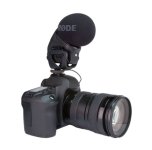
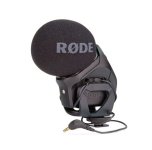
VideoMic HD

Grisnjam

Well-known member
This is kind interesting:

http://www.rodemic.com/news/announc...orlds-first-digital-recorder-video-microphone

vmhd.jpg


Built in digital recorder with a safety mode that records dual mono with one track at -20db to protect against spikes. Wonder how the pre amps are ...
 
OMG, I guess this will please virtually all HD SLR shooters, as it seems to enable all HD SLR shooters to capture quality audio without having to deal with mixers, recorders, line matching, and other issues or hassles, thereby focusing on capturing great shots while leaving pro audio work to those pros. Rode rocks again!
 
The VideoMic HD has a built-in voice recorder record directly to microSD card. That's a great idea... not only it's a micrphone, but it will be a competitor to Zoom and other voice recorder.
 
This is great development. Now it only needs a pro-brother with 4 channels recording: stereo-mic (ms) and 2 separate channels. Go rode!
 
Yeah, it has a line-in for lav or wireless receiver input. From what I understand, it will record dual mono to left and right channel. But it can also set to record default level in one channel, and a -20db in another channel. that's just so smart.
 
I will definitely be nabbing one. I think the target audience here may be people doing street interviews and weddings, where this would shine (i.e. bridal prep).
 
For "having fun but still want to have good sound...Well...it may be a little off but not distorted and not toooooo bad", then this is...well...fine.

For professional films, shorts,.... it's just....guide sound...
 
OMG, I guess this will please virtually all HD SLR shooters, as it seems to enable all HD SLR shooters to capture quality audio without having to deal with mixers, recorders, line matching, and other issues or hassles, thereby focusing on capturing great shots while leaving pro audio work to those pros. Rode rocks again!
Don't hold your breath about it letting you capture "quality audio." It still doesn't address the main reason for poor quality recordings with mics on or in the camera, which is that 99.99% of the time, the camera position is the absolutely WRONG place to put a mic to record anything except ambiance. Even for closeup dialog, the camera position is going to be 3 or 4 times, usually more, farther away from talent than is the optimum working distance for even the best directional microphones recording his speech. In addition the axis of a mic at the camera will be pointed at the subject parallel to the lens axis, happily picking up all the background noises from activity behind the talent. There's no substitute for proper location and that usually puts the mic above and in front of the talent about 18 inches away from his mouth pointed down at an angle. Do the math ... consider a shot that's a CU of the talent speaking, as you might shoot in a location interview sequence. Camera is about 6 to 8 feet from the subject with a short telephoto setting so you render the image with the most pleasing perspective without distorting his facial features. Mic on the camera puts it is ALSO 6 to 8 feet from the subject, resulting in hollow, distant-sounding, noisy, low level audio. Doesn't matter if you're recording in the camera or with an external recorder - any deficiencys in the quality of the recorder and its preamps, or conversely any excellence they may have for that matter, will be completely masked by the poor quality of the sound picked up by the mic from attempting to record with the mic in that position in the first place .
 
Last edited:
Don't hold your breath about it letting you capture "quality audio." It still doesn't address the main reason for poor quality recordings with mics on or in the camera, which is that 99.99% of the time, the camera position is the absolutely WRONG place to put a mic to record anything except ambiance. Even for closeup dialog, the camera position is going to be 3 or 4 times, usually more, farther away from talent than is the optimum working distance for even the best directional microphones recording his speech. In addition the axis of a mic at the camera will be pointed at the subject parallel to the lens axis, happily picking up all the background noises from activity behind the talent. There's no substitute for proper location and that usually puts the mic above and in front of the talent about 18 inches away from his mouth pointed down at an angle. Do the math ... consider a shot that's a CU of the talent speaking, as you might shoot in a location interview sequence. Camera is about 6 to 8 feet from the subject with a short telephoto setting so you render the image with the most pleasing perspective without distorting his facial features. Mic on the camera puts it is ALSO 6 to 8 feet from the subject, resulting in hollow, distant-sounding, noisy, low level audio. Doesn't matter if you're recording in the camera or with an external recorder - any deficiencys in the quality of the recorder and its preamps, or conversely any excellence they may have for that matter, will be completely masked by the poor quality of the sound picked up by the mic from attempting to record with the mic in that position in the first place .

+1
 
OMG, I guess this will please virtually all HD SLR shooters,

But, alas, it won't please anyone who really cares about recording good production sound. Mounting the microphone on the camera is no more appropriate than mounting the light on the camera. Wandering around a wedding reception recording random comments is the only semi-legitimate use for either.
 
1) The best way to use a piece of equipment, be it flashgun or mic or else, changes with the underlying goals to be achieved by using the equipment.

Mounting a pro-grade flashgun on a camera body isn't the best way (in theory) of using the flashgun. Almost every pro and serious amateur knows that. Yet many people, including many of those who take and make pictures for a living, do that on a regular basis. Examples: photojournalists, wedding photographers, street shooters, sports photographers, creative shooters, etc. Likewise, the same can be said of a microphone. Examples: just imagine those photographers already mentioned have begun to capture motion pictures with sounds, instead of, or in addition to, shooting still images.

2) Specialization lets you achieve greater efficiency.

Think of this: how many of pro audio guys who regularly use pro-grade equipment such as mixers and expensive mics also shoot many hours of video footage a week on a regular basis? Or, put the question in another way: how many of those HD SLR shooters regularly produce high-quality sound recordings using pro audio equipment on a regular basis, in addition to shooting hours after hours of video footage? I don't think there are many. In other words, if you are a HD SLR shooter, it's unlikely that you are also a pro audio person, or at least, you can hardly wear both the hats at the same time or do both video and audio equally well at the same time.

3) Rode VM HD is a great step up for virtually all HD SLR shooters (except for the few who don't need to deal with audio at all; in case you shoot silent video, no mic can please you).

Please read my original post again: with this new Rode VM HD, every HD SLR shooter can focus on getting great shots without having to deal with audio equipment to get quality audio (if you don't think this is pro-quality, that's fine. Just read on from here), thereby leaving the pro audio work to those pro sound guys who typically carry mixers, and/or use boom poles, and/or wear headphones, etc. You may be one of those rare people who are really good at both video and audio. Yet, generally speaking, it's harder to do a good job if you have to deal with both video and audio at the same time, than if you concentrate on either video or audio but not both. And Rode VM HD is a great way to let you focus on video.

Rode VM HD seems to be an all-in-one deal. If you give a HD SLR shooter such a mic (which is also a recorder) to replace either a built-in mic or a recording chain, how likely will he NOT be very pleased?

4) Now, the only question left unanswered is: how much will it cost to get such a wonderful convenience?
 
Last edited:
But, alas, it won't please anyone who really cares about recording good production sound.

Although you are right and I totally agree with you, your point is NOT a refute to my original post, which describes my first impression after reading the news: it's a wonderful convenience that in my opinion should please most, if not all, HD SLR shooters who really care about capturing great shots.

The top priority of a HD SLR shooter should always be capture great video, not "record good production sound"; in case they only need to shoot silent video, they won't even need to capture sound. Recording good production sound is best left to those sound people (occasionally a pro sound person may also shoot HD video using an SLR).
 
Back
Top