variND for Panny Pancake lens?

Jonathan12uiz

Well-known member
Which variND are you guys recommending for the 20mm f1.7? I can't seem to find a 42mm variND. Are you guys using step down rings? and what size are you using? Does it cause vingetting?
 
I've used the LCW Fader ND with the 20mm. It's been awhile, but I don't remember any vignetting. I have the 72/77 Fader version and had to use two step-up rings to get from 42mm to 72mm.
 
I have the LCW FaderND as well, great piece of kit. Some trash it for softening the image at long focal lengths but I haven't seen this at all when shooting with adapted lenses up to 85mm. On the 20mm pancake the image is as sharp with the FaderND as it is without.

I recommend getting a larger ND than 46mm, so you can use it with other lenses down the road. Step-up adapters from 46mm-52mm or 55mm etc cost a few bucks on eBay and let you swap the same FaderND between all your lenses.
 
I see no vignetting at all with the 52mm LCW FaderND on the 20mm pancake. It pays to remember that adapted lenses only hit the Pana's sensor with the center of the lens, so you can actually use a smaller diameter ND with legacy glass that has wider mounts. I use the 52mm LCW in front of my Canon FD 35mm and 85mm, both of which have wider filter mounts than 52mm, and there's no vignetting because the edges of the filter fall outside the sensor capture area.
 
Like shaveblog, I've had no noticeable degradation of the image using the Fader. I'm sure if I pixel peeped footage with it and without it, some very minor softness or color shift might be there, but it's nothing I've ever noticed. Like all variable ND filters (as far as I know) it's made with two polarizers. My understanding is you never want to use polarizers on really long lenses. So if you shoot at super tele focal lengths, you should expect to start seeing problems. The Fader I use is 72mm on the camera end and 77mm on the other end. It flares out, which probably helps reduce vignetting. With the kit lens, I don't see any vignette even at 14mm unless the hood is on the lens. In that case, it disappears around 17 or 18mm.
 
So I should get a filter bigger than the lens thread to avoid vingetting? Because I was looking at the lcw 52mm fadernd for 78.00, but I just realized Polaroid has a 46mm for 25.00. I'm only going to use the nd on the 20mm and I need to save money so I'm thinking the Polaroid is the best option. Will it vignette? Anyone know?
 
If you are sure the 20mm pancake is the only lens you'll need a FaderND for, by all means get the Polaroid 46mm. I have both it and the LCW FaderND Mk.II and the Polaroid is just as good at less than half the price.

You don't need to worry about vignetting with these FaderNDs. Lots of guys seem to be overly concerned with this and it's a non-issue you can easily verify for yourself by holding the FaderND up to your lens without screwing it on, look through the VF or at the LCD, and slowly bring the FaderND away from your lens. You'll be surprised how far you can pull it away before you start to see vignetting at the edges of the frame. I see guys getting the largest FaderND they can, 72mm or larger, because of worries about vignetting. It's just not a problem. In many cases you can even use a smaller diameter FaderND than the filter thread on a given lens, if you have the right step-down ring.

Thanks for the quick reply, I just saw a bad review of the Polaroid Variable ND and was thinking of saving for the LCW, but if you have both and say that it's almost as good, I'll take the slight quality loss for the savings, I'm no pro ya know...
 
If I never bought anything that got a bad review by some anonymous ass hat on the web I'd never buy anything. For $25 you can't go wrong with the Polaroid, it's at least as good to my eyes as the LCW (haven't tested the $300 Singh-Ray) and it's going to make a huge improvement to anything you shoot outdoors if you like shooting wide open for shallow depth of field.

Got that link to the bad review? I need some entertainment. Please tell me he used the words "fail", "phail", or "massive phail".


here is the link on amazon: http://www.amazon.com/review/R2BMSO28IYGR8U/ref=cm_cr_rdp_perm
and here is his YT link: http://www.youtube.com/watch?v=36oVmXzA9eU

embeded YT:
 
Couple of things:

The guy seems genuine and not an ass hat, but I question whether he knows what he's doing. My guess is he's shooting the T2i with the kit zoom or another zoom, and he's shooting at the longest end of his glass. If this describes his test conditions, I'm not surprised he got poor results. With a Variable ND filter, you shoot normal primes. You don't shoot long focal lengths, and you certainly don't use a slow kit zoom at its longest end.

Interesting he doesn't mention comparing the Polaroid to any other Variable NDs. Because he hasn't tried any others, and doesn't know how to use one. The 10,000 guys who know what these things are and how to use them don't post videos to Amazon saying "well, it worked, it's a Variable ND filter, what else do you want me to say?". This is the problem with Amazon user reviews, they're heavily weighted toward inexperienced users who vent about their poor experience when 99% of the time it was user error.
 
Thanks shaveblog . I thought the guy in the video was using a zoom lens so he got blurry images.
Looking to get one of this cheap polaroid.
Since you have both(LCW and Polaroid), for a 50mm lens on GH2, you think they will produce almost the same image output?
 
To me eyes they have the same IQ. The LCW is a great Variable ND and I don't feel it's a ripoff at $70 -- it's saved my ass on numerous shoots and some of my favorite footage was shot with it. But at $25, the Polaroid offers the same quality.

It should be noted that just because these Vari-NDs are sold under the Polaroid brand, it doesn't mean that the venerable company actually designed or makes them. They're made in China (like the LCW) and distributed by C&A Licensing in Ridgefield NJ who licenses the Polaroid name for camera accessories.
 
Massive flare? Ghosting? Indoors?

Not sure where to begin. Can you post an example?

I've never felt the need to use a Vari-ND indoors, and I sure haven't ever seen flaring or ghosting with either my LCW or my Polaroid.
 
Just wondering here, but why would you be using an ND indoors?
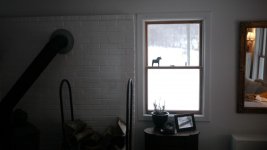
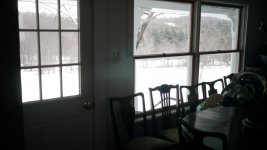
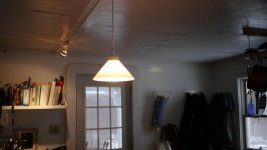
P1010464.jpgP1010461.jpgP1010467.jpg
So, the "ghosting" I'm talking about is the greenish bit to the left of the window in the first picture, the greenish bit between the door glass and the windows in the second picture, the small ghosted light to the right of the hanging light in the third picture. When shooting docs I frequently follow subjects from exterior to interior locations and stopping to unscrew a filter is often not a good option. Plus, sometimes I still need some light reduction indoors (though not with these example photos obviously) in order to maintain the aperture, shutter speed and iso I want. Maybe "massive flare" isn't a good description but I do seem to always get these ghost-ish type things in my images when using the LCW indoors. Don't have the same issue with other filters.
 
View attachment 29611View attachment 29612View attachment 29613
So, the "ghosting" I'm talking about is the greenish bit to the left of the window in the first picture, the greenish bit between the door glass and the windows in the second picture, the small ghosted light to the right of the hanging light in the third picture. When shooting docs I frequently follow subjects from exterior to interior locations and stopping to unscrew a filter is often not a good option. Plus, sometimes I still need some light reduction indoors (though not with these example photos obviously) in order to maintain the aperture, shutter speed and iso I want. Maybe "massive flare" isn't a good description but I do seem to always get these ghost-ish type things in my images when using the LCW indoors. Don't have the same issue with other filters.

I see what you are talking about, but i see flares like these even with some UV filters, do you have a mattebox? I was wondering if some french flags will cut this out.
 
Back
Top