VariCam: better to power camera accessories from camera DC Out or d-tap from battery?

Anon Amarth

New member
Hi, all, I recently picked up a VariCam LT and am contemplating how I plan to power camera accessories, (incl. monitor, OLED viewfinder, transmitter etc.). I'm getting a 150wH Gold Mount battery and am considering two options for how I power my accessories:

Option 1--DC Out (4-pin hirose 73) to d-tap to d-tap splitter.

Option 2--d-tap splitter from the gold mount battery directly.

The reason I'm leaning toward option 1 is that I plan to operate a Steadicam sometimes which means on occasion I'll be powering the camera through DC In (from the battery at the bottom of the Steadicam sled) and so it would be easier for me to use the DC out from the camera to power accessories than to split the incoming power before it gets to the camera. I'd appreciate any thoughts.

Thank you.
 
Anon, in my experience the 4 pin Hirose is rated around 1 amp of draw while a d-tap connector provides 10 amps. You'd have to check on the various components to see how much they add up to--a high bright onboard monitor for instance can be pretty power hungry.

What I would recommend from my own former Steadicam days is to use the 12v service from your top junction box and get a cable that terminates in a female d-tap. So when you switch from studio to Steadicam mode, unplug the d-tap splitter from the gold mount and plug it into that cable, and you are good to go! Not sure which sled you have, hopefully one that has more than one 12v service on the j-box. If not, the Y cable you were thinking of wouldn't be a bad way to go either. I know it's one more step but, c'est la vie.
 
+1. What Charles said. Usually, the Hirose output was just to power wireless receivers.

Chris Young
 
Anon, in my experience the 4 pin Hirose is rated around 1 amp of draw while a d-tap connector provides 10 amps. You'd have to check on the various components to see how much they add up to--a high bright onboard monitor for instance can be pretty power hungry.

What I would recommend from my own former Steadicam days is to use the 12v service from your top junction box and get a cable that terminates in a female d-tap. So when you switch from studio to Steadicam mode, unplug the d-tap splitter from the gold mount and plug it into that cable, and you are good to go! Not sure which sled you have, hopefully one that has more than one 12v service on the j-box. If not, the Y cable you were thinking of wouldn't be a bad way to go either. I know it's one more step but, c'est la vie.

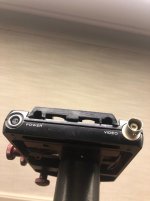
Thanks so much for your help, Charles. I recently picked up this Steadicam and am truly a beginner. In order to implement the solution you proposed, I think I'd need a 2-pin male LEMO to female d-tap and then a male to multiple female d-tap splitter. Then from the splitter, I'd have one d-tap male to 4-pin XLR female to power the VariCam LT via the DC IN terminal and then d-tap male to whatever power connector is necessary for other accessories. I'm attaching a pic of my top stage (btw the rig is an original Steadicam ProVid 1). Does this sound like the correct approach? Is there anything I'm not considering or getting wrong (especially the LEMO part). Thanks again for your help.
Unknown.thumb.jpeg.e8b7cf6e19259fd9f3aa74327cd7651c.jpg
 
Last edited:
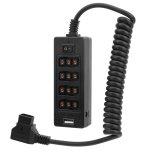
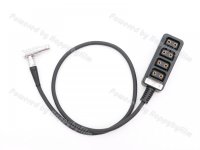
Wow, that brings back memories. The old Provid. I used to own one of those and spent many hours filming many sport/drama and entertainment shows over many days with it. Personally for powering out I would use something like one of these below. The three pin dual entry one is a good way to go as you can plug into it from either direction to allow for plug/cable clearance depending on what kit you are running with it. You would just need to Lemo it.

One tip with the Provid. Keep a very close eye on the locking grub screws that retain the needle roller bearings under the correct tension adjustment on the arm posts. If they become too slack and allow too much movement the needle bearing retainer sleeves will break and collapse the bearing. We discovered this the hard way when one of the bearings crushed and the arm started to seize up at the pivot. If left like that it can damage the pivot point as movement will start to scour out the bearing seat. We struggled through the rest of the shoot with a rough limited movement on that arm pivot. Afterward, I discovered all the bearing adjustments were out so had to adjust all of them and replace the damaged parts. Express airfreight from Steadicam cost me a fortune. Mind you we were using the Provid four days a week on a TV show for eighteen months so it was getting a hell of a workout. Each week I would spend a couple of hours lubricating and adjusting everything to maintain well-adjusted movement without any play on the bearings. BTW I think somewhere I may even have the original manual for the Provid and I'm 99% sure in the library somewhere there is the original VHS Provid Setup and Training tape. If I can find them I could PDF and MP4 them for you if they would be of any help.

Chris Young

https://www.ebay.com/itm/D-TAP-Adap...638185?hash=item44710fd169:g:vS0AAOSwGB1f~-Jb

Dtap Lemo distributor 02.jpg

https://www.ebay.com/itm/0B-2pin-An...7328?hash=item1cc1d6b250:g:EY4AAOSwq~tZQ09 G

Dtap Lemo distributor.jpg

One of the best I trained on the Provid, 1997. Ex dancer and pro skater Art Kade. He would do an hour a day training with it without fail.

 
Last edited:
Wow, a Provid 1! That's going back a while. OK, yes, the route you described will probably work. Generally I think it's best to avoid powering a camera via D-tap connector as there may be a bit of throttling the amperage down from the battery (and given the history of the older Steadicam rigs, you may already be seeing some loss due to the wiring used to pass the voltage up to the top stage). A better version would be a Y-cable that splits the 2 pin Lemo into a 4 pin XLR and female d-tap or quality d-tap splitter. I qualify on the splitter because sockets can fail on those over time (I have a bunch of the classic Anton Bauer version with tape over one of the 4 ports that no longer work), so that's why I recommend the single female d-tap version so you can swap out splitters as needed.

What you may want to consider if you plan on keeping this rig for a while is modifying the top stage by adding a female d-tap port to the top stage to further simplify this. involves opening up the top stage and splicing into the 12v cables to the Lemo port. Another option would be to run an additional external power line up from the bottom of the sled. I don't know if your rig has been modified to HD wiring but if not you are presumably running external HD-SDI down to the monitor (if using a modern monitor), so not that big a deal to add a second power line to that. Bottom line is if you are running with a 30 yr old Steadicam model, better be read to modify it! (A very helpful choice would be to chop off the lower part of the sled and replace with rods to give you more flexibility in balancing).

One last thing about that 2 pin Lemo--I can't say with 100% certainty but I believe that was from the original era of 2 pin Lemo wiring, which is reversed from most cables you will find today. You have to be very careful about this! If you don't have a voltage meter, strongly recommend one so you can make sure you are sending correct polarity to any accessory or camera. See this list of 2 pin wiring: https://rencherindustries.zendesk.c...t-polarity-do-I-need-for-my-2-pin-Lemo-cable-

So, if you were going to start making cables, you may want to think about swapping polarity within the sled to give you a modern compatible Lemo plug setup, so then you could order stock cables like this: https://www.amazon.com/Alvins-Cables-Splitter-RTmotion-Sidekick/dp/B01MYX8T2B.

Lots to think about, but that is the nature of owning an older rig!
 
Just to be fully cautious here I am going to re-iterate this part again since Chris posted a similar cable to the one I linked (Lemo to 4 pin d-tap splitter). Unless your rig has already been modified, use of a cable like this will deliver reverse polarity to anything plugged into it which means at best it will shut down and at worst you will fry it. It's the same Lemo but different wiring. Please be careful!
 
Charles &Chris have you covered on the Provid sled side of things, so I'll make one note on the LT itself. You mention an OLED viewfinder, so I take it that you are going to use a 3rd party VF rather than the Panasonic one. On the top front of the camera on the non-operator's side, there are a pair of connectors for use with a viewfinder. One is a BNC for the SIDE video feed and the other is 12v power. It is worth it to get a cable made to power your viewfinder directly from this, thus keeping the rig clean and straightforward to use when not on the sled.
 
Back
Top