EVA1: V60 SDXC cards

Seanik

Well-known member
As Firmware 2.0 will soon be upon us, I've re-engaged in the search for V60 (or faster) cards that will allow rec the newly available of All-I codecs... I was hoping that since the EVA1's debut (and my initial search), that some manufacturers would have put some of these on the market (or at least made announcements) in anticipation of this long promised new firmware. I'm looking at you SanDisk (and maybe Lexar)!

At the moment, it looks like we would have to go with the Panasonic micro P2 or roll the dice with Delkin or Angelbird... is that right, or am I missing something? I really, really hope I'm missing something!
 
I have 2x expensive 128GB Angelbird V90 cards and 2x cheap 128 GB Sony cards with 100MB/s write and 260 MB/s read speed. Both should work for the 400 Mbit Codec.

But there are literally hundreds of cards out there...
 
Lexar ceased manufacturing SD cards before the V30/v60/v90 classification category was initiated. So it is not possible to know if any of their cards would qualify.
 
Thanks for the help, but I am still very confused about this SD card "V" rating.

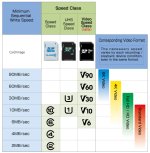
So, here is a nice chart I found that describes what the ratings cover:

video_speed class_01.jpg
https://www.sdcard.org/developers/overview/speed_class/

Right, so a "V30" card has a Minimum Sequential Write Speed of 30 MB/s, a "V60" card writes 60 MB/s, etc. Likewise, a UHS Class 3 card ("U3") has a Minimum Sequential Write Speed of 30 MB/s, etc. I can get my head around that.

Here is what I can't seem to find clarity on:

-- Is a U30 card necessarily also a V30 card? Are the "U" and "V" ratings distinctive in that they apply to different standards (not apparently visible to the consumer), or is it simply different labeling of the same thing?

-- Is the Minimum Sequential Write Speed necessarily the same as the "write speed" indicated on the card's label (or in the manufacturer's specs)?


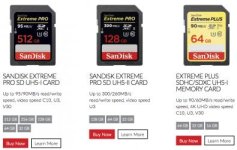
Below are three cards from SanDisk that prompt my questions above:

Screen Shot 2018-02-27 at 11.51.45 PM.jpg
https://www.sandisk.com/home/memory-cards


The first card here, the Extreme Pro UHS-I states a 95/90 MB/s read/write speed, but is rated at only U3 and V30... Only V30? Not V90, or at least V60?

The second card, the Extreme Pro UHS-II boasts a whopping 300/260 MB/s read/write speed, but is only rated at U3... No "V" rating at all?

The third card, the Extreme Plus UHS-I states 90/60 MB/s read/write speed, and again is only rated at U3 and V30... again, not V60?


I'm thinking that there is more to the "V" rating than simply the write speed claims. Does Panasonic maybe have a list of tested or approved cards to use as a V60 (i.e. shooting the 400 All-I codecs)?
 
U ratings and V ratings are not necessarily the same U3 ( there is no U30is not V30). UHS 1 is an older, slower card interface from UHS2, which can transfer data quicker than UHS1 cards. The device being used had to support UHS2 ( havebthis interface) to get the max speed out of a UHS 2 card. However, UHS2 interface is backwards compatible to UHS1 cards.

No, the data speed on the card is based on non-continuous data transfer, and while it reflects average read/write times, it is not necessarily inductive of the write speed for continuous video recording, whereas the new V rating is.
But this is going to depend on the camera recording compression and SD card interface. Blackmagic rates the San Disk Extreme Pro UHS 1 cards as a V30 card equivalent for full HD recording, Raw and ZProRes, but calls for the UHS2 San Disk card for 4K/UHD recording. So Ir is going to be on a case-by-case basis, as cards are certified by the various camera manufacturers.
Cheers
Cheers
 
Last edited:
The first card here, the Extreme Pro UHS-I states a 95/90 MB/s read/write speed, but is rated at only U3 and V30... Only V30? Not V90, or at least V60?
The second card, the Extreme Pro UHS-II boasts a whopping 300/260 MB/s read/write speed, but is only rated at U3... No "V" rating at all?
The third card, the Extreme Plus UHS-I states 90/60 MB/s read/write speed, and again is only rated at U3 and V30... again, not V60?

The V rating is a guaranteed write speed the card can sustain until the card is full. Anything else U or C etc are 'up to' ratings.

The ONLY cards that appear to work 100% fully, all the time, with 400Mbps ALL-I *AND* in dual / backup mode on the GH5, appear at this time to be only Panasonic's own brand, which is very odd.

Heard of AngelBird, ADATA, Delkin, Hoodman failing in backup recording mode.

I fully expect Sandisk to release new cards that fully support V90 - I can't believe they haven't already!
 
Last edited:
That's simply not true.

I have recorded dozens of hours with the Angelbird 128GB V90 cards already. Absolutely no probs.
The Panasonics have the same rating but are simply overpriced.

These guys are rated V90 which is more than enough for the codecs, the EVA1 will ever have (max. 400 Mbit/s).

Surprisingly even the cheapish Sony's with guaranteed 100MB/s have proved to work fine.
I used them in a dual slot recording mode as backup anf they just worked with the 4k 150 Mbit codec.

As it is not possible to test the all-I 4k 400 Mbit codec yet, nobody can tell if it's gonna work or not. It's just guessing...
 
That's simply not true.

I have recorded dozens of hours with the Angelbird 128GB V90 cards already. Absolutely no probs.

The Panasonics have the same rating but are simply overpriced.

These guys are rated V90 which is more than enough for the codecs, the EVA1 will ever have (max. 400 Mbit/s).

Surprisingly even the cheapish Sony's with guaranteed 100MB/s have proved to work fine.
I used them in a dual slot recording mode as backup anf they just worked with the 4k 150 Mbit codec.

As it is not possible to test the all-I 4k 400 Mbit codec yet, nobody can tell if it's gonna work or not. It's just guessing...

But just because YOU have not experienced any problems does not mean that there have not been others that have. That's why I always recommend that manufacturer approved media be used. Call me crazy, but why should I just trust "some guy on the internet" that has nothing to lose if my shoot goes belly up?

Don't take this personally, I'm saying this in general.
 
Panasonic has not isued a list of approved cards from other manufacturers, and don't expect us to anytime soon.

It's not because we're trying to force people to only use our cards. Really.

The issue is that we simply cannot speak for another manufacturer's product. Other companies have made changes to their product during the course of production, changing performance without changing the model number or otherwise indicating. The item still falls within their spec, but it may no longer do what we would require for our use.

This sort of issue happens a lot. Remember that I have seen this from my days at Convergent Design. It can be a nightmare and you have to remember that we are a tiny spec of the user base for their product. It's why CD had to resort to having its own drives made contractually to a certain spec. It wasn't until Samsung agreed to a minimum spec that aligned with its needs that CD agreed to open up to using Samsung, and even that came after months of testing.

Panasonic can state that our cards work with the EVA1 because we control our cards and we know they will work. If we tested 100 samples of Brand X cards and found they worked but then someone bought card 101 and it failed, that would be a problem for us. So we're not going there.
 
Recording 400 Mbps ALL-I with my GH5, I've have good luck with 280 MB/sec and 300 MB/sec premium cards from Sandisk and LEXAR. ( I haven't tried the DUAL record mode )

I also have a couple of the slower LEXAR 150 MB/sec cards that work, and a whole bunch of the same card that quit after 20 seconds of recording. ( you have to get lucky to find a card that works )

So my guess is that most of the premium 300 MB/sec Sandisk cards will work at 400 Mbps, but might not work in DUAL record mode.

Otherwise the gold standard are the Panasonic V90 cards that can do everything.
 
The Angelbird V90 cards have the same certification and thus shouldn't be any different here.

It's up to you what you buy. I needed 4x 128GB cards 4 weeks ago and I'm happy not having paid 1000 bucks.

There won't be a general rule of thousands cards officialy tested by Panasonic either. Do your own tests and you should be fine.
This has never been any different with serious people using camera equipment. YOU need to do the tests...
 
Recording 400 Mbps ALL-I with my GH5, I've have good luck with 280 MB/sec and 300 MB/sec premium cards from Sandisk and LEXAR. ( I haven't tried the DUAL record mode )

I also have a couple of the slower LEXAR 150 MB/sec cards that work, and a whole bunch of the same card that quit after 20 seconds of recording. ( you have to get lucky to find a card that works )

So my guess is that most of the premium 300 MB/sec Sandisk cards will work at 400 Mbps, but might not work in DUAL record mode.

Otherwise the gold standard are the Panasonic V90 cards that can do everything.

TheDingo, you are correct. My Sandisk 280 MB/s, works flawlessly with my GH5. It will not work in backup mode, but does work in relay.
 
How are those Angelbirds holding up?

The Angelbird V90 cards have the same certification and thus shouldn't be any different here.

It's up to you what you buy. I needed 4x 128GB cards 4 weeks ago and I'm happy not having paid 1000 bucks.

There won't be a general rule of thousands cards officialy tested by Panasonic either. Do your own tests and you should be fine.
This has never been any different with serious people using camera equipment. YOU need to do the tests...
 
Is anyone actually using the ProGrade cards for high data rate recording?
A lot of non-functional links on their website - but eventually found a page stating that while max read speed is 200, max write speed for the SD cards is only 80...
Thinking they might be fine for LongGOP 150mbps on EVA1, but not sure I'd be trusting them when the 400mbps intra firmware is out...
 
...however, the important spec we should be concerned with (re 400mbps recording) is "Minimum Sustained Write Speed." Supposedly that is how the "V" ratings are awarded.

Panasonic says we need V60 (or greater) for the All-I codecs. OK then, can we assume that all V60 cards work? Read reviews on the Delkin cards at B&H, and one might wonder who it is that gives out the ratings... an independent third party, or do companies "self-rate"? (Not surprised about Delkin, btw... all of their products are cheap).
 
...however, the important spec we should be concerned with (re 400mbps recording) is "Minimum Sustained Write Speed." Supposedly that is how the "V" ratings are awarded.

And of course Minimum Sustained Write Speed is one of those specs that I was unable to find for the ProGrade cards...
 
And of course Minimum Sustained Write Speed is one of those specs that I was unable to find for the ProGrade cards...

But the pictures of the cards show a V60 designation. ( which I would still want to test, as some V60 cards have still been too slow for 400 Mbps recording )
 
Back
Top