Use with mixer?

Wow... no headphone jack. I am missing so many "little" details. @#!%$!$!!!

Realistically, what do you think are the chances that the hack guys are going to give us that function from the AV I/O? Give me a % number.

Maybe a hard hack turning the built in mic into an input... but even less likely for the nature of it.
 
Zacuto guys did same test as me
http://www.vimeo.com/zacutousa#4782593

Except they test the 5DM2 vs the zoom H4n. Watch video from the 9minute mark
They came up with the number of 99.9% you need to shrink the audio file which
is exactly the same findings as me.

But as has been pointed out elsewhere, the %d (both versions) shoots 30 frame non-drop, which is distinctly non-standard. I'm willing to bet that if you grab a brand X NTSC camcorder which shoots at the normal rate of 29.97 fps, the Zoom will stay in sync with it.

In fact, the Zacuto post-guy-whose-name-I-forget says at 9:55 that the canon is shooting 30fps and that this is why he has to stretch the audio. This will not be an issue for footage coded at 29.97 (or 23.98) as on the 7D because there won't be any frame doubling when you put it on the timeline as there is with 30nd.

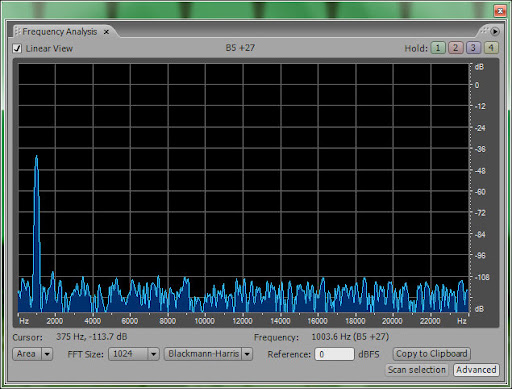
Like I say, the only way to really measure the accuracy of the zoom's internal clock is record a constant-frequency signal (1 KHz sine or saw wave would be ideal) from your computer for ~15 minutes or so and then load the resulting file into a multi-track editor alongside the original test tone. If there is bias drift, they'll go out of sync; to measure this, you'd invert one wave and add them together, and then look at the frequency of the spike in an FFT view.

When I get a H4n I'll do this as soon as I unbox it and upload some screenshots, but you can easily do it yourself with any dedicated audio editing software. This is what you'd see if the zoom were really running 0.1% slow:

Fullscreen%20capture%209152009%2054059%20PM.jpg


By the way, all that mung at the bottom below -108db is an artifact of the FFT window size, which is a measure of precision.

My only problem with the zucuto technique is they speed up the clip in FCP which alters the pitch of the audio.
I'm a perfectionist I guess and use STP.
The timestretch in STP will recalculate pitch

Don't worry about this - on dialog nobody can hear that. A musician would on an instrument recording, but only if they have perfect pitch. The only exception would be if you had on-camera audio you wished to mix in, which might give rise to a comb filtering effect - but this is something you have to watch out for with mics recording from any two different positions, due to the speed of sound in air. Speeding it up is faster too - this is effectively what pro tools does by changing the hardware playback speed during bouncing. Stretching it independently of pitch introduces minor signal processing artifacts at the inverse of the grain size, 1khz in this case which can give an unpleasant edgy quality on very quiet source material.
 
Last edited:
Hey Eddie ... looks like I've met another audiophile!
Audio was my first love ... many years before I started saving for cameras I was saving for samplers. I look forward to comparing tests with you when these 7D's arrive.
BTW - when I was testing with the GH1 I was checking the 1080p30 file with pulldown and the 1080p24 (23.987) file after pulldown and the sync error was identical. Not sure what bearing this will have when it comes time for the 7D. Also there are a lot of reviews floating around on the net, just put 'zoom H4 sync problems' into google and the list goes on.
 
Hey Eddie ... looks like I've met another audiophile!

Indeed :grin:

I've been reading up on the various other problems over the last day or two and I'm convinced the problems described everywhere are related to an incorrect SMPTE setup somewhere along the line. I just can't believe it's a coincidence that the stretch factor applied to the Zoom's recorded audio is exactly the same as the one for pulldown.

By contrast, on RAMPS (a usenet group mainly populated by Hollywood soundies) people are a little sniffy about the audio quality - remember that everything sounds crap if you've got a $5-10,000 multichannel field recorder - but no real griping about the sync, because everyone on that list knows that stuff inside out.

Anyhoo...I definitely look forward to examining files from a H4n/7d combo...and in the meantime, I'll be looking for ways to accumulate the ~$3000 to own such a combo myself! (FX: curses self for not putting DAT recorder on eBay 18 months ago)
 
Wow... no headphone jack. I am missing so many "little" details. @#!%$!$!!!

Realistically, what do you think are the chances that the hack guys are going to give us that function from the AV I/O? Give me a % number.
.

If it can be done, the hackers will do it. Based on nothing, I'd wager 85.36% probability there will be a Magic Lantern style hack to disable auto gain.
 
I wouldn't feel so bad if they had auto gain off and working peaking bars for monitoring the recorded signal. However you'd have to shoot a short test clip and listen to it before each time that you are going to record something important to make sure everything sounds clean... and you'd still be flying blind. But peaking bars should give you a degree of safety.

Basically, if it is worth it you should record off camera. Would something like an SD 744T go out of sink like the H4?
 
Basically, if it is worth it you should record off camera. Would something like an SD 744T go out of sink like the H4?

I'm assuming you are planning on use with the 7D...in which case...

The Zoom H4(n) won't go out of sink. It goes out of sync with the 5D MkII because it misrepresents its actual frame rate. For everything else, it should work perfectly.
 
Back
Top