C200: Two camera C200 interview

rob norton

Veteran

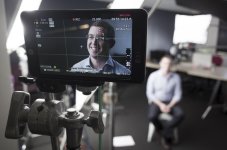
tech: canon 24-70 on the wide, canon 70-200 for b-camera. The off centre framing was to help if text was going to be added later. This video is part of a series where text is in other videos. However, I don't mind the asymmetrical frame without text.

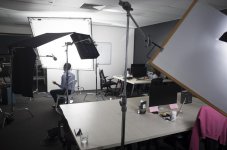
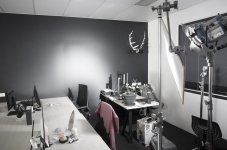
key light is 1800 HMI into poly into 6x full grid cloth, intellytech lc-160 for subtle back light (not much). The wall gradient was done with a 575w HMI PAR with I think a spot lens, moved until we found a spot we liked. I just wanted dark/light/dark. We feathered off some extreme chair shadows on the wall with a 2x3 silk close to the light (you can see its effect far left of frame). I wonder how close an aputure 300d ii would've come in terms of quality of hard light.

I'm pretty happy with the results given the location. Now I just need to shoot in areas other than offices :)

Rob Norton DP interview sample1.jpg

Rob Norton DP interview sample2.jpg

Rob Norton DP BTS1.jpg

Rob Norton DP BTS2.jpg

Rob Norton DP BTS3.jpg
 
Last edited:
Nice setup Rob. Did you have a gaffer/grip or was this a DIY OMB thing?

Thanks. A Gaffer did the lighting and "went halves" with the B-cam op in getting equipment into the building or other two person tasks (eg frame set up). It was so nice to actually think about framing and not be the sweatiest person in the building before rolling.

I think 6x/8x frames become a pretty strong line in the sand for bringing on extra help. In the past I've "t-boned" a single frame length with diffusion fabric but you obviously lose the ability to tilt the frame.

Also, it SUCKS moving all of that equipment. This is the fourth time I've worked with crew members like this and I'm trying my hardest to make this a standard working scenario, also of course the results look better!
 
that's a nice setup and the results vindicate the effort. As a solo operator, I would struggle to set that up, so would use a softbox (photographer background).
 
Your Gaffer is aware that "big sources matter". You want to achieve that lovely wrapping of light on the face, you need a big source. A 1x1 LED panel with a softbox attached won't get you there.

Thanks for sharing.
 
Nice work. Like the wall gradient approach and the fact you didn't get any banding in the gradation. Were you shooting the raw lite format? Thanks for sharing.
 
I end up on a few "gaffer" shoots a year and it's like flying private, you get spoiled quickly and realize it SHOULD be like that all the time. What? I don't have to schlep my own lights in? Or set them up? What? I don't have to stand in line for TSA? Or sit next to two strangers for two hours that won't shut up?
 
I had a five ton and my favorite key grip and gaffer for my recent BTS shoot on a national commercial.
6x6 and 8x8s make nicer light but yeah, too much for solo operating unless you have a lot of time.
I enjoy small crews best, I don't like OMB and I don't like having a 40-50 person crew. 5-10 crew is perfect.
 
What was the thinking behind the second angle? I see angle shifts like that on YouTube a lot and I always wondered what the creative decision behind it was.
 
What was the thinking behind the second angle? I see angle shifts like that on YouTube a lot and I always wondered what the creative decision behind it was.

It can give you an out for an edit if you need to cut or trim a bite, also You can cut to the second angle to break up a long rip of sound if you don’t have a lot(or any) related b-roll of the subject matter or person talking. Plus it gives the impression of higher production values: “Look, we have multiple cameras”. We do it in TV interviews all the time, where you’ll have a normal or wide shot of the subject and then something like a tight or super tight from the same angle or profile.
 
Any suggestions for 2-3 crew utilizing big source setups in small spaces like modest living rooms? That you can fly with?
 
What would be your definition of “big source”? A 4x4 packs down very small. And now we have LED panels that are approaching that size and bigger. Or are you talking like 6x6/8x8?
 
I like to show up as a one man band with a five ton grip truck, get there several hours early, use disguises to fool the client into thinking they have a 10 person crew (of which they personally meet each crew member but oddly never see more then one of them at a time), and then walk home with a $10k-$20k check for the day that goes all to me, myself, and I.

I do have respect though for ya’ll who run charity projects to give away your money to other crew members so they can feed their families.

I’m in NY right now and had to pull a full cart, a second wheeled lighting bag, and shoulder carry a tripod, all by myself in one trip down two or three blocks from the nearest parking, without a PA, because I’m not a nice enough person to donate money to PAs when I can make an extra $200 just by carrying a good amount of stuff for 20 minutes in a day. This also helps prevent obesity.

Now multiply $200 times 100 shoots in a year, $20,000. That’s a new C500 Mark II, or one Arri Signature Prime, or a down payment on a three bedroom house. So remember, when you’re obese and homeless, it’s because of PAs.
 
Last edited:
Sounds just like a story I would expect from someone who just recently said they want to be an “$8,000 a day commercial DP”...

Which is it man? Do you want to be the big baller DP making commercials with multi-million dollar budgets or do you want to be the one man band dragging multiple carts around by yourself down the sidewalk so you can pocket an extra few bucks and staying in your car like a homeless person and showering in truck stops so you don’t have to spend $100 on a hotel on the road?

I’ll let you in on a little secret how most of us have been doing it all these years. That money for the PA and the hotel, that goes on the invoice as a line item to the client. It doesn’t come out of your pocket. Or are you billing extra for a PA and just pocketing the money, which sounds similar to someone else I used to know from Tampa, who would bill for things that were supposed to be paid to crew, but was instead pocketed. Trying to pocket that extra $50 here and there was part of what ended up costing them a ~$500K/year client.
 
I own and travel in a $100k RV now, so not too shabby of a way to travel. That said, if someone like me preferred or prefers sleeping in their SUV over a hotel, then why should someone like you insist on acting like that’s a great travesty just because you happen to prefer hotels? I don’t like hotels, don’t sleep well in them, and sleep better in my car, but sure, let’s keep the hotel business thriving for the sake of appearances. I’ve literally had times where a client booked and paid for a hotel for me and I slept in my car instead.

Billing for crew that don’t show up was a joke.

Big baller DP, sure, but I’m not there now, so $20k of savings in a year still means a good amount to me. I mean, if $20k means nothing to you, then great you’re making so much money.

Another interesting thought, Deakins likes to work with a small crew and also typically man’s his camera. When I’m DPing a bigger set with various PA’s, I don’t suddenly become afraid to carry equipment just because i have others to do it for me. A DP being physically lazy on a big shoot is still going to slow that shoot down.

Most clients come with budgets and I charge more money than most cameramen, my rates now starting at $3300 per day with a C300 and support gear. It’s often a case where a client says they have around $3k in the budget for a two or three person crew and I then quote them close to that for a one-man-band setup (likely with higher end gear than most other cameraman have). Money isn’t going to magically grow on trees and suddenly their budget is $4.5k so I can then bill them for additional crew, so in many cases your little secret is not applicable. Sure, I crew many jobs and bill and upcharge the clients for crew, but many clients don’t have the budget for that but do have the budget to pay me a good rate. That’s where cutting out the crew as much as possible can be quite profitable.

So say in a year I save $10k on hotels, $20k on PAs, $50k from not hiring audio professionals for simple audio I can do, $30k from not hiring gaffers for interviews, etc., and get all that money myself while working harder and still delivering a quality product to the client. (These numbers are probably exaggerated, but in any case it adds up to a lot of money)

In many cases, clients go with my high one-man-band rates rather than someone else quoting a similar rate with crew. So, it’s me working harder and making more money. I just don’t get the, “I’d rather not work as hard in a 10 hour day and then make a lot less money” mentality. If one is old, I can get it, but particularly for young people who can easily carry equipment, what’s the big problem with working hard? Like, corporate and doc style videographers who refuse to learn the basics of audio and then have to turn down otherwise full rate jobs that don’t have the additional budget for an audio professional for something as simple as a single sit down interview, doesn’t make sense to me.
 
Last edited:
We do it in TV interviews all the time, where you’ll have a normal or wide shot of the subject and then something like a tight or super tight from the same angle or profile.
Thanks for the informative reply. I guess I phrased the question poorly. I am curious about the change in profile/eyeline from down the lens to a different angle. I always try to put both cameras close together, but it seems like a trend to change angle significantly.
 
Another interesting thought, Deakins likes to work with a small crew and also typically man’s his camera. When I’m DPing a bigger set with various PA’s, I don’t suddenly become afraid to carry equipment just because i have others to do it for me. A DP being physically lazy on a big shoot is still going to slow that shoot down.

Most clients come with budgets and I charge more money than most cameramen, my rates now starting at $3300 per day with a C300 and support gear. It’s often a case where a client says they have around $3k in the budget for a two or three person crew and I then quote them close to that for a one-man-band setup (likely with higher end gear than most other cameraman have). Money isn’t going to magically grow on trees and suddenly their budget is $4.5k so I can then bill them for additional crew, so in many cases your little secret is not applicable. Sure, I crew many jobs and bill and upcharge the clients for crew, but many clients don’t have the budget for that but do have the budget to pay me a good rate. That’s where cutting out the crew as much as possible can be quite profitable.

So say in a year I save $10k on hotels, $20k on PAs, $50k from not hiring audio professionals for simple audio I can do, $30k from not hiring gaffers for interviews, etc., and get all that money myself while working harder and still delivering a quality product to the client. (These numbers are probably exaggerated, but in any case it adds up to a lot of money)

In many cases, clients go with my high one-man-band rates rather than someone else quoting a similar rate with crew. So, it’s me working harder and making more money. I just don’t get the, “I’d rather not work as hard in a 10 hour day and then make a lot less money” mentality. If one is old, I can get it, but particularly for young people who can easily carry equipment, what’s the big problem with working hard? Like, corporate and doc style videographers who refuse to learn the basics of audio and then have to turn down otherwise full rate jobs that don’t have the additional budget for an audio professional for something as simple as a single sit down interview, doesn’t make sense to me.

To me there's no difference in the format being an interview vs. a commercial - it's a video production that has to look a certain way. The goal for the shoot was high production values within a 5 hour half day window. It would have been impossible to pull off the same results if I was by myself. I know you've had major success with the OMB make as much money as possible model, which is great (No sarcasm - I'm honestly happy for any freelancers making good money in film production). But making as much money as possible and achieving certain looks are often two very different things. You hit a ceiling fairly quickly with what you're capable of when you're solo. This isn't to say people aren't doing amazing work by themselves because they are. But I'm more interested in maxing out the product I can deliver in a collaborative environment.

It's less about making the day easy, going beyond carrying/not carrying objects. More crew members means:
- Faster set up times, which gives talent a higher number of takes, increasing the chances of delivering a better product.
- Lets the production get in and out of a location (company that wants to keep working) in a short period of time.
- I can efficiently go over any issues with client/director.
- improved composition because all of your focus is on lighting/composition.

I usually have the same day rate whether there are crew members or not so I haven't taken a hit at all. If I'm a producer who has $3300 for production and I see a shooter with a day rate of $3300 vs. someone with a $3100 day rate (all else equal) then every single time I'm going with the $3100 option plus PA for $200. You've obviously proven that it's possible to find repeated success doing it your way but most producers here would tell me to get lost if I suggested taking 100% of a budget where a certain level of quality is expected.
 
Last edited:
Your Gaffer is aware that "big sources matter". You want to achieve that lovely wrapping of light on the face, you need a big source. A 1x1 LED panel with a softbox attached won't get you there.

Thanks for sharing.
Hah yes we were all repeating the JP mantra. I've added two 12x frames so want to try that right on top of talent for ultimate softness. Except I think it'll be too wrappy and you'd lose a lot more shape. Will report back.

Nice work. Like the wall gradient approach and the fact you didn't get any banding in the gradation. Were you shooting the raw lite format? Thanks for sharing.
Thanks. Yes both cameras are using the raw format, it does pretty well. I can see some noise in the shadows on the wall but I can't afford noise reduction (free version of resolve 12 doesn't have it).

Any suggestions for 2-3 crew utilizing big source setups in small spaces like modest living rooms? That you can fly with?
6x is a pretty nice size for living rooms. What about 2x 3' frame lengths? A 6x6 ultrabounce is pretty cheap. Just hang the bounce vertically from the bar on a single stand. Something like this and an aputure 300d ii would be a pretty good travel kit.

Thanks for the informative reply. I guess I phrased the question poorly. I am curious about the change in profile/eyeline from down the lens to a different angle. I always try to put both cameras close together, but it seems like a trend to change angle significantly.
I've always disliked the camera angles being too similar but that's just my preference. Like you mentioned, this scenario is unusual because one is looking at the lens and the other is like a traditional off-camera look so maybe that's why it's jarring for you as well?

^^I don't know how to quote multiple names in a single post. Forgiveness please.
 
Back
Top