Tiffen announces new low cost Steadicams at NAB 07 - *** Now Shipping! ***

The Merlin's metal gimble is shipping with the Merlin Arm & Vest now.

In the UK?!

My email to Robin has been sent. He had said that IBC was looming large, but there's been no news in the UK market.

Almost every shoot I've done could have been enhanced with some steadicam shots. I've had the pot of cash waiting for quite some time now...
 
Pilot battery issues

Pilot battery issues

Normally you use the camera's own battery with DV cameras - as they don't have a 12v input.
Mikko, thanks for being so responsive on this thread, it definately helps. Now I know I'll have to deal with 2 different sets of batteries/chargers.
Here's another question. What if a DV camera comes along in 2009 with a 12V input? Is there any way to modify the Pilot battery mount after purchase? or am I stuck with that battery mount forever?

I've ordered the Pilot ($245 for a bigger 16:9 monitor? Yes please!) with the AA battery mount. I'll be testing it upon arrival to see how long a AA set power the monitor...
Yes! Please post these results. I'll wait to see this before I order.

I'm thinking that it won't run on rechargeables... 8x 1.5 volts (alkaline AAs) is 12 volts, but rechargeable AAs are 1.2 volts ...
Yes, the monitor is rated for 12V, but it might run fine at 9.6 volts. Let me know if/how this works.
 
From what I've heard, the AB, V-Loc and AA battery mounts are completely modular and very easy to interchange.
 
Yes, the battery mounts are fully interchangable in seconds.

And reardless of the battery mount, the power from it through the sled (that runs the monitor) is also always available at the stage for the camera too. All you'd need is one simple cable from the DC connector on the stage to whatever 12v connector the camera uses.

- Mikko
 
Mikko
In an earlier post you said that the metal gimbal ship with the new vest. Do you know whether the gimbal ships separately? I haven't been able to find it anywhere by itself.
 
Hi All, I am newbie to dvxuser, just been introduced from dvinfo.net :).

I use Canon Xh-A1 and struggle in choosing Merlin Rig & Pilot Rig, greatly appreciate if you can help (as most of your discussion above have helped me a lot already, thanksss).

1. based on Tiffen's reference chart, Merlin handheld is IDEAL for A1 while both Merlin Rig & Pilot Rig are only SUITABLE for A1. Do you know What is the different behind this IDEAL & SUITABLE definition ?

2. What is the total weight of Merlin if configured for A1 ? will it get 2 kilos or more in order to work with A1 ? how would this be considered IDEAL as it seems too heavy for handheld, am I right ? I am a tiny guy, 2 hands holding A1 is the limit I can do for 30min around...

3. Is Pilot easy to setup when changing camera or accessories ? I have a PD170 as well and I understand Merlin have a lot of marking on the plate that might help you to memorise the configuration setting for each camera, also Merlin have some fine-tune panel for balance quick fix. Does Pilot have similar help ? I worry I may need to change the size of battery in the field, will it take me 5 minutes or more to regain the perfect balance ?

4. I believe Tiffen's products are built with highest quality, but which one could last longer time if handle with care (3 years or more ?). It seems to me Merlin's gimbal is easy to break, but now with metal version, it shouldn't be a problem compare to Pilot's gimbal, am i right ?

5. I do wedding event video mostly, long day work. I understand everyone have different fitness. But I wonder if you could work with Merlin rig for 3 hours, how much time you could do with Pilot rig ?


6. Sorry, silly question, what are telescoping & tilting stage ? are they available in Merlin ?

7. Some says Merlin may have monitor in near future, is this something in schedule soon and upgradable for existing Merlin rig ?

Thanks again for helping me :smile:
 
Hi All, I am newbie to dvxuser, just been introduced from dvinfo.net :).

I use Canon Xh-A1 and struggle in choosing Merlin Rig & Pilot Rig, greatly appreciate if you can help (as most of your discussion above have helped me a lot already, thanksss).

1. based on Tiffen's reference chart, Merlin handheld is IDEAL for A1 while both Merlin Rig & Pilot Rig are only SUITABLE for A1. Do you know What is the different behind this IDEAL & SUITABLE definition ?

2. What is the total weight of Merlin if configured for A1 ? will it get 2 kilos or more in order to work with A1 ? how would this be considered IDEAL as it seems too heavy for handheld, am I right ? I am a tiny guy, 2 hands holding A1 is the limit I can do for 30min around...

3. Is Pilot easy to setup when changing camera or accessories ? I have a PD170 as well and I understand Merlin have a lot of marking on the plate that might help you to memorise the configuration setting for each camera, also Merlin have some fine-tune panel for balance quick fix. Does Pilot have similar help ? I worry I may need to change the size of battery in the field, will it take me 5 minutes or more to regain the perfect balance ?

4. I believe Tiffen's products are built with highest quality, but which one could last longer time if handle with care (3 years or more ?). It seems to me Merlin's gimbal is easy to break, but now with metal version, it shouldn't be a problem compare to Pilot's gimbal, am i right ?

5. I do wedding event video mostly, long day work. I understand everyone have different fitness. But I wonder if you could work with Merlin rig for 3 hours, how much time you could do with Pilot rig ?


6. Sorry, silly question, what are telescoping & tilting stage ? are they available in Merlin ?

7. Some says Merlin may have monitor in near future, is this something in schedule soon and upgradable for existing Merlin rig ?

Thanks again for helping me :smile:

I'm a newbie too, but have been looking at this for a while, so here's my 2 cents.

You said you are "a tiny guy", so don't even consider the Merlin by itself. It's much easier to "wear" the camera on your body than to hold it with your hands. If you're doing long duration shoots, get the arm and vest.

The Merlin arm & vest rig doesn't have a monitor. As I understand it, using the LCD on the camera will hinder you on many camera moves and positions. If you're just trying to keep the camera stable at eye level and don't move it around much, the Merlin / arm / vest combo will be fine.

If you want to get the camera really high or really low or you move the camera a lot, you'll be able to see what you're doing much better on the Pilot. The Pilot also seems to be a little more stable. Personally, I'm waiting for the Pilot.

I'll try to answer your questions as best I can. Guys - let me know if I'm off on this...

1. The Merlin by itself uses a human arm, which can generally carry more weight than the iso-elastic arm, so that's why the chart says IDEAL. But as we know, human arms get tired. Bottom line, all three will work fine with the XH-A1.

2. If you are doing long duration shoots, get the arm and vest - either the Merlin combo or the Pilot.

3. Don't know about camera changing times. Why would you change the size of the battery in the field?

4. It should last many years if you take care of it

5. Think of wearing a backpack. It's a nuisance, but you can do it a very long time.

6. There are 3 basic parts: Arm, Vest, and Sled. See picture here:
http://www.steadicam.com/images/content/Dealer_Pilot_Broch_si-lo.pdf
The Pilot Sled has 4 sub-parts:
- Stage - the part that holds the camera
- Post - the vertical post that connects the stage to the cross tube
- Cross Tube - holds the monitor, batteries, and weights
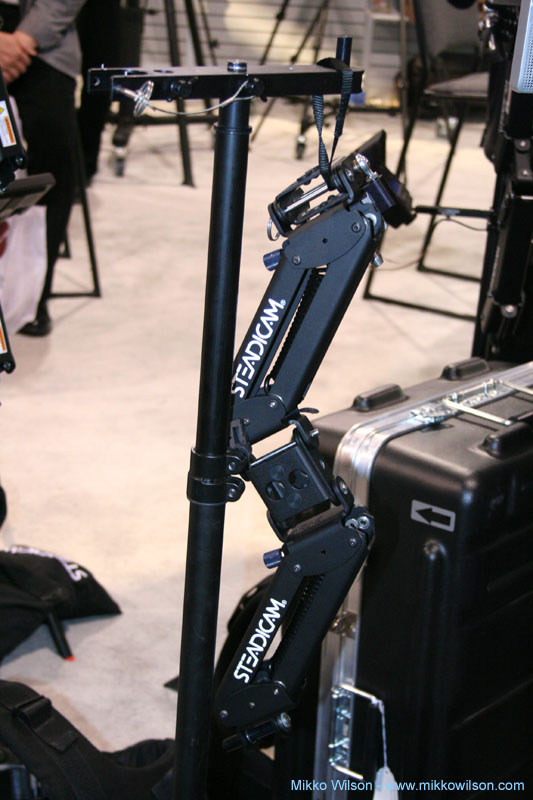
- Gimble - attaches the Sled to the Arm, allows movement in all 3 axis
So a tilting Stage means that you can tilt the camera without tilting the whole Sled. A telescoping Post means that you can make it longer to get the camera up really high, or down low in inverted mode. Inverted mode is where the camera is on the bottom and the cross tube is on top.

7. If you think you need the monitor, go for the Pilot. This is Tiffen's lowest priced product that still has all the basic elements of their bigger rigs. As for adding a monitor and batteries to the Merlin, you would not have the intertial resistance in the pan axis, so it wouldn't be as stable as the Pilot. In other words, the length of the Cross Tube plus the weights at the end make it harder to twist the post inadvertantly.

Which leads us to the inevitable question that has been asked here before: Will Tiffen see fit to sell the Pilot Sled separately? If they do, it might be a while. So if you're unsure - go for the Pilot.
 
Last edited:
Thank you Dogman-X

Thank you Dogman-X

Thank you very much dogman-x :), I now understand why Pilot worth the extra thousand dollars, just for the telescoping & tilting stage, and the blooming range.

Please can I confirm I understand it correctly, with Pilot, you can tilt the camera on the fly without re-configure the balancing weight. Or no, you have to fix the tilting angel and re-adjust the weight to balance the whole sled.

And the position of the post is not fixed with the gimbal, unlike Glidecam Pro sled, the Pilot sled is flexible for us to lock the gimbal at any position of the post on the fly. This will affect the balance, but for temporary shoot with extreme blooming range, this is still a very useful & practical feature.

p/s: the reason I change battery because I have couple different size batteries, I worry a little weight change will cause me lots of time to fix the balancing.

I definitely have to take arm & vest because wedding event in asia would last more then 12 hours a day and have to on-off to up to 5 or 6 different locations. This is why I prefer Merlin Rig as it is so versatile and low profile to use. But you have just give me a good reason to take the Pilot rig. So I have to choose either:
- get a Merlin combo rig first, then get a separate Pilot sled later
- skip Merlin, straight go for Pilot rig. if I am still earning, go back to get a Merlin

Both are nice option, I won't get wrong with either one... mmm.. but which path to go...

When will you get your Pilot ? I hope to hear your review again.

Many thanks~
 
Last edited:
Just a little clarification:
The Steadicam Pilot does NOT have a tilting stage at this time.

It does however have a telescoping post, and yes, the gimbal of course is adjustable (moves on the post), as with all Steadicam Gimbals. - That combination gives you a huge amount of balancing options! Check out thes photos:
Short sled: http://www.mikkowilson.com/photos/SteadicamNAB07/pages/IMG_9562.htm
Long sled (high camera): http://www.mikkowilson.com/photos/SteadicamNAB07/pages/IMG_9564.htm
Long sled, low mode: http://www.mikkowilson.com/photos/SteadicamNAB07/pages/IMG_9566.htm
That's the same camera & configuration in all those photos!

- Mikko
 
Thanks a lot Mikko for the clarification & nice photos :).

is the tilting stage a kind of add-on device to Pilot or it is included in the package once it ships (i haven't hear anyone own it yet so I assume it is still in production)..

thanks@@
 
You can see the tilt-rails on the Steadicam Ultra2 stage here: http://www.mikkowilson.com/photos/SteadicamNAB07/pages/IMG_9925.htm

Some better pictures of the tilt-head on the Ultra2 can be seen here: http://www.tiffen.com/userimages/SteadicamUltra2_0407.pdf - notice the 2 pictures at the top right of page 4 showing the tilt range.

All the bigger Steadicams ($20,000+) come with tilt-stages as standard. They arn't available for the lighter rigs (Flyer and Pilot).

A tilt-stage is something that is very much built into the Steadicam - though it is possible to add one later to the models that support it, but it's not that common. It's something that you use to set the angle (tilt) of the camera on the post before the shot, then do a quick re-balance and performs the shot/s. It's not anything that can be adjusted mid shot.


- Mikko
 
Thank you very much Mikko, I learn so many new stuff fro you all today, thank you :) :) :).

So no tilting stage for Pilot, in fact i don't think it is practical for event videography as well (as it's not anything i can do easily at mid shot).
 
Mikko, I notice from this picture here:
http://www.mikkowilson.com/photos/SteadicamNAB07/pages/IMG_9566.htm
that you are using the Pilot in low mode "inverted".

In other words, both the camera and the monitor are upside down, so you see fine on the shoot, but have to rotate the image 180 degrees in post.

If I have this right, then what do I need to enable this configuration? The Flyer kit seems unnessary since the camera is upside down.
 
In that photo I'm in "quick n' dirty low mode" - where in deed you simply slide the gimble a little on the post to make the rig top heavy, then flip it over so everything hangs upside down.

This works just fine with film and progressive video - interlaced video can have issues depending on how you flip it.


There are a couple of tools to do this job "the right way"


One is to use a "low mode cage", take a look at this picture:
discussing_low-mode_shot_SOA2004.jpg

The camera is mounted in a very sturdy cage - which in this case is also a "weight cage" to add weight to a light camera for practice - but lighter cages just for low-mode are available.

The other (and normally better) option is to use a "low mode clamp" which looks like this:
LowModeClamp.jpg

It simply clamps to the handle of your camera and has mounting threads in it allowing you to mount the camera "upside-down" to the stage of the Steadicam, then when you flip the rig over to low mode, the camera "hangs" from this camp the right way up under the stage.


Either way, when you flip to low mode, the angle of the gimbal handle can interfere with the stage, and raise the rig up again.
To get the rig lower and provide better clearance, a "F-Bracket" is used:
F-Bracket.jpg

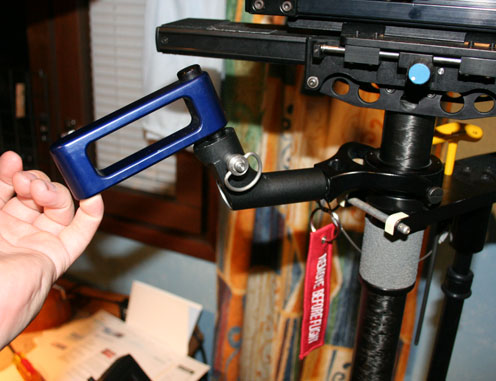
The post of the arm goes where my pinky is into the clamp, which then "flips" the gimbal over, again allowing it to "hang" down. In this photo the sled itself is the "right way up" in the stand, and you can see the clearance issues, but once the rig inverts to low mode, there is a LOT more space there thanks to this bracket.

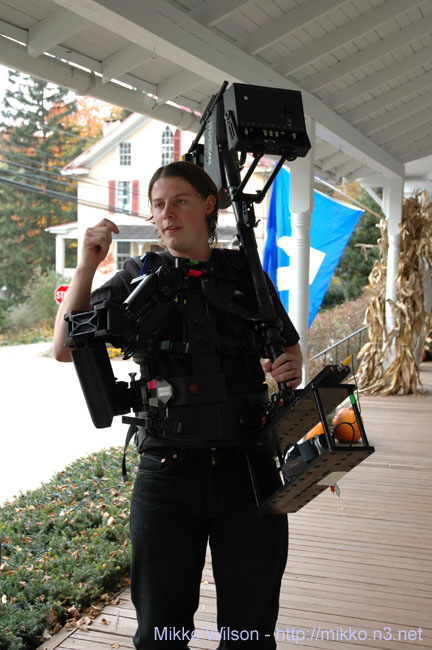
You can see the F-Bracket in the first picture on the bigger rig too - it's harder to spot because it's black, but it's the piece directly under my chin with the bright colored bits of tape on it. :)

Of course after you've done all this work to get the rig upside down properly, and the camera "hanging" the right way up, the last thing left to do is to flip the monitor, or the image on the monitor. - Luckily practically all Steadicam monitors can flip the image, and they can all flip on their mount too - so you can choose the best method for any particular situation.

- Mikko
 
Mikko - Thanks!!! Awesome response.

So now I'll be ordering the Pilot (large monitor version) along with an F-Bracket and a stand.

Any recomendations on the stand? Tiffen says "The Optional SteadiStand™ or Turtle Base “C” Stand is required for Steadicam balance and operation". I can't find any literature or pictures of either stand and they both list for just under $200. Is there one that you would recommend over the other? Are there other stands available?

I'm assuming that the stand is for the sled only, and that you would lay the arm on a table or chair when you're not using it.

Thanks again.
 
The system comes with the "Dock" which is the piece that the sled sits in (you can see it to the right of my 3rd picture). The dock has a yoke for holding the sled normally (where it is now), a "balancing stud" used to set the rig on [emulating the arm] to balance so you don't have to carry it to balance. There's normally a hole or two for the Allen Wrench for the gimbal, and a spot to hang the arm too!

The Steadicam Pilot dock:
IMG_9918.jpg

You can see the yoke on the left (with the safety pin open), the balancing stud on the right (where the arm is hanging) and a hole just to the left of the stud for the Allen wrench.


The stand can be any regular Medium duty lighting stand (that's why it's not included, many people have them already).

The "Steadi-Stand" is a good strong stand that collapses to a very compact size for transport.
The "C-stand" is a standard Matthews Turtle-Base C-stand.
You can either order from Steadicam, or you can buy a C-stand at your local grip store, or even on e-bay :)


If you are getting low-mode gear, I'd recomend simply getting the "low-mode kit" It includes both the F-Bracket and the Low Mode Clamp. (I'm assuming you will be flying a camera with a handle?)


- Mikko
 
Back
Top