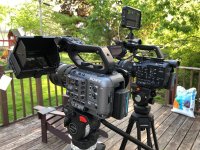
FX6: The Sony ILME-FX6V Owners Club

Ooh nice loads of room. Do you mind if I use one of your pics to update the OP?

Sure, no pb :)
There is a lot of delay at Manfrotto currently. This one was the last remaining one in my area. I decided to take it instead of the 193N, which is a little bit smaller, because Manfrotto told me that all these series 19xN is on backorder until (at least) end of June.
 
I completely disagree with his advise about exposure and don't like many of his settings . . .

Hey Lenny, since it seems a little slow around here lately I wonder if you'd care to elaborate on a comment you made last week about me. What specific advise to you disagree with? Why? And how do you do you set exposure differently? What advise have you given your friend for setting exposure? Whatever method it is that you use, why do you think it is better? Please educate me.
 
Well Doug , i could be wrong, but my understanding of your advice on exposure for Slog3 is to always use a white reference - either a card or something in the shot and put that at a specific point on your waveform . (as I recall its 60% though I don't remember exactly since its not always what i do - and without looking it up i can't recall if you do that with or without the LUT in place - maybe without?) That's a precise way of working and it will give you consistency , but in my experience its often too much of a PITA. For controlled situations its great but you're always dependent on a white reference and its not always convenient. Maybe its not in the shot at all and you need to place a card in the shot before shooting then hope your exposure stays the same. Even shooting an interview though the room light could change on you virtually imperceptively but your reference is gone or if you ahve a battery powered light it starts dimming before you notice. For documentary shooting you need to be able to set your exposure on the fly all the time and move fast. No time to place white cards around.

I had to argue with an inexperienced shooter who read your book and got into to trouble because the light changed on her after she set up. Something i could have guaranteed since there was a window in the shot . It was off to the side but it changed the rooms ambience and affected everything differently. But she never changed the exposure.

I don't think there are any hard and fast rules about much of anything. If I'm dealing with caucasians I tend to put the faces at 60% with the LUT or if I'm shooting WYSIWYG gamma. That ain't perfect and i know that everey face is different but I keep that in mind and it always gets me close enough and never gets me in trouble . If the light changes I see it right away. For doc work its often all I have to go on and I'll use my own hand sometimes. With dark skinned people its trickier and I'll try to find some other reference or go 50% or whatever. To me its all a matter of experience and judgement and every situartion is different. I've used Auto focus and even Auto White in some rare cases, if that was the right tool for that specific job. I also like to always have a trustworthy monitor ( as much as any one can be) around as often as possible to double check. Now of course lots of times you may not want the face to be at full exposure so I just deal with that situation however it seems best. Maybe with a white card or chip chart look to get what looks solid on the waveform. I like Artb Adams "one shot" DSC card, but I added my own peice of paper that was 60%.

I have the impression ( and I could be wrong) that you have strong opinions on the right and wrong ways to do things and there aren't too many exceptions. I think there's lots of exceptions to every rule. NowI don't own your books so I'm going by what I've read here and what my friend who did buy FS7 book said. BTW I told her to buy your book, just not to take your shooting suggestions as gospel.
 
Last edited:
Well Lenny, it is strange that you told your friend (and posted the same thing on this forum) that you “disagree with his advise about exposure and don't like many of his settings”. Yet it turns out that you know virtually nothing about my advice or settings -- so how can you disagree with them?

i could be wrong, but my understanding of your advice on exposure for Slog3 is to always use a white reference - either a card or something in the shot and put that at a specific point on your waveform .

Partially correct. My advice is to use a white reference whenever possible. This is true for not only for S-LOG3, but also for S-LOG2, REC709, and every other shooting mode a camera offers. White is always the best and most consistent way to measure correct exposure onboard Sony cameras. I agree that are plenty of times when a white reference won’t be available, but that doesn’t mean that all exposure rules should be thrown out the window. Whether you admit it or not, most professionals have a target they are aiming for when they set exposure. I’m not saying everyone has to agree on what that target should be, but a professional ought to have some sort of exposure level in mind where they would say a “little more” is overexposed and a “little less” would result in underexposure. Why do we have light meters, waveforms, zebras, and histograms if there are no targets for professionals to aim for?

Personally, I believe it is important to teach newbies and less experienced shooters how to use the tools at their disposal to at least aim for a correct exposure. As they gain more experience they will then have the confidence to vary that exposure for creative reasons or to make an educated guess in the heat of the moment. But they should learn the basics first.

I recall its 60% though I don't remember exactly since its not always what i do - and without looking it up i can't recall if you do that with or without the LUT in place - maybe without?)

Holy crap. You’re telling someone to ignore my exposure advice but you don’t even know if my advice is based on viewing a MLUT or not. Don’t you think that would be a really important thing to know before telling someone to ignore it.

BTW, 60% is Sony’s advice, not mine. My exposure advice ranges from as low as 68% up to 94% -- depending which camera is being used and also on whether the camera is using S-LOG or a REC709 scene file. And even more importantly, whether a MLUT is being used or not, and if so, which one. They are all different and there is no single correct exposure target that will work for all shooting modes. It all depends on the setup of the camera at the time. You cannot say 60%, 75%, 90% or any other number without also knowing WHAT camera settings are being used.

But exposure is not as random as you imply. For any given camera setup, there is a correct exposure target to aim for. For every camera, for every shooting mode, for every gamma, for there is a best target exposure to aim for that will provide the best mix of dynamic range, highlight handling, shadow detail, and noise. That is a fact.

Even if you choose to fly by the seat of your pants, that doesn’t mean there are not rules and best practices Again, newbies and less experienced shooters need to be taught what those targets are, and then they can color outside the lines as they get more experience.


I had to argue with an inexperienced shooter who read your book and got into to trouble because the light changed on her after she set up. Something i could have guaranteed since there was a window in the shot . It was off to the side but it changed the rooms ambience and affected everything differently. But she never changed the exposure.

Do you seriously think I am telling people to set their exposure and then forget it -- even if lighting conditions change? Really, that’s what you think I’m telling people? Do you think I am also telling them not to change the audio levels if the sound gets louder? Do you think I am telling them not to re-focus the lens if the subject moves? I never gave the advice you are objecting to.

If I'm dealing with caucasians I tend to put the faces at 60% with the LUT or if I'm shooting WYSIWYG gamma. That ain't perfect and i know that everey face is different but I keep that in mind and it always gets me close enough and never gets me in trouble . If the light changes I see it right away. For doc work its often all I have to go on and I'll use my own hand sometimes. With dark skinned people its trickier and I'll try to find some other reference or go 50% or whatever.

I’m sure you don’t consider yourself a racist, but you have just described a racist shooting technique. I never set my exposure based on the actual person I’m shooting. For example, I could setup my shot with darkest-skinned person you could find, and then replace that person with the whitest-skinned person you could find, and it wouldn’t change my exposure even a fraction of a stop. My exposure is not based on skin.

Beyond the racist nature of your technique, it is also sloppy and prone to mistakes. You are relying on guessing at the exposure and then constantly second guessing yourself. That’s not what I teach or how I work.

To me its all a matter of experience and judgement and every situartion is different.

No, every situation is not different. I’m not saying experience and making some educated guesses isn’t part of the process, but things are nowhere near as random as you make them out to be. You think things are always random and in flux because you have never been taught how to do things correctly. You don’t know wow to deal with fast-changing conditions and challenging situations while also being precise. So your reaction is to throw up your hands and say there are no rules and it doesn’t matter. Well, having rules and exposure targets to aim for doesn’t make me wrong even if I miss those targets sometimes. Your advice to your friend says more about you than about me.

I also like to always have a trustworthy monitor ( as much as any one can be) around as often as possible to double check.

If you can’t be bothered to have a white card in your back pocket, I don’t know how you manage to carry around a monitor. Judging exposure from a monitor (unless you are in ideal viewing conditions and have a good calibrated monitor) is completely unnecessary and a total waste of time. Yeah, yeah, yeah, I know on big productions that is standard procedure but that’s not the level of production we are talking about here. If you’re judging exposure solely by looking at a monitor or a viewfinder you are wasting your time. Even the greatest cinematographers in the world, surrounded by very skilled crews carry a light meter or use other more modern exposure-assist tools.

I don't think there are any hard and fast rules about much of anything.

Neither do I. But that doesn’t mean there aren’t any best practices and targets to aim for. Consistency with exposure, white balance, focus, audio levels, etc. absolutely produces the best results and can save a lot of time and hassle in post. Telling a newbie or a less experienced shooter to just throw all the rules and professional techniques out the window is foolish and does them a disservice as they try to learn the ropes.

Auto focus and even Auto White in some rare cases, if that was the right tool for that specific job.

I’ve never used either of those in my entire 40 year career, and if people will take my advice, they can do the same. It is critical to have the skills to run everything on the camera manually, and then people can pick and choose when (if ever) to use those automatic settings. If you think it is a mistake to teach people how to run their camera manually, then we have a fundamental difference on how best to help people get better results.

. . . that at a specific point on your waveform

If you know enough about my advice to disagree with it, and even tell others not to follow it, you’d think you’d also know that I never use the camera’s waveform and I strongly recommend against it.

I have the impression ( and I could be wrong) that you have strong opinions on the right and wrong ways to do things and there aren't too many exceptions

Congratulations!! You finally got one thing exactly right.
 
Now Doug , you asked for my opinion but I don't want to get into a flame war with you. I was very wary of indulging you and am not surprised by your reply but it really is over the top and its why people get mad at you. I wrote out a reply but would rather send it privately because I don't think these forums are the place for personal arguments .

I decided to add just a a couple of public comments . Re exposure. i think there a number of ways to determine it depending on the situation and i would counsel people to know all of them and use with discretion. Re tone: I assume we are all professionals here and mutual respect is important. Lastly: Cinematography is an Art not a Science.
 
Last edited:
For those of you interested in seeing how the FX6 stacks up against one of its predecessors I'm currently doing some testing of the two cameras:

IMG_7795.jpg

I'm doing what I can to control variables—e.g., same lens models, shooting both cameras simultaneously—but I don't have the equipment (or skill, probably) for truly rigorous, scientific testing. That said, if anyone in this thread has suggestions or ideas for what you'd like to see compared feel free to let me know.

Also while the FX6 shares a body style with the Fs5, I think it's more accurate to view the FS7 as its true predecessor. Alas, I don't own that camera, so the Fs5 (which does have the FS7 sensor) will have to suffice.

Just from a few basic shots yesterday (in HD S35 mode on the FX6, for apples-to-apples to start), the Fs5 produces a significantly greener image, and it loses highlights a bit earlier. Not exactly a hot take but it's still early in the testing :smile:
 
Anyone using a Gimbal for the FX6? I've been following a thread over at DJI and the FX6 is still not supported for the RS2 (though I know that others seem to have the combination working).

I'm also a bit surprised there is not an adapter out yet to give audio via the IF on the top of the body (that the handle uses).

Thanks
Nathan

Edit: I see the Zhiyun-Tech CRANE 3S supports the FX9 with the 28-135 Lens but no mention of the FX6 (I have the 28-135 lens as well). Edit 2 nope, looks like with the FX9 "The maximum compatible lens is Sony E PZ 18-110mm F4 G OSS." which is kind of .....
 
Last edited:
I put a 150wh battery on the Fx6 and it read 12hrs of runtime on the Anton Bauer side screen. Is anyone getting that when recording, or do you see a drop in battery life when rolling? Either way, that is insanely convenient. BTW, Tilta did a tight job of their Fx6 rig. blends in so well.
 
My Anton Bauer 150wh batteries show between 9.5 to 11.5 hours depending on the individual battery and whether I'm also running my Gratical or not. Even at the low end, 9.5 hours is pretty impressive for both camera and viewfinder. I can't say that I've ever let the camera run down to see if time shown on the battery is accurate, but I assume it is. Those numbers are spot-on when I'm using the batteries on my LED lights. Very reliable system.
 
I put a 150wh battery on the Fx6 and it read 12hrs of runtime on the Anton Bauer side screen. Is anyone getting that when recording, or do you see a drop in battery life when rolling? Either way, that is insanely convenient. BTW, Tilta did a tight job of their Fx6 rig. blends in so well.

That sounds about the right ball park. I think I got 5-6hrs out of my IDX 98Wh batt.
 
Unfortunately, nothing related to the missing AF tracking, which is available on the A7 series and the FX3 :/

Yeah I don't get that. I think that it doesn't make a lot of sense that the FX6 doesn't have the same AF abilities as the A7 series as well as the same WB function. Those two things drive me nuts on this camera.
 
Since 2016 or so, both Canon and Sony left all their best video AF and AF features for their stills cameras.

Some of us used to speculate it was because the hardware was designed for AF much more than the cinema cameras, but at this point I think it's another method of separating the lines because there's not much of a logical explanation of why they wouldn't allow touchscreen tracking on the FX6.

It should be the other way around, if anything. Reward the people who spend more money.
 
Yeah I don't get that. I think that it doesn't make a lot of sense that the FX6 doesn't have the same AF abilities as the A7 series as well as the same WB function. Those two things drive me nuts on this camera.

Oh god tell me about it. White balancing on the FX6:

1. Disconnect monitor from camera
2. Take camera off tripod and pick up white card
3. Walk over to talent with camera and white card
4. Hand white card to talent
5. Take a step back and perform white balance
6. Now go through all the above steps in reverse

I recommend quietly swearing to yourself throughout the entire process.

It's unbelievable to me that 120 fps raw is considered a press-release level big deal when something so fundamental to daily operation is so poorly implemented. WB on the a7Siii is perfect and takes 5 seconds.
 
Do people really have that much trouble with white balance? Even when I've been lumped with digital cameras that only give you 3200k or 5600k, or even film stocks at a single consistent white balance, it's really never been that big of an issue. Put a gel on the lights, or a filter in the mattebox.

Nowadays you can literally dial in exactly what you want in 50k increments. Surely any residual issues people were having are sorted now?
 
Update done with the SDX card method.
Seems the faster and the more secure way. About 5 mn.
The file on the SONY site is not a zip, it's the actual file.
(for the 1.01 update I used the PC/USB method. After reaching 100% on the appli, the camera stayed about 7mn in a 'no man land' status before nothing visible happens and the FW update completes)
 
Last edited:
Back
Top