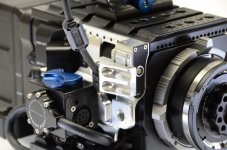
F55: The red guys are really losing the market.

What do you plan to use 20 stops for? Please explain.
(IMO of course)

Why not? That's a better question... Why limit progress?
As I said: sure there are other things that need prior attention, not 20 stops, but disregarding this point of view I have absolutely no complaints!:)

As has been stated in this thread before: RED is an innovative company that likes to push the envelope, so this 20 stops of DR is right up their modus operandi.
 
Its not too techie, the F55 for example is 16-bit and at 960/mbps with a 3.6:1 compression ratio it fits the 16-theoretical value posted above. But REDcode if it is 16-bit at 3:1 compression somehow falls short of the 16-bit theoretical value and is much closer to the 12-bit rate. Red has danced cicrles with their response to this. It iether is or isn't, not sure what's hard for them to explain about it.
 
There are two reasons to be in the technology game
1) Profit
2) Profit
In 1) It's just about sales
In 2) It's about licencing
Blockbuster companies get both 1) & 2) cornered
Deep in my heart I've always sensed that RED Digital was about Licensing. To profit from licensing patented innovative technology, you have to spend gobs of time and money on patent attorneys. Rumours are that RED have recently filed suite against Sony for Patent infringement on core tech. We'll see how that goes and they'd better win because if and when they do, then they can profit from licensing out their IP.
Sony and the rest of the bigger players, have lawyers too so they duke it out and the judges make the decisions after a weird and stupid process is done.

I do want to point out that I saw this coming for RED, but arrogance and snail-paced technology evolution being what it is, they may have lost some lead-time.
I recommend a business strategy team reshuffle for them.

RE: Dynamic Range - The more the better. It gives the feature film and documentary shooter as well as TVC DP HUGE flexibility in lighting and in POST. Ambient becomes the fill and a handful of flashlights bounced off walls and cards, the mains, direct off small booms- inkies and hairlights for accents etc
Cinema production has already transformed dramatically thanks to wider DR and low light sensitivity. I just can't imagine going back to 40ASA film stock :(
 
Last edited:
Well all I know like I said is I have no issues with colour rendition or tonal gradation in a well treated redcode raw image. It could be 8 bit's I don't care at this point as it's not hindering my work. I'm not smarter than Graeme and he does not lie, as he says math does not lie. But if you don't have all the variables making assumptions from your own math is not something concrete to stand on.

All I am saying is if you are not an engineer on the project then you don't really know, now neither do I but as you would with sony or arri or canon I'm going to take their word for it when the only counterpoints brought up are from outsiders. Look in that thread and others linked within red has answered many people's querys just like yours and even tried to explain how it's not as simple as one might think and there are many intricacies going on. on a computer or in uncompressed it may be as simple as the numbers make it seem, but I don't think every compression scheme is equal, or linear, so to try and equate the bit rate from standard uncompressed data rates is false in my opinion or at the very least misleading and unverified.

From what we are told it's 16, you may think it's 12 but you are taking an educated guess. So yes red has answered the question, maybe in a confusing manner but perhaps it's not as simple an answer as what you are looking for. So that's where it is I would just say if you were to refer to it again just state red claims 16 I think 12. Simple, I don't really care if it is or isn't I'd just prefer if people were clear when they were spreading around information that it is their belief and the manufacturer themselves claim otherwise.

you may be camera engineers even but that still doesn't mean you know what is going on under the hood of Redcode, and neither do I. And we all know the line about assumptions...

Now lets put the rulers away and get back to shooting and finding and discussing real issues with our cameras and real world work around to those problems, rather than arguing if we have an extra 4 bits in a camera most of you don't use and wouldn't even notice if it was, or was not there in the first place.
 
What do you plan to use 20 stops for? Please explain. (IMO of course)

1: Naturally lit scenes containing both very bright lights and dark shadows, especially people back lit by the sun. No more faces looking black/near black when you have DR near that of the human eye.

2: Very low light high contrast shots. With a great low light camera like the FS100U, but only decent dynamic range you have to obliterate highlights in order to obtain those very dark details.

3: Interior shots with the sun beaming through the window would mean the window would blow out much less or not at all without needing to gel the windows or add tons of light to bring up the lighting ratio of the room. Cuts down on lighting costs.


I don't understand why anyone would complain about a sensor capable of capturing range much closer to the dynamic range of the human eye. It would give so much freedom to shoot in naturally lit environments or very high contrast scenes and save on lighting costs. I could definitely use the extra DR. 13 stops is great, but 16+ would make a huge difference.
 
It is 100% not 16-bit. The ADC off the sensor is, but REDCODE raw is 12-bit and you can easily do the math yourself to prove it. I have links to RED where they don't want to answer it outright, but say "its like 16-bit" but deep down it is not 16-bit despite what anyone has told you. The data rates would be larger than they are today.

The Epic/Scarlet R3D incarnation is a 16bit Container. The camera is putting 12bits into it currently, but thats why they rebooted R3D for the epic. So it could take advantage of (most likely) a real 16bit signal.

I've owned so far: Sony TRV70, Dvx100, HVX200, 5D mkII, Sony F3 w/ Log, RED Scarlet, and now an Epic. My two favorite cameras have been the HVX200 and the Epic. The thing with a RED camera is this, you have to know how to use it. You have to fully understand it, how RAW effects what you can do, and what you need to do to get the best out of it. ( like EVERY other camera) BUT, REDS are unforgiving to mistakes, despite RAW. You really have to treat it like film. Know your toe, your shoulder, and leave it at "ISO800", but if you REALLLY know what you are doing you can push it up to 1600(even 2500) and get great results. Its about exposure, experience and control. The "horror" stories i come in contact with are from union 1sts/Dp's who never bothered to learn how it works. They shoot it like its an Alexa. Its not. Nor should it be. it has a different skill set and look. I recently trained a few 600 DIT's on my epic, and by end of the class, all essentially said, "Oh wow, its not that bad.... actually.... this is kinda cool...." The probelem with digital cinema is that each camera is a new eco system. Where as with film, the stock is the stock. It will perform the same in a Panaflex, Arri or Aaton. Most producers who made the transition from film to Digital did so on the Alexa as it had the ARRI badge. As people learn more and more about the RED system, they realize its now quite stable, and looks great. That said, the Alexa is just bloody gorgeous. Plain and simple, and it deserves its place in the industry.

The F55 is a nice medium in between. Having tested the camera, i have a few issues with it, but im happy to use it. great picture. Ultimately, i'm making my day rate and I choose the right camera for the Job.
 
I predict long term reliability issues with the viewfinder connection ports and 4k raw.recorder docking bracket.
 
I predict long term reliability issues with the viewfinder connection ports and 4k raw.recorder docking bracket.

Solid Camera & Arri have already got parts to protect the EVF connection. Not ideal, but I think it will likely solve the problem for users going that far with things. If the camera REALLY takes off, I could see companies just replicating that port with a lemo. Lemo for those pseudo DVI connections has not been without problems over the years either. It's a tough nut to crack.

I know what you mean about the multipin on the back though. I could see it going bad. But on the other hand, Sony does have a long history of complicated docking connections (going back to Betacam, afaik), so I could see it not being an issue too. Hard to tell.
 
I predict long term reliability issues with the viewfinder connection ports and 4k raw.recorder docking bracket.

The EVF connector is definitely fragile. The high-density multipin connector should be safe though. It physically floats to eliminate stresses during docking and while it is connected. I believe you would have to be quite careless to damage it. If it does get damaged, it's on it's own PCB with a ribbon. This keeps the repair cost down as well.


CJA_9685.jpgCJA_9690.jpg
 
Interesting thread - im basically an outsider to camso of this price point but some observations..

Red are not at a sweet spot IMO right now - their current sensor is too slow for all but high budget lit projects and also fall over big style with no onboard codec (not that I personally think RedRaw is a PITA to work with) there are some prod houses that are still a little raw allergic.

In the long term I think red make a pretty good offer in terms of the 'upgrade path'

Sony F3s are basically a big loss makers now and do nothing in terms of your F5/55 budget, its the same with the FS100-FS700 move and the EX1 - PMW 200 upgrade path - none - no loyalty

Not to mention all the cages or whatever people feel the need to add.

So IMO Red have the right philosophy to design, but are right now not at the top of the curve..

S


Sam, the Epic and Scarlet are 800 ISO, that's the same native sensitivity as the Alexa, the F65, and the F3 - so I hardly see how that makes it demanding of higher lighting budgets.

Sure you can't push the Red's sensitivity as far as the others, but its performance is in line with the age and resolution of the sensor.
 
Maybe maybe not - IMO the Red is around 400 - my own tests of exposure/noise

Certainly not up there with the FS100 for 'no lights'

Absolutely 'up there' with the 'age and res' of the sensor

And thats it - IMO the RED sensor is old - its slated for replacement - without buying a full new camera system but through an upgrade path of a type Sony dont have

For a project next month Id choose the F5/55 but in the bigger picture of owning a camera system over years I think the choice is less clear..

Especially if that project were smaller with use of (some) nautural light and a 1080 final, commercial deadline etc.

S
 
Last edited:
I always see cameras in 'cost of life'

Epic - Epic + dragon = $6k?

F3, F5, F7 = $30+K depreciation?

Of course the turn over of cameras is different in every business, mine is 3 (actual) t0 5 (ideal) years I guess

Of course a functioning 2014 BMC-alike will end all of that in the main and make all cams of the higher echelons mere historical quirks IMO
 
I purchased my F3 on March 27th 2011. Got an email yesterday that my F55 is available. Camera ROI might be down to a two year time frame. I've been talking to my leasing agent about a true lease, but the suits aren't stepping up with serious residual values. I'd save around $5000 over the buyback lease. Not worth it.
 
Sony have a minimal upgrade path unlike red, basically last years camera becomes a near worthless hunk (or at least 50% depreciated) and all its accessories too

REDs upgrade path just saves you having to sell the camera on the private market. RED isn't immune to depreciation. The Epic lost 50% of its value due to price cut. I'll believe the Dragon is 6K upgrade only when I see it. RED has said a lot in the past that hasn't panned out. You can only upgrade old body designs so much before a fresh design is needed to compensate for new requirements (heat, power, computing). What will happen to Scarlet upgrade path? Is buying a new camera really an upgrade path? The whole obsolesence is obsolete is just marketing jargon mostly. Red One accessories are becoming obsolete.

All digital cameras depreciate faster as tech moves faster and camera tech is in the heyday right now. Realistically many channels on TV (my bread and butter) aren't even HD yet. I think much of the race is what used to be Pro market acting just like the consumer market does and everyone must have the newest gadget when the one they own does a fantastic job still. The Epic without Dragon puts out a fantastic picture as does the F3 etc.
 
@Tubular, I think the new Sony f55 will have a better resale value than the f3, not based on the overall cost, but just due to the feature set alone. There's not many features this cam doesn't offer, or will be able to upgrade to with either hardware or firmware. I honestly don't see anything other than super high frame rates that this cam is missing, global shutter being one of the most exciting, followed by it's light sensativity, and 4k ability. Smaller is about the only upgrade I see for this line, unless someone knows of something I missed.

It seems cameras are dropping about 15-25% or their value with each passing year for the first few yrs, then it tapers off.
 
Back
Top