
Navigation
Install the app
How to install the app on iOS
Follow along with the video below to see how to install our site as a web app on your home screen.
Note: This feature may not be available in some browsers.
More options
You are using an out of date browser. It may not display this or other websites correctly.
You should upgrade or use an alternative browser.
You should upgrade or use an alternative browser.
The Perfect Camera 1.0
- Thread starter jcs
- Start date
I don't get the obsession with autofocus here.
Solo shooters like it because it can sometimes keep focus with a fast moving subject, and vloggers like it because they don't have to worry about staying in focus if they move around.
I don't use it because I don't trust it, but I can see some situations where is might be handy. ( definitely not a deal breaker for me )
I don't get the obsession with autofocus here. That's a complete non-issue for me, so it would never factor into my idea of a "perfect camera." I don't know the last time I even used it, except to demonstrate it for one reason or another (might have been in the CX350 videos).
Could you elaborate that? Which AF systems are you familiar with?
I could understand that you can't remember the last time you used it if it is Panasonic AF system.
Competent AF is quite handy when shooting with and without 1st AC.
Large sensor cameras in combination with longer lens and larger aperture produce shallow depth of field which can be quite challenging even for experienced focus puller.
Add unpredictable movement of the subject and only one take to capture it, then competent AF becomes big issue.
With competent AF you only have to choose if you want to use it just as focus guide or as replacement for focus puller.
More here:
Using AF as focus guide starts at 1'46".
Enjoy.
The only time I do use it is if I'm not sure, but it doesn't happen all that much.
But I don't do guerilla-style or run-and-gun work where only one take is possible. (Never cared for it at all.) I also don't do documentaries.
I don't doubt AF is more useful in those scenarios (or when using an iPhone as a monitor), but I don't much involve myself in them. As I said, it's non-issue for me.
Solo shooters like it because it can sometimes keep focus with a fast moving subject, and vloggers like it because they don't have to worry about staying in focus if they move around.
I don't use it because I don't trust it, but I can see some situations where is might be handy. ( definitely not a deal breaker for me )
I get it, but the topic is "perfect camera" as a general matter. It's being touted as one of the most important things. Might be so for a certain style, but solo shooters and vloggers are fairly niche.
The point is (as others have said), "perfect" for your own purposes shouldn't be confused with universally "perfect."

Run&Gun
Veteran
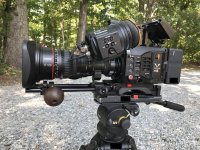
Yes! Let's start with an a really nice S35 sensor. To that we'll add a PL mount for good cinema lenses. Add some room for an ND wheel. We'll need some big heat sinks so we can crank the frame rate. Then add a bunch of tactile buttons for quick access to functions and put them where they need to be. A high quality EVF so we can see what we are doing. We'll need an external battery because that sensor uses a lot of power. Add a few locking connectors for audio and video. A few other bits and I think we will have it. When we're done, it might look like this:
View attachment 136543
That looks very familiar... Lol

Liam Hall
Veteran
But none of the above require a 20 lb weight
I never said they did. Lighter would be a blessing in my book. I'm sick and tired of humping heavy kit all over the planet, but, unless we are talking B or C cameras there are minimum requirements for a camera to make its way onto set.
Liam Hall
Veteran
@Liam Hall- the Competent Camera list is about good enough stable in-focus footage with good audio.
Good enough? I must have misunderstood the point of this thread - It is called the "perfect camera" after all.
Good enough? I must have misunderstood the point of this thread - It is called the "perfect camera" after all.
From the original post:
What makes a perfect (fully competent) camera?
Competent:
- Color Science / Skin Tones
- Dynamic Range (Log Support)
- Autofocus
- Audio Quality
- Stable Shots
- Light Enough for One Hand
In 2019, this is what it takes (IMO) to get a Competent Camera (about 7.5lbs).
We could add to the list, e.g. providing True Resolution (Detail) for the output, e.g. ~6K sensor producing Nyquist Limit 4K detail without aliasing. That's really important to me, especially regarding how cameras are marketed (e.g. C300 II isn't really a True 4K camera, nor is the EOS R), however it's not a deal breaker, though it's the most important feature not on the list IMO.
I've been working with cameras since a kid with Super 8 and film, and many years writing software for camera systems (+ audio), creating our own content, and rarely shooting for others. Thus I've stated IMO and think future cameras systems should be fully competent out of the box with no add ons. Also note the "1.0" meaning it's a Minimum Viable Product (MVP) and that it will be iteratively improved with time.
Right. But the technology makes smaller body/lighter weight cameras perform on a level of the "full size" cameras. If one compares Mini LF with Alexa LF, the Mini LF lacks the higher frame rates ... but the new BMD Pocket6K does full 6K at 50 fps while Mini LF only does 40 at 4.5K. So, a $2,500 camera outperforms a $60,000 camera (on some specs).I never said they did. Lighter would be a blessing in my book. I'm sick and tired of humping heavy kit all over the planet, but, unless we are talking B or C cameras there are minimum requirements for a camera to make its way onto set.
Now, let's see what the IBC brings. There may not be a perfect ENG and cinema camera in one body but there may be a cinema camera that also does a pretty decent run&gun.
Run&Gun
Veteran
Right. But the technology makes smaller body/lighter weight cameras perform on a level of the "full size" cameras. If one compares Mini LF with Alexa LF, the Mini LF lacks the higher frame rates ... but the new BMD Pocket6K does full 6K at 50 fps while Mini LF only does 40 at 4.5K. So, a $2,500 camera outperforms a $60,000 camera (on some specs).
Now, let's see what the IBC brings. There may not be a perfect ENG and cinema camera in one body but there may be a cinema camera that also does a pretty decent run&gun.
I’ve been told by an historically reliable, accurate source that the replacement for the Fs7mkII is coming (more than likely) at IBC. Whether they stick with the Fs7 moniker, who knows...
I’ve been told by an historically reliable, accurate source that the replacement for the Fs7mkII is coming (more than likely) at IBC. Whether they stick with the Fs7 moniker, who knows...
That'd probably depend on whether they keep the current body and its general layout. Unlike Canon with its Cinema line up to C700 - Sony changes things up. Which makes sense since the functionality of features and performance options changes as well.
Now, watch out for FS-7 MKIII.
PS. I would name it F6, since it can be an excellent cinema camera but that would infringe on the Cine Alta division and they are unlikely to release a new model after a two year old Venice and its continuous upgrades.
Now, watch out for F9.

puredrifting
Major Contributor
I’ve been told by an historically reliable, accurate source that the replacement for the Fs7mkII is coming (more than likely) at IBC. Whether they stick with the Fs7 moniker, who knows...
This should be a big hit for Sony, they've sold a boatload of FS7s.
Liam Hall
Veteran
I’ve been told by an historically reliable, accurate source that the replacement for the Fs7mkII is coming (more than likely) at IBC. Whether they stick with the Fs7 moniker, who knows...
Sony FX9. I think it might be more a replacement for the F5 than the FS7. We'll see.
Here's a fun 55s first test with this rig, shot running around in sandals while Jacqui skates (and Leo claps lol)- no stabilization in post:
It's a mix of HD (mostly, to get the wider angle) and 4K. Canon's HD is soft low detail, will shoot wide shots next time in 4K with the 16-35 F2.8 II (might need to get something wider as that's really 32mm with a 2x crop vs. FF).
The challenge was getting decent shadows and preserving the blue sky (using Canon Log and Filmic Skin tuned to work like Canon Log (almost as good as Canon Log except for color near highlights)).
The gimbal worked great.
I’ve been told by an historically reliable, accurate source that the replacement for the Fs7mkII is coming (more than likely) at IBC. Whether they stick with the Fs7 moniker, who knows...
Sony FX9. I think it might be more a replacement for the F5 than the FS7. We'll see.
And the latest gossip says it could be both - FX-9 now (Sept, 13th announcement) and FX-6 a year later.
Sony Alpha Rumors has semi-reliable sources.
Ha yes with mushy hd and huge crop and RS in 4k I find it hard to see the EOS-r as having anything to do with the perfect camera
It's an optimization problem, right? Our constraints are:
1. Usable AF
2. Good skintones
3. Good DR
4. Good audio (even with a bit of wind)
5. Stable
6. Lens selection (this can depend on what one already owns and/or is willing to invest in)
7. Small & light enough for gimbal usage
Close alternatives to the EOS R:
The X-T3 has superior detail and more usable DR (+10-bit), however Fuji broke the AF with FW 3.0 (at some point in the future this will likely be fixed).
The A7 III also has superior detail- I can work with Sony color (A7 III has better color than my last Sony, the A7S II, which I was able to make look good for skintones).
The S1H has superior detail and comparatively weak AF (no phase detection); prefer Canon, Sony, and Fuji color (from examples posted so far).
I sold all Sony lenses and never had any Fuji or PanaLeica FF L-Mount lenses. I have a bunch of Canon lenses (mostly L, where the RF > L).
For this use case and constraints, the EOS R is the optimal choice. RS is a non issue on a gimbal, and when enabling the digital IS & no gimbal, RS hasn't been a problem even with fast pans:
See any RS, especially for the basketball and skateboard fast pans?
The notion of Perfect Camera 1.0 (with the version number), is it meets competent constraints as the first version, with future versions, e.g. 2.0 being better, namely no crop, less RS, real resolution/detail etc. Something like the A7S III perhaps.
As for using 4K and getting wide enough, Canon has a $199 10-18 4.5-5.6 IS STM that will work in 4K mode on the EOS R (APS-C lens). For gimbal shots this is probably fine (it's also a light lens). For higher quality, there's the Canon 11-24 F4L, mostly distortion free though much heavier ($2700). It's full frame so could be useful long term with stills and architecture (where low distortion is more important). This will still be lower cost than 'switching brands' where cost is added to the constraint optimization.
What are your constraints for a camera, and once optimized, what is the perfect camera for you?
Yes I just see too many compromises with the EOS-r and having to use different lenses to get different focal lengths depending on 4k or hd (and for use as a still camera) makes it a pain to carry around. I need a camera to also work well handheld and having tried the EOS-r, the RS is bad in 4k. The digital I.S. makes a softish 4k image even softer, the c100 in hd is probably similar resolution without the horrible RS.
I still have a c100 but have been using a Fuji XT3 more and more for travelling light run n gun scenarios - the image is beautiful and prefer it to the Canon . I don't use AF much unless using the Crane gimbal like yourself - but haven't updated the firmware and it seems to work very well. Have sold almost all my ef lenses and will off load the c100 too eventually for another Fuji or possibly the Panasonic S1. Have been waiting years for Canon to make an affordable stills camera with decent video - it's not going to happen and is quite liberating to be leaving the constant disappointment of Canon and go with Fuji and Panasonic who seem to understand the video needs of a hybrid camera. The Panasonic S1 also has a nicer image than Canon to my eyes, particularly with the full V-log - and much better DR, RS and the wonderful IBIS. AF may not be up to Canon standard but looks good enough for my occasional use, IBIS is way more important to me.
The Nikon Z6 is another camera that I would chose over the EOS-r - has IBIS, no 4k crop and the recent firmware update shows its AF performance is up there. The Sony A73 also has good AF without the silly crop problems - to me the EOS-r is the bottom of the pile. Af is its only positive. I am happy to move away from Canon and sell all the lenses as I don't think they cater for people wanting to use hybrid camera for 4k video. They want you to buy into their Cinmea EOS line and if you want 4k and 10 bit that means the expensive C300 mk2.
Your needs are for gimbal only - I want to be able to use a camera handheld too and the RS of the EOS-r isn't good enough
@ade4all- yeah X-T3 is a nice camera and fits your use case well. The X-T3 and A73 were in the first post of this thread as alternatives based on use case (where 'perfect/competent camera 1.0' is the complete rig, not just the camera body). I'm currently shooting more stills right now and the Canon cameras + lenses when shooting RAW stills makes a lot of clients happy with the results. I had hoped the EOS R would be a smaller replacement for the 1DX II (I don't shoot sports), however so far the 1DX II stills look better in terms of color and noise. The EOS R has more resolution and with the RF 24-105 is really sharp/detailed. Also the new C-RAW is 40% smaller with no visible loss in quality- that's pretty cool.
Again the EOS R digital IS handheld while even softer worked OK handheld for the Venice video linked above. The X-T3 has no IS, and the A7 III IS doesn't really do much: both need a gimbal. The S1H has great IS but weak AF (+ color science needs work; could work with it though (had a GH4)). When Fuji fixes the IS with FW > 3.0, might take another look at it; might also consider the A7 III too (has better dynamic range than the Canon and Fuji). While more detail is welcome, most people watch content on their phones for the kind of content we create (which YouTube & IG etc. stream around 720p or lower (YT app is slightly better than browser)).
Again the EOS R digital IS handheld while even softer worked OK handheld for the Venice video linked above. The X-T3 has no IS, and the A7 III IS doesn't really do much: both need a gimbal. The S1H has great IS but weak AF (+ color science needs work; could work with it though (had a GH4)). When Fuji fixes the IS with FW > 3.0, might take another look at it; might also consider the A7 III too (has better dynamic range than the Canon and Fuji). While more detail is welcome, most people watch content on their phones for the kind of content we create (which YouTube & IG etc. stream around 720p or lower (YT app is slightly better than browser)).