
Navigation
Install the app
How to install the app on iOS
Follow along with the video below to see how to install our site as a web app on your home screen.
Note: This feature may not be available in some browsers.
More options
You are using an out of date browser. It may not display this or other websites correctly.
You should upgrade or use an alternative browser.
You should upgrade or use an alternative browser.
The Next Panasonic Camera -- suggestions to the product manager
- Thread starter Barry_Green
- Start date
This, for under 10,000, would be incredible.Take varicam's sensor stick it to a fs7 body and price it nicely. Boom best seller
combatentropy
Veteran
I would like higher priority given to global shutter.

Take varicam's sensor stick it to a fs7 body and price it nicely. Boom best seller
I don't think you'll find it in that plastic body coming from Panasonic however. Next 4 or 5 months should be interesting and I'll leave it at that.
youre right. not body but specsI don't think you'll find it in that plastic body coming from Panasonic however. Next 4 or 5 months should be interesting and I'll leave it at that.

walkaboutcamera
Active member
Keep the current physical, data, and electrical connections between the gh4 and yagh the same going forward with future gh cameras and yaghs. I would like to see future yagh development split into two streams, one more oriented to the studio like the current yagh and one oriented to the indie filmmaker and possibly call something other than yagh to differentiate it. The filmmaker ( affectionately called ) brick might include for a start, raw recording to raided sd cards. Also recording of minimally baked in 4k downscaled to 1080 debayed, uncompressed or lossless, full sensor bit depth; let's call it semi raw. This downscaling should an averaged downscale not line skipped and bined downscale.
Which "plastic body" are you referring to? I thought at first you were referring to the FS7 - but that is certainly not plastic, it's die-cast magnesium alloy.I don't think you'll find it in that plastic body coming from Panasonic however. Next 4 or 5 months should be interesting and I'll leave it at that.
Newsshooter ( http://www.newsshooter.com/2014/11/01/sony-fs7-field-report-week-1-the-canon-c300-killer/ ) described it "The body itself .... is made of magnesium alloy and looks to be suitably tough."
I've only seen one for a short while but I'd agree with that - it terms of general build quality it was far better than I'd have expected for the price.
Since the FS7 shares the sensor with the F5, and the Varicam sensor is pretty much on a par with that of the F5, that is not too much to hope for!Take varicam's sensor stick it to a fs7 body and price it nicely. Boom best seller
 In another thread it's exactly what I have predicted for the "AF200" - but it would be s35, which may disappoint those hoping for a 4/3 AF200....
But in the context of this thread, such is far more likely to come from the professional division, surely? Whereas the opinions being canvassed here are for the consumer division of Panasonic. And I simply do not see the consumer division of Panasonic releasing anything with a varicam sensor, or to the standard of the FS7.
Come on, Noel, don't leave it at that.... Next 4 or 5 months should be interesting and I'll leave it at that.
Drop a few hints, at least.
I don't think this is true. The Varicam 35 is almost quadruple the price of the F5, and the sensor has some pretty amazing new technology in it.the Varicam sensor is pretty much on a par with that of the F5
Yup. Local rental says its better or as good as an alexaI don't think this is true. The Varicam 35 is almost quadruple the price of the F5, and the sensor has some pretty amazing new technology in it.
Barry_Green
Moderator
Except you're talking about a product that would be coming from the broadcast division. This thread is not about that, this is about what the consumer division would be producing.Take varicam's sensor stick it to a fs7 body and price it nicely. Boom best seller
I would like everyone to please keep that in mind. This thread isn't about dream cameras at $10,000 price points, this thread is about suggestions to the consumer division of Panasonic about what we would like to see next from them. Accordingly, discussions of modular Alexas or Reds or Varicams or F5's should be directed to a different thread.
michaelaranda
New member
Hello! Long-time lurker, first-time poster, here.
For years I've been a little disappointed with what Panasonic has put out; it just hasn't really fit my videography needs. Every time a trade show comes around, I hold my breath for the following, in an ENG form-factor:
1. Global shutter
My inquiries to Panasonic representatives about global shutter at trade shows have sometimes even been met with scoffs and ridicule. I, however, don't care how much the rolling shutter artifacts have been minimized or mitigated with various techniques; with the kind of run-and-gun shooting I do most often, I NEED the camera's sensor to fire all of its pixels at once. I have, so far, refused to upgrade from my HPX-170 solely because of this reason. CMOS chips have allowed a lot of innovation in power consumption and low-light sensitivity, but until they also provide a global shutter, the other stuff isn't worth it to me, though I realize I'm in the minority here.
2. 13+ stops of dynamic range
With Blackmagic's cinema cameras on the market, I'm going to feel like I'm sacrificing picture quality to some degree by choosing Panasonic over even just an $800 pocket camera, unless Panasonic can offer me the same (or better) dynamic range. As it stands now, I carry both my HPX and my Blackmagic Pocket Cinema Camera into the field, and use the BMPCC for big, static, landscape shots. I would love for Panasonic to cause my BMPCC to be useless.
3. 240+ FPS at 1080
The 60 FPS ability of Panasonic's ENGs was cool in 2008, but in 2015 (and beyond), even a $1,000 camera should be able to out-perform my phone.
If you're reading this, Mr. Panasonic Man, thanks. I appreciate you taking the time to listen to your customers.
Last edited:
combatentropy
Veteran
Take the HC-X1000's body, chop off the lens, pull out the sensor, shove in the GH4's sensor, and put an M4/3 mount on it.
In the same vein as Barry Green's very level-headed request with a twist, something like what I talked about with Jan Crittenden six years ago:
2K for $2K. Take the Sony PXW-X70's body, chop off the lens, and put in the Sony IMX174 sensor.
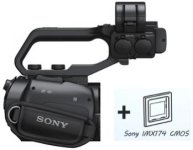
16mm-size sensor, global shutter, SDXC cards, 10-bit 4:2:2.
The excitement for the Ikonoskop, Digital Bolex, and Blackmagic Pocket prove a market for 2K 16mm interchangeable-lens digital cameras. Each of those cameras fall short in certain ways that stymied their success.
- The Ikonoskop was expensive, had no XLRs, and used unusual cards.
- The Digital Bolex is still a little too bulky when fitted out (which is why I specify the Sony PXW-X70 as the starting block. The detachable handle is important, too, for those who want to go a little more stealthy).
- The Blackmagic Pocket has sold plenty but could be even better with a handicam body style, instead of a still camera's.
This camera remedies all of those shortcomings. The Sony IMX174 sensor can be sourced from Sony at I'm guessing a reasonable price, plus it's global shutter, 12 f-stops, and high frame rate.
This camera would appeal to hobbyists, students, event shooters, low-budget filmmakers, and many more. A decent depth of field can be had with, say, a Voigtlander f/0.95 (the depth of field of about f/2 in S35). Or, for those event shooters who actually want deep focus, they could slap on a m43 zoom and have ENG-style zoom range and depth of field.
For the many artistic prospects in the market for such a camera, I strenuously suggest going with 10-bit 4:2:2, as the Sony PXW-X70 has. You could use one of your Panasonic codecs or ProRes. But the creme de la creme might be the MOX format (basically MXF) using 10-bit 4:2:2 JPEG still images (JPEG can do 10-bit 4:2:2). That would definitely catch the attention of some of the more bohemian prospective users.
Last edited:
Be careful, because it can be a case of either/or. You either get full resolution at normal frame rates *OR* higher frame rates at reduced resolution. That applies to relatively expensive cameras, so I'd be surprised if not to phone cameras as well!I hold my breath for the following, in an ENG form-factor:
1. Global shutter
2. 13+ stops of dynamic range
3. 240+ FPS at 1080
The 60 FPS ability of Panasonic's ENGs was cool in 2008, but in 2015 (and beyond), even a $1,000 camera should be able to out-perform my phone.
They get the higher frame rates through skipping lines.Good example is Sonys FS700 - very good resolution spec at normal frame rates, but drops off at the high frame rates. May be difficult to see on average pictures at 240fps (though very obvious on a chart!), but pretty glaring at 480fps, and even more so at 960fps!
Just because a camera will do high frame rates does not mean they will be as good as the performance at 60fps.
If this is in regard to my comment, then I'd like to say that Alexa M and Varicam were used as an example of a "piggyback" rather than of a "pedestal" stack such as deployed by the GH4+YAGH combo. Presuming this falls under the guidelines of the stipulated discussion, the "piggyback" modular design can prove to be very popular if it delivers on the value chart.... This thread isn't about dream cameras at $10,000 price points, this thread is about suggestions to the consumer division of Panasonic about what we would like to see next from them. Accordingly, discussions of modular Alexas or Reds or Varicams or F5's should be directed to a different thread.
Sony products come with a lot of non-compete caveats. They're useful as commodities on the low end where such caveats rarely exist but are not conducive to higher end models where a different manufacturer wants to beat Sony in its own game.... This camera remedies all of those shortcomings. The Sony IMX174 sensor can be sourced from Sony at I'm guessing a reasonable price, plus it's global shutter, 12 f-stops, and high frame rate.
Last edited:
If thats the case, its all about the DR and VFR.Except you're talking about a product that would be coming from the broadcast division. This thread is not about that, this is about what the consumer division would be producing.
I would like everyone to please keep that in mind. This thread isn't about dream cameras at $10,000 price points, this thread is about suggestions to the consumer division of Panasonic about what we would like to see next from them. Accordingly, discussions of modular Alexas or Reds or Varicams or F5's should be directed to a different thread.
-No pixel bin or line skipping.
-13+ stops, 120fps max
-Bonus: 4k at 60/30 & global shutter (i like global shutter, but its the least in my priorities)
make the sensor's photosites huge. (Like a7s' FF 12megapixel or c300's s35 4k)
On the Phantom the higher frame rates are achieved at expense of vertical coverage, so you might get 100,000 fps but at 16 lines. So something that does a widescreen "cinema" effect at the higher frame rates would be a workable approach. Your consumer cat video producers will thank you.
combatentropy
Veteran
please, no bickering
Can we please just let people make suggestions without running them through our ingenious clairvoyant omnicience about what is possible over the next couple years?