FS7: The Great S-Log-2 vs S-Log 3 Debate

This is nothing new. I've been an advocate for S-LOG2 over S-LOG3 since the F55 came out in 2013, a year before the FS7 was even released. It's all right there in my books and videos.
And it is a myth that S-LOG3 is easier to grade. They are equally easy to grade. I would say S-LOG3 is more convenient to grade for some people because the LUT you need as your starting point is already built into Resolve. But for S-LOG2 you must download the correct S-LOG2 LUT and install it yourself. Apparently that is too much work for some people.

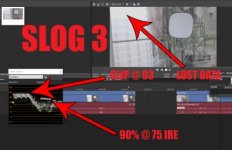
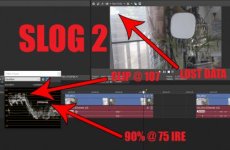
Yes, both of them can be graded to look identical if nothing is clipped at the time of shooting. But S-LOG3 clips highlights at only 94 IRE, while S-LOG2 goes to at least 107. So S-LOG3 is a poor choice to use in uncontrolled lighting situations, such as outdoors or when there are windows in the shot, etc. But in situations where the lighting is under control , such as an interview, then it really doesn't matter which one you choose.

I normally shoot RAW on my F55 and then I can grade that footage as either S-LOG2 or S-LOG3 in post. And when I have tested grading the exact same clips both ways, I usually prefer the S-LOG2 grade.

My opinion: S-LOG2 is superior and S-LOG3 is the dumbed down version that Sony released to satisfy the demands of Hollywood colorists who wanted to be able to dump S-LOG footage into a project and handle it exactly like Arri Alexa footage. In fact, you don't even need to use Sony's S-LOG3 LUT for S-LOG3, you can just use an Arri LUT and get nearly identical results.
 
Last edited:
Really appreciate your thoughts and agree completely. I was getting my hands slapped for saying something similar and just wanted to make sure I hadn't lost my mind. I think people get conditioned to look for complexity when the answers are often simple. Thanks again and have a great day!
 
Another vote for S-Log2. And agree with Chris - it's also better on my A7RII, although according to some "experts" (no-one on this forum), because it's 8 bit it's supposed to be unusable on the A7 cameras. You can't push it through the roof but it's by no means too fragile to do a decent grade.
 
I prefer S-log2 as well. Doug, have you tried grading X-OCN using S-LOG2 with the ARRI LOG-C LUT applied? I'm just wondering if there are any issues with remapping the data.
 
Check out https://cameramanben.github.io/LUTCalc/LUTCalc/index.html . You can see that SLog2 is very similar to Canon's Canon Log 3, which is very popular on Canon cameras and is easy to grade. SLog3 is very similar to Canon Log 2 and ARRI LogC = much flatter and all can be used with typical ARRI LUTs (for gamma). On the A7S II, I found SLog2 + SGamut3.cine +16 saturation produced really good results which was easy to grade; that's likely what I'd use if shooting on the FS7x. Sony's VENICE color science on the VENICE looks really good- to my eye from online tests I'd put it up against ARRI color (not as a match- a really good look on it's own, like an improved F65 look (e.g. from Lucy, Oblivion)). The VENICE LUTs don't look the same- perhaps updated sensors/color filters are also needed (FS5 II VENICE looks pretty good). Perhaps the FS7 III will get VENICE color too.

If wanting to use SLog2 with ARRI LUTs- probably best to create an SLog2 + SGamut3.cine (or your choice of color space) to ARRI LogC+Alexa-Wide-Gamut using LUTCalc first.
 
Im going to break some myths, and then agree with everone else :)

AC wrote..
"S-Log2 captures more dynamic range than S-Log3, it goes to a higher level on the waveform, S-Log3 clips the highlights sooner."

Wrong! Sooner than what? Any digital capture should be driven by protecting the highlights and then examining what is in the frame and how noisy the shadows are.

Again Karma17s image is dumb.
The correct way to expose is to protect the highlights. The clipped highlights just show 3 to have a higher effective iso than 2 and the operator failed to account for that.

Now this image is far more telling. If you know what to look for and how to expose.. (I cant embed the image here)
http://www.cinematography.com/cine-uploads/monthly_07_2015/post-34233-0-73986000-1437896168.jpeg

WHat you will see is the data per stop of the two curves

Now Slog 3 has more stops that have a decent amount of data while Slog 2 has more data per stop on less stops.

Ergo Slog2 has less dynamic range (less stops with a decent amount of data) but is more maleable in post.. haveing more levels of data per decent stop.

So..
In a lit/controlled low DR situation Slog 2 will be the better choice as you get a more maleable file
In a wide DR situation Slog3 will be better because you get data over more stops.

Neither is better or worse.

I however tend to shoot in lit/low DR situations, or not give a hoot about blowing some bits of the image, maybe a window, and therefore prefer Slog 2.

Realistically Slog2 has about 8stops of DR while Slog 3 has 10,
 
Last edited:
..I also think Doug's unfungling of raw using the two curves is also 'poor' for learning.. as the core raw data recorded is so far superior as to wipe out useful analysis. (of the XAVC cameras)
 
Annoying thing about FS7 is that in Slog 2 you are frozen out of User 3D LUT's which I generally prefer to the generic LC709A . Why? well we could sak that about a number of things can't we.
 
I prefer S-log2 as well. Doug, have you tried grading X-OCN using S-LOG2 with the ARRI LOG-C LUT applied? I'm just wondering if there are any issues with remapping the data.

I shoot XOCN-ST almost exclusively even though I call it RAW. I don't usually use the Arri LUTs but I would be extremely surprised if you could detect any difference between how they would affect XOCN and pure RAW. But I couldn't say for sure because I've never tested.
 
..I also think Doug's unfungling of raw using the two curves is also 'poor' for learning.. as the core raw data recorded is so far superior as to wipe out useful analysis. (of the XAVC cameras)

Not sure what your point is here, Sam. Are you saying that I can't compare RAW that as been decoded as S-LOG2 vs. RAW decoded as S-LOG3, and come to any conclusions about how XAVC S-LOG2 would compare to S-LOG3? If that's what you're saying, you're incorrect because I've done those tests too. It just happens to be a lot easier using the same clip twice. But the results are the same either way.
 
On the A7S II, I found SLog2 + SGamut3.cine +16 saturation produced really good results which was easy to grade; that's likely what I'd use if shooting on the FS7x.

Except that, unless I'm misunderstanding your post, you can't choose the 3.cine gamut with Slog2 when using the FS7. You can create a LUT with Ben's great app (Ben - haven't seen any wonderful posts from you lately - hope you are well) to use in post - but unless you're burning in a LUT into your recording on the FS7, you can't mix / match Slog's gamuts in the camera. I know this is confusingly possible on the Sony mirrorless /dslr's (at least on some of them)
 
Annoying thing about FS7 is that in Slog 2 you are frozen out of User 3D LUT's which I generally prefer to the generic LC709A . Why? well we could sak that about a number of things can't we.

I think I had forgotten this... that is a great WHY?
 
Not sure what your point is here, Sam. Are you saying that I can't compare RAW that as been decoded as S-LOG2 vs. RAW decoded as S-LOG3, and come to any conclusions about how XAVC S-LOG2 would compare to S-LOG3? If that's what you're saying, you're incorrect because I've done those tests too. It just happens to be a lot easier using the same clip twice. But the results are the same either way.

I think you are wrong. Consider the image I linked to
(http://www.cinematography.com/cine-uploads/monthly_07_2015/post-34233-0-73986000-1437896168.jpeg)

For example stop 'clip-3' Slog2 has 120 levels of gradiation while Slog3 has 80 levels of gradiation, the latter would fall apart more easily when graded hard and would tend towards banding. But your raw source probably (being 12bit?) might have 400 or so levels, so would, when graded, not collapse like the thinner of the XAVC examples might.

You would need to actually get your raw, save it to XAVC then grade it so see the qualitive differences, maybe that is what you are doing?

Also we have apparently seen above that slog3 clips at a lower light level than 2 and should in many circumstances therefore be shot on a smaller Tstop. So to make a good/fair comparison one might be want ing to compare slog3 at T5.6 vs slog2 at T4
 
Last edited:
You are welcome to be skeptical if you'd like, but I have done my own testing several times and I know what i know. The bottom line is that the difference between S-LOG2 and S-LOG3 usually doesn't matter, but sometimes S-LOG is clearly the better choice in uncontrolled lighting. I cannot recall any instance where S-LOG3 provided better results. Maybe the same, but never better.
 
Wrong! Sooner than what? Any digital capture should be driven by protecting the highlights and then examining what is in the frame and how noisy the shadows are.
The correct way to expose is to protect the highlights. The clipped highlights just show 3 to have a higher effective iso than 2 and the operator failed to account for that.

I disagree with your approach here. I would never expose for highlights. I always expose for reflected whites (same as using an incident light meter) and the highlights will just have to fend for themselves, which is why having that extra +13 IR of headroom that S-LOG2 provides comes in very handy. If you never have sunsets, backlit clouds, chrome, lights, flames, etc. in your shot, then you are working in a different environment than me. Clipped highlights are always a potential problem outdoors. Exposing for highlights, or protecting highlights that are not the main subject of the shot, is a fundamental mistake that will almost always lead to underexposure.
 
Clearly we both know how to get a result in the real world :)

In terms of post 8, for example, which appear to be some kind of test, which appears to be implying that slog3 clips badly, then an asstute tester would have considered closiing the iris on the Slog3, and then pulling up the mids in post, then doing a side to side with the Slog 2.

Such tests.. closed iris, pulled mids and examination of shadow noise inform ones exposure choices.

No one would give credance to a tester who tested 100ISO film stock against 800 iso film stock at the same Tstop and then hit the 800 for bad highlights :)

When doing such a test one must nail something some where, maybe putting a grey card at a certain IRE or closing until the highlights are held.

Once one has such test data, have worked out the best curve to add in post (or made a lut) one can go into the field and make intelligent choices about which element of the image are not important and can die in shadow or clip. Windows, chrome bumpers, led spots, and many other elements in an image are of course let to blow by intelligent shooters.
 
Last edited:
Back
Top