
Navigation
Install the app
How to install the app on iOS
Follow along with the video below to see how to install our site as a web app on your home screen.
Note: This feature may not be available in some browsers.
More options
You are using an out of date browser. It may not display this or other websites correctly.
You should upgrade or use an alternative browser.
You should upgrade or use an alternative browser.
The Graduate
- Thread starter DLD
- Start date
combatentropy
Veteran
There are things I like about The Graduate. The acting is great. The camerawork is probably in my top 10 (I like long takes from oblique angles).
But I am not a fan of the hard light. Was it because the emulsions back then were less sensitive? Soft light became more popular in the '80s, which for me was cinematography's peak (not the cheesy teen comedies but the high-end movies and commercials, usually by British directors like Ridley Scott and Adrian Lyne).
I'm treading on shaky ground, though, criticizing the work of Robert Surtees. He was nominated for 14 Oscars.
But I am not a fan of the hard light. Was it because the emulsions back then were less sensitive? Soft light became more popular in the '80s, which for me was cinematography's peak (not the cheesy teen comedies but the high-end movies and commercials, usually by British directors like Ridley Scott and Adrian Lyne).
I'm treading on shaky ground, though, criticizing the work of Robert Surtees. He was nominated for 14 Oscars.

JPNola
Veteran
There are things I like about The Graduate. The acting is great. The camerawork is probably in my top 10 (I like long takes from oblique angles).
But I am not a fan of the hard light. Was it because the emulsions back then were less sensitive? Soft light became more popular in the '80s, which for me was cinematography's peak (not the cheesy teen comedies but the high-end movies and commercials, usually by British directors like Ridley Scott and Adrian Lyne).
I'm treading on shaky ground, though, criticizing the work of Robert Surtees. He was nominated for 14 Oscars.
I've always wanted to say this but refrained because it might offend: The lighting in some classic films widely considered "great" films is terrible by today's standards. And it isn't only a matter of not having the technology / equipment available at the time. DP's often just thought differently back then about lighting and accepted lighting quality that today would not be accepted. I think that DP's of yesterday many times did not take as much care with lighting as do DP's today. The standard is higher today, and not just because of having more tools with which to achieve that higher standard. It is also a cultural change in the DP culture / cinema culture.
Look at all the hard shadows in this scene from The Sting. Shadows that are unmotivated and shadows coming from all different direction in the same shot:
Yes, the need for a large number of foot-candles was part of it. But not always. In older films there will be exterior scenes shot in daylight and the actors have ugly shadowing on their faces that could have been cured by simply employing a silk yet still achieving the required exposure. Or, you can see where reflector boards were used and used poorly. It appears that in previous eras there was just not as much care taken and more of an attitude of "it is what it is". You let things be that aren't left to be today.
Now, all that said, at the same time there is hard-lighting seen in older films that is perfectly executed. Many highly experienced Gaffers and DP's working today would struggle to perform that sort of hard-lighting. Soft light can be more difficult to control than hard lighting, but with soft lighting the placement and angles are not nearly as critical as with hard lighting. Generally you can move a large soft source one foot laterally and it won't alter the light on the subject much. But if you move a hard source a foot to the left or the right it can dramatically alter the lighting on the subject. When soft-source lighting is poorly executed it doesn't show as poorly executed as much as when hard-source lighting is poorly executed. Generally speaking, it requires more effort and more time to get hard-lighting right than to get soft-lighting right. And maybe that explains why so many older films have "bad" lighting. Not only were DP's less scrupulous on the whole compared to today but it required more effort and attention to detail to execute hard-lighting well. Or, put another way, hard-lighting is easier to screw up than soft lighting.

Batutta
Major Contributor
It wasn't just the ASA, the dynamic range of film wasn't as wide either, so the hard, hot light needed to blast the scene with light couldn't be filled by a soft source. Also, through the 50's and 60's, drive-ins were a factor, and darkly lit films just wouldn't play well on those outdoor screens so studios mandated a certain level of brightness. Gordon Willis got hell from the studio for lighting The Godfather the way he did, but drive-ins started to phase out by then so he was able to get away with it. Once faster emulsions with wider dynamic range started to come into play and cinematographers realized what they could do with that, styles started to change.
I actually like the hard light look when it's done well. One thing I miss about Tarantino's recent films is the hard, kind of retro style he had in Reservoir Dogs and Pulp Fiction when Andrezj Sekula was his cinematographer.
I actually like the hard light look when it's done well. One thing I miss about Tarantino's recent films is the hard, kind of retro style he had in Reservoir Dogs and Pulp Fiction when Andrezj Sekula was his cinematographer.
Last edited:

Jim Feeley
Veteran
DP's often just thought differently back then about lighting and accepted lighting quality that today would not be accepted. I think that DP's of yesterday many times did not take as much care with lighting as do DP's today.
I think the constraint might have been the producers and studios, rather than the DPs. Think about noir... Remember that book Painting With Light by John Alton first published in the late 40s?
https://www.ucpress.edu/book/9780520275843/painting-with-light
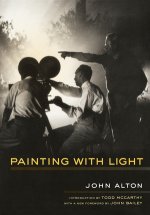
I'd say the DPs working with Welles and Kubrick did pretty good work, too.
Remember the tales of the studio complaining during dailies that Gordon Willis's work on The Godfather was too dark...and I think they thought he (and Coppola) were making rookie mistakes.
Perhaps the studios were worried audiences wouldn't like that arty stuff, at least not for a mainstream film like The Sting. Funnily enough, my wife and I watched The Graduate a few weeks ago. Parts held up, parts were meh... but I think Robert Surtees' work was good, or at least got what Nichols wanted. Wasn't Surtees considered a good and flexible DP (ie- he shot Ben Hur).
Anyway, I think the DPs back then could do amazing work, when they were allowed to do amazing work. But I'd guess the studios liked hard light because they thought anything else might scare away audiences.
JPNola
Veteran
I still think part of it was the "culture" of lighting at the time. That is, DP's didn't much think about lighting realistically because they weren't lighting a documentary, after all, but a fictional piece. They largely lit as one would for a stage play. They didn't see any need to light realistically. And to some extent the culture of the time was more one of "the audience doesn't care and the film isn't hurt at all by having lighting that is obviously not realistic". Only later did the DP-culture transform to thinking it mattered that lighting was realistic-looking. Maybe it is that the need for a lot of light resulted in inability to light realistically and that set the culture from the beginning of film-making up until a change in approach. The mindset was that you can't light realistically even if you wanted to and why would you want to when there is no need? Audiences don't care. The content is still the content. Films aren't lit realistically, everyone knows that.
On a related note, I often see lighting that is simply not flattering or even "ugly" and I wonder why it is the DP allowed it to be when it is apparently not done on purpose, for the character. I'm not talking about using shadowy, "ugly" lighting on a villain to visually reinforce that the character is a villain. More just "ugly" lighting that appears to be happenstance that was allowed. For example, the "ugly" shadows on the face of Pacino in this scene from The Godfather:
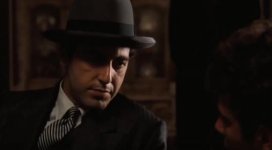
I understand that the "moody" lighting was deliberate. But the actor looks like he has a black-eye on his right eye and there is an ugly shadow from the brim of his hat over the left eye. I could imagine an actor being unhappy with that lighting. Moody is one thing but here the lighting is moody and ugly on the actor. The key-light is so far lateral that it produces that black-eye looking shadow on the right eye, the fill is so high that it results in that nasty brim-shadow over the left eye that could have been "cured" by lowering the fill-source. Is the hat-brim shadow intentional on the part of Willis, is it that he didn't think it needed "fixing", or is it that he couldn't easily keep the mood but improve the hat-brim shadow? Is the black-eye shadow shadow intentional? Or just sloppy? Was it not possible to light the scene moodily and avoid the black-eye / brim shadow at the same time?
Here's another example from Willis, and again as a result of the positioning of the lighting we have an ugly "black eye" shadow as well as a brow shadow on the same eye. ( there is also a weird nose shadow happening as a result of top-light positioning and size ). Was this done intentionally? Did Willis deliberately set the lights so as to produce a brow-shadow and a black-eye look and a weird little "booger-nose" nose shadow over one nostril? I doubt it.
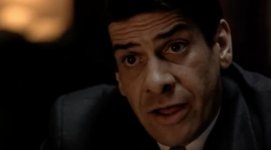
If you look at films shot recently, even scenes in those films that are moody and dark, you'll less see things like this black-eye effect or brow shadows. And I think it is because in the DP culture today DP's care more about such things and are more meticulous in lighting. They less just let something "go".
Now here is a frame grab from The Irishman, the scene is lit in a moody and dark manner but without the brow-shadow and the black-eye look. The lighting here is more sophisticated and more careful than in the frame grab above from The Godfather-
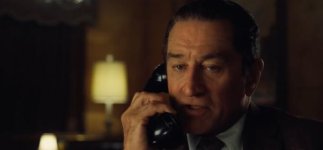
The last frame grab is lighting I would be proud to have executed. The other two, not so much. It may be arrogant of me, I dunno, but I do wonder if other DP's even see the things I see and think need improving. Or if it is instead that they also see it but don't see anything wrong with it and as a result "let it go" where I would not. Do you guys see what I see? If you were handed that frame grab of Pacino above, independent of this discussion, would you have thought it bad lighting because of the hat-brim shadow and black-eye shadow? Would you have even noticed those things specifically and have decided that they are acceptable? Would it jump out to you as "bad" lighting ( poorly executed ) as it did to me?
On a related note, I often see lighting that is simply not flattering or even "ugly" and I wonder why it is the DP allowed it to be when it is apparently not done on purpose, for the character. I'm not talking about using shadowy, "ugly" lighting on a villain to visually reinforce that the character is a villain. More just "ugly" lighting that appears to be happenstance that was allowed. For example, the "ugly" shadows on the face of Pacino in this scene from The Godfather:
I understand that the "moody" lighting was deliberate. But the actor looks like he has a black-eye on his right eye and there is an ugly shadow from the brim of his hat over the left eye. I could imagine an actor being unhappy with that lighting. Moody is one thing but here the lighting is moody and ugly on the actor. The key-light is so far lateral that it produces that black-eye looking shadow on the right eye, the fill is so high that it results in that nasty brim-shadow over the left eye that could have been "cured" by lowering the fill-source. Is the hat-brim shadow intentional on the part of Willis, is it that he didn't think it needed "fixing", or is it that he couldn't easily keep the mood but improve the hat-brim shadow? Is the black-eye shadow shadow intentional? Or just sloppy? Was it not possible to light the scene moodily and avoid the black-eye / brim shadow at the same time?
Here's another example from Willis, and again as a result of the positioning of the lighting we have an ugly "black eye" shadow as well as a brow shadow on the same eye. ( there is also a weird nose shadow happening as a result of top-light positioning and size ). Was this done intentionally? Did Willis deliberately set the lights so as to produce a brow-shadow and a black-eye look and a weird little "booger-nose" nose shadow over one nostril? I doubt it.
If you look at films shot recently, even scenes in those films that are moody and dark, you'll less see things like this black-eye effect or brow shadows. And I think it is because in the DP culture today DP's care more about such things and are more meticulous in lighting. They less just let something "go".
Now here is a frame grab from The Irishman, the scene is lit in a moody and dark manner but without the brow-shadow and the black-eye look. The lighting here is more sophisticated and more careful than in the frame grab above from The Godfather-
The last frame grab is lighting I would be proud to have executed. The other two, not so much. It may be arrogant of me, I dunno, but I do wonder if other DP's even see the things I see and think need improving. Or if it is instead that they also see it but don't see anything wrong with it and as a result "let it go" where I would not. Do you guys see what I see? If you were handed that frame grab of Pacino above, independent of this discussion, would you have thought it bad lighting because of the hat-brim shadow and black-eye shadow? Would you have even noticed those things specifically and have decided that they are acceptable? Would it jump out to you as "bad" lighting ( poorly executed ) as it did to me?
Last edited:
Willis was no rookie on "Godfather", having just done "Klute" for Alan Pacula. I certainly believe none of those shots was accidental. Having said that, one can adjust the "final look" digitally these days and, if Scorsese wanted an eye shadow removed, it can easily be done in post.
Batutta
Major Contributor
I still think you guys are underestimating how much harder it was to expose an image back in the old days, and how that dictated the look of things. When Technicolor film first came out, its ASA rating was 5! Even up until the 70's, the fastest film stock was ASA 100, and DP's would push that a couple stops, which made it grainer, contrastier and with less dynamic range. You could not light things the way you would today with sensitive digital cameras, or fast film stock.
combatentropy
Veteran
Thanks for the clip from The Sting (also by Robert Surtees and also nominated for Best Cinematography). It helps clarify that it's not simply hard light that I dislike but when both the subject and the background seem to be lit by the same big bright light.
This makes the background look flat. Nowadays backgrounds are more often spiced up with angled lights, cookie-cut lights, flagged lights, practicals, etc.
Backgrounds today are also more often simply dimmer. It aids in bringing out the subject. This happens naturally when you use soft light, whose brightness falls off quickly.
---
As for The Godfather, no, it doesn't bother me. I kind of like it a little sloppy, where an actor is not always perfectly lit. If it's too perfect, it starts to feel fake again.
Gordon Willis loved precision and simplicity at the same time, which I don't think is a contradiction. So if a character is lit in an unflattering way, I think he knew it. The Godfather is famous for its overhead lighting that cast eyes into shadow. From what I read, it began as an adjustment to Marlon Brando's make-up. Then when he saw that it made all these villainous people look mysterious, he was like, even better. But the movie also has a lot of scenes with flattering, soft, side light.
This makes the background look flat. Nowadays backgrounds are more often spiced up with angled lights, cookie-cut lights, flagged lights, practicals, etc.
Backgrounds today are also more often simply dimmer. It aids in bringing out the subject. This happens naturally when you use soft light, whose brightness falls off quickly.
---
As for The Godfather, no, it doesn't bother me. I kind of like it a little sloppy, where an actor is not always perfectly lit. If it's too perfect, it starts to feel fake again.
Gordon Willis loved precision and simplicity at the same time, which I don't think is a contradiction. So if a character is lit in an unflattering way, I think he knew it. The Godfather is famous for its overhead lighting that cast eyes into shadow. From what I read, it began as an adjustment to Marlon Brando's make-up. Then when he saw that it made all these villainous people look mysterious, he was like, even better. But the movie also has a lot of scenes with flattering, soft, side light.
Willis also wasn't fond of colorful palettes. He called them a "Sherwin Williams explosion". You can see even "Godfather III" being very dark and void of much besides black, white and brown. Whether he would have retained his philosophy in the modern era of LED's, lasers and the "native ISO" of 5,000 will never be known.
Mitch Gross
Veteran
Gordy was an absolute perfectionist. He refused to use 1/4 CTO gel because he felt that two layers of 1/8 CTO was more accurate. There is absolutely nothing that was done sloppily or without specific intent on a Gordon Willis shoot.
Gordon specifically stated that he wanted the shadows in the eyes of these mobsters because he felt that these shadowy guys were always trying to hide their true nature. In fact you can track the difference between various characters and their lighting, and even how some progress within the story. Look at the lighting on Al Pacino before the big assassination scene in the restaurant and then the lighting after. There is a progression. In The Godfather, Part II Gordon took it even further, with Pacino sometimes nearly disappearing in shadow and that wonderful last shot where he eye is just barely visible. That's when they started calling Willis the Price of Darkness.
BTW, at the time there were many DPs who felt as you do about Willis' work on The Godfather. They couldn't believe anyone would light a scene where the eyes would go dark. They absolutely hated it and there was a real East Coast / West Coast brouhaha. This was also around the time of movies like The French Connection and the original The Taking of Pelham One Two Three, and many guys one the West Coast were not appreciative of the "New York School" of cinematography. I think it was in the book Masters of Light that you hear some of the arguments from both sides.
Gordon specifically stated that he wanted the shadows in the eyes of these mobsters because he felt that these shadowy guys were always trying to hide their true nature. In fact you can track the difference between various characters and their lighting, and even how some progress within the story. Look at the lighting on Al Pacino before the big assassination scene in the restaurant and then the lighting after. There is a progression. In The Godfather, Part II Gordon took it even further, with Pacino sometimes nearly disappearing in shadow and that wonderful last shot where he eye is just barely visible. That's when they started calling Willis the Price of Darkness.
BTW, at the time there were many DPs who felt as you do about Willis' work on The Godfather. They couldn't believe anyone would light a scene where the eyes would go dark. They absolutely hated it and there was a real East Coast / West Coast brouhaha. This was also around the time of movies like The French Connection and the original The Taking of Pelham One Two Three, and many guys one the West Coast were not appreciative of the "New York School" of cinematography. I think it was in the book Masters of Light that you hear some of the arguments from both sides.
JPNola
Veteran
BTW, at the time there were many DPs who felt as you do about Willis' work on The Godfather. They couldn't believe anyone would light a scene where the eyes would go dark. They absolutely hated it and there was a real East Coast / West Coast brouhaha. This was also around the time of movies like The French Connection and the original The Taking of Pelham One Two Three, and many guys one the West Coast were not appreciative of the "New York School" of cinematography. I think it was in the book Masters of Light that you hear some of the arguments from both sides.
My dislike is not that the eyes are dark but HOW they are dark. I'm not knocking the look but the execution of the look. There is dark that is well-executed and there is dark that isn't well executed.
I find the "dark" in this scene to be better executed than in that scene from the Godfather-
And this goes to my assertion that the standards of lighting are higher today than in the past.
Mitch Gross
Veteran
To each their own. You may be the first person in 40-some years to criticize the cinematography of The Godfather, but you do you.

CharlesPapert
Director of Photography
I had long admired Willis' work (who hadn't) and finally had a chance to meet the man. It was 1992 and he was in Northampton, MA to shoot what was to be one of his last films, "Malice", which is largely remembered now for Alec Baldwin's "I am God" monologue. I was living in Northampton at the time and the little city was buzzing about having a major motion picture there, mostly due to the presence of Nicole Kidman and her new husband Tom Cruise. I was more excited about watching the shoot itself when they were out on the streets. One day crowds lined downtown as the company was shooting the opening sequence, hoping to catch a glimpse of one of the stars--they were to be disappointed as none were there that day. As they were setting up for this shot (a pretty impressive piece of operating--I'd guess at least 200mm on a moving subject), I spotted Gordon standing by himself a little distance from the camera and I approached him. Blurted out some awkward stuff about how honored we were to have him here which didn't interest him much, so I asked how the movie was going. He squinted up at the sky and growled "I'm just a goddamn meter monkey on this one".
Amazing. In retrospect, a lot of the material shot in Northampton was day exterior so I imagine he was coming off a week or two of that at that point.
Haven't watched the movie in years, it was a pretty good thriller and I remember a few scenes in his inimitable dark style, may have to watch again.
Mitch (or anyone else), I feel like you must also have some story about meeting him in your youth?
Amazing. In retrospect, a lot of the material shot in Northampton was day exterior so I imagine he was coming off a week or two of that at that point.
Haven't watched the movie in years, it was a pretty good thriller and I remember a few scenes in his inimitable dark style, may have to watch again.
Mitch (or anyone else), I feel like you must also have some story about meeting him in your youth?
I still think you guys are underestimating how much harder it was to expose an image back in the old days, and how that dictated the look of things. When Technicolor film first came out, its ASA rating was 5! Even up until the 70's, the fastest film stock was ASA 100, and DP's would push that a couple stops, which made it grainer, contrastier and with less dynamic range. You could not light things the way you would today with sensitive digital cameras, or fast film stock.
+1..and in 16mm (mid '60s to mid '70s), it was even tougher. The available color stocks were mainly Ektachrome Commercial, a "lower contrast" original for making Kodachrome prints (ECO: ASA 25 Tungsten, 16 Daylight with an 85 filter) and EF with a blazing tungsten ASA 0f 125 that had to be "flashed" by the lab to lower the contrast enough to print from (it was initially used as a direct projection news film for film chains).
16mm versions of color negative really only became usable with the introduction of 100 ASA 7247 in 1974...it could be pushed a stop and still look decent.
Still think a base ISO of 800 is too slow?
Ken
JPNola
Veteran
To each their own. You may be the first person in 40-some years to criticize the cinematography of The Godfather, but you do you.
A heretic in our midst.
Mitch Gross
Veteran
Mitch (or anyone else), I feel like you must also have some story about meeting him in your youth?
I met him a few times in the 1980s as I was a young teenage enthusiast just learning stuff. Back in the day in NYC you could meet a lot of people by hanging out at places like Magno or DuArt. I especially liked DuArt film labs, home to The Slowest Elevator On The Planet (tm). Get a guy stuck waiting in the lobby with you and then stuck in a 6'x6' box for several long minutes and you could learn a lot (or burn a bridge forever -- always be nice kids!).
The first time I met Gordon was when he was working on color timing Perfect, the John Travola / Jamie Lee Curtis movie about LA gym culture. I think they shot in LA but Gordon was timing it in NY because he hated LA and wanted to go there are little as possible. I was basically this kid just out of school who was allowed to hang out in the back as long as I kept quiet. I remember how unremarkable the color timing session appeared to be and said as much to the colorist afterward. He explained that it was always that way with Willis. "Gordon times a movie on set. Everyone remarks on his work on Zelig and Broadway Danny Rose because they seem so special, but the answer print for The Purple Rose of Cairo looks identical to the dailies."
For those too young to know, that basically never happened. Gordon would test to achieve the look he wanted beforehand, and pick the printing lights (color correction) he wanted for Day Interior, Day Exterior, Night Interior, and Night Exterior. Then he shot the entire movie with those printing lights in mind. The lab would steadfastly take NO creative steps or try to "help" him in any way. They would just print the dailies based on those four preplanned printing lights. And he would nail it every single shot. Because he was just that good a craftsman.
Nestor Almendros was shooting a gangster film in NYC (Billy Bathgate) and Gordon came in to help out for a couple days because Nestor was ill (it's been a few decades so I guess I can share this now). Nestor had set up a row of 5Ks pumping through diffusion along a row of windows. When Gordon came in he looked at the row of 5Ks (it was a big warehouse and there must have been 20 of them) and he asked a grip to grab a rope. He then strung the rope from one end of the line to the other and pointed out how the lights weren't the same distance from the windows. There was a few inches variance here and there, and we're talking about fixtures that were pumping light to a distance of some 50'-75'. But Gordon made them line the stands up perfectly like little soldiers. I'm sure it made a difference in his eyes.
On The Godfather, Part III I got to help out on the BTS featurette. I remember being on the set the day Pacino was sitting by the coffin of an old Don back in Sicily (the scene was actually a reshoot in NYC because they had to change some story point in editing). I recall thinking that it was crazy bright in the room and we were able to shoot a very poppy 16mm image for our footage. Of course Gordy was overexposing, pull processing and printing at a high light in order to have deep blacks and crisp contrast. Plus he wanted his faces to be a little dark, so when they were purposefully underexposed in the range they actually dropped into darkness quickly without showing any grain. It was a really slick look and I was amazed by how different his footage appeared compared to ours, all in the same light.
When Gordon participated in the Visions of Light documentary, he'd been retired for a few years already. The crew showed up to his house in a truck containing every possible lighting option because the DP was terrified to not have whatever might be needed when it came to lighting an interview with Gordon Willis. In the end he used a fairly basic setup but the funniest part was that Gordon had never seen a Litepanel before. At the time it was the original brick, about 2" x 6" with a battery that could snap on the back. Gordon was fascinated with it, kept playing with the thing, and for a minute they considered shooting the whole interview with just Gordon holding the little LED and lighting himself.