The Full Frame Look is a Myth. Here's how to Prove it to Yourself

See, you keep taking your small sensor and opening up the iris. I keep telling you we stand side by side exact same settings.
I already agreed with you that if you open up the iris you can get a similar look.
What you are failing to see is that if we use the same settings, you won't get the same look.

Christopher- we're in agreement: I agree that we can't use the same settings for both cameras and that the looks will be different if we do. That's what the math for equivalence tells us. The Canon 85mm 1.2 with a Speedbooster and S35 will work fine. Again, the assertion of this thread is that the sensor size doesn't do anything special or unique by itself. If an equivalent lens system isn't available for a sensor size- either it's not on the market or one doesn't have one on hand at the time, use what works or what you have. At some point you may have access to equivalent lenses, or new lenses or focal reducers can be released into the market. The sensor size isn't the image-defining factor (only when one is limited with lens selection at the time- it's lens+sensor combination that defines the look).

dhessel- great illustration! A physically modeled ray-tracer & camera model does an excellent job demonstrating equivalence. Any difference in looks comes down to available lenses, not the sensor size.

There have been comments that medium and large format sensors provide less distortion on the wide end. If that's true, example images with cameras set up with equivalence would be helpful. It's possible to build flat/lower-distortion lenses, or not. Here are examples for Super 35: https://www.hurlbutvisuals.com/blog/2014/03/why-do-we-want-flat-glass/ . For architecture, flat is more desirable, however for people and '3D pop', distortion may be more desirable. These are artistic choices with lenses and not a characteristic of sensor size: nicely illustrated by dhessel's physically modeled ray-traced images. VRay provides a physical camera model, so it's possible to simulate many different types of lenses (some with distortion, some without, etc.): http://help.chaosgroup.com/vray/help/150SP1/examples_vrayphysicalcamera.htm . So we can make even better predictions about sensor size and lens combinations without having the physical cameras+lenses on hand. Ultimately, the final tests require using real cameras & lenses- post 'em if ya got em'!
 
I understand the point and you're not wrong but

a) The speedbooster is adding significant distortion to the image

b) The way the rays hit the sensor is going to be different with a stock FF lens compared to a speedboosted one on APS-C, the speed boosted one will be less tele centric (and most SLR lenses are). This is because you have a new rear element that changes everything. Rays are now more oblique than they were designed, this can create shading issues at the edges of sensors (see the Leica magenta/green fringing). Therefore aberration control and the lens design is now different to how the designers wanted. If this was a seamless solution then all FF lens manufacturers would be sticking speedboosters inside their lenses as part of their design for APS-C but that's not the case. Brian Caldwell who designed the speedbooster i think said as much way back when. He's off designing the new Panavision 70mm lens series. Basically YMMV depending on lens and sensor combination.

c) The sensor pixel size *can* be different. i.e. you're not going to get 4K a7s pixels on a APS-C

Sure, for the most part you can match pretty well and perhaps well enough for what you need. Personally i found the distortion on the speedbooster a problem.

I'm nit picking but lens design is a very complicated business, read some erwin puts on leica lenses and see what goes into creating a design for all situations.

cheers
Paul
 
Personally i found the distortion on the speedbooster a problem.

Can you point to lens combos that would illustrate this issue ?

I haven't done any side by side tests ( with and without the SpeedBooster ), but haven't seen any huge problems with these adapters so far.
 
Can you point to lens combos that would illustrate this issue ?

I haven't done any side by side tests ( with and without the SpeedBooster ), but haven't seen any huge problems with these adapters so far.

I am also curious. I have a GH3 + Speed Booster + Tokina 11 - 16mm here. Do I see some barrel distortion at 11mm? Yes. Is it a bit worse when mounted on the Speed Booster? Yes, but for god's sake it's a 8.5mm F2!! That's almost as extreme as it's gonna get.

When I have my Sigma 18-35mm on it, there is visually not more distortion than the lens itself already has. The more 'tele' you go, the less the effect is visible. Hey I'm not saying that a Speed Booster is better than a native lens designed for the format you're shooting on, but it's pretty damn great. I'm shooting with it for more than a year now and I'm still amazed at the results everytime I watch the footage back.
 
Some corrections . . .

Some corrections . . .

I understand the point and you're not wrong but

a) The speedbooster is adding significant distortion to the image

b) The way the rays hit the sensor is going to be different with a stock FF lens compared to a speedboosted one on APS-C, the speed boosted one will be less tele centric (and most SLR lenses are). This is because you have a new rear element that changes everything. Rays are now more oblique than they were designed, this can create shading issues at the edges of sensors (see the Leica magenta/green fringing). Therefore aberration control and the lens design is now different to how the designers wanted. If this was a seamless solution then all FF lens manufacturers would be sticking speedboosters inside their lenses as part of their design for APS-C but that's not the case. Brian Caldwell who designed the speedbooster i think said as much way back when. He's off designing the new Panavision 70mm lens series. Basically YMMV depending on lens and sensor combination.

c) The sensor pixel size *can* be different. i.e. you're not going to get 4K a7s pixels on a APS-C

Sure, for the most part you can match pretty well and perhaps well enough for what you need. Personally i found the distortion on the speedbooster a problem.

I'm nit picking but lens design is a very complicated business, read some erwin puts on leica lenses and see what goes into creating a design for all situations.

cheers
Paul

A few corrections/clarifications are in order I think:

1) Speed Boosters add only a very small amount of distortion. Most of the "added" distortion comes from revealing more of the image circle of the attached lens.
2) Speed Boosters make the lens *more* telecentric, not less, and the chief ray angle becomes less oblique.
3) A well-designed focal reducer, like the Speed Booster, shrinks aberrations, therefore improving the MTF even as the lens gets faster.
4) Adding a S.B. to a lens is a pretty seamless operation, and in many instances results in superior performance to what is available from "native" optics.
5) I'm done with the PV project. Off to bigger and better things.
 
Can you point to lens combos that would illustrate this issue ?

I haven't done any side by side tests ( with and without the SpeedBooster ), but haven't seen any huge problems with these adapters so far.

I was just using a CZ 50mm f1.4 and found the distortion quite noticeable. It was better in that case to use a 35mm.

A few corrections/clarifications are in order I think:

1) Speed Boosters add only a very small amount of distortion. Most of the "added" distortion comes from revealing more of the image circle of the attached lens.
2) Speed Boosters make the lens *more* telecentric, not less, and the chief ray angle becomes less oblique.
3) A well-designed focal reducer, like the Speed Booster, shrinks aberrations, therefore improving the MTF even as the lens gets faster.
4) Adding a S.B. to a lens is a pretty seamless operation, and in many instances results in superior performance to what is available from "native" optics.
5) I'm done with the PV project. Off to bigger and better things.

Well that's learnt me :)

I can't argue with you because you're obviously right! But by placing an optic behind the rear element wouldn't that have to force the rays to be more oblique to get to the edges of the sensor because the rear element is physically closer than it was before, at least that was my thinking? At least at the edges where some sensors suffer colour shift. Perhaps that's compensated by the reduced image circle though. Cancelling each other out.

You mentioned a while back on other forums that the exit pupil affected issues like hot spotting quite a lot. Do you think that speedbooster works well for all lenses or that there are some it may struggle with? I have this recollection of it not being a panacea for all, but in the mists of time perhaps that was someone else in a discussion, not you. At least i can clarify my memory now!

Why do you think that these aren't standard parts of the design of all lenses at the rear element? Design a lens for a larger image circle and reduce that with the final element to always improve the image? Just curious.

thanks for replying.

cheers
Paul
 
I was just using a CZ 50mm f1.4 and found the distortion quite noticeable. It was better in that case to use a 35mm.


Well that's learnt me :)

I can't argue with you because you're obviously right! But by placing an optic behind the rear element wouldn't that have to force the rays to be more oblique to get to the edges of the sensor because the rear element is physically closer than it was before, at least that was my thinking? At least at the edges where some sensors suffer colour shift. Perhaps that's compensated by the reduced image circle though. Cancelling each other out.

You mentioned a while back on other forums that the exit pupil affected issues like hot spotting quite a lot. Do you think that speedbooster works well for all lenses or that there are some it may struggle with? I have this recollection of it not being a panacea for all, but in the mists of time perhaps that was someone else in a discussion, not you. At least i can clarify my memory now!

Why do you think that these aren't standard parts of the design of all lenses at the rear element? Design a lens for a larger image circle and reduce that with the final element to always improve the image? Just curious.

thanks for replying.

cheers
Paul
Regarding telecentricity, remember that the Speed Booster has positive optical power, so it will naturally bend a chief ray that is travelling "uphill" to a direction that is less "uphill". As an extreme example, you can take any lens with exit pupil distance = X, then place a fresnel lens with focal length = X directly in contact with the image plane, and you will have created a perfectly telecentric optical system. This trick is actually done with some types of projection lenses. The distance from the rear element to the image plane really doesn't matter as much as you think. All that counts is the chief ray angle after leaving the rear surface.

Hotspots are a ghost image of the pupil. So the position of the pupil does matter because it will change where the ghost image gets focused as well as the size of the ghost image. Controlling ghost images is extremely difficult, and during the design phase I normally try to ensure that these images are as large and poorly focused as possible (thus making them more or less invisible) over a reasonable range of master lens exit pupil distances. Often you find that controlling ghost images conflicts with normal aberration correction, and in this case you just have to do the best you can and rely on good coatings to do the rest. If you ignore ghost images during lens design then you will often find sharply focused ghosts in the finished lens. I suspect this is what happened to the cheap copycats that began appearing about 6 months after we released the Speed Booster.

The truth is that mirrorless lens design is a fairly new area in optics. Leica should have figured it out with their M lenses over the last century, but they stopped doing real innovation many decades ago. Other companies like Panasonic, Olympus, Nikon, Canon, Kenko, etc. are just big and bureaucratic, and its not that hard to invent stuff they have overlooked. BTW, Speed Boosters have 4, 5, or 6 elements depending on the model. As far as I know only the infamous light cannon used a singlet design. Another tidbit: adding a focal reducer to a large image circle lens is better than scaling the lens to a smaller image circle because the MTF is as good or better and you get an extra stop or more of speed. This fact is probably almost unknown even among lens designers.
 
And I thought this thread was already dead :)

Let me just say I'm super happy with my speedbooster, what a clever concept. The thing is obviosly powered by some sort of witchcraft.
 
Regarding telecentricity, remember that the Speed Booster has positive optical power, so it will naturally bend a chief ray that is travelling "uphill" to a direction that is less "uphill". As an extreme example, you can take any lens with exit pupil distance = X, then place a fresnel lens with focal length = X directly in contact with the image plane, and you will have created a perfectly telecentric optical system. This trick is actually done with some types of projection lenses. The distance from the rear element to the image plane really doesn't matter as much as you think. All that counts is the chief ray angle after leaving the rear surface.

Hotspots are a ghost image of the pupil. So the position of the pupil does matter because it will change where the ghost image gets focused as well as the size of the ghost image. Controlling ghost images is extremely difficult, and during the design phase I normally try to ensure that these images are as large and poorly focused as possible (thus making them more or less invisible) over a reasonable range of master lens exit pupil distances. Often you find that controlling ghost images conflicts with normal aberration correction, and in this case you just have to do the best you can and rely on good coatings to do the rest. If you ignore ghost images during lens design then you will often find sharply focused ghosts in the finished lens. I suspect this is what happened to the cheap copycats that began appearing about 6 months after we released the Speed Booster.

The truth is that mirrorless lens design is a fairly new area in optics. Leica should have figured it out with their M lenses over the last century, but they stopped doing real innovation many decades ago. Other companies like Panasonic, Olympus, Nikon, Canon, Kenko, etc. are just big and bureaucratic, and its not that hard to invent stuff they have overlooked. BTW, Speed Boosters have 4, 5, or 6 elements depending on the model. As far as I know only the infamous light cannon used a singlet design. Another tidbit: adding a focal reducer to a large image circle lens is better than scaling the lens to a smaller image circle because the MTF is as good or better and you get an extra stop or more of speed. This fact is probably almost unknown even among lens designers.

Wasn't the Sigma 18-35 f1.8 also designed like that? I believe I read somewhere a while ago that this lens also has a 'build-in Speed Booster' and that's why they created such a 'cheap' f1.8 constant zoom lens with a weird focal length.

Anyway, if that's true it is actually funny when you use it together with the Metabones Speed Booster. Then you are effectively boosting the same lens twice, and with great great results. Then I start wondering, how many speed boosts can you do until the image falls apart? :D
 
I own a Sony A7 and a6000. Full disclosure, I'm full-frame still-photography snob. I agree with JCS's less "fun" argument, that in practical terms, especially in video, there isn't much of an advantage shooting full-frame. In video, I may gain ISO at full-frame, but then I get aliasing/moire due to the pixel distances. And then there's the cost. The full-frame premium is at least about $1,000. And it's bigger, heavier. I have a 35mm/1.8 for the A6000 and since I doubt I'll eve shoot below f2.8 on the A7, in video, what do I gain?

One thing that hasn't been mentioned in this thread is the video sharpness you lose with larger sensors that must scale down to 1080. You can shoot 4K, sure, but you're really talking about a lot of money/time for all the obvious reasons there. When it comes to sharpness, the MFT cameras, to me, kill the full-frames in video. Of course, if you want shallow DOF that doesn't matter.

I have a BMPCC with the Olympus 12mm/2.0 and 17mm/1.7. Even wide open, they're sharp, small, amazing.

Anyway, I'm with JCS about re-thinking my prejudices about cameras. As I said, I'm a snob. But the truth is, unless I'm going to shoot hyper-shallow on a full-frame, it doesn't really gain me much. Sure, I like using legacy glass at their rated focal lengths. But I also LOVE using that $30 Fujian on the c-mount adapter and A6000.

So thanks for posting JCS. I've really enjoyed all the posts. What Dusty is saying sounds trivial, but it isn't. Standing in the back of the room is often not a good option, or even A option! As I've gotten older and more into wide angle shots, this has become apparent to me. Or if you don't buy that, what if you want to use a tilt-shift lens? What MFT/ASP-C glass is there comparable to the Canon / Nikon offerings? Full-frames have real advantages in the real world.

But again, I think I'd do better if I spent more money on lights for my A6000 than lenses for my A7 ;)
 
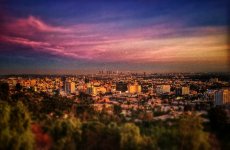
Good points max. The best camera is the camera we have on hand. On a regular basis I shoot more photos with my 'old' iPhone 5S (skipped the 6), with a 1/3" sensor, 7.21x crop factor. Many times processing the photos immediately with Snapseed (HDR, shadow boosting, excellent color controls, tilt shift and shallow DOF effects, etc.) and emailing/uploading when done editing. Example iPhone 5S shot & edited on Runyan canyon above Hollywood:
iPhoneLA_1024.jpg

Another illusion is that larger sensors have better low light performance. Note that in the equivalence equations, we have to square the crop factor when scaling ISO when going from a smaller sensor to a larger sensor. That's because the same number of photons ultimately get through the lens system when the cameras are equivalence matched and the larger sensor has more area, which goes up by a square factor. So the only reason a larger sensor is better in low light is the sensor technology itself, not the sensor size. Medium and large format cameras which act like focal enlargers after the lens need an incredible amount of light.
 
Last edited:
Good points max. The best camera is the camera we have on hand. On a regular basis I shoot more photos with my 'old' iPhone 5S (skipped the 6), with a 1/3" sensor, 7.21x crop factor. Many times processing the photos immediately with Snapseed (HDR, shadow boosting, excellent color controls, tilt shift and shallow DOF effects, etc.) and emailing/uploading when done editing. Example iPhone 5S shot & edited on Runyan canyon above Hollywood:
View attachment 98106

[...]

I didn't follow the whole thread, but I'm sorry to disagree about this particular point.
Should I consider the pic you posted as example to corroborate your assumption, than your assumption is wrong. The pic you posted is poor in terms of colors (there's so much going on, not a good balance perhaps due to the CC you did but still...), detail is low and in this case I'd love to have more details about what I'm seeing, otherwise it's a mess. Grain deserve another topic, but surely is not helping this picture at all.

Now, coming to the idea that the best tool (I want to keep the assumption generic and for a wider audience) is the one you already have, it's just not true.
If I need to render a physically accurate 3d image, most likely I need something like VRay (or similar), not a scanline render engine. If I want to draw with a greasy, soft effect, I need something like a HB-8 pencil, whereas if I need something sharp I'd probably go with at least a HB-2.
Same goes for cameras. Sure, you can test your framing skills with a phone, or capture a moment by walking on a street. But good luck being in full control of the tool if you need to tweak shutter speed, aperture, focal length and so forth...
 
dsp_418- it's art! I dig all the colors- lots of energy and emotion. The original shot was very dark, the grain is sensor noise from very low light. Yet we can still see the buildings in downtown LA in the distance: beautiful. Lot's going on for sure- it's LA! If that makes you uncomfortable while looking at it, maybe that's what it's supposed to do as art: LA is a grinder of a city- not for everyone. If I didn't have a camera on my phone, the 'effective shot' would have been an all black screen: nothing at all. I am grateful to have been at that location at that time to capture such amazing colors produced by nature. I didn't change the colors at all, other than boosting what was there. Using a bigger camera would have a different look, different emotion, but wouldn't necessarily be better as art. The average person doesn't nitpick technical details- they experience the art. Sometimes it touches them emotionally, sometimes it doesn't. That's art!

Of course the best tools are the ones we have on hand or access to. How do you create art with no tools? Sure everyone could use better tools, especially for paid work, however when creating art, it's not about the tools. Sometimes limitations and so-called low-quality and artifacts help tell the story, help create emotion. Folks waiting around for the perfect tools aren't creators, aren't artists, and have nothing to show except negative comments on internet forums. However, constructive criticism is cool- it helps move the discussion forward, can help the artist grow, and can help others learn something too. Getting hung up on sensor size when it doesn't matter for a shot isn't creative or productive. On the technical side, if you go back and read the entire thread you'll see that sensor size alone doesn't provide any kind of unique look. On the artistic side, we get creative with the tools we have. The above post shows we can simulate shallow DOF/tilt-shift in post with a cellphone. I shot, edited, and uploaded the above image while hiking- I think being able to do that is pretty cool. It's possible to do this with larger Wifi/Bluetooth cameras along with cellphones, but that's only possible if you have the larger camera with you! :)

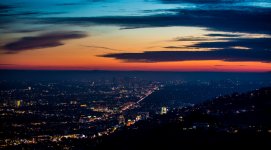
Here's a full frame shot with the 5D3 from Runyan canyon looking West toward Century city:
AZ1C9933.jpg
A different look, more detail, less noise, and more sterile. Is it better than the other shot? Not to me, it's a different emotion, a different story.

Here's a shot in South Beach, Miami. I also had the 5D3 but used the iPhone 5S so I could edit & upload live:
SouthBeach5S.jpg
Shallow DOF, vignetting simulated. Brings back good memories!

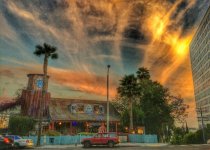
Sunset on Sunset blvd: waiting for a friend to perform at the Comedy Store. Noticed the amazing sky and captured the House of Blues with the iPhone 5S. Edited and uploaded in a couple of minutes while waiting in line:
HouseOfBluesSunset.jpg

Sensor size, lenses, etc. don't matter as much as the camera's we have access to at the time we are creating :)
 
Sometimes it touches them emotionally, sometimes it doesn't. That's art!

Quite impressive seeing a complex topic like Art being explained so briefly.
The assumption of Art as an emotional touch that might turn on or off it's a misconception, a naive, misleading idea of Art, not to mention also a very risky assumption as a lot of people (and the sad thing especially in the creative field) believe they do Art when what they do actually has nothing to do with Art. Nowadays, considering how simple is to get so many sources to copy from (in the creative field under the name "gathering references", i.e., stealing), you do the math and see how much creativity is left. But that's another story.
By the way, it seems you're against spending much words on the technical side yet you seem very excited about the potential of smart phones, wi-fi, post-process and so forth. It sounds quite contradictory.

Anyway, if Art was just about emotion and about what people may or may not like, we would have lived our entire art history under a big idea of Facebook without knowing it. If Art was just about that, then the simple man who doesn't have any clue about what Avant-Garde movements did, would be damn right to quickly get rid of a Cezannes' Still Life with Fruit Basket, or a Gorky, Klee, Tanguy, you name it. He would probably say "My nephew can do it!"

As for the grinder LA, well I live in there and I don't know what you're referring to. Anyway trust me, that's not what makes me uncomfortable, in fact I'm totally fine with the pic. I just consider that picture an average picture, maybe good for some "likes" on FB...?
The beautiful colors of the sky over LA aren't simply properly rendered, plus the out of focus on top of a digital grainy image, makes everything muddy. If this aesthetical gritty, rough surface is what you were after in order to convey a mood of a complicated city, well it didn't work. When the technique overcome the meaning, than the meaning is lost and the technique takes over. Furthermore if (like in this case) is a result of a unsuitable tool (a limited smart phone), than there's nothing left.

I agree with you, people spend a lot of time in search of the perfect tool, winding up not doing anything creative at all. That doesn't mean that we don't have to know what we use (you started this thread after all). Or perhaps you believe that painters didn't do their research for tempera, pigments and so forth? Because if that would be the case you'd be still using a pencil and a paper, and you should have drawn LA rather than wi-fiing from your phone.
Not being proactive hiding behind a curtain of technical limits it's definitely a mere excuse. There's a boundary though between looking for alibis and having the proper tool for the job (and this has nothing to do with FF vs Crop, that's another story I'm not interested in at the moment). If I need an establishing shot of a plaza, and the plan is a wide view of it, but my only lens is a 200mm, well there isn't nothing left to do. I had to do a dolly once, I didn't have one though then I tried to find a way to do it anyway (and I did it, wasn't perfect but it did the job). There are things you can workaround, others you can't.
 
Quite impressive seeing a complex topic like Art being explained so briefly.

"The most beautiful thing we can experience is the mysterious. It is the source of all true art and science." -Albert Einstein

The beauty of math is if all parties agree and understand the math, there can be no argument. Math is abstract, physics deals directly with reality. In science there is argument however when everyone follows the scientific method, consensus can be achieved.

In a sense, art is everything math and science are not, even though math and science can be used to create art. Arguing about art is like arguing who'd win in a fight, Superman or Batman (obviously Superman unless Batman has a kryptonite gun). If one wants to show us they are a great artist, why not show us with your art not your words about art?
 
[...]If one wants to show us they are a great artist, why not show us with your art not your words about art?

This is the kind of comment that doesn't make any sense.
First off, when did I say I want to show I'm a great artist?
Second off, if the only ones allowed to talk about something are the ones who work in that field, then what Art Galleries are for?

jcs,

I'm not arguing about Art in general, I'm just saying that your pic is an average shot that can't validate your assumption "The best camera is the camera we have on hand".

If you're inferring from my participation to this discussion that I'm arguing about Art, that's probably because you believe your pic is without any doubt a piece of Art, ergo no one can tell you anything about it, neither give you a critique. Good luck with that approach for your career.

That being said, if you believe Art is something no one can argue about, then my only advice is to pick some good books to help you understand Art first (that by the way doesn't hurt).
Again, clearly your assumption about Art is romantic or naive, something that can either trigger an emotion or leave the viewer indifferent.
If you'll keep thinking that Art it is just that, than what's the difference between a good work and a bad work?
There are languages for any artistic form of communication (as for photography, cinematography, etc.), rules, things that have developed over centuries of hard work that artists did spending their entire lives for, sometimes giving literally blood for it.

"Art is everything" is the simplistic explanation that people of the street would give. In a field of so called creatives we've higher responsibilities and we must confront ourselves with more serious understanding of what we do and why we do it. Or simply don't call it Art, then I'm totally fine with that. But nowadays it seems that being connected, having access to expensive tools, makes people feel their artist all of a sudden.
Unfortunately Dadaist were dead right when they said Dada was gonna fully accomplish its own very raison d'être by only dying, ending itself. I'm saying unfortunately because, though they were right, after their work anything seems plausible. So, yes, in a sense you're doing Art, if we agree that Art is no more and you're allowed to call Art whatever you want, even an urinal.
 
Last edited:
dsp_418- this thread is about dispelling myths, illusions, specifically that sensor size by itself provides any specific look. I provided a few example images shot with a small sensor camera with shallow depth of field added in post (+ a large sensor camera shot with deep DOF) and another with cool HDR. I like the shots, they make me happy. My friends and colleagues like them too. You don't that's cool too. You don't make art? You're an art critic, a philosopher? Right on, carry on. There are no rules for art- anything goes. Can a more powerful effect, more powerful message, more powerful emotion be generated by following certain guidelines- for sure. This applies to music, to screenwriting, to photography, to cinematography, editing, acting... everything too! Knowing when to break the guidelines is an art too. Sometimes we don't know- it's an accident! When meeting artists who state, "oh, that's too technical, I'm an artist!" I reply, "have you ever heard of Michelangelo or da Vinci? There's no exclusive artist club- everyone can be an artist. What defines good or great art is in the eye of the beholder, just like beauty. If your goal is to promote better art, you can give constructive criticism and help others improve. Or provide examples that might help the artist see how to improve their work for the future. Constructive criticism is helpful and welcome!
 
Back
Top