Alpha Beta Omega
Veteran
I'm also keen on trying the DLED7 when it will arrive. Fighting daylight isn't easy and I find it often best to just use a reflector.

Follow along with the video below to see how to install our site as a web app on your home screen.
Note: This feature may not be available in some browsers.
My test with (above) put the Dled 4.1 as brighter than the DLH4 (with daylight filter in place)
So if you're diffusing a hard light maybe start with something soft?
Having a hard light gives one the option to diffuse or just blast when you need or want to.
Also hard lights and diffusors pack down much smaller than kino size fixtures
Outdoors kino size fixtures can have wind issues aka blow over unless sandbagged to the max.
The A48 does offer an interesting mid point.. it is smaller than I thought (I had it in my head that it was the size of a 4bank Diva)
It should pack in my 64L Really Useful Boxes and is not the size of a sail!
S

Area 48.. it is firmly on my hitlist. I wonder if you could photograph a gretag card with a stills camera set on 5500k and ping me a jpg. The ChromaQ seems similar tech (100w RP) and was clearly green. That does not make it a bad source.. just tricky to use in mixed conditions.
Any other comments on the A48 .. eg noise also appreciated.


I'm really keen to give the new Arris a try - they're revolutionary so far as lighting with saturated colours goes (since you get none of the stop loss from adding gels to regular fixtures) you can just dial in exactly the colour you want - deep reds, royal blues, forrest greens (and all of them with the full output of the fixture). Very cool stuff. They're big heavy bastards though.
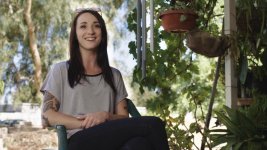
Going back to the Area48s again for a second (with the thread title in mind), here's probably a good example of what can be done with them:
This was shot on the F5 in SLOG3/Sgamut3.cine, in deep shade (under a verandah), with the blazing Australian summer sun beating down outside (that's a 38 degree day in Outback Australia, 100 degree fahrenheit for United Statetians). So basically, as bright and brutal as the sun is capable of being anywhere on the planet.
The shot was done at (I think) 28mm with two Area48s at full blast, as close to the subject as they could be without being in frame. I underexposed the subject by a stop, but this allowed me to JUST hold that background without clipping out anywhere. And since pulling the foreground up a stop (in order to have her properly exposed in the graded image) is easy to do without any real noise penalty- I was able to get away with balancing the EXTREME contrast ratio that was present at the location, with just two 160w Area48 lights...
That's pretty remarkable really.
Cool. I'd argue that in your log you had even more latitude in the highlights to play with, the graded version appears to have lost that detail.
That's good to see.
cheers
Paul
Cool. I'd argue that in your log you had even more latitude in the highlights to play with, the graded version appears to have lost that detail.
That's good to see.
cheers
Paul

I decided that it was illuminating an 8ft wide 'target' shot at FstopX at 1/50 800ISO (nikon D600 6k raw processed in capture one)
Awesome post. Are those measurements with any kind of diffusion, or open face?
Thanks. I want to replicate your test with my 650W tungsten fresnel and my DIY LED fresnel, that's the reason for asking about the details.
It's definitely not a "sun competing LED", but I'm curious to see how it does. The head is around 500g (one pound) and about the size of a 150W fresnel, so it does have its advantages. I'm using an 80W LED right now, with plans to go 130W if I can get enough juice out of my power brick. It's not color-selectable and won't be, but I can make 3000K and 6500K versions. It uses a very mild frost as well. It costs it around a fifth of a stop of light. A more regular frost would cost it one full stop. Without any frost, the inidividual LED points can be focused by the lens and projected on to the subject (I'm using optical-grade glass, not a fresnel lens), this very mild frost is enough to diffuse that.


...scored a deal on a steadicam system
Off topic: Adam which steadicam system did you get?