Sun competing Led?

My test with (above) put the Dled 4.1 as brighter than the DLH4 (with daylight filter in place)

So if you're diffusing a hard light maybe start with something soft?
Having a hard light gives one the option to diffuse or just blast when you need or want to.

Also hard lights and diffusors pack down much smaller than kino size fixtures

Outdoors kino size fixtures can have wind issues aka blow over unless sandbagged to the max.

The A48 does offer an interesting mid point.. it is smaller than I thought (I had it in my head that it was the size of a 4bank Diva)

It should pack in my 64L Really Useful Boxes and is not the size of a sail!

S

That's good to know, i guess photometrics can be deceiving at times as they rarely include the circle of light produced.

I'm just wondering if you could get away with a lesser hard light if you use other soft lights as diffused light.

I don't know whether prokit could lend you one?

cheers
Paul
 
Area 48.. it is firmly on my hitlist. I wonder if you could photograph a gretag card with a stills camera set on 5500k and ping me a jpg. The ChromaQ seems similar tech (100w RP) and was clearly green. That does not make it a bad source.. just tricky to use in mixed conditions.

Any other comments on the A48 .. eg noise also appreciated.

To the Area48s, I currently have two (and plan to add another two as soon as finances allow). And they've completely replaced Kinos for me (in terms of soft lights that I carry), they have better colour, they're more controllable, they put out a tad more light than a four-foot four-bank Kino, and they have perfect dimming.

Perhaps the best thing I can say for them, is that since getting mine - three separate gaffers that I work with have invested in Area48s for themselves. Once people see how much more efficiently they allow you work on set (the speed that 0-100% dimming, and changing phosphor panels compared to flouro tubes gives you) they tend to be won over pretty quickly.

The colour beats out both Kino tubes and HMI bulbs, plus they're built like tanks (production lights need to be IMO) and you can run them on batteries.

Highly recommended.
 
Interesting to note about the Area48s. I will see if I can rent to try out in a future shoot.

Has anyone gotten a chance to work with the ARRI Skypanel S60 or S30?
http://www.bhphotovideo.com/c/product/1139015-REG/arri_l0_0007077_skypanel_s60_rp_daylight_led.html

I wanted a high output soft LED source to minimize aperage draw and that could potentially run off of a block battery/power station (even if that limits that output). I wanted to see if anyone know if they run quiet (in terms of fan) and if the colors are really good (CRIs can be misleading sometimes).

They also make a dial-tunable temperature and color version for a little more, which is a bit less bright, only loses 10% when switching to tungsten, and does not require a change in phosphor panel to switch kelvin.
http://www.bhphotovideo.com/c/product/1139005-REG/arri_l0_0007067_skypanel_s60_c_led_softlight.html
 
I'm really keen to give the new Arris a try - they're revolutionary so far as lighting with saturated colours goes (since you get none of the stop loss from adding gels to regular fixtures) you can just dial in exactly the colour you want - deep reds, royal blues, forrest greens (and all of them with the full output of the fixture). Very cool stuff. They're big heavy bastards though.

Going back to the Area48s again for a second (with the thread title in mind), here's probably a good example of what can be done with them:

djEs88P.jpg


8jc0cbT.jpg


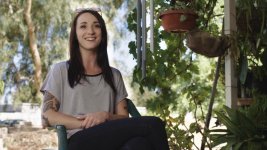
This was shot on the F5 in SLOG3/Sgamut3.cine, in deep shade (under a verandah), with the blazing Australian summer sun beating down outside (that's a 38 degree day in Outback Australia, 100 degree fahrenheit for United Statetians). So basically, as bright and brutal as the sun is capable of being anywhere on the planet.

The shot was done at (I think) 28mm with two Area48s at full blast, as close to the subject as they could be without being in frame. I underexposed the subject by a stop, but this allowed me to JUST hold that background without clipping out anywhere. And since pulling the foreground up a stop (in order to have her properly exposed in the graded image) is easy to do without any real noise penalty- I was able to get away with balancing the EXTREME contrast ratio that was present at the location, with just two 160w Area48 lights...

That's pretty remarkable really.
 
Thanks for the pics, Grug! Good problem solving there, and glad to know that you were able to compete with the sun, only using those two Area48s.

I am secretly hoping that the ARRI S60 with the S30 for fill could do something similar in terms of competing with the sun. Your experience with the Area48s seems promising.

I am in Pre-Pro for a three week shoot that will be in several locations where we won't have access to large gennie and amperage draw will be a factor...not to mention minimizing heat and strike times. We will also be looking to compete with the sun for some of these locations. I was hoping to test out a simple three piece kit (since we have little time and not a lot of hands). I was thinking of testing out the following:
-ARRI Skyoanel S60 (for soft key)
-ARRI Skypanel S30 (for soft fills or BG/set illumination)
-Mole-Richardson 900w LED daylight Fresnel (lighting through windows or for extra punch through silks...or a hard light when necessary)

I have never gone full LED like this. But I have to say, I am eager to see if this LED test will allow me to move away from tungsten and lower wattage HMIs. Of course, I don't see LEDs replacing large HMI units in terms of output and color any time soon, but for smaller/quicker jobs I think this could work.
 
I think that, for a small three-light kit, that package would go a looong way. The fact that all of the fixtures can be dimmed without colour shift, and the Arris' ability to adjust colour to whatever you want, really opens up a lot of options for very little power draw.
 
I'm really keen to give the new Arris a try - they're revolutionary so far as lighting with saturated colours goes (since you get none of the stop loss from adding gels to regular fixtures) you can just dial in exactly the colour you want - deep reds, royal blues, forrest greens (and all of them with the full output of the fixture). Very cool stuff. They're big heavy bastards though.

Going back to the Area48s again for a second (with the thread title in mind), here's probably a good example of what can be done with them:

This was shot on the F5 in SLOG3/Sgamut3.cine, in deep shade (under a verandah), with the blazing Australian summer sun beating down outside (that's a 38 degree day in Outback Australia, 100 degree fahrenheit for United Statetians). So basically, as bright and brutal as the sun is capable of being anywhere on the planet.

The shot was done at (I think) 28mm with two Area48s at full blast, as close to the subject as they could be without being in frame. I underexposed the subject by a stop, but this allowed me to JUST hold that background without clipping out anywhere. And since pulling the foreground up a stop (in order to have her properly exposed in the graded image) is easy to do without any real noise penalty- I was able to get away with balancing the EXTREME contrast ratio that was present at the location, with just two 160w Area48 lights...

That's pretty remarkable really.

Cool. I'd argue that in your log you had even more latitude in the highlights to play with, the graded version appears to have lost that detail.

That's good to see.

cheers
Paul
 
Cool. I'd argue that in your log you had even more latitude in the highlights to play with, the graded version appears to have lost that detail.

That's good to see.

cheers
Paul

Yep I see that too but the nature of the composition makes a good secondary complex to pull.

S

grug_grade_1.30.1.jpg
 
Cool. I'd argue that in your log you had even more latitude in the highlights to play with, the graded version appears to have lost that detail.

That's good to see.

cheers
Paul

Yeah, you could balance the background and foreground perfectly if you wanted to. However I found that looked a bit too unrealistic to my eye. So I prefer it playing hotter in the background.
 
Awesome post. Are those measurements with any kind of diffusion, or open face?

Im not sure if I posted all the data.. which Im still working on

Most fixtures were bare

The Joker 800 has the 'frost' modifier that is part of the Joker lens kit.

My 'feel' is that this 'cost' the Joker at least a stop and we probably could have got a brighter result with a different modifier.

The Joker is particularly unpleasant with no modifier.. it is not meant to be used like that.

S
 
Thanks. I want to replicate your test with my 650W tungsten fresnel and my DIY LED fresnel, that's the reason for asking about the details.
It's definitely not a "sun competing LED", but I'm curious to see how it does. The head is around 500g (one pound) and about the size of a 150W fresnel, so it does have its advantages. I'm using an 80W LED right now, with plans to go 130W if I can get enough juice out of my power brick. It's not color-selectable and won't be, but I can make 3000K and 6500K versions. It uses a very mild frost as well. It costs it around a fifth of a stop of light. A more regular frost would cost it one full stop. Without any frost, the inidividual LED points can be focused by the lens and projected on to the subject (I'm using optical-grade glass, not a fresnel lens), this very mild frost is enough to diffuse that.
 
Last edited:
Thanks. I want to replicate your test with my 650W tungsten fresnel and my DIY LED fresnel, that's the reason for asking about the details.
It's definitely not a "sun competing LED", but I'm curious to see how it does. The head is around 500g (one pound) and about the size of a 150W fresnel, so it does have its advantages. I'm using an 80W LED right now, with plans to go 130W if I can get enough juice out of my power brick. It's not color-selectable and won't be, but I can make 3000K and 6500K versions. It uses a very mild frost as well. It costs it around a fifth of a stop of light. A more regular frost would cost it one full stop. Without any frost, the inidividual LED points can be focused by the lens and projected on to the subject (I'm using optical-grade glass, not a fresnel lens), this very mild frost is enough to diffuse that.

So getting the spread right was the complexity of the test. Im sure your light will do a high Fstop but up close.

So the 'spread is no more than 2 stops drop off by the edge of the 8ft target';

So if you are reading F8 in the middle and F4 at the edge you have a pass, but a 2.8 at the edge is a fail

You have to move the light back/forwards to get this. Most fixtures were 10ft back.

S
 
Off topic: Adam which steadicam system did you get?

I bought a glidecam devin graham with CAME pro vest/arm off of a friend. I'm surprised at the quality of the vest/arm for the price. My FS7 was too heavy for gimbal alone. I don't need to fly heavier cameras than C300/FS7.
 
Sam,

I should be able to get the Area48 stuff to you later.

These guys are interesting too

http://www.digitalsputnik.com/ds-1/

Mostly rental at the moment (i believe Rogue One has been using them) but the DS1 will be retail, should be out soon. Price comparable to everything else but the head is 140w of RGBW goodness, which is a bit different to some being discussed here.

cheers
Paul
 
Back
Top