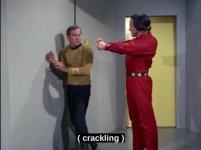
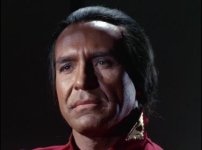
Stylized Lightings in different eras

ahalpert

Major Contributor
I screenshot frames that have striking or unusual lightings, and I love to see how lighting style and technology has evolved.

I thought I'd start posting some to this thread, and you can feel free to do the same.

Rewatching the Khan episode from Star Trek TOS tonight (aired 1967) - I love their use of hard, theatrical lighting and also the rich colors from the period costumes/film/grading:
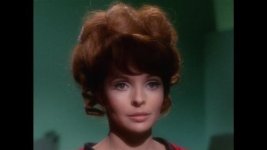
Screenshot 2020-07-05 at 12.49.33 AM.jpg

And it's amusing how much her CU lighting differed from the wide shot that it cut from:
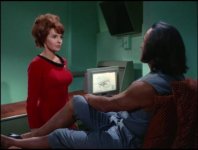
Screenshot 2020-07-05 at 12.59.57 AM.jpg

And later, same episode:

Screenshot 2020-07-05 at 9.33.42 AM.jpg
Screenshot 2020-07-05 at 9.31.41 AM.jpg
 
Last edited:
I would suggest you study the DPs of the classic age of cinema, they are the ones who wrote the book that we're all still reading from really.

This is the list you want. https://www.imdb.com/list/ls008698075/ Fire up your streaming services or hunt their work down. As a producer who worked on nothing but documentaries and
shorts on the Golden Age of Cinema for five years, it's getting more and more difficult to find these films to watch unless you are willing to hunt down DVDs.
Few people today under 50 will watch B&W films, their loss. Although more esoteric, you probably should take a look at the German Expressionism and Weimar Cinema
as they also had a very bold and unique visual style in their cinematography. My favorite of this era is "Pandora's Box" by GW Pabst, starring Louise Brooks. The cinematography
is outstanding and very beautiful. Here's the trailer for a 2018 UK theatrical release, pretty impressive for a 91 year old film! https://www.youtube.com/watch?v=P4EzcJPqAGg

Sol Polito, Greg Toland, Bert Glennon, Jack Cardiff, Harold Rosson, these are the guys who basically invented and refined modern cinematography.
If you start with these guys, they are "Genesis" and all of the styles of the 40s, 50s, even into the 70s evolved from what they did in the 30s.
And of course, you need to take some detours into French New Wave, Italian Art Films, Film Noir to see who the breakouts/styles were of those eras.
If you are into music, those three styles/eras were basically the "Punk" movements of modern film.
 
Thanks for the input, puredrifting. I've seen about 1/3 of the movies on that IMDB list but I should see them all again. I had film history courses that took me from Gold Diggers of 1933 and the Twisted Cross to Bicycle Thief and Breathless to Dogme 95, wong kar wai... But I'm sure I'd get more from them today. I'm getting a lot more out of my current Star Trek viewings both in terms of cinematography and writing/directing/acting.

Interesting - apparently the Oscar's had separate best cinematography awards for B/W films and for Color films from 1936-1966.

I was thinking about getting a Criterion Channel subscription after I finish my current Star Trek marathon. But looking through their offerings, they're missing many of the titles on that imdb list. It will be a hunt.
 
When I was working in a video section of a large electronics store in 1986-87, I tried recommending black and white films. I got scoffed at.

PS. Criterion has the "The Ascent" by Larisa Shepit'ko and should have the restored version of "I am Cuba" by Mikhail Kalatozov.
 
Yeah, color is not like 3D. People actually want it.

But there was Roma, The Artist, recent B/W releases. It is a different mode of imagery.

People who won't watch B/W are depriving themselves, just like people who won't read subtitles.
 
When I was working in a video section of a large electronics store in 1986-87, I tried recommending black and white films. I got scoffed at.

PS. Criterion has the "The Ascent" by Larisa Shepit'ko and should have the restored version of "I am Cuba" by Mikhail Kalatozov.

Gold Diggers is a very fun one of that era.

"I am Cuba" is jaw dropping, some of the most advanced, sophisticated visual language in all of cinema. It's no wonder Scorsese got the restoration done
and did all of the bonus features, that film is just incredible. Scosese was actually the one who told me to see it when I interviewed him for a different
project in his screening room.

I have not seen Roma yet, although the wife watched it and loved it. The Artist was also amazingly well done, that film put a huge smile on my face, being
a huge silent film nut. When I had the FX9 a few months ago, all of the interviews I shot were for a friend who is working on the definitve Douglas Fairbanks
documentary. His wife happens to be the author of the foremost book on Fairbanks and their home is a veritable Fairbanks museum.

I completely agree, those who shun B&W cinema are missing out on some of the most compelling films ever made.
 
I screenshot frames that have striking or unusual lightings, and I love to see how lighting style and technology has evolved.

I thought I'd start posting some to this thread, and you can feel free to do the same.

Rewatching the Khan episode from Star Trek TOS tonight (aired 1967) - I love their use of hard, theatrical lighting and also the rich colors from the period costumes/film/grading:

View attachment 139545

And it's amusing how much her CU lighting differed from the wide shot that it cut from:

View attachment 139546

And later, same episode:

View attachment 139562
View attachment 139563

Also, the heavy soft filtration used on her CU, as well. I used to notice this a lot more in "older" shows/movies than I do today. Wide shots and even CU's of the male actors were generally unfiltered(or very very lightly done) but the female actors had obvious filtration.
 
Yeah, color is not like 3D. People actually want it.

But there was Roma, The Artist, recent B/W releases. It is a different mode of imagery.

People who won't watch B/W are depriving themselves, just like people who won't read subtitles.

Getting off topic (surprise surprise), but I hate subtitles in a movie or show(I'm not talking about the quick occasional use). You're watching a movie. It's a visual medium. You are supposed to be watching what is going on, on the screen. Instead of paying attention and catching a subtle telling glance that someone may have thrown or visual clue to something in the background, you're reading. Perfect example: Inglorious Bastards. There was ZERO reason for every scene that had German speaking characters to be subtitled. The Hunt for Red October showed an easy way around that. When the Russian speaking character were around Americans that didn't speak Russian, there were subtitles, but when it was just Russians speaking amongst themselves and you were "in the circle", it was English. There have been a few "foreign" series on Netflix where the native language spoken is not English and they have dubbed them. Yeah, the lip-sync is off sometimes, especially with words that don't fit the same time span to speak, but I'd much rather have that than an entire show/movie subtitled. At that point, you're just reading a book on-screen with something going on in the background. It totally defeats the point of MOTION PICTURES. A great modern-day parallel is someone reading a text and replying while driving. What are you paying attention to? Even if you didn't wreck or have some type of accident, what color was the car you just passed? Wait, what car? Exactly...
 
In my yuf, all foreign films were dubbed. Even in musicals ... although in "Csardasfürstin", singing was from the original German soundtrack. But these days, with much of Europe being fluent in English, there's a tendency to leave the original sound in.

In "Der Untergang", Bruno Ganz's Hitler would have been disastrous in any overdub.
 
Getting off topic (surprise surprise), but I hate subtitles in a movie or show(I'm not talking about the quick occasional use). You're watching a movie. It's a visual medium. You are supposed to be watching what is going on, on the screen. Instead of paying attention and catching a subtle telling glance that someone may have thrown or visual clue to something in the background, you're reading. Perfect example: Inglorious Bastards. There was ZERO reason for every scene that had German speaking characters to be subtitled. The Hunt for Red October showed an easy way around that. When the Russian speaking character were around Americans that didn't speak Russian, there were subtitles, but when it was just Russians speaking amongst themselves and you were "in the circle", it was English. There have been a few "foreign" series on Netflix where the native language spoken is not English and they have dubbed them. Yeah, the lip-sync is off sometimes, especially with words that don't fit the same time span to speak, but I'd much rather have that than an entire show/movie subtitled. At that point, you're just reading a book on-screen with something going on in the background. It totally defeats the point of MOTION PICTURES. A great modern-day parallel is someone reading a text and replying while driving. What are you paying attention to? Even if you didn't wreck or have some type of accident, what color was the car you just passed? Wait, what car? Exactly...

I consider cinema to be not simply a visual medium but an audiovisual medium. Even silent films are typically greatly enhanced by the addition of sound. I prefer to watch any cinematic work in its original language form, because in that way I get to experience the most of the original production's creative aspects. The tones of the actors' voices, as well as the original sound mix, put me more into the story. I find dubbed films all too often have voice actors whose vocal qualities are mismatched to the visual and personality aspects of the characters they are playing. And then there's the sound mixing! One of the first things to take me out of the story and be aware I'm watching a film is to hear lines that are obviously being recorded in a sound booth, not sounding like they are taking place on set. Watching films that are entirely (or largely) dubbed in post, I can get used to the sound when the dialogue is in the original language. But when it's being dubbed in a different language, the mismatch between spoken words and mouth movements just amplifies whatever negative aspects are there, such as vocal quality and sound mixing. All that being said, I greatly appreciate subtitling that is done with the viewer in mind (try to make it easier to determine which character is saying which line, and make the screen time match the time needed for reading--why in the world am I given 2 seconds to read a 20 word line, and 10 seconds to read the word "Yes"?).

Back on the topic: It seems that, generally, black and white cinematography was more "artistic" than color until sometime in the late-60s/early-70s. By that I mean that it wasn't until the latter era that color cinematography (in general) let go of the high key lighting with its harsh and/or unrealistic shadows. In black and white, artful cinematography used the shadows to help make the image. But in color, in the first several decades, the shadows were an unwelcome byproduct of the amount of light needed to expose the film, and it took a while to perfect lighting techniques to equal the artistry of the good black and white images. Instead of helping make up the image, the shadows seemed to be contaminating the image.

At least, that's my opinion...
 
A good subtitling example is Miyazaki's "Spirited Away", an obvious favorite of mine. The English dubbed version isn't nearly as compelling as the Japanese version with subtitles.
I agree, in a film with a lot of visual action going on especially, reading a lot of subtitles can be distracting. But hearing foreign langage speaker's inflections and speaking rhythms in their
native language can also be a significant portion of the storytelling too.

Being a silent film fan, the transition from reading intertitles to subtitles for foreign language films always felt smooth to me, I never felt like I was missing action, but I can read with
my peripheral vision pretty well and I am fast reader too. But the subtitles versus dubbing debate has raged on for decades. I guess it just depends on the film.
 
Another good one to study are the portraits of George Hurrell

Any of these lighting styles look familiar? Most of us who light women especially havn't deviated all that much from what he was accomplishing in the 30s and 40s.

Crawford Hurrell.jpg

Lake Hurrell.jpg
 
With a zillion parodies out there, the original "Steiner angriff" scene is almost forgotten. Here, it is in German with English subtitles. Ganz is just phenomenal.

 
Das Boot has an amazing English dubbing job. You pretty much can't tell it was originally in German. The Criterion Channel is always changing its offerings so every month there's something new. I've discovered some interesting films on it and the quality is usually pretty high. The 4K restoration on Chaplin's The Kid was kind of jaw dropping.
 
Another good one to study are the portraits of George Hurrell

Any of these lighting styles look familiar? Most of us who light women especially havn't deviated all that much from what he was accomplishing in the 30s and 40s.

View attachment 139565

View attachment 139566

These are beautiful.

The 1st feels very modern, could have been shot yesterday. Also a bit more naturalistic - if the sun were streaming in behind her and bouncing up against a white floor/wall.

The 2nd feels more dated (though also because of hairstyle and fashion). But it would look at home in a modern perfume commercial
 
Subtitles vs dubbing

I suppose I should have said you're depriving yourself if you won't watch foreign films. Not everything is available with a dub. You lose something either way (not getting the original soundtrack/performances vs having to read simultaneously). I'd rather watch with subtitles because dubs are weird and it puts another constraint on the translation to have to match words to actors lips.

If you really like the movie, just learn the native language! ;):tongue:
 
... If you really like the movie, just learn the native language! ;):tongue:
If you learn Russian, you can watch almost every movie ever made ... in Russian. Somewhere on the web.

Side note, "Stalingrad" (1993) was badly voiced-over in its original German. The film itself was phenomenal but the audio part was too "studio", too clean.

https://www.youtube.com/watch?v=Yfk178n80CU

Here it is in English. Really not much of a difference.

https://www.youtube.com/watch?v=-MJqGiSTFD4
 
If you learn Russian, you can watch almost every movie ever made ... in Russian. Somewhere on the web.

This reminds me of the line in the star trek film I just watched where Klingon Christopher Plummer says, "You have not experienced Shakespeare until you have read him in the original Klingon."

This was in Star Trek VI: The Undiscovered Country. The "undiscovered country" itself is a Hamlet reference, though Hamlet was talking about death and here they used it to refer to the future.

Side note - every time they quote Shakespeare in Trek (and it happens regularly), it's a reminder of how much his writing blows theirs and everything else out of the water. Yes, his writing is more formal/poetic/archaic. But so memorable, beautiful, musical and impactful.

But late in the film they take it way over the top with Plummer spinning in his chair and quoting Shakespeare as his ship fires on Kirk:
https://www.youtube.com/watch?v=fg58hVEY5Og&feature=youtu.be&t=29

Then he gives the "to be or not to be" line as Kirk's torpedo closes in on him...so dumb

But on the subject of lighting, this trek film was released in 1991 and already feels much more modern to me than the 60's-80's Trek. Deeper black levels and more naturally motivated light sources. Not everything is so theatrical. I dont think there is as much stylistic evolution in Trek from 1990 to today as there was from 1970 to 1990. All that's changed is lighting technology and where that lets them put the lights.
 
Last edited:
I a bit of a heretic in that I think a lot of old stuff looks old. It is interesting to consider using hard lights which are now so unpopular for shooting people.

I think it is well worth considering the tech when examining images. As the cinematographer would have been restricted if, for example, shooting 25ISO stock. Many of these looks are created by slow stock, bright lights, and off colour film stock*

These may not have been options desired or specced by the cinematographer they were just the tech of the day. Just like most of us have LEDs now that are not as punchy as we want.

If looking to reproduce such images engagement of the ND would be the first step?


*not to mention stock can have degraded or been badly scanned (every digital image we see of film has been scanned!)
 
Last edited:
Back
Top