Navigation
Install the app
How to install the app on iOS
Follow along with the video below to see how to install our site as a web app on your home screen.
Note: This feature may not be available in some browsers.
More options
You are using an out of date browser. It may not display this or other websites correctly.
You should upgrade or use an alternative browser.
You should upgrade or use an alternative browser.
Studio layout advice requested
- Thread starter firehawk
- Start date
say_doyster
Active member
"The white cyc is particulary perplexing for me since I've never used a permanent one. If I pulled a 15' long car by that 38' right side wall, angled toward camera won't I likely need the curved cyc corners to avoid having hard corners come into frame on a wide shot?
Or how about if I staged some furniture with actors and needed to pan the camera a bit?
Or had a group of dancers?
My limited brain seems to think that if I'm using any much more than a straight on shot I will need at least one curved side?"
First, if you bump out the basic structure a bit, I would add at least 7 feet to the width of the cyc to give you more width for dolly and pan shots (and only build out about 15 feet from the back wall of the cyc to give you room to pan and move a bit - don't forget you can always learn to position the staged area for maximum camera flexibility) - also, if the cyc remains the same as designed here (two corners) you can do nothing of value (except having some background) with the curves - and it likely can only bit lit from the grid. At least with the full width you can stage and work with the flat floor.
One other point before I give you feedback on the above quote - if you build the cyc as presented, it limits movement of things like cars and presents a liablity if someone backs into it (either punctures the wall or is injured by the curve - and I have found it is easier to deal with one wall that has the curve rather than two or three walls and far easier to construct with a tighter radius).
Hard corners may sometimes cause a problem, but so can the curves in their own/different way - pick your poison.
If you have 6-12 ft of additional flat wall space across, it may never come up, but proper planning/staging can usually avoid this problem.
What I have done with music performances and dancers is to put draperies on either side of the back wall (a cyc in your case) as it might be in a theater - this may or may not work all the time, but if you are staging a live performance, having a way to get talent to the back of the staging may be facilitated by the draperies (it works in my case. This obviously will not work if you want only white everywhere, in which case you really need a 5000 sq ft space with 80-100ft run of cyc and 36 in radius curves.
So much to consider and now is the time to do it.
Or how about if I staged some furniture with actors and needed to pan the camera a bit?
Or had a group of dancers?
My limited brain seems to think that if I'm using any much more than a straight on shot I will need at least one curved side?"
First, if you bump out the basic structure a bit, I would add at least 7 feet to the width of the cyc to give you more width for dolly and pan shots (and only build out about 15 feet from the back wall of the cyc to give you room to pan and move a bit - don't forget you can always learn to position the staged area for maximum camera flexibility) - also, if the cyc remains the same as designed here (two corners) you can do nothing of value (except having some background) with the curves - and it likely can only bit lit from the grid. At least with the full width you can stage and work with the flat floor.
One other point before I give you feedback on the above quote - if you build the cyc as presented, it limits movement of things like cars and presents a liablity if someone backs into it (either punctures the wall or is injured by the curve - and I have found it is easier to deal with one wall that has the curve rather than two or three walls and far easier to construct with a tighter radius).
Hard corners may sometimes cause a problem, but so can the curves in their own/different way - pick your poison.
If you have 6-12 ft of additional flat wall space across, it may never come up, but proper planning/staging can usually avoid this problem.
What I have done with music performances and dancers is to put draperies on either side of the back wall (a cyc in your case) as it might be in a theater - this may or may not work all the time, but if you are staging a live performance, having a way to get talent to the back of the staging may be facilitated by the draperies (it works in my case. This obviously will not work if you want only white everywhere, in which case you really need a 5000 sq ft space with 80-100ft run of cyc and 36 in radius curves.
So much to consider and now is the time to do it.
morgan_moore
Major Contributor
While I’m not sure about a cyc at all - I think to have one it needs to be “all in” and symmetrical as the camera may move (dolly) or need to shoot a set of positions with angular variance
morgan_moore
Major Contributor
Looking at the camera positions you can’t back the camera back too far. If there was a central corridor as per previous plans (?) the camera could stay back.
morgan_moore
Major Contributor
Also the space between oh and oh seems wasted as it needs to be kept clear to access the shoot space.
Yes lots to consider and now is the time since can't feasibly fix it later
Yes the space between OH door and OH door is "wasted" since anything I put there would have to be moved to use the OH doors but I'm not sure what to do about that.
Yes the camera distance from subject is limited since there is no longer a wide central corridor to back into. I have almost center double doors to help some but that is limited and will also potentially allow more noise inside.
This is tricky determining the inner box building "studio" ratio dimensions. Obviously a huge space solves the shooting limitations but since that isn't possible so then begin the compromises.
If it's really wide vs deep then the depth becomes the limiting factor. If it's really deep vs wide then it's not wide enough. If its really wide and deep then the height becomes the limiting factor
I suppose there might be some kind of happy aspect ratio of L x W x H for smaller spaces like mine but I don't know what it is.:laugh:
Yes the space between OH door and OH door is "wasted" since anything I put there would have to be moved to use the OH doors but I'm not sure what to do about that.
Yes the camera distance from subject is limited since there is no longer a wide central corridor to back into. I have almost center double doors to help some but that is limited and will also potentially allow more noise inside.
This is tricky determining the inner box building "studio" ratio dimensions. Obviously a huge space solves the shooting limitations but since that isn't possible so then begin the compromises.
If it's really wide vs deep then the depth becomes the limiting factor. If it's really deep vs wide then it's not wide enough. If its really wide and deep then the height becomes the limiting factor
I suppose there might be some kind of happy aspect ratio of L x W x H for smaller spaces like mine but I don't know what it is.:laugh:

paulears
Veteran
Finish your cyc as high as you can go - You will constantly kick yourself every time the low camera height and up angle reveals the edge. I found some old documents on a hard drive where I'd ordered paint for the floor in 2001. In the April to April year, the floor had changed colour 6 time. White, black, green.grey and two I couldn't identify. Whatever you plan now gets thwarted by the second client! I think you have a nice space - so if it was me, I'd try to keep things as flexible as you can. My small studio has cloth walls in the main, and I use about 3ft behind it for flight case storage! I have black, white, blue and green cloths and the only one never used, but always left hanging at the back is the blue. White was this years most useful. For your kind of studio a pipe and grid at the highest level is probably the most versatile - you can lift things, attach things and modify it with not too much effort, for reasonable cost - once you check what kind of loads your roof structure can support
morgan_moore
Major Contributor
Im lost here on sound proofin the main space? will it have a 'lid' or will it soundproof adequately without a lid. Sure some spray on the ceiling is possible to lift it beyond 'barn'.
Id really think a small greenscreen sound room that has 24in of insualtion would have value.
Im not an expert but most stages ive seen are not that quiet and most music recording have 24in walls.
I certainly think in my area anyway, and abiity to have rock solid sound on a talking head to waist is very saleable. But Im in a city noise is everywhere.
A 'rule of design' is that it wont be good unless you know what you are trying to design!
This local space has been a success.. the 'small' sound studio makes them most money I think.
Have a proper look around the site and videos https://www.bandstudios.co.uk/
Id really think a small greenscreen sound room that has 24in of insualtion would have value.
Im not an expert but most stages ive seen are not that quiet and most music recording have 24in walls.
I certainly think in my area anyway, and abiity to have rock solid sound on a talking head to waist is very saleable. But Im in a city noise is everywhere.
A 'rule of design' is that it wont be good unless you know what you are trying to design!
This local space has been a success.. the 'small' sound studio makes them most money I think.
Have a proper look around the site and videos https://www.bandstudios.co.uk/
Last edited:
morgan_moore
Major Contributor
Thiking about Band.. wheich has a space between OH and OH it does have a use.. 'todays props'
for exmple a sofa (devan?) shoot they turn up with 6 models blue, suede, whatever, and need somewhere to put the 5 not in this shot
Its well worth looking through thier vimeo..
https://vimeo.com/73464283
I not that they started with studio 2 being green, but now I think it is white with a couple f green backdrops.
Did you see the Dune doco where they used brown screen (!) as the green cause problems with reflections which modern tech is sensitive enough to key brown.
for exmple a sofa (devan?) shoot they turn up with 6 models blue, suede, whatever, and need somewhere to put the 5 not in this shot
Its well worth looking through thier vimeo..
https://vimeo.com/73464283
I not that they started with studio 2 being green, but now I think it is white with a couple f green backdrops.
Did you see the Dune doco where they used brown screen (!) as the green cause problems with reflections which modern tech is sensitive enough to key brown.
Last edited:
say_doyster
Active member
Two things,
I second Paul's most recent post completely with a couple of observations. Your ceiling height at 18 ft could easily become a factor. My ceilings are at 22 ft and I have bumped into that on a number of occasions. Admittedly, I have the Chimera bank hanging (with all the hardware and positioning mechanics) but if the ceilings were lower, then it would lose almost all its flexibility (I wish I had three more feet at minimum). Second, the cyc wall needs to go to the ceiling for sure (up to the hanging point of your lighting grid - which should begin with about 30in of space in front of the cyc wall). This for exactly the reason he states - when you look up with a slightly wider than normal lens you will quickly see the top if it does not go as high as the ceiling.
One more idea on the cyc. Get as much width as you can with the curve across the back wall. Then curve just the vertical inside corners (but not the floor) as you meet either side wall. Yes it will be a strange compound wall on the ground in the corner, but you gain all the floor space back within a few feet that would otherwise be curved out about 15-20 feet. Since the radius is going to vary anyway, make the vertical corners a slightly wider radius going up to the ceiling so they are a bit easier to light. The trick is in the corners themselves as far as finish, but you gain a sense of infinity on the walls and much added space on the floor because the cyc curve tapers very quickly. Just a thought.
I understand Morgan's ideas and agree but do not know the cost and space downside of fully implementing further sound refinements. I have curtains everywhere and shoot most critical sound projects at night when traffic and outside noises are a rarity. When scheduling does not permit this, I have only had a handfull of re-takes because of a loud/unexpected noise. YMMV
Bill
Edit - The magic smaller space IMHO is 45x65ft (W x L), with 24ft usable ceiling height that is entirel available for production. All storage, talent, production and client services would happen outside this area (with visual access in some fashion).
I second Paul's most recent post completely with a couple of observations. Your ceiling height at 18 ft could easily become a factor. My ceilings are at 22 ft and I have bumped into that on a number of occasions. Admittedly, I have the Chimera bank hanging (with all the hardware and positioning mechanics) but if the ceilings were lower, then it would lose almost all its flexibility (I wish I had three more feet at minimum). Second, the cyc wall needs to go to the ceiling for sure (up to the hanging point of your lighting grid - which should begin with about 30in of space in front of the cyc wall). This for exactly the reason he states - when you look up with a slightly wider than normal lens you will quickly see the top if it does not go as high as the ceiling.
One more idea on the cyc. Get as much width as you can with the curve across the back wall. Then curve just the vertical inside corners (but not the floor) as you meet either side wall. Yes it will be a strange compound wall on the ground in the corner, but you gain all the floor space back within a few feet that would otherwise be curved out about 15-20 feet. Since the radius is going to vary anyway, make the vertical corners a slightly wider radius going up to the ceiling so they are a bit easier to light. The trick is in the corners themselves as far as finish, but you gain a sense of infinity on the walls and much added space on the floor because the cyc curve tapers very quickly. Just a thought.
I understand Morgan's ideas and agree but do not know the cost and space downside of fully implementing further sound refinements. I have curtains everywhere and shoot most critical sound projects at night when traffic and outside noises are a rarity. When scheduling does not permit this, I have only had a handfull of re-takes because of a loud/unexpected noise. YMMV
Bill
Edit - The magic smaller space IMHO is 45x65ft (W x L), with 24ft usable ceiling height that is entirel available for production. All storage, talent, production and client services would happen outside this area (with visual access in some fashion).
Last edited:
A big thank you again, everyone.
As to Morgan's question yes the plan is to have a top/lid on the studio (inner building) to give an extra noise barrier from above.
The way we are thinking to do the top may actually allow space lights to be attached a bit higher than the grid so they hang down through the grid. That way they don't eat as much of my total height by hanging quite as low? I haven't seen anyone do this yet, and it may not work, but seems like it may be possible. I'm planning on having my permanent space lights, and a few others, and the rest will be changed / attached per project.
I'll plan on finishing the cyc wall(s) all the way up to grid.
Thanks about the 30" distance off the wall to start the lighting grid - I was wondering about that.
The 45 X 65 X 24 idea makes sense and sounds ideal.
I'll check with architect to see if we can widen the cyc wall a bit to get about 40'. Looks to me like we can?
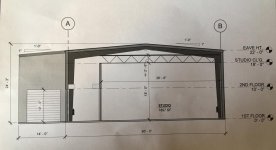
And it doesn't look too costly to widen the side garage/storage since it's not big clear span trusses like the main 50' PEMB box.
I'd love to make the entire thing bigger and taller but I have to compromise a lot.
Thanks for the Band site and video.
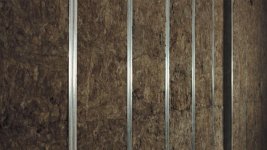
What is this they are using for wall insulation?
As to Morgan's question yes the plan is to have a top/lid on the studio (inner building) to give an extra noise barrier from above.
The way we are thinking to do the top may actually allow space lights to be attached a bit higher than the grid so they hang down through the grid. That way they don't eat as much of my total height by hanging quite as low? I haven't seen anyone do this yet, and it may not work, but seems like it may be possible. I'm planning on having my permanent space lights, and a few others, and the rest will be changed / attached per project.
I'll plan on finishing the cyc wall(s) all the way up to grid.
Thanks about the 30" distance off the wall to start the lighting grid - I was wondering about that.
The 45 X 65 X 24 idea makes sense and sounds ideal.
I'll check with architect to see if we can widen the cyc wall a bit to get about 40'. Looks to me like we can?
And it doesn't look too costly to widen the side garage/storage since it's not big clear span trusses like the main 50' PEMB box.
I'd love to make the entire thing bigger and taller but I have to compromise a lot.
Thanks for the Band site and video.
What is this they are using for wall insulation?
Last edited:
morgan_moore
Major Contributor
It looks like rockwool. Clearly one must consider flamability as per local building regs.
paulears
Veteran
Yes - it does appear to be rock wool. Are they leaving it like that or putting something over the top? Chickenwire does the job quite nicely but it's very pretty. rock wool can sag over time and bulge out - so something to prevent that and also prevent you thumping it and poking lumps out.
say_doyster
Active member
One clarification about the grid distance from the cyc wall. Many things come into play and lighting requirements can influence this. In no particular order, because of the cyc curve, a lift may not get you to the lighting instrument closest to the wall, so a ladder may be necessary (and may well be necessary to service anything attached to the top of the cyc or ceiling close to the wall). You need room to climb for install and adjust. The distance from the cyc wall may need to be more than 30 inches depending on how low you pole the lights down towards the floor. Also, if you want to hang a reflector, hang a curtain or position lights directly to the top of the cyc wall (or some other custom mod) you do not want to fight the grid to do so. I have a pulley system that allows me to hang almost anything I want very close to the wall (lights, curtains, backgrounds, etc... - and several suspended dedicated 20A circuits that "float") and place it at any height down to the floor. When not in use, I just pull it to the ceiling out of the way. So, perhaps the grid system might be best starting 48 or more inches off the cyc. How you work, what flexibility you want and how you might reach the ceiling all play a role in this.
Also, I did understand that you have done some serious sound dampening in the design. While there may be moments that a big sound intrudes from outside, I doubt that you will need a lot more insulation than you are planning now (it will be far quieter than my space is now (and ruined audio has never been an issue for me). As far as internal acoustics, hanging panels that absorb sound, and anything that naturally disperses sound waves to break up reflections inside the space goes a long way to improving the sound quality of the space ( I like a very small degree of "live" for acoustic performances - clap hands/shout and hear no return, but it does not sound "dead"). The grid will do a bit of this (especially if you deaden the ceiling above the grid for internal reflections.
One other thing. House lights. I almost never use mine any more. I know you likely cannot get an occupancy permit without them, but I have put LED tubes in all my fixtures that come on when they sense motion (and off when they don't). I use my Chimera for "house" lights in the shooting area and it's wired with remotes that I can turn on/off the three banks separately. I do have lighting on switches as well, but I can navigate most of the space and have lights just turn on when I enter a given space in the various parts of the studio not directly lit by the Chimera. YMMV
Also, I did understand that you have done some serious sound dampening in the design. While there may be moments that a big sound intrudes from outside, I doubt that you will need a lot more insulation than you are planning now (it will be far quieter than my space is now (and ruined audio has never been an issue for me). As far as internal acoustics, hanging panels that absorb sound, and anything that naturally disperses sound waves to break up reflections inside the space goes a long way to improving the sound quality of the space ( I like a very small degree of "live" for acoustic performances - clap hands/shout and hear no return, but it does not sound "dead"). The grid will do a bit of this (especially if you deaden the ceiling above the grid for internal reflections.
One other thing. House lights. I almost never use mine any more. I know you likely cannot get an occupancy permit without them, but I have put LED tubes in all my fixtures that come on when they sense motion (and off when they don't). I use my Chimera for "house" lights in the shooting area and it's wired with remotes that I can turn on/off the three banks separately. I do have lighting on switches as well, but I can navigate most of the space and have lights just turn on when I enter a given space in the various parts of the studio not directly lit by the Chimera. YMMV
The land I am looking at is pretty quiet (not on main noisy roads or near railroads etc).
Rockwool - I dont' know if they are leaving it like that or not. The photo is from the Band site that Morgan shared on page 14. https://www.bandstudios.co.uk/
So it sounds like the building in a building design may not need a lot more sound blocking from outside. That would be great!
The PEMB outer building may have 8" or 10" insulation (not sure yet).
I need to ask my architect again about the inner box walls and then run that past you guys on how to do those walls, inside and out.
And on the top/lid of the inner box as far as helping sound.
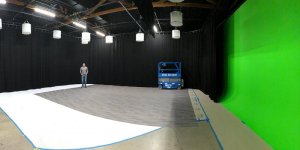
I want the ability to slide black curtains around the studio similar to this pic. It appears their grid has some distance from the cyc. I was wondering about being able to reach the fixtures at the walls. 48" sounds doable in my case. Morgan and Paul have shared some input on ladders previously. I won't have an electric lift until I can afford one later. I'd like a lowerable grid system but haven't found one affordable yet
Rockwool - I dont' know if they are leaving it like that or not. The photo is from the Band site that Morgan shared on page 14. https://www.bandstudios.co.uk/
So it sounds like the building in a building design may not need a lot more sound blocking from outside. That would be great!
The PEMB outer building may have 8" or 10" insulation (not sure yet).
I need to ask my architect again about the inner box walls and then run that past you guys on how to do those walls, inside and out.
And on the top/lid of the inner box as far as helping sound.
I want the ability to slide black curtains around the studio similar to this pic. It appears their grid has some distance from the cyc. I was wondering about being able to reach the fixtures at the walls. 48" sounds doable in my case. Morgan and Paul have shared some input on ladders previously. I won't have an electric lift until I can afford one later. I'd like a lowerable grid system but haven't found one affordable yet
Bill, could you share a pic of the upper area of your space? I'd like to rig some type of soft box chimera but haven't understanding of how to acomplish it. I suppose I would need the ability to suspend it above a car when needed, and with lights blasting through it, and then hang it elsewhere out of the way when not needed.
Or light it from the floor..
Or light it from the floor..
say_doyster
Active member
Will look through pics I have. Note, I do not have a grid, but the ceiling is constructed of steel joists that have ways of attaching to them (how I suspended the Chimera and other grip/lighting/drapes/pulleys). I, personally am not a fan of grids (huge expense to get the capability and you lose the ceiling height - great for 'permanent" installs like TV news, but not so much for constantly changing custom sets and projects.
Take a look at this - https://billdeusterphotography.com/Resources/SetUpYourInHouseStudio_2019.pdf
And this (let the top images slide) - https://billdeusterphotography.com/billdeusterphotography-contact.html (this link will just show some of the applications)
Note that the Chimera is not a temp set up. Mine has been up for over 30 years (lowered it three years ago to wash the silk and install LED lighting and remote turn-on). Orginally took me a week to assemble and suspend it. It can be supported by light stands on all four corners, but that creates its own set of visual/reflective problems. Also, it is big.
Will see if I can get a pic of the area above the chimera and post later.
Bill
Take a look at this - https://billdeusterphotography.com/Resources/SetUpYourInHouseStudio_2019.pdf
And this (let the top images slide) - https://billdeusterphotography.com/billdeusterphotography-contact.html (this link will just show some of the applications)
Note that the Chimera is not a temp set up. Mine has been up for over 30 years (lowered it three years ago to wash the silk and install LED lighting and remote turn-on). Orginally took me a week to assemble and suspend it. It can be supported by light stands on all four corners, but that creates its own set of visual/reflective problems. Also, it is big.
Will see if I can get a pic of the area above the chimera and post later.
Bill
morgan_moore
Major Contributor
I think that 'rockwool' is a 'during construction' photo. and was boarded over and then on the cove side plastered.
remember they have two spaces..
this big space has insulation but is still not really good for sound, they have the little space which I think has 12in of sound treatment, and that space is the most profitable pr sq/m
of course we are in a city of noise.
remember they have two spaces..
this big space has insulation but is still not really good for sound, they have the little space which I think has 12in of sound treatment, and that space is the most profitable pr sq/m
of course we are in a city of noise.
say_doyster
Active member
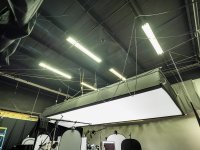
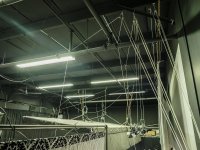
Don't know how much these might help, but here are ttwo different vantage points to see the ceiling. In the pic that has the entire Chimera SB, the diagonal across the studio from where I am standing is about 60-65ft (maybe even 70). The ceiling height is at its lowest point in that back part of the studio (the roof pitch goes from about 22.5ft in the very front of the building to just under 21 ft at the back where the end of the SB is). In the one from the back of the box, most of the pulley system is back there for the various items that are hanging including some lights and draperies. The SB can be raised and lowered using ropes to the front and back of the light (10ft depth) to control the final angle. You can get a clear 13-14 ft under it and it will go to the floor. Usually I position the box - higher in front and lower in back - sometimes as much as 25-30 degree angle.