Sound Devices MixPre-D!

I don't know! I figured they wanted to save on production costs by putting in a spdif jack rather than 2 XLR jacks with phantom for channels 7 & 8. Spdif is small RCA connection, and AES is a big XLR thing. Or if they would have just put 2 more TRS inputs in like channels 5-6, that would have been cool. But no, we need to spend 500.00 - 1,000.00 more dollars to use 2 channels... Oh well. It's an awesome recorder any way you cut it.
 
This is cool..but makes me wonder why someone would go with the USBpre2 over the mixpreD. Ok..mixpreD has return ins for switching to additional inputs.

And hey..the venerable 302 is getting long in the tooth too. Hopefully an update soon. How bout a 3022, 2 track flash recorder in the 302?


But the big NAB news might be Zaxcom's Nomad.
 
Maybe because they feel the need to record music at 192 or whatever the USBpre 2 does. The MixPre-D "only" does up to 96.

I mentioned this on another thread but This is VERY nice. If I could get 50% off for trading in my original MixPre I would do it. It's still on my buy list.

I am glad I let mine go a while back. This was good timing for me! I lucked out.

Well, there are some of us who are in the market for the original, and I'm sure you could sell it for more than half the cost of the new version.

Selling a MixPre for half the cost of the original would be a ripoff. You can kill someone with the thing and it would still work.

You realize that's a FireWire filter for interfacing their 7-series recorders to external drives, right?

What you want is the XL-WPH3 power adapter for all SD mixers and recorders. $78.

View attachment 32613

I was busy looking at all the new stuff.

BTW, in case you guys haven't seen it yet...
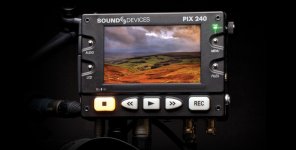
...Sound Devices is taking over the planet:

240-cover-800px.jpg

Imput Flexibility:

  • HDMI input accepts(480i, 525i, 720p, 1080i, 1080p), v1.3
  • HD-SDI input accepts (480i, 525i, 720p, 1080i, 1080p)
File Formats:

  • Apple ProRes 422 (Proxy/LT/422/422HQ)
  • Avid DNxHD 36, 145, 220 Mb/s, 8- and 10-bit, available as an option
  • .mov Quicktime File Wrapper
  • All audio contained within the single .mov file
Audio Performance:

  • Premium microphone preamps, on balanced XLR, mic/line selectable with 48V phantom, limiters, high-pass
  • -128 dBu input noise, 115 dB dynamic range A/D
  • AES3 digital inputs 2 x 2 channels (PIX 240)
  • Two-channel, line level balanced output on 5-pin XLR
  • Embedded audio on HDMI, 2 channels
  • Embedded audio on HD-SDI, 8 channels (PIX 240)
  • High output, low-noise headphone amp
:droooool:
 
Last edited:
Just curious -- why does Tascam support S/Pdif? AES3 came out sometime in the 1980s didn't it? I thought AES3 was supposed to supercede S/Pdif. It's been like 25 or 30 years -- so isn't S/Pdif obsolete?

IDK, I must be lost. Again. Sigh...

S-PDIF is the "Sony-Philips Digital InterFace" - it's used on consumer equipment. It runs unbalanced and uses phono connectors.

AES3 is the professional interface - it runs at a higher level and runs balanced on 110-Ohm cable with XLR connectors - it can also run unbalanced on 75-Ohm co-axial cable.

One is designed for pro gear and the other for consumer (domestic) gear. AES3 did not replace S-PDIF, they are for different purposes.

For instance AES3 does not carry CD start IDs, S-PDIF does.

I would add to John's post. In the US those "Phono connectors" are usually referred to as RCA connectors. Also As I mentioned earlier they are cross compatible with an adapter (basically just padding down the AES to a S/Pdif level). I don't know for sure but I suspect that AES was around before S/Pdif. What exactly seems obsolete about S/Pdif? It's a standard not a device. Standards are good.
 
By their next generation of PIX, where they will likely record ProRes 444, a lot of people may finish off those files.

I asked about the sampling rate on the PIX, and it seems it will be the same as the MixPre-D, 96k.
 
Selling a MixPre for half the cost of the original would be a ripoff. You can kill someone with the thing and it would still work.

I'm not saying to sell it for half, I'm just saying that some of us don't need the new features, and are in the market, so if they want to upgrade, they will still be able to sell their current mixpre for a good price, and the new one won't end up costing a ton more. Now is probably a good time to do it, though, since my guess is that the price on the original mixpre is going to drop a bit once the new version has had a chance to start filling the market.
 
Heh..that Fostex is very similar to what I was thinking would be SD's revamp of the 302 with flash recording. I was predicting the name 302R. Fostex came up with ...DC-R302. More pressure for SD to deliver similar. At this point, they only have built in recording on very pricey models. Love to see some pricing on the Fostex. (rumored: $799 on LSC facebook!)
Hmmm...could be more than a contender if is reasonably on schedule and not perpetual vaporware and sounds good. I like the auto slate for solo run and gun. Smart. With this, can't imagine no countering from SD.
Yes...downward pressure on the original mix pre as well once newer one ships. Makes me wonder at what point stores will be allowed to reduce price of new original mix pre. Would anyone pay full pop for original with the recent news? New stock may have to come down in price..putting further pressure on used original mix pres. Of course, SD is a bit err..controlling regarding pricing (same price everywhere). Many SD models are still first generation..not sure how they will manage model upgrades. Should be interesting.


OOOPS! I just saw other Fostex thread pointing out lack of XLR out...something a new 302R could address;)
 
Last edited:
The MixPre-D is powered from either a pair of AA batteries or the Hirose 4-pin DC power input. It cannot be powered from the USB jack. The DC input on the Hirose 4-pin can accept voltages between 10 and 17 Volts, so our XL-WPH3 will work for powering, but any other DC source that meets those voltage requirements will work fine too.

There is a standard 1/4"-20 female hole built into the bottom of the chassis, and our XL-CAM accessory ($80 list) will provide a 1/4"-20 male mount to attach gear to the top of the MixPre-D.

Some features of the MixPre-D that are not on the USBPre 2:

  • Stereo, unbalanced, mic-level output on a TA3 connector (convenient for DSLR's)
  • Option to power with AA batteries.
  • Stereo and MS linking of inputs.
  • 2 channels of Tape Return input that can optionally be configured as auxilary mixer inputs.
  • Tone generator and slate mic.
  • Mixing capability in the form of L, C, R switch on each input.

Some features of the USBPre 2 that are not on the MixPre-D:

  • Up to 192 Khz sample rate
  • Digital inputs (SPDIF on RCA or optical TOSLINK)
  • SPDIF output on optical TOSLINK
  • USB powered
  • Input 2 loop source to feed output of left channel back into Input 2 (convenient for test and measurement applications)
 
Hey Roberto, nice find.
I noticed that in the specs it lists "Unclippable" input peak limiters
is that a new thing? any of their other units offer this feature?
I would love that on a 702
 
Hey Roberto, nice find.
I noticed that in the specs it lists "Unclippable" input peak limiters
is that a new thing? any of their other units offer this feature?
I would love that on a 702
It is just a description of the limiters. We use that term elsewhere in reference to our limiters on our other products. There is nothing drastically different about the limiters on the MixPre-D and our other mixers. As they say: "If it ain't broke..."
 
Some features of the MixPre-D . . .

Since the instruction manual for the MixPre-D is not online yet, I had some questions comparing the 302 mixer to the MixPre-D. I realize that the MixPre-D has A-D conversion out to USB and the unbalanced mic output (useful for DSLRs and consumer level video camcorders), which the 302 doesn't have.

Does the MixPre-D have any of the setup features that are accessible on the 302 at power on? (That is one of the very nice features of the 302.)

The 302 has Gain (Trim) controls as well as Faders to actually adjust level during mixing. The Gain (Trim) controls can be set so that the Faders on the 302 can be used near their unity positions. The MixPre, MixPre-D, and USBPre 2 all have a single Gain control for each input, but not a Gain control and a Fader. In practice, how does this limit them as mixers compared to the 302?

I guess overall I would like some better understanding of how the MixPre-D compares to the 302 when both are used as field mixers. I have (and love) the 302, but sometimes I could use A-D conversion output through USB, I could really use the unbalanced mic-level output, and two mic inputs would be sufficient for me. What would I be giving up in functionality with the MixPre-D compared to the 302?

Thanks
We'll have the MixPre-D manual up soon (sometime next week).

The main thing you're losing when going from the MixPre-D to the 302 is the dual gain staging that you mentioned and (of course) an additional input. You can essentially think of the MixPre-D's input gain structure to be the same the 302 if the faders were locked at 0 dB. The dual gain stage is convenient because it allows you to set a level and then make slight adjustments with the fader. You can also turn the fader all the way down without adjusting the trim to effectively mute an input and then bring the fader back up to unmute it in a way that allows you to more easily return to your previously set gain value. The advantage of a dual gain stage structure is clearer on the bigger mixers (like the 552) as certain routings and outputs can be configured pre or post fade, allowing you to (for example) send isolated signals out to a multitrack recorder (with the trim level) and simultaneously construct a mix for camera(s) with the faders that won't affect the isolated direct outputs.

So the main thin you would be losing is one input channel, dual stage gain structure, and (maybe not an issue but worth mentioning) T-power on the mic inputs. Also, the 302 allows you to set the output attenuation in dB increments from 0 dB down to -50 dB, whereas the MixPre-D options are just line or mic (-40 dB).
 
Nic, thanks for the explanation of gain staging.

I'll look for the manual next week. Any approximate timeframe on when the MixPre-D will ship?
 
So with a built-in A/D chip, that should, in theory, make it very simply and cheap to get a recorder, since you can go digital-to-digital right?
Obviously you wouldn't get true 24-bit out of a cheaper recorder, but with SD quality limiters and a careful eye it could probably work really well.

So 2 questions...
1. Anyone know of a small, portable, and cheap recorder that would work with AES3 or USB inputs?
2. On SD's website they mention the USB jack for "Mac OS, Windows, Linux, and select iOS devices"
So... does that mean I can plug my iphone into a MixPre-D and record straight to that?
 
On SD's website they mention the USB jack for "Mac OS, Windows, Linux, and select iOS devices"
So... does that mean I can plug my iphone into a MixPre-D and record straight to that?

The answer at this point is maybe. See

http://www.sounddevices.com/notes/usbpre/usbpre2-with-ipad/#more-1482

which shows how to use the USBPre 2 with an iPad. Whether this will work with the MixPre-D and whether it will work with the iPhone (as opposed to the iPad), someone will have to try to answer after the MixPre-D comes out. The idea of recording digital bits to a small device, as opposed to using the analog out of the mixer to go into the analog inputs of a portable recorder, to be converted to digital by the recorder, is appealing.
 
Back
Top